The Best Advice

Here’s the thing about advice: it’s best recieved from an inanimate object. I meant a book. Because the worst you can do to a book is rip it to pieces, and what it says isn’t going to change. It’s much better than taking advice from friends or family where at the end of the day, the relationship might be hanging on a noose.

Anyway, books — they have the best advice. A few quotes always help me so much on a bad day. Here are a few of my favourite quotes.

“First sign of madness, talking to your own head,”

~Harry Potter

I talk to myself a lot. Random ramblings to conversation replays — it all happens in my head. And I smile each time I think about that line. Sheer madness!

“Keep in mind that many people have died for their beliefs; it’s actually quite common. The real courage is in living and suffering for what you believe.”

~ Christopher Paolini, Eragon

Dare to believe in what is worth believing and worth dying for — a great advice. This book surprised me, and I enjoyed it thoroughly. Pity the others in the series weren’t as interesting.

““We’’re fighting.”

~Harry Potter

If an imaginary character can fight for something he believes in, why can’t I? Motivation in its purest form. Someone says something like that to me when I’m distressed, I’d probably punch them — but it’s just a quote, so it’s fine.

“Everyone seems to have a clear idea of how other people should lead their lives, but none about his or her own.”

~Paulo Coelho, The Alchemist

This is where I fell for Paulo Coelho’s writing. Raw truth, not to mention bitter. I know this feeling only too well — when I wish people would stop telling me what to do and leave me alone. Been there?

“I am not worried…I am with you.”

~Harry Potter

An incredible teacher — student conversation in a life threatening situation! How would it be if teachers trust students with their lives? What would students do? Endless possibilities; endless entertainment.

“Truth doesn’t have to be liked. It only has to be spoken. Speak it out. The truth may hurt you, but it will set you free.”

~ Amish Tripathi, The Secret of the Nagas

Well, Amish has said it all, and I have nothing better to add.

Any thoughts? You know what they say, “Spit it out!”


National Blog Posting Month – #Day8
These Are a Few My Favourite Books

reading 2

I’ve been into books for a long time, and over time, I’ve had a lot of favourites. These books made, completed my childhood, and some of them I still turn to whenever I’m tired of the world. (Which is, a lot of times)

So, when I realized that IndiSpire had the perfect prompt for this week, I decided to take the plunge. Here’s a list of 10 of my favourite books. In no particular order,

1. Poems for Pleasure: I love reading poetry. I don’t know why exactly, but there’s a sense of peace that engulfs me whenever I curl in a corner with this book. There’s also a sentimental value to this book – my mother bought this in a second hand sale ages ago, and she gave it to me when I first started writing.

2. Tuesdays with Morrie: I watched the movie first and was so impressed when I learnt this was a book. It’s a small, simple book, but it’s so relatable. You can’t help but agree with the ideas expressed in the book. It’s quite amazing what an ALS patient has to tell the world. Wonder what Morrie would say about the Ice Bucket Challenge?

3. Harry Potter and the Order Of the Phoenix: It’s not the only HP book I like, but there’s something about Harry’s fifth year that strikes me hard. I remember not wanting to read this after I heard of Sirius death in this part. But ever since I read it, my love for Sirius has only increased.

4. Eragon – #1 of The Inheritance Cycle: I was so surprised when I read that Christopher Paolini was only 15 when he finished the first draft of this book. This isn’t the best book I’ve ever read, but it is a special book. I was captivated by the simplicity of the narrative. Surprisingly, Eldest (#2) and Brisingr (#3) weren’t that great. And I didn’t read Inheritance (#4)

5. The Adventures of Sherlock Holmes: I can’t claim that I’ve read all of the Sherlock Holmes adventures, but of the few I’ve read – I’ve never been so impressed. What an amazing man, Sherlock Holmes! Everytime I think about Sherlock’s powers of deduction, I can’t help but imagine what kind of a man Arthur Conan Doyle would’ve been!

6. Agatha Christie: Again, I haven’t read all of Agatha Christie (quite impossible, actually) But of the ones I did read, I was impressed with her writing and the complexities of her plots. “Minute,” that’s how I describe her crimes. Particularly, The Mirror Crack’d from Side to Side. No wonder she’s the Queen of Crime!

7. A Christmas Carol: This is the first book I ever reviewed. Once in our English class, we were asked to write about “my favourite book,” and I chose this. That’s when I first learnt that when you write about something you’ve read, you get better at explaining your thoughts.

8. Les Misérables: I stayed up until 4 AM reading this book. It was a translated copy of Penguin Publications that I had borrowed from my school library. Great story, and the quotes are still etched deep in my memory: “Unwitting innocence is sometimes more penetrating than cunning.”

9. Wuthering Heights: A love story like no other. I often wonder how the literary world would be if Emily Bronte had written more than just this one book. But perhaps that’s her greatness: one book that shook the world. This book remains my favourite story of love to this date, no competition.

10. Enid Blyton’s classics: Childhood is incomplete without Enid Blyton. What hasn’t she written about? Adventure series, The Famous Five, Secret Seven and The Find-Outers mysteries, The Malory Towers and St. Clares for school goers to relate to. And so many other books every child should enjoy.

The list doesn’t end with these books though. There are countless other books that didn’t make the list, but still deeply affected my life.

Remember the Tinkle Digest? Suppandi, Shikari Shambhu, Tantri the Mantri and all those comic characters that made boring days bearable – ah, this prompt makes me nostalgic.

Epic Understanding. Finally!

I read a new book.

For a long time now, it’s been artcles and magazines online. It felt so good to feel a physical book again. I’ve been trying so hard to finish reading at least one book, and I’ve been repeatedly failing. But this one was different. I could sense it as soon as I started it.

It’s a work of fiction. From a novice writer; Kavita Kane. It’s “Karna’s Wife: The Outcast’s Queen.” And it’s a nice book.

Karna's Wife - The Outcast's Queen

It’s longer than “Immortals of Meluha,” and I can’t help but instinctively compare the two. Comparing in the sense, not as in ‘compare and contrast the stories of…’ (Phew! How glad I am that I’m not in high school) It’s more of musing of how similar both of these novels are.

“Immortals of Meluha,” the first book of the Shiva Trilogy was a fictitious account of the life of Shiva. Whereas this one is a fictitious account of the life of a warrior’s wife.

“Karna’s Wife” is self explanatory. It’s about Karna’s second wife, Uruvi. The whole story is spun from her point of view, but we get a glimpse of the elder wife, Vrushali, and her seven sons. And I didn’t even know Karna was married in the epic! (I like and know of Karna only because of a movie that portrayed him well. And that movie said nothing about Karna’s wives.) The title itself came as a shock, but the story steadily got better.

I also got to know the background story of the Mahabharath. It was the epic I never understood. Yes, I didn’t make too much effort to understand it, but the Ramayana was much simpler.

With a hundred brothers on one side and a quintet (they don’t sing, by the way) on the other, the Mahabharath is a battle of cousins. The “good” predictably wins, but it depends on your perception of good.

It’s a twisted tale. Where the good warrior (Karna) sides with the evil Duryodhana just because he is his friend. Karna knows well that Duryodhana will exploit his brilliant archery skills against the mighty talented opposition. But nothing falters his affection for Duryodhana. Not even the knowledge that he’d walk into Death in the war. Because, Duryodhana was the only person to give Karna the respect he deserved. (Everyone else abhored Karna because they thought he was of a low birth and was not worthy of being a Kshathriya (a warrior))

Ah, the friendship is supposed to make you tear. And even if you know it’s stupid of Karna, you will feel the sadness when he dies.

That’s how great epics work. And the author has captured it well. It was good enough for me.

The more I read about writing, the more I recognized the too many adjectives in the novel. Perhaps I use a lot of adjectives too, but I realised it only while I read the book.

That’s a lesson for me to take as well.

Coming back, “Karna’s Wife” will keep you hooked if you like to know the Mahabharath story. But of course it’s fiction and will contradict with a lot of other versions of the Mahabharath. Overall, this is a good book to read on a lone Saturday afternoon.

The Perks of Being a Wallflower

Perks of being a wallflower

I recently watched “The Perks of being a Wallflower”. Though I don’t usually watch movie adaptations, without first reading the books, I know I can’t read every book that was adapted into a movie. So I decided to shed my useless ego and watch the movie.

First, I liked Emma Watson’s look in the movie. Free spirited, smiling girl. With short hair.

But the movie was more than pretty faces.

From sexual abuse, to introversion and deaths, the story speaks of stuff that any teenager can easily relate to.

And yes, bad relationship decisions too.

Thing is, a lot of movies nowadays, cover all these topics. But, this wasn’t just another story.

The protagonist, Charlie, is an introvert. The story begins with him writing a journal entry about his fears for the following day, his first day of high school.

Personally, I could relate to this character unlike, any movie I’ve seen before. (And yes, I’m selective when it comes to movies) An introvert, he makes his action plan for the next day, but as all plans go, he was flunked.

That’s when I felt like shouting, “That is so me.

At the end of his first day, Charlie is left with one friend. Which, his English teacher thinks, is good for starters.

“If my English teacher is the only friend I make today, that’ll be sorta depressing.”

Then come his friends. Patrick and Sam. Step-siblings. And seniors.

Those two, reflect simplicity. Their love for old songs, and the way Sam enjoys tunnel rides, all of that will bring a smile on to your lips. If it didn’t, well you need to loosen up a bit.

All seems fine, until Charlie realizes his feelings for Sam (Sam’s a girl (FYI)). Yet again, he does something realistic, he ignores it. He wants Sam to be happy, but he also knows that she has chosen the wrong person.

The English teacher Mr Anderson is a perfect embodiment of a great teacher. He lends Charlie books to read, and does give away some brilliant relationship advice,

“Because we accept the love we think we deserve.”

We, as an audience, are constantly surprised at the depth of the characters. Patrick, shows that he is capable of some deep thoughts as well.

“Why can’t we save anybody?”

This is probably one of the most relatable quotes of the movie. We’d have all had the same thought at one point of time. I know I did.

And though it might sound trivial, the situation is not.

This movie is full of wonderful dialogues. Even though I can’t tolerate romance, I’m wondering if I should read that book, only for the dialogues.

“You see; you understand, you’re a wallflower” – Patrick

They were that good.

Refreshing Memories With Nancy

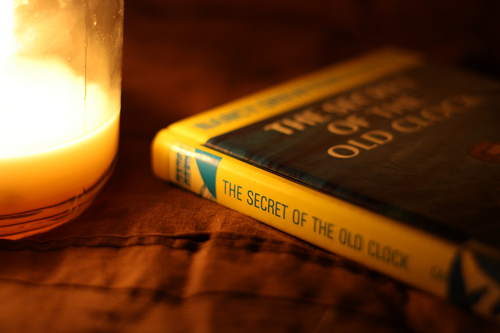
Nancy Drew

It’s been long — literally years — since I abandoned Nancy Drew to the unavoidable circumstance of growing up.

After such a long time, I was able to lay my hands again on the series when I visited a book fair at home.

This book fair comes to my hometown twice a year; in July and in December. And though I have been to the fair more times than I care to remember, I am, unashamedly, every time overwhelmed by the collection they seem to display.

Any vain pride that I have about knowing a lot of books, is just washed away in a huge wave of unheard authors and books.

But it was Nancy Drew that helped buried memories surface. So I bought a Nancy Drew: Girl Detective trilogy. (I didn’t even know Nancy Drew came in trilogies!) This particular trilogy is the Eco Mystery Trilogy.

I started reading the first book and was surprised (like countless times before when it came to books,) with the narrative. All of the previous Nancy drew books I had read followed the third person narrative. This trilogy however, was of Aladdin Publications (whose books I’ve never read before)  and followed the first person point of view. That was unexpected. I have never experienced Nancy describing a situation from her view. It was rather bizarre. It had always been the narrator-writer, Carolyn Keene, who told us about Nancy and her friends.

This Aladdin Publications raised a question in my mind: how was the stories originally written? It is possible that the author herself adopted a change of point of view? As always, I turned to Wikipedia. It says that Carolyn Keene was a pseudonym that multiple authors wrote by. So Nancy Drew was a work of multiple authors, the revelation leaves me a little disappointed.

Moving on to other things, there was one other thing about the story that caught my attention than anything else. It was the simplicity of the narration. This is one thing that almost everyone speaks of nowadays. But what I’m trying to point out here is that the books are so simply written that it involves less or no effort to read it.

That’s really important, in any book. As we grow up, we move on to bigger and, what we assume, better books that are merely complicated reads. In other words, they are just simply too tough to read easily. Which is one of the reasons reading has become a chore.

Mysteries are knotted, complicated and twisted. If a writer (or many) can vividly bring crime scenes to our minds, without using twisted vocabulary and grammar, then it is a good read, isn’t it?

Children’s and young adult mysteries like The Famous Five, The Secret Seven, Nancy Drew, The Hardy Boys are all great examples of simply describing serious plots.

We do need more of such books, if we are to encourage youngsters to read. Maybe after reading effortlessly and loving it, kids would opt to explore the more complicated plots.

Just a random thought.