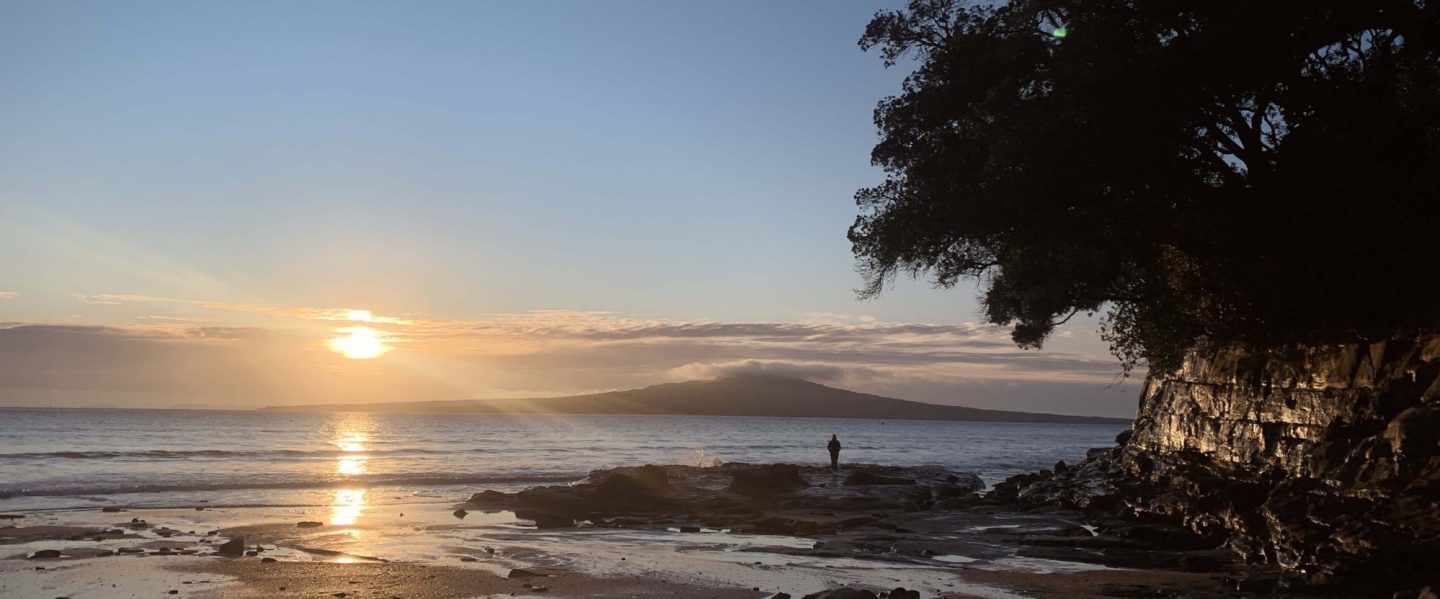
Ah, that primal instinct to put a price tag on everything. As a product on painted, plastic shelves with curved edges that emit fringes of varnish smell from last year’s spring cleaning, and yet, not quite strong enough to mask the sweat of high-vis employees who’ve rested many a heavy heads and brushed uniformed shoulders against.
As if what doesn’t give material back doesn’t warrant time or effort. As though without return on investment—solid pieces of paper and clinking disks you can trade for something else, you shouldn’t bother at all. For what brings you only joy strips away precious time you can manage in other ways. Creeping seconds on a grandmother clock, hands inching from a number to another—time, that you can do more things with, other things. Time, that you can manage efficiently, effectively in order to make something of it, of yourself, of your time on this what’s left of this round, blue pool that’s melting away in its own time.
As if poetry is another supermarket commodity. As if you can valuate bliss.
Note: I was at a poetry festival, and the value of poetry was one of the panel discussions. This is my response, inspired by intriguing opinions.
I was attending Poetry on the Move, an annual festival in Canberra that celebrates poetry and poets of the world. A recognised poet asked me that inevitable question. I’d told her how much I’d enjoyed her performance the previous night, and she seemed pleased. Either that, or she was so articulate and polite to acknowledge, without betraying any of the weariness that comes with being a popular poet, with the hundreds of people telling them how great their work is. Oh well, just another day.
Then she popped the question. I was stumped.
I don’t call myself a poet. When I share a piece with my writers group, I say dub it a “poem” or a free-style-poetry-thing. I’ve never felt enough to call myself a poet. Or a writer.
When people ask what I do for a living, I say I’m a copywriter.
Even though it triggers conversations I’d rather swivel away from, it’s also a digestible way to avoid admitting the twelve hours I spend in a day on a computer… writing. Copy for websites, blogs, articles, ads, and whatnot, gleaning whatever time I can get to write the snappier, shorter stuff that pleases me: self-declared haiku, short stories, and the occasional “poetry”.
“I just—write stuff.”
The poet smiled, letting it reach her slender eyes, perched elegantly on the edge of her blemish-free face. So unlike my own sunken ones.
She respected my insecurity.
However, she did mention later that we’re all poets, regardless of where or how or how much work we’ve published, introducing me to another as a poet, shooting a thrill down my spine. I smiled and let the statement wash over me, unregistering its impact.
Later, mulling it over, as I do everything these days, I straightened, my gut clenching, the tiniest sense of pride creeping up my face. And I fought to contain the idea lapping my heart: me a poet.
When I was about 13, I decided I wanted to write—to be a published novelist.
Then life happened. Luckily, however, I still wanted to write. That’s how this blog came about, and ever since I’ve been writing plenty of self-declared short stories, opinions, random musings, and travel thoughts.
Moving to Canberra took my writing to a whole new level. I joined a writers group, and thanks to being exposed to incredible poetic talent, the embers of my poetry began to flare up. As a result, I’ve been writing and experimenting a lot with free verse poetic forms.
Now I’m super thrilled and proud to say that with the help of my incredible writers group, I’ve managed to get in on an anthology of womxn’s poetry from all over the world.
Published by Animal Heart Press, the book is called From The Ashes. It’s co-edited by Amanda McLeod and Mela Blust.
I went for a movie last night. Not the fast-past, steamy, nail-biting, popcorn-munching kind of movie. Nope—it was the first time I’d been to a cinema theatre in Canberra and it was for a movie about Aboriginals. It was Another Country.
To put it the words of the narrator, “This film is about what happened my culture when it was interrupted by your culture.”
And as soon as the echoes of that resounding statement died down, the screen flared up with young Aboriginal men, dancing to rock and roll music, shaking their hips, faces contorted in concentration, and enjoying, apparently, the westernisation that had crept into their veins, pulsating through their feet.
With gut wrenching grace, the film touched upon many issues that Australian natives endured during the initial stages of colonisation.
“Then the white men came. With their cattle. If we didn’t do exactly what they told us to do in our own land, they would shoot us or poison us.”
As I heard the unwavering voice of the narrator, gliding over emotional scars and scabs oozing with fresh blood and pain, I shuddered. It was normal. And that was scary. As the audience, every moment of revelation was a gasp of shock, while it was everyday reality for the voice that told the story.
The more I watched, the more I understood how Aboriginals have been isolated in their own land. The documentary revolves around one small town in Northern Territory, emphasising the lack of everything there. When the government built a school, a store, and basic medical facilities, Aboriginal people from neighbouring lands had to move into a single town, where they were given periodic pension money to spend on supermarket-grade food that were ferried across or flowing into from other parts of the country. Since the town was devoid of everything else, including amiable weather, adults had no jobs to earn from. They were given money to buy things that the government intended them to—and as I watched kids and adults gulp down bottles of teeth-rotting Coca Cola and other carbonated, sugary drinks as if it were water, I cringed.
Alcohol is banned in the town. But soda that’s just as disastrous to health is abundant, encouraged, and in a sense, shoved upon these people. With nothing to do other than sit around, play cards, and participate in traditional celebrations, young men with a mischievous spark are punished. Possession of alcohol and kava are enough to land them in jail. About it the narrator says, “They get sent to jail, to Darwin, for doing things that other Australians are allowed to do.”
As if these youngsters aren’t Australian at all, just because they’re Aboriginal.
It was abominable to think of it that way. But it was more shuddering to realise that that’s how the rest of the world’s treated Aboriginals all along.
What a load of rubbish we are for looking down on fellow humans that way. Rubbish—the film covered that too.
When you think of it, the native people use nature’s elements to make baskets, tools, and almost everything else they need for living. When these things die, they return to the earth and people make new ones. However, the outskirts of the town are lined with garbage, broken appliances, and products used no longer. As the camera panned over piles and piles of old stuff now replaced by newer, shinier stuff, you can’t help but feel claustrophobic. And to imagine people living with all of that in their backyard—shame on us.
“We never had rubbish. Everything comes from the bush; everything goes back to the bush. […] We’re choking on rubbish. That means we’re choking on your culture.”
This documentary was eye-opening. It’s an assertive stance against the unfairness that’s become so internalised and normal in today’s Australia. And even though millions of people try and consciously avoid harming the essence of Aboriginal culture, or be patronising, it feels as if rules that require least 3 Aboriginal students in the opera club is also a way of enforcing the western culture in them.
This movie’s made me think—what’s happened between these two cultures isn’t a simple matter of right or wrong. And as we try to solve it, we will run into polarising problems. Finding the right balance will take time and and open minds. Question is, do we have that luxury?
I’ve already written about my experiences with Australian prices. When I first arrived, I spent hours walking down supermarket aisles, monitoring, comparing in my head, how much each product costs in various stores.
Although it’s waned over the last few months, the habit has stayed with me.
That’s why when I heard a small cup of flat white with almond milk and an extra shot costs $5.20, I had a hard time masking my bitch face. I swallowed the anger that rose to my lips and smiled instead. Thank you for such unfairness.
$5.20 isn’t a lot of money, I admit. But it’s still a lot for a not-so-great coffee in a not-so-big-enough cup. And yet, I’ve noticed that it’s the standard in most places in Canberra.
Imagine my surprise when I arrived in Melbourne.
For $4.50, I got a much bigger cup of more satisfying coffee. And I fell in love with Melbourne. Well, not just because of the coffee, but it sure helped.
That said, even in Melbourne, alternative milks and extra shots of espresso cost an additional 50 cents each. Some places dare go even further and charge anything between 80 cents and a dollar.
And that’s on top of the standard price of a coffee.
I couldn’t comprehend the reasoning behind it. I don’t even think there is a reasoning. Of course, almond milk is more expensive than regular cow’s milk, but that doesn’t justify charging extra over a commodity I didn’t ask for.
I could, for the sake of an argument, dissect the price points of each element that goes into a flat white and evaluate the fairness of the price. But that’ll get me nowhere.
So I chose to rant here instead.
In all honesty though, this elevated coffee prices has made me appreciate it more than ever. Now getting a coffee outside is special. It’s not the kind of pick-me-up you associate with takeaway cups and Hollywood heroins in a rush. Coffee means proper coffee, and that means treating it with the respect it deserves—savouring every sip as it travels down my throat.