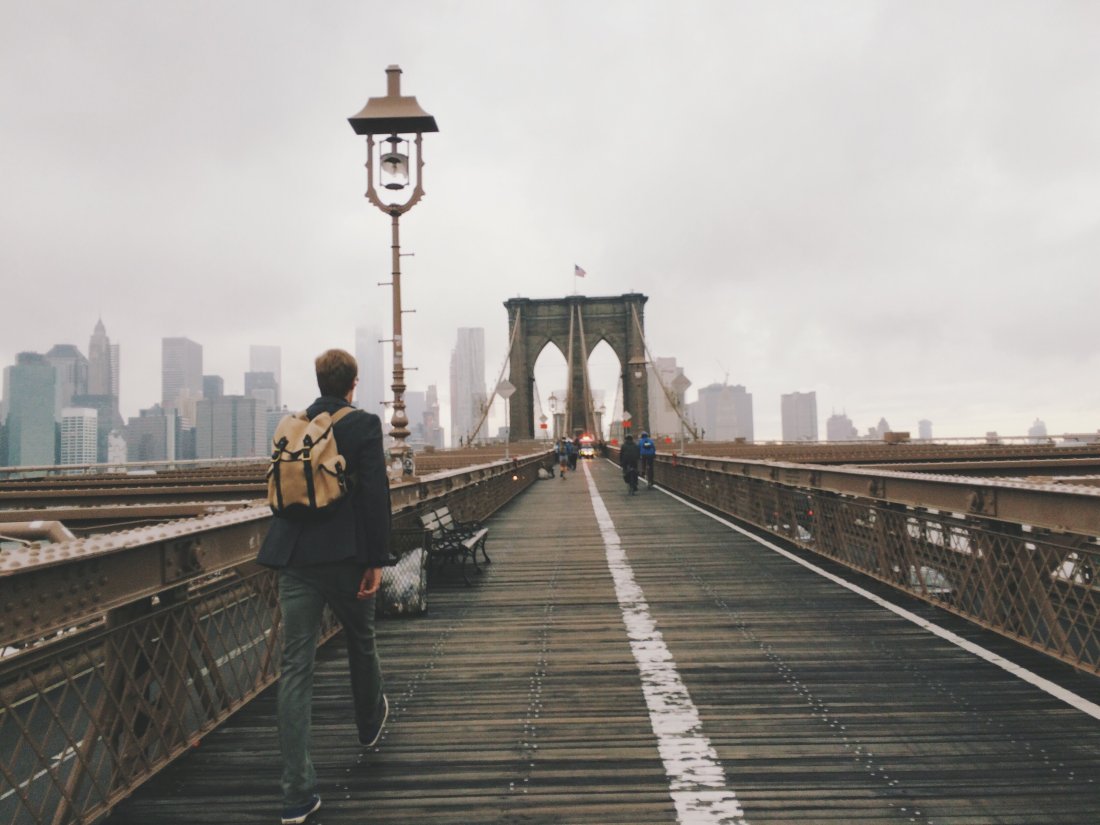
My first big trip

After months of anticipation and weeks of feverish online searching, I think I’m prepared to take on a journey of 20 hours—but I also know I’m far from ready. That’s solvable, though. Things will become more real than ever as soon as I board a cab to the airport. I’m still stunned that I’m travelling almost halfway across the world. I want to jump up in the air screaming, but my pessimism and over indulgence in worst-case scenarios prevent me from doing so.

Nevertheless, I’m excited. Just the idea of gawking at sights I’ve never had the nerve to even dream up is overwhelming—in a good way. But what’s made this trip even more thrilling is the recommendations I’ve received from people I know.

When you’re planning a trip, there are two kinds of people who give you suggestions. One, the family and friends who love you so much, but have no idea of what you need to carry and how you should approach your trip planning. They’re so happy for you that they find solace in sharing their dream trip tips and tricks with you. Not to devalue their concern, but often times, they’re far from helpful. Sure, it’s great when your father reminds you to carry an extra pair of gloves in your cabin baggage because the flight would get chilly. But it’s also annoying when your grandfather suggests you buy a new toothbrush and a fresh tube of toothpaste just for the trip.

The second kind of advice givers are more reliable. They know what they’re talking about, and it’s unsurprising they make a lot of sense. These are the ones who’ve either travelled far and wide—the globetrotters, or, those more grounded to the place you’re visiting: the locals. Not only do they know what you should bring and do, but they also know what to avoid. Now that’s advice you can’t get from family or forums. Hundreds of travellers worldwide advise on online forums, but having gone through some of them, I realise they’re too generic. You’d have a rough time combing through millions of answers before you find the one you need.

Having a local explain the locality is a different thing altogether. I had a colleague kind enough to draw up a map of the city. He even browsed AirBnb listings to help find a place closer to all the main attractions. This colleague (D for easy reference) also suggested food trucks I should stop at, and the cuisines I might enjoy. It’s all new for me—the culture, the weather, the people, even the concept of bicycle paths is unfamiliar—and it made planning so much easier because D had done most of the heavy lifting for me. Every first timer needs that kind of travel planning.

Sure, you do need freedom to get lost and wander off on your own—which I will be doing (weather permitting), but you also need some basic assurance that you’re going to be fine. I got that from asking a local to help me plan my trip. And that’s why it’s always a great idea to collaborate with people who know the place.

Of course, not everyone would have colleagues as wonderful as D, and that’s where Facebook groups and online communities come in. Although, one powerful lesson I learnt from planning this trip is that focussed advice is so much better than scattered advice. Or to put it another way, ask someone in the know, than leafing through endless threads of unsure conversations—at least you’d get proper direction.


P.S: I may sound like I know much about travelling, but I’m still a first timer myself. Perhaps when I come back (wiser, I hope) I’d have changed my opinion. Alas, we humans live as on a pendulums.
In a STEM-empowered women’s world, are the Arts dying?

I’ve been thinking about this for a while now, and the more I see articles and blogs online talking about the importance of girls and women taking on Science subjects and technical jobs, I fear for the ones who choose to go non-technical.

For far too long, the world has thrust the Arts on women because it’s easy. (Or so they think it is) A degree in any of the many Arts subjects is a safe choice for a girl — and a cheaper choice for her father — because a few years down the line, the girl would get married and settle to doing dishes anyway. It’s hard to believe that that was the reasoning in my mother’s generation. And, although it makes me sick, I can accept that even the narrow minds that make our society have a right to their own beliefs.

All of that said and done, things are changing faster than ever now. Well, the reason for this rapid change is perhaps the long-standing narrow-mindedness. Now anywhere I go, any web page I open, and any Twitter account I come across has a supportive declaration to women in technology. I’m happy that it’s so. As someone whose salary stems from the tech industry, I’m happy to see that people are becoming more broad in their minds.

But I’m also afraid.

I’m afraid for girls and women like me. Girls and women who preferred to major in an Arts subject because that is their true passion. When all the world (and his scientist wife) encourages more womenfolk to take up technical subjects, it seems that without a direct reference, the world is discouraging women from taking up Arts. Ironical, if you think about it. There was a time when people frowned upon women in science, a practice that’s now flipped: it’s the women in Arts who’re now frowned upon.

Women in Arts — women who chose the Arts because they wanted to — are now the weaklings in society. People look at a literature major and wonder if she’s too foolish to major in mathematics. Of course, I know literature and history demand as much as number-crunching and memory building as mathematics and physics. Regardless, our colleagues looking down on us, because we’re not as tech-savvy as they expect us to be, is a little worrying.

Some of this mentality flows from the ideology of empowering women. In recent years, so many influencers have presented TED talks and YouTube interviews about the great women in scientific and challenging industries that as a result, they’ve underplayed the Arts a little too much. I realise this isn’t often intentional, it’s a consequence nevertheless. While our society empowers (read: permits) women to take on male-dominant areas of work and study, it penalises those who don’t.

Perhaps penalise is too strong of a word to describe it. However, it is the reality that we, Arts majors, now face. In a mad rush to offer equal employment opportunities and social status for women, our society has concluded that the only way to do that is to subjugate women to Science, Technology, Engineering, and Mathematics. I may be overthinking, but we as a community don’t understand women empowerment as well as we thought we did. Otherwise, we wouldn’t have fathers who believe that the best way to empower a potential-painter is to persuade her to finish her engineering degree, land a job in a corporate, and paint during her leisure — as a measure to de-stress.

What a poet wants

Now that’s a question worth answering. That’s a question that keeps many a poetry fanatic up all night. I don’t mean to exaggerate, but nevertheless, a poet’s internal conflict gives birth to such pristine work that it’s well worth a trip down to a poet’s thought lane to figure that out.

Well, one poet made it so much easier by writing it down. I came across a poem titled Ars Poetica by Dorothea Lasky. When I saw the title, I rolled my eyes, skeptical. Great, another poet who uses fancy foreign language to convey her meaning. Although I appreciate quirkiness in poetry, I only do so for as long as I understand it. This one, I didn’t. When I searched online, however, I realised that the phrase refers to an ancient treatise on poetry written by Horace. The phrase itself means “The art of poetry” or “On the art of poetry”. That was more than enough to intrigue me. And so I set out to read the poem,

It bagan so,

“I wanted to tell the veterinary assistant about the cat video Jason sent me”

Ok, my mind paused, frowning. For a poem following the old tradition of using Latin terms, that was an unconventional opening line. But it is also an interesting line, because it introduces so many people in so few words. My mind landed on the veterinary assistant who seemed out of place in the world of the poet, Jason, and the cat video. A therapist would’ve been more appropriate, I observed lingering on that first line.

I read further.

“But I resisted for fear she’d think it strange”

Yeah! I raised my eyebrows in agreement.

“I am very lonely”

Oh. I saw now. That made sense to an extent. The cat, the vet, the fear of being ridiculed—they were all justified now.

The poem doesn’t end there, as Lasky goes on to explain more about her life. But those three lines had told me so much more than I had hoped to learn in the first few lines of a poem that stretched for 30 lines.

In the next few lines, the poet describes a telephone call she received from her boyfriend. Yet another character.

And told me that I was no good
Well maybe he didn’t mean that
But that is what I heard
When he told me my life was not worthwhile
And my life’s work the work of the elite.

Ouch. We’ve all been there. While we’re already basking in self-doubt and discomfort of ourselves, someone plucks up the courage to tell it to our face. I could now relate to this poet whose topic of conversation I still wasn’t sure about. But I read on, because from what I’ve read so far, she sounds a lot like me, and I wanted to know how she’d reply to her boyfriend and carry the poem to its conclusion.

Then she talks about what matters the most to her. She accepts to herself what she is, and what she wants from her life.

I say I want to save the world but really
I want to write poems all day

Aha, I thought smiling in victory. So, this is nothing but a poet who wants to write poetry for the rest of her life. Now that’s not much to ask.

Or so I miscalculated.

It’s a simple desire. It’s the basic right of any individual to spend their life doing what they yearn for. Regardless, it’s also the most unattainable thing in life: Doing what you love, and doing it long enough without hating yourself or dying of starvation.

This poem is a bundle of mixed emotions and harsh realities. For me, it portrayed the life of every artist who pines to create art. It reflects undeniable truth that makes you smile in sadness as you finish reading the poem.

Here it is in its entirety, if you’re interested:

Ars Poetica — by Dorothea Lasky

I wanted to tell the veterinary assistant about the cat video Jason sent me
But I resisted for fear she’d think it strange
I am very lonely
Yesterday my boyfriend called me, drunk again
And interspersed between ringing tears and clinginess
He screamed at me with a kind of bitterness
No other human had before to my ears
And told me that I was no good
Well maybe he didn’t mean that
But that is what I heard
When he told me my life was not worthwhile
And my life’s work the work of the elite.
I say I want to save the world but really
I want to write poems all day
I want to rise, write poems, go to sleep,
Write poems in my sleep
Make my dreams poems
Make my body a poem with beautiful clothes
I want my face to be a poem
I have just learned how to apply
Eyeliner to the corners of my eyes to make them appear wide
There is a romantic abandon in me always
I want to feel the dread for others
I can feel it through song
Only through song am I able to sum up so many words into a few
Like when he said I am no good
I am no good
Goodness is not the point anymore
Holding on to things
Now that’s the point

One hell of a ride

Life’s been giving me a hard time for a while now, but this morning while on the way to an important appointment, life crossed my path and dropped a truckload of lemons right on my head.

Hang on to that thought while I digress before I regress.

When I tell someone I’d be available in a particular place at a specific time, I try my best to keep my word. And this appointment was far bigger than meeting a friend for coffee to discuss the latest fashion fallout. This was an examination, and one that required my entire concentration and my sound sense of time.

I left early. Three hours should be more than enough time to travel 45 km (28 miles). Why, I thought, I might even reach early. That’s always better than rushing in through the doors just as they’re closing. (Although what a dramatic entry that would make.) And so with my perfect plan laid out, I booked a cab and we started the ride.

The first phase was smooth — 45 minutes of near-vacant streets, with mild congestion that cleared up even before I knew it. I kept looking at the time, and was happy to see we were well within our goal. But as we transitioned into the second phase things became a little more crowded. The sun had risen to all its glory and people had begun to drag their feet from their homes and onto their motorcycles and cars. Rush hour or work hour—however you name it, everyone was on the street.

Our vehicle stopped moving right behind a long line of other vehicles. Although Google Maps assured us, “Despite usual traffic you’re still on the fastest route…” somehow, it felt like we were far from it. Of course, the ever-reliable voice of Google Maps was saying the same thing to the driver honking behind us, and to the many others all around us. Two hours later, we were still, still on the fastest route, except now it was “Despite heavier than usual traffic.”

It would’ve turned any rider’s head. And would’ve depressed any driver. Incredible though it seems, neither happened. My Uber driver maintained his composure, and because he didn’t start honking or teetering in his seat irritated, I hung in there as well. While my mind whirled, conceiving the worst case scenarios and wild cover up stories to explain my delay, the congestion on the road had no congestive effect whatsoever on my heart’s pumping. All seemed fine.

Phase three: Panic attack. When the traffic started moving again after what seemed like hours, but what had been only an hour, our mechanic guide opened her throat again. This time, she wasn’t event attempting to assure. She declared that I was going to be late. And she didn’t seem as upset or as concerned as an assistant should. I checked the time, and then my schedule. I had an hour’s grace period to show up before they’d declared me a no-show. I looked at the back of my driver’s head with an urge to urge him, but what would I say, and—even if I did—what could he do? I ate an apple, instead, to calm my nerves.

Phase four brought along a miracle. Just as the clouds cleared way for the sun, the roads cleared up for us. We didn’t pause to think or drop our jaws in wonder. My driver stamped on the accelerator and we shot forward. The cool voice of the guide came again, with good news at last: I would reach just on time.

When my driver pulled up at my destination, it was one minute past my reporting time. I had made it.

Inside, lemonade awaited me.

A letter

Dear Sir,

I’m writing to express my disagreement with your idea of entertainment. I am, of course, referring to a number of programmes telecast in your channel.

First, let’s talk about the reality show you call, Real People, Real Lives. For one, I don’t think there’s anything real about paying celebrities to pretend to live together for a month, and appointing a mediator to solve petty disagreements between them. After all, these celebrities have no reason to live together—except perhaps for the money you pay them, and for the controversial paparazzi that ensues. If you and your children spend your evenings watching this show, I’m sorry, but you all need to get a life.

Second, I came across a programme that your channel’s hosts dub as Share your Feelings. Now, I may have to agree that sharing emotions and deep feelings may have a positive effect on the person doing the sharing. Having said that, however, I do not agree that sharing on national television, a story about how I let my boyfriend down by lying to him, is not a decent way of expressing my feelings. And I don’t think that you or your channel’s hosts should encourage such behaviour, and play irrelevant songs to trigger even more emotional callers. Callers might get some solace — sad though it is — but for a young family watching the show at home over dinner, it’s nothing more than a mindless way to spend the evening.

Now I understand that your choice of programmes doesn’t depend on what your audience wants to or needs to watch. Instead, it depends on what will get them excited to keep on watching. It doesn’t take a master’s degree in Psychology to decode your algorithm: You just give people sensational issues so that they get used to it and keep coming back for more. It’s not unlike training a dog by giving it chocolate treats that you know would only harm it. It’s simple logic, yet a powerful influence.

And that’s the reason I ask—implore(well… no)—you to reconsider your offering. Not only are your shows mind-numbing and disgust-inducing, but they are also a spark of painful-disagreement between husbands and wives all over the country. Well, yes, I haven’t spoken to my wife in a few days, and that’s perhaps why I decided to write to you in the first place, but nevertheless, it’s time for you and your channel’s administrators to call that long over-due meeting and reassess your goals for the new year.

With that I conclude this letter. And although I’m certain—beyond belief—that you would never acknowledge reading this letter, or even the existence of it, I would still like to tell you that your feature programme titled News Around the World in 60 Seconds is the best of all in your agenda.

I don’t look forward to hearing from you,

Not a fan,

n