The Castro

Having spent a couple of hours in Haight Ashbury, I moved on to the next place on my list: Castro District in San Francisco. Although I had had a peek at Castro during my hop-on-hop-off tour, I hadn’t spent much time there. And so when a colleague suggested I spend some time looking around Castro street, I was happy to oblige.

I grew up amidst people who don’t discuss gender as anything aside male and female. Where I’m from, we have an isolated gay community. Sure, I’ve heard there’s a strong vocal presence and representation for the gays in my country, but I’ve never seen it or heard about it. As a result, I walked into San Francisco’s Castro without any previous interaction with the LGBTQ community.
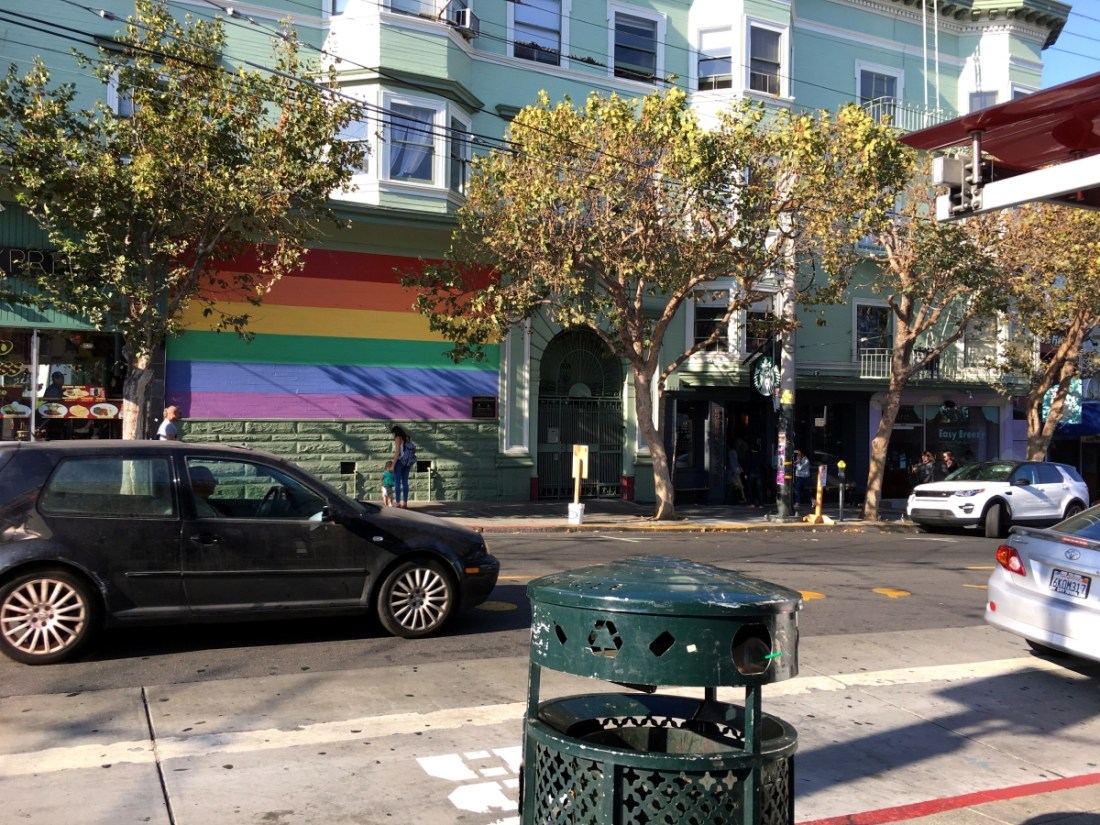
Castro 3

Although I do have friends from work who identify as LGBTQ in the US, and it was with their guidance that I found out about Castro. To find out more and to experience actual gayness, however, I had to explore the streets on my own.

Oh my, what a day that was.
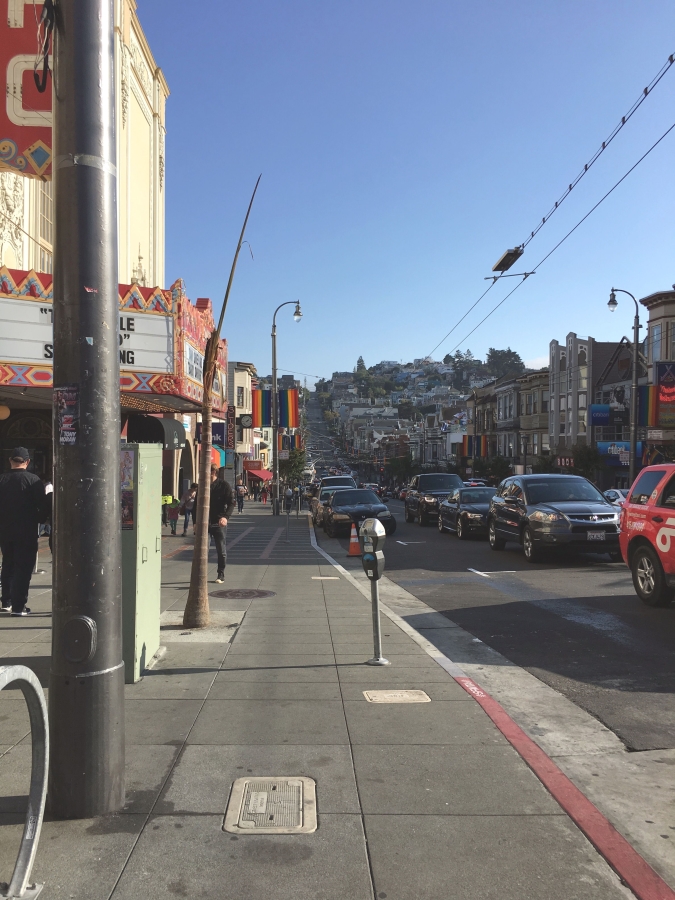
Castro 1

I can’t recall the first thing I noticed. Everything seemed new and grand. Right from the sloping streets to the rising flag poles, everything vivid caught my eye. It was even more exciting to see cable car lines over my head and street car tracks under my feet. I saw the gigantic rainbow flag, fluttering in the warm September afternoon. And I saw plenty of smaller flags swaying along. It meant only one thing to me: declaration. Never before have I seen someone asserting their identity with such pride. It was the ultimate claim of authority, although far from authoritative. It was welcoming. Walking into such a neighbourhood, I felt no discomfort or fear. I saw people being themselves without the fear of judgement. I saw Castro and its people emit a sense of belongingness that anyone could relate to. I didn’t have to dress a certain way or wear make up to be a girl. I could walk around sporting short hair and shorts if I want and people still smiled at me from the bottom of their heats. It was all obvious from the way people walked and conversed.

Dancers in Castro

As I walked further I noticed a group in the middle of the street, dancing. Every street lamp in the area housed a flag. It could because it was pride week, but it could also be Castro’s characteristic. The dancing men spun about as the DJ played in the corner, and older men sat around chatting yet making meaningful conversations. A banner on the DJ table told me it was an organised celebration. Talking to one of the men in the cheering lot, I further learnt that gay organisations in Castro rent out public places and often set up celebrations — just for the hell of it.

I smiled. Then lingered, wanting nothing more than to linger longer. But I continued. There was more of Castro to see.

Trying to balance between the map on my phone and the splendour around me, I found myself standing at a crossing, staring at the crossing. While fellow pedestrians crossed the road onto the other side, I looked with wide eyes at the lines that stretched out from my feet.

Castro 2

And at that moment, I concluded that Castro is one hell of a place to live. It’s not only for the lesbians, gays, the bisexual, transgender, and queer who know how they identify themselves, but even for those confused souls bordering in-between. Who’s to say, perhaps there are more, better, gay villages in other parts of the world, but from my sample of a gay village, I’d say it’s worth cherishing such a vibrant community.

I discovered a marvellous face of San Francisco that day, and it was a discovery I had to make on my own. I already feel like I’ve grown up a little. And that’s always a good sign.

Walking down Haight

It was love at first sight. And my first sight was through the windows of a bus as it cruised along the street that’s Haight Street. My friend and I were on a hop on-hop off tour then, and the moment I entered the street, I knew I had to come back again to explore further.

It looked like any other street—except that it wasn’t. There were buildings and there were people. But unlike most other parts of San Francisco, the buildings weren’t picture perfect. The people weren’t suited, booted, or groomed. Purple-headed women walked hand in hand with pink clad men. No one stared at each other as weird. No one seemed conventional, and yet, no one seemed to care. Some wore jeans, some wore mascara, and a lot wore whatever felt comfortable.

Haight 1

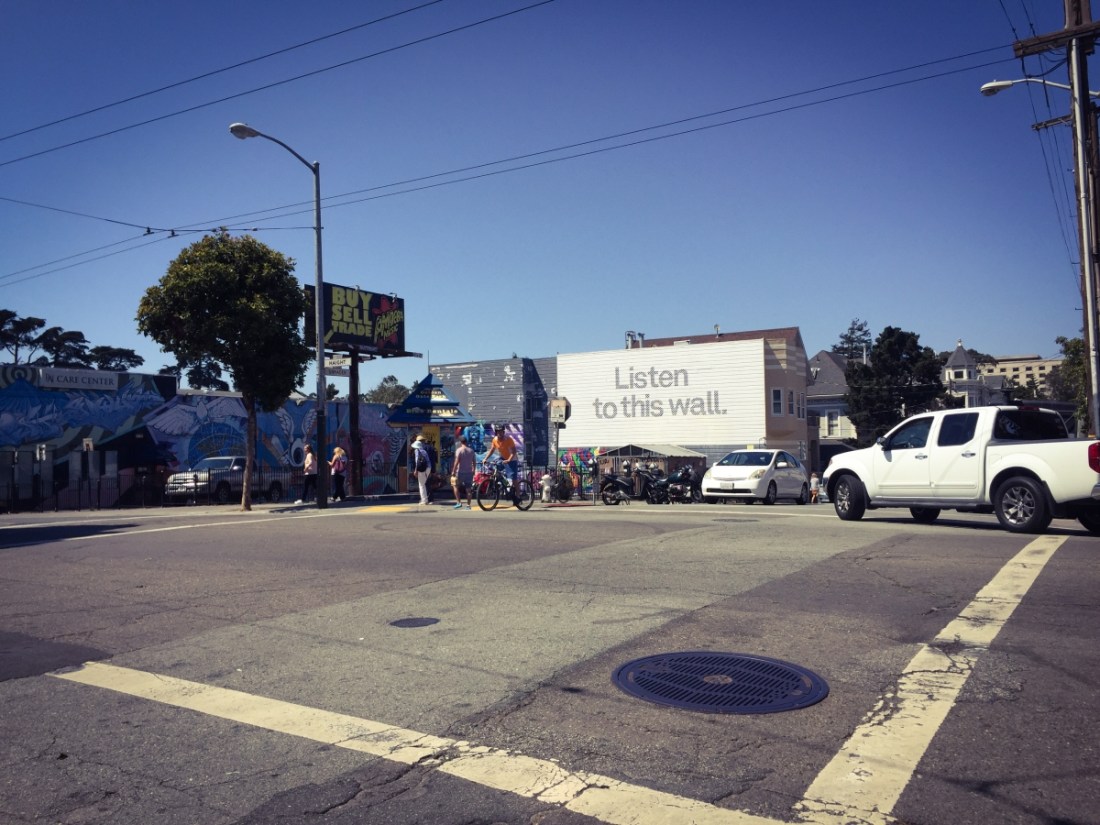
Store exhibits advocated peace and love, street signs echoed similar emotions, and even the walls called passers by to listen. Love afloat, was abundant, and at times as with love, overflowing and breaking norms.

Haight 2

Seeing all of this left a permanent smile of my face. I felt as if a bloom ballooned up within me, filling me up with the joy of welcome. There sparked inside me a sense of belonging to the place. I wanted to stay there, to walk down the street, to walk into shops. I wanted to talk to the people on the streets, befriend them, and hang out. For someone who’s reluctant to barge into another person’s consciousness and force discussion, I felt like doing that exact thing. To my surprise, I realised that the people of Haight Street would’ve been only too happy to talk to me.

Haight 2

For the first time in my life, I saw a hookah bar. Curious, I went in. Men and women had seats for themselves, going about their usual business, smoking away, reading a book, watching a game, and unperturbed by the stranger who’d just walked in unashamed and out of place. The shop owner came up to help me settle in, and I stepped back telling him I was just looking. A big smile came onto his face, and he waved his arms around the bar, inviting me to look around and hang around for as long as I wanted. When I left, my compassion for the people of San Francisco had magnified.

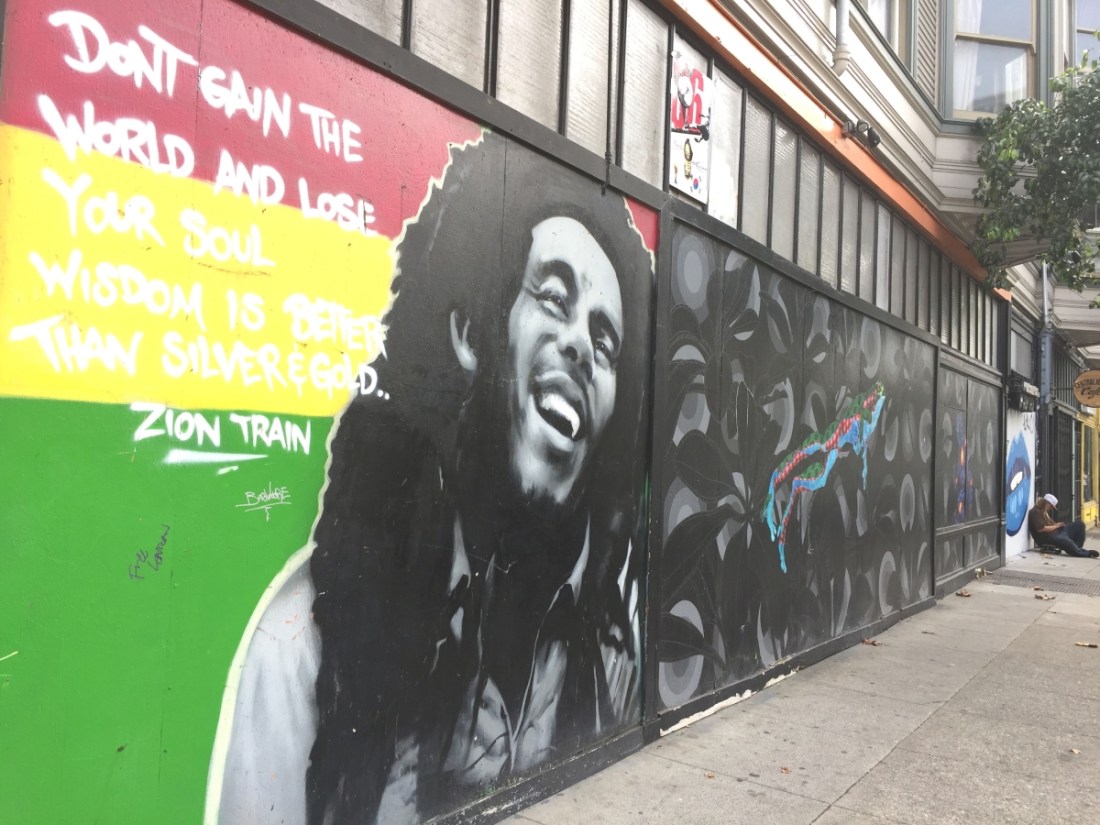
When I went back a second time to Haight Street—alone, this time—I felt the same sense of joy. This time, however, I realised what about the locality made me so ecstatic. Being in the street made me feel rebellious. All around me people embodied everything that our typical society scorns upon. Metaphorical reminders of Bob Marley and John Lennon, their beliefs, and The Beatles of 1960s hung over the sky exuberating with positivity and encouragement.

Haight 1

Sure, I did come across a couple of guys who willed sell me pot. Illegal though it is, I didn’t feel scared or ominous. In fact, it was so casual and so matter of fact that I understood there was nothing to fear. It was just a part of everyday life.

All my life, my family had taught me to be wary of strangers, of people who’d lead me astray—but here I was passing people whose habits I’d never micic, but people who I’d respect nevertheless. It was a new experience and I enjoyed every moment of it. And I realised how huge San Francisco is—diverse, yet inclusive of every weirdo, every nut job, even every other corporate guy. The city continued to surprise me.

More sights at the Golden Gate Park

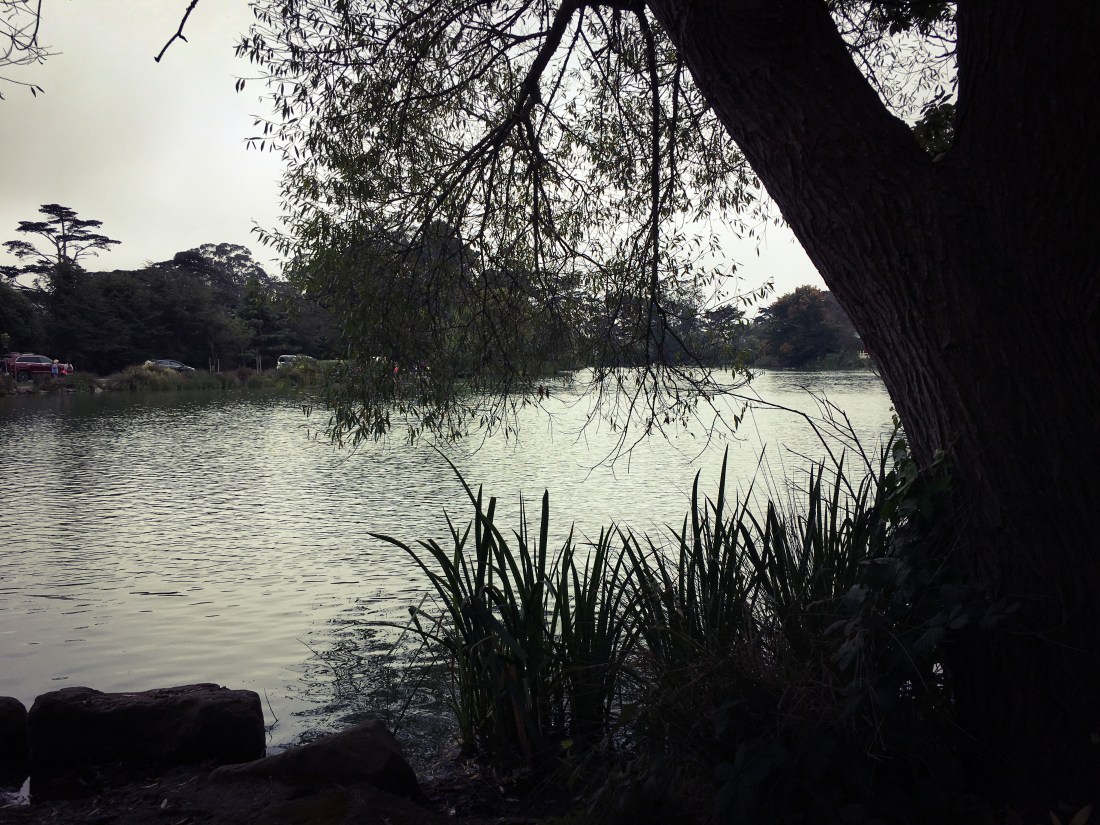
The Stow Lake in the Golden Gate Park

In a previous post, I shared my observations about the Botanical Garden and the Japanese Tea Garden in the Golden Gate Park.

By the time I left the Japanese Tea Garden, despite covering so much ground, I hadn’t even scratched the surface. I realised with mild apprehension that I’d never see the remainder of the gigantic Golden Gate Park. I walked on nevertheless.

Following the maps installed every few feet in the park, I walked towards the Stow Lake. The park’s size amazed me as as I realised that it could be a tiny town by itself. With well-paved roads, car traffic, bicycle lanes, traffic lights, and pedestrian walkways the park had everything necessary for human habitation. And although a huge tourist attraction, the park is also a part of local lifestyle.

Joggers and walkers passed me at every turn, flashing a smile and counting a mile. Tennis courts echoed with players keeping scores: “love all, ya’ll”. Dogs brought their humans for a walk in the park. These locals went about their everyday routine unperturbed by backpackers or touring groups. That’s the true worth of the park—not only is it a national tourist magnet, but it’s also the life of the Bay area’s residents.

When I arrived at Stow Lake, I noticed a path leading upwards. unsure of what I’d find there, I followed the path. After walking what seemed uphill for about 10 minutes, I came to a small clearing. It seemed like a flat surface, but also with a path leading further up.

A park attendant was gathering up water hoses while responding to another gentleman holding a map. I approached the two men and asked where the hell I was. The park attendant smiled, informing me that I stood on an island on the lake. Ha, I hadn’t even realised it. If I follow the trail uphill, he said, I’d come to the top of the Strawberry Hill.

That hill wasn’t on any map. The island was, but I had no idea that the island was indeed a hill, and had such an intriguing name. I reached the top.

This slideshow requires JavaScript.

It was a beautiful sight: I stood on the rugged edges of the hill and on one side, the lake spanned below me. The other side faced more hills and rocks. Unlike anything suggestive of the name, the Strawberry Hill was brown and barren. There weren’t many plants on it, but it seemed a wonderful picnic spot. Families and friends had hiked all the way up the hill for a quiet lunch. Tables lined one corner of the hill, hosting picnicking families. A father and daughter sat on rock stumps looking through photographs in their camera. As a gentle breeze kissed my cheek, I wanted to linger for hours together.

But I was just a traveller. I had to move on.

On the way down, I came across the park attendant again. He recommended that I visit the de Young Museum and, instead of going in, going up to the observatory. The museum was pricy (I knew from research) but the observatory was free. I did not know that from research.

I asked him for directions and he questioned me in return: “Do you want to take the short route or the scenic route?”

Scenic, of course.

He directed me through the Fallen Oak Path (I’m sure he made that name up, but I like it nevertheless), past a waterfall, and down a bridge to the main street that led to the museum.

Up the observatory I went, and in a few moments, I had seen the entire park from above. The best of nature and the best of human architectural talent married to make the park what it is. For the second time that day, I wished I could stay put.

This slideshow requires JavaScript.

I left because more jaw dropping sights awaited. That day I cherished the freedom of travelling. The only reason to go is to see more places, and that’s more than enough of a reason.

A visit to the Golden Gate Park

When I was in Pleasanton, my friend and travel partner took a weekend off for Chicago to meet with her friend. That gave me two whole days for myself. And what else would I do than explore the city of San Francisco?

Although I’d hit a lot of popular places the last time I was there, I missed on one important monument: The Golden Gate Park. So I went there that Saturday morning.

The moment I entered the park, a smile came on to my lips—a bunch of kids skateboarded on the street leading to the park. It was a pleasant sight, for I had never seen such effortless skateboarders on street without being afraid of getting hit by a car. In fact, it was the first time I walked without the fear of motorists.

Before going further, I calculated how much time I should spend in the park. Little did I know then how big the park is. My first stop was the Botanical Garden. As I paid for my entrance ticket, the gentleman at the counter handed me a map of the garden and informed me that the 55 acre-garden hosts plants from all over the world. My heart skipped a beat as I heard the number—there was no way I’d cover all of that within the time I had planned. With a skeptical mind, I stepped into the garden.

The entire garden was categorised by region. On my right was Australia and to my left was South America. I went by what was right by me. The deeper I went into the garden the more fascinated I became of the plants. Time came to a stand still and I no longer worried about rushing off to the next place. The scent of living, breathing, greenery convinced me to linger in its essence and absorb the goodness it emancipated.

This slideshow requires JavaScript.

I walked along from region to region, stepping over Peru, walking through the Andes, and swerving around Africa. I stopped at the Redwood Forest and went round and round in search of the Moonlight Garden before realising I had already been there. Name cards lined each plant and tree but none made sense to me. I was no Botany student, and I didn’t know the medicinal values pertaining to the plants. I was, instead, a backpacker, a nature lover, a passionate greenery-seeker who was more than happy to stand amidst teak woods a hundred years old. I cherished the feeling of past, present, and future life all around me. I felt elated.

Somehow it seemed unbelievable that people would flock to such a tree abode when they could be elsewhere doing something else. What I loved most about the garden was the lack of people. Even though there were many explorers like myself, the garden was so huge that I seldom came across them. Although the Botanical Garden was meant as a place to appreciate wild in its wilderness, I realised that garden authorities had to do something for people to visit. That’s why the Botanical Garden has special clearings, tree stumps, and benches—so that people could pose with plants. Perhaps the authorities thought that would be a way to attract more visitors. At least that’s how it seemed to me.

Whether or not the tactic works, it also seemed to me a little pathetic. It’s sad that we have to resort to such measures to appreciate nature. It’s sad that there aren’t many people who’d value the wilderness for what it is. And I know for certain that most people who visit natural reserves and gardens go for the photos.

My suspicion became a conviction by the time I left the Botanical Garden and entered the Japanese Tea Garden across the street. The difference was unmistakable, and it was evident even at the price of the entrance ticket. It was only a dollar more, but as I paid I sensed that the woman at the counter was bored. It wasn’t a mark of how tough her job is, but instead, a mark of how tired she was of talking nice to tourists. When I turned to the garden, I saw an abundance of people amidst manicured plants.

This slideshow requires JavaScript.

To be fair, the plants were mesmerising. But about ten minutes in the garden, I couldn’t wait to get myself out of there. Every side I turned a couple or a group posed with the shrubs. And the plants, too, seemed pruned for pictures. People rushed to reserve their spot near weird-shaped plants. Although the plants radiated a calming sensation, mingled with it came unwanted and palpable excitement that didn’t originate from me.

I’m not against photo taking, for I took plenty myself. But it’s the excess touristy behaviour that made me uncomfortable. Nevertheless, I spent over an hour walking around, musing. With far fewer people, the garden would be a wonderful spot for a quiet afternoon. Not only was it domesticated, but it was also lush. Looking at the photographs I took there, I can’t believe how charming the entire garden is. Sure, I still feel it’s commercialised but it’s also a wonder.

It’s the first time that I can’t decide whether I like a garden. In every other circumstance, I would brim with compassion. Regardless of what I felt, though, the garden is a favourite place for both locals and tourists alike. In fact, a friend living in the Bay area mentioned to me that she adored the Japanese Tea Garden—she speculated it was the weekends that drew the crowd. Perhaps she’s right. Perhaps I chose the wrong day.

But my day wasn’t over yet, for I explored the Golden Gate Park further. More about all that in a part 2 of this post.

Golden Gate Bridge: An inexplicable romance

For decades now people consider the Golden Gate Bridge as one of the greatest monuments in the United States. It’s the identifying icon for every soul living in the Bay area. Not only is the Golden Gate Bridge the most photographed bridge in the world but it’s also one of the most overrated.

Yes, I said it.

Having grown up listening to so much hoopla about the bridge, there was no way I’d skip the bridge during my visit to San Francisco. Besides, a trip to the Bay area is incomplete without a lame photograph reminder of the bridge. And now that I have plenty of photos to prove I’ve been there, I’ve also acquired some knowledge about the Golden Gate Bridge that’s made it less impressive in my mind.

Golden Gate Bridge
The Golden Gate Bridge
To be clear, I don’t hate the bridge. And no, I didn’t hear some grotesque story about the bridge’s history. But I did realise that the Golden Gate Bridge isn’t the only awe-worthy construction in the city. In fact, there are more attractions in San Francisco than people give it credit for. Speaking of bridges, though, there’s the Bay Bridge.

When I first saw the Bay Bridge, I was still high above the sea level. I stared down at the bridge through the window in my flight. From up there, I, like so many other tourists before me, mistook the Bay Bridge to be the Golden Gate Bridge. After all, a typical misinformed tourist to San Francisco only hears about the towering Golden Gate Bridge that they have to see. My neighbour in the flight explained my blunder to me, and to pacify me, he also commented I shouldn’t feel bad because so many people make the same mistake as I. That only made me feel smaller.

Bay Bridge
The Bay Bridge
Even when I trudged to the Coit Tower about a week later, I saw the Bay Bridge more times than I did the Golden Gate Bridge. It was so massive that it popped up at every clearing. The Golden Gate Bridge, on the other hand, was shrouded in mist.

The more I learnt about the Bay Bridge, the more I felt bad for the injustice we’ve inflicted upon it. The bridge is the direct road running between the cities of San Francisco and Oakland. It’s a two-deck bridge that carries upto 260,000 vehicles a day, and was opened in 1936—about 6 months before the Golden Gate Bridge.

The Bay Bridge’s international orange-coloured rival, on the other hand, has always been the perfect spot for tourists and suicidal folks alike. And the fact that the mist from the ocean’s heat hides most of the bridge from view is only an additional attractive feature.

I won’t deny that the Golden Gate Bridge is beautiful. I will look at it all day if I could. But I will also look at the Bay Bridge all day. If I had to choose, I’d choose the Bay Bridge just because it’s more interesting. It’s interesting how much we humans under appreciate it despite the fact that it’s as deserving as the Golden Gate Bridge. It’s much like an under valued older son in a family of two boys.