An uncanny realisation

an uncanny realisation

A few weeks ago I met with an old school friend. We had a lot to discuss about the last six years that had elapsed since we last saw each other. But of all things we spoke of, one stood out to me, nagging me from within.

She mentioned our school principal, Mrs. D. She also taught English Literature for senior classes during our time, and I had the opportunity to sit through her classes for a short 2 months before changing schools. The last thing I had heard of Mrs. D was that she had retired. I had no idea of her current whereabouts until my friend revealed it to me.

Mrs. D now taught English for adults from the comfort of her home. “Oh, nice!” I exclaimed when I heard that. I knew my teacher could never stop teaching, but I hadn’t thought of her moving on from enlightening school students to adults. Nevertheless, I was happy to hear that she had moved on and enjoyed retirement.

My friend continued her story. Everyone in school knew how much Mrs. D appreciated good music. She’d nod her head, smiling, whenever a student played the grand piano in the auditorium. And then she’d voice her admiration to the entire school during assembly. She was also a great pianist herself.

And so when my friend told me that Mrs. D still played the piano whenever she had time, I took a hike down my mind to those days when we’d file into the auditorium every morning, beating our feet to crescendos and staccatos. But the fleeting image burst like a gum bubble when I heard Mrs. D couldn’t play as often as she’d liked to because she had wrist pains and nerve issues. “Old age, you know.” My friend commented, offhand. It was just a matter of fact. At that moment, my reality stood still.

I hadn’t thought of my teachers getting old. I had been so busy focussing on my life and the changes I underwent that I didn’t even pause to think that my teacher had a life of her own—a life that went by just as mine did. My memory of Mrs. D was frozen in the classroom, and that I could walk into class tomorrow, flip the page of my text-book, and continue reading between the lines of Iago’s speech.

I hadn’t, even for a moment, considered that my teacher’s life no longer involved striding into class in a smart sari and not-so-heeled shoes. I hadn’t thought of her slumping on the couch in a sweatshirt, or watching television after 10 pm. Somehow, it never struck me that teachers are normal people, too, and that as they grew older, they’d also grow weak in the knees, stutter in their speech, and caress wrinkled skins.

It made me feel old to hear the reality of my teacher. She wasn’t as old as dying a natural death, but she was older than my image of her, and for a while, I couldn’t accept that. Here we were, standing at the airport, chatting away like a couple of adults discussing serious economic issues, when in truth neither of us felt adult-like at all. We had, of course, walked out formal education and into employment, but our memories still lived in the same school uniforms that we clad six years ago.

Oh, how much we hated Mrs. D’s rules. She made us all wear ribbons on our hair and would ensure our skirts reached well below our knees—the punishment for improper length being teachers undoing the hemming our skirts to make them longer.

Yet now, life had turned the tables on us and we just stared in longing into the mirror of our memories, that shadowed fondest part of our lives.

Of poetry

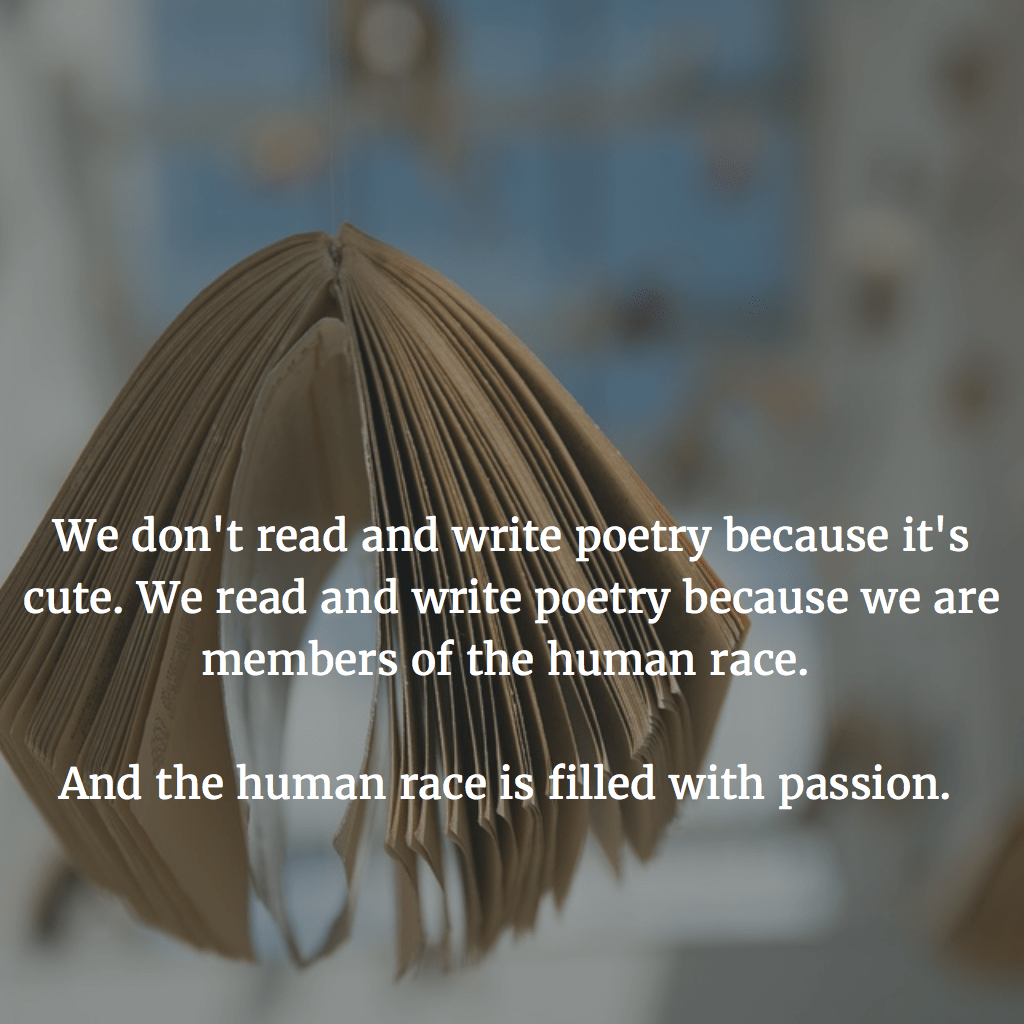
I adore poetry. I try writing poetry, too, from time to time, but I fail almost every time. I still try, though. It’s such a disciplined and sensual form of art that I know I want to get it right some time or the other. How much command over the language a poet must have to express limitless vision in limited words.

It all started when I read Tennyson’s Charge of the Light Brigade. From there, my craze only magnified as I read Wilfred Owen’s Anthem for Doomed Youth and Dulce et decorum est. Those three war poems changed the way I see words and respond to their lure—it’s weird how war is always the starting point of enlightenment.

Once I understood the underlined meaning in these poems, I wanted more. I was addicted, and was desperate to quench the dryness that these poems left in my throat.

I had read poetry before, of course. I had read some of Shakespeare’s sonnets, and yet, these poems were different. Reading Shakespeare requires effort sincere effort and interest. These poems, though, thrust themselves at me. I didn’t have to know the details of war to understand its effects as told by Tennyson and Owen. They inflamed a strong passion in me for simple, yet well-articulated words.

For instance, this one in particular:

“Dulce et decorum est pro patria mori.”

Which translates to: “It is sweet and fitting to die for one’s country.” Ah, the intensity of those words—coming from a soldier nonetheless, who knows what he’s talking about better than anyone else ever would. But what makes it even better is the placement of the phrase: “The Old Lie:”

“The Old Lie: Dulce et decorum est pro patria mori.”

The entire poem walks us through a vivid description of the war zone, and then, we get to the end where the poet claims that all the bullshit stories we tell young soldiers are empty words; lies. Poor Owen, he must’ve believed them all, like the rest of the lot. What a great poet he turned out at the hospital, before recovering and heading to the battleground again.

But that’s the power in good poetry: When said “write”, a writer writes, but a writer who said it right, writhes the emotion out of readers.

Wilfred Owen was one such writer. He made me, the reader, feel what he felt. The pain, the anguish, the heartbreak, and the loss of hope—I felt them all because the poet put them in such an artistic narrative. And that’s why we should read good poems, because like John Keating says, we need science and business to sustain, but we need poetry to live.

And what would we do if not live?

Get a life!

I had just begun to read One Hundred Years of Solitude. I had left the book on my table while I rummaged in my bag for something when my colleague (a senior) cast me a look as if I were crazy to read such big a book. (It wasn’t that big, still—)

“Why are you reading stuff like this?” He raised his eyebrows in a scorn, then shook his head continuing, “Read about marketing, about selling, business, and technology. Those are the stuff that’s going to help you in future. These are just useless.” He cast a dirty look at the book I had wrapped in a polyethylene cover to protect its beautiful art.

He wasn’t the only one. About three years later, I had a similar conversation with another senior colleague. This time, it was poetry. I had mentioned reading some new poems when he suggested I read about the latest mobile technology instead. Sure, I laughed, I’ll subscribe to all tech magazines and read them, but poetry is for my personal time. And he smiled in a crude way shrugging, “Well, read this during your personal time.”

To which I replied, “I need a life.”

He just laughed it off, but I felt proud of myself. The first time, I was new at the job and worried about being rude to an experienced person at work. The second time, I was more concerned about myself. I had grown up.

But the fact remains: a lot of my colleagues, friends—even my parents—feel that work has become such a large part of our lives that we have no time for anything else. My married colleagues complain how they can’t bond with their in-laws. Some others worry each day that they leave home for work even before their children wake up. Even the typical 9–5 corporate world now has employees clocking in from 8 to 8 or 8 to 12. And it’s not just for a day, it’s for days together.

In a flurry of product launches and a rush of marketing campaigns, we often forget that home is a place away from office. We spend so much time at work, and all of the little time at home thinking about work. The balance goes to the noose.

It’s sad but it’s reality. We’ve lost so much of our life to work that we seldom realise what we’ve lost. We spend all our days toiling to ensure someone else’s luxury while we skip lunches for meetings, put off a family reunion for an official trip, and stay a little longer than midnight to finish testing the code. And the purpose of it all—an extra shift, a higher bonus.

However, at the end of the day, lying in bed, thinking about the tasks for the following day, we fail to feel the warmth of the blankets, hear the soft—yet evident—creak of the fan or the wind tapping against the windows, and notice the curtains swaying in the breeze. Somehow, while we were busy living to work, we lost the will to live at all.

My colleagues are (un)living examples, and I’m walking on the tightrope. It’s time for a change.