
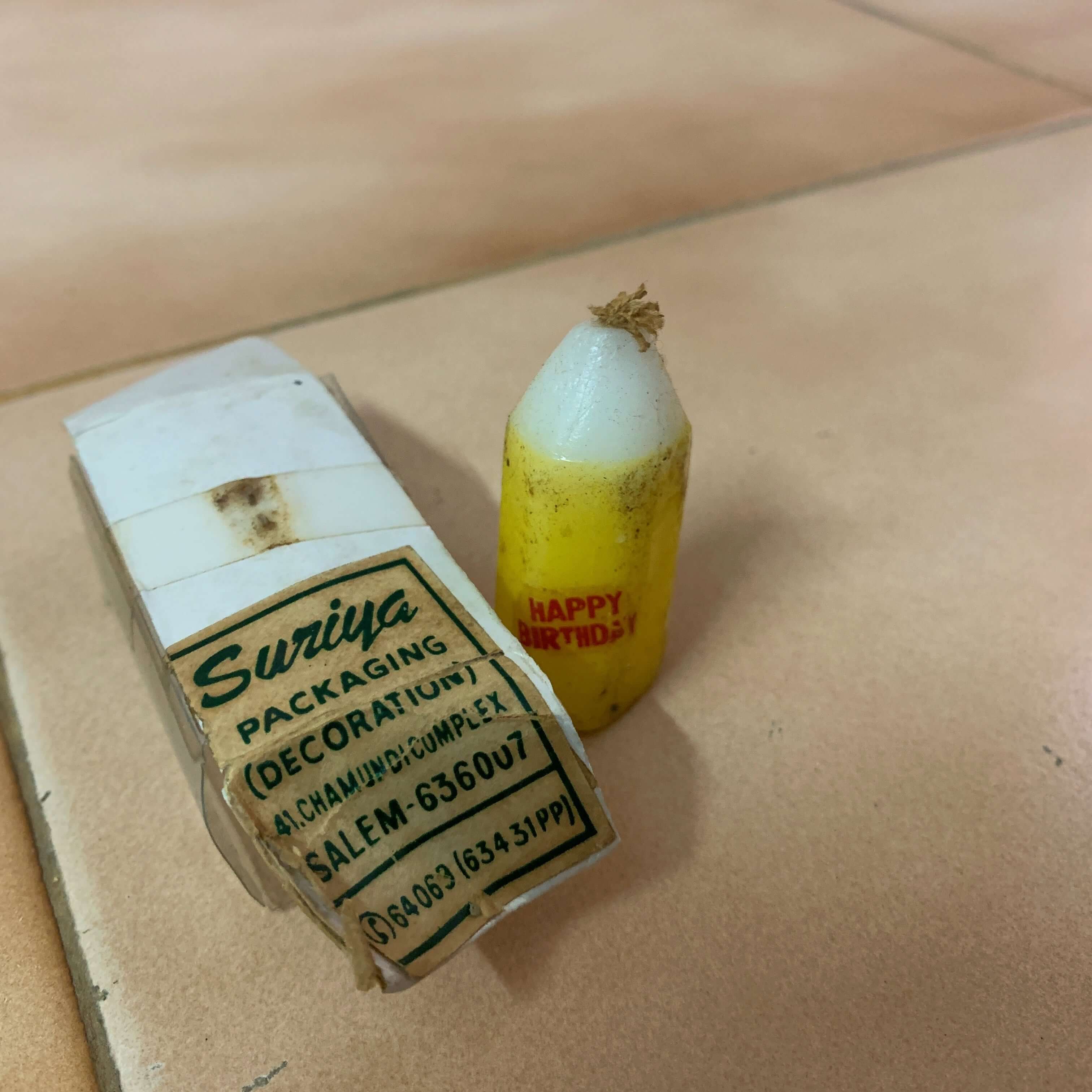
Bright-eyed and sparkling,
candle, wastes its life away;
defines another.
Bright-eyed and sparkling,
candle, wastes its life away;
defines another.
It’s my mother’s birthday. For weeks leading to today, I wondered what present I should get her. It wasn’t easy figuring it out.

My dad’s birthday falls at the end of the week and I know he’d appreciate the book I got him. He’s always said he wanted it.
My mother, on the other hand, never says what she wants. And so I had no idea. I wanted to gift her with a surprise, but I didn’t want to stick to age-old conventions of wall hangers, posters, or ornaments that collect more dust than memories. I wanted to give her something that she’d use every day, something that would make her smile when she looked at it, and something she’d cherish on a day-to-day basis.
It was a nice thought, but I couldn’t think of any such thing.
I don’t know what my mother likes because she’s never told us what she likes. Even in my earliest memories, my mother’s always been the kitchen figure, with a floured nightgown and butter-covered fingers. Thanks to her I grew up knowing I needed baking powder for baking. Because of her, I developed a passion for artisanal cooking. And she who taught me to treat the kitchen as a place of worship. But everything she ever made in her kitchen was for us. Sure, she’d have a couple pastries, but even when she’s unwell, she’d push her boundaries to make our favourite food.
I didn’t think there ever was anything that’d justify my reverence.
So I asked her, instead. From past experience, I knew she’d only want something for the kitchen or our home. She’s never once wanted anything just for herself.
This year was no different. She asked for a lunch box to pack meals for my dad. I got her that lunch box, chiding her all the way. But then I also got her a pair of soul-comforting soft-soled slippers. Her feet has seen so many bad days, and no one deserves pampering more than mom.
What’s the purpose of birth?
It’s a zen-like rhetorical question, but like they say, everything has a purpose.
How about an accident? I like to look at accidents and huge catastrophes – sad though they are – as Nature’s way of clearing up the world; as a way of weeding out ripe lives so as to make room for fresh ones.
But what happens when birth itself is an accident? Is it just Nature’s way of telling us there’s still something left to experience? We’ll never know, unless we pay attention.

All the world’s a stage,
And all the men and women merely players:
They have their exits and their entrances;
And one man in his time plays many parts,
His acts being seven ages. At first, the infant,
Mewling and puking in the nurse’s arms.
And then the whining school-boy, with his satchel
And shining morning face, creeping like snail
Unwillingly to school. And then the lover,
Sighing like furnace, with a woeful ballad
Made to his mistress’ eyebrow. Then a soldier,
Full of strange oaths and bearded like the pard,
Jealous in honour, sudden and quick in quarrel,
Seeking the bubble reputation
Even in the cannon’s mouth. And then the justice,
In fair round belly with good capon lined,
With eyes severe and beard of formal cut,
Full of wise saws and modern instances;
And so he plays his part. The sixth age shifts
Into the lean and slipper’d pantaloon,
With spectacles on nose and pouch on side,
His youthful hose, well saved, a world too wide
For his shrunk shank; and his big manly voice,
Turning again toward childish treble, pipes
And whistles in his sound. Last scene of all,
That ends this strange eventful history,
Is second childishness and mere oblivion,
Sans teeth, sans eyes, sans taste, sans everything.
— Jaques (Act II, Scene VII, lines 139-166)
The seven ages of man, as told by the man who celebrates yet another birthday today.
Alright, he’s done that for years now and will do so in future as well. That’s not the matter. No. I am not going to write another blissful blog post about how Shakespeare influenced the language and literature that we hold dear. That’d be a crappy and boring read; too many people would be doing it. Having read that excellent speech recorded in the pages of literature, I’d be surprised if you are even reading this. That’s the point. Shakespeare’s words need neither prologue nor epilogue. Thus, I wind up.
 The Chaos Within