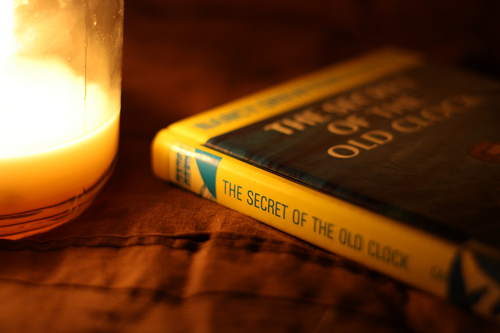
Refreshing Memories With Nancy

Nancy Drew

It’s been long — literally years — since I abandoned Nancy Drew to the unavoidable circumstance of growing up.

After such a long time, I was able to lay my hands again on the series when I visited a book fair at home.

This book fair comes to my hometown twice a year; in July and in December. And though I have been to the fair more times than I care to remember, I am, unashamedly, every time overwhelmed by the collection they seem to display.

Any vain pride that I have about knowing a lot of books, is just washed away in a huge wave of unheard authors and books.

But it was Nancy Drew that helped buried memories surface. So I bought a Nancy Drew: Girl Detective trilogy. (I didn’t even know Nancy Drew came in trilogies!) This particular trilogy is the Eco Mystery Trilogy.

I started reading the first book and was surprised (like countless times before when it came to books,) with the narrative. All of the previous Nancy drew books I had read followed the third person narrative. This trilogy however, was of Aladdin Publications (whose books I’ve never read before)  and followed the first person point of view. That was unexpected. I have never experienced Nancy describing a situation from her view. It was rather bizarre. It had always been the narrator-writer, Carolyn Keene, who told us about Nancy and her friends.

This Aladdin Publications raised a question in my mind: how was the stories originally written? It is possible that the author herself adopted a change of point of view? As always, I turned to Wikipedia. It says that Carolyn Keene was a pseudonym that multiple authors wrote by. So Nancy Drew was a work of multiple authors, the revelation leaves me a little disappointed.

Moving on to other things, there was one other thing about the story that caught my attention than anything else. It was the simplicity of the narration. This is one thing that almost everyone speaks of nowadays. But what I’m trying to point out here is that the books are so simply written that it involves less or no effort to read it.

That’s really important, in any book. As we grow up, we move on to bigger and, what we assume, better books that are merely complicated reads. In other words, they are just simply too tough to read easily. Which is one of the reasons reading has become a chore.

Mysteries are knotted, complicated and twisted. If a writer (or many) can vividly bring crime scenes to our minds, without using twisted vocabulary and grammar, then it is a good read, isn’t it?

Children’s and young adult mysteries like The Famous Five, The Secret Seven, Nancy Drew, The Hardy Boys are all great examples of simply describing serious plots.

We do need more of such books, if we are to encourage youngsters to read. Maybe after reading effortlessly and loving it, kids would opt to explore the more complicated plots.

Just a random thought.

The Last Lecture

“Take Time Out. It’s not a real vacation if you’re reading email or calling in for messages.”

Randy Pausch, The Last Lecture

While reading the book, there was only one thought in my mind. How the hell did a programming nerd (yeah, that he was) have such an interesting way of thought?

I know a lot of programmers, the nerdy people whose world is made of directories and variables. There are exceptions everywhere, yes, but I have seen programmers who are so immersed in what they do, that they have made it their life. They’re the classical thinkers; the impassive people.

For a romantic thinker like myself, they appear dull, and I’ve seen the shocked look they give me when I tell them coding is boring. They look at me like I have no interest in life. To quote another person, you know you are a romantic thinker when, “you give more importance to feelings and less to facts.”

But that’s the way we think of each other.

Getting back to The Last Lecture, this Randy Pausch was such a classical thinker, except for the craving for fun. He was a nerd, a computer scientist and a professor. And from what I could discern, he was good at what he did.

Before writing this, I went through the reviews of the book and the lecture on Goodreads. There were a lot of people who gave four or five stars for the book. But, there were some who rated it one or two. There was such a contradiction and wondering why, I concluded, sometimes it’s arguable that one takes a view of life as Randy had, when he is counting his time. I don’t care though. Dying or not, the book has some very valuable thoughts. There is no guaranteeing that it would work for everyone, but it sure did for Randy, and considering that the lecture and the book was his message for his kids, I would say that Randy has succeeded in leaving a legendary legacy behind.

This book greatly reminded me of a similar story I read sometime back. A story of a dying professor – a story about living, in the words of a student. This, on the other hand, is a narrative from the professor himself, about the way he lived life and his regret of not being able to be a father.

It’s ironical that he practically raised his sister’s children and so many other students, but not his own children. That’s the sad part; that you were reading words of a dying person who prepared for his last lecture instead of spending his little time with children who would hardly remember him in future.

The book was the written form of his lecture. I watched the lecture too and Randy was careful to avoid topics that would make him emotional. He was just joking around, like he was trying to make an interesting class out of a dull one.

As a lot of people would say, the book was bound to have pathos spilled all over. It was, yes, it’s a pity to realize that the man who had such unique views is no longer living.

It’s quite similar to what I felt when I read Tuesdays with Morrie; I wish I had had a teacher like that. Two teachers; two conditions; two very different attitudes; both wonderful!

Life Is What You Make It

“If you have not made somebody’s day happier, if you’ve not appreciated something good that has happened to you and if you have not felt thankful to be alive, then you have wasted that day of your life on earth!”

~Preeti Shenoy, Life Is What You Make It

Alright, before I start about the book, let me just declare that I can’t tolerate love stories. Surprised? Yeah, I get that a lot.

Bleeding hearts, love letters, sleepless nights, butterflies and all the other insane things people relate to love – I hate them all. Particularly when the author takes up multiple pages describing how blissfully painful the sensation is.

I totally hate when simple events are exaggerated. Oh, I can’t stand to read how people in love, trip over something as tiny as a pencil and break their leg! Love isn’t about such mindlessness and I dislike it when authors illustrate it so.

Having said that, I was a bit tentative about reading the book. Knowing it was a love story, I had evaded the book for some time now. It was only when I held the book and read the description on the cover that I realized that the story addressed a bigger issue; a disease bigger than unrequited love; Bipolar Disorder.

I so wanted to read the book after that! 

I wasn’t new to the condition; I’ve read blogs of people who are bipolar, and a few other articles too.

So the adventure began. It kept me awake through the night, and that doesn’t happen often, in the case of books that is.

I’m not into reviews, so here’s the story in short. It’s the life of an Indian girl, whose ambition penetrates her love story. She is the brightest student in her MBA batch, until she starts showing signs of bipolar disorder. With her recovery, ends the story.

I only felt that the learning-to-manage-without-medication process was too quick to be true. It is a lengthy process, as I understand, but it seemed simple in the book.

Bipolar Disorder seems to have a simple solution, and trivial matters, like trusting the “weird sisters“, end up tragic. Maybe that’s the queer thing about the written word. But that’s a topic for another time.

Of Fantasies and Simplicity

When I tell people that I like a certain fantasy novel, they look at me like I’m an intolerable kid. ‘Fantasy books as those, are school kids material; older people shouldn’t read those books. They are childish and off reality’. This is the common attitude people have.

I have a different view of fantasy tales. Apart from being dreamy, fantasies are artfully narrated. It is that particular style of narrative that appeals to everyone. They don’t complicate things. Even the most complex and tough thoughts are conveyed easily so that even kids can understand. That is not childish; that is the toughest thing to do for a writer. To explain worldly philosophy in simple words is something that everyone should learn to do. Simplicity is what everyone desires, even if they claim otherwise.

So what’s wrong with reading fantasies that spell simplicity? Some of the best-selling fantasy novels have life time lessons that thick-bound books can never teach. I say it’s never too late to read fantasies.

Tuesdays with Morrie

“So many people walk around with a meaningless life. They seem half-asleep, even when they think they’re busy doing things they think are important. This is because they are chasing the wrong things. The way you get meaning into your life is to devote yourself to loving others, devote yourself to your community around you, and devote yourself to creating something that gives you purpose and meaning.”

A long time ago, I just happened to come across a movie titled, ‘Tuesdays with Morrie’. The title seemed interesting and so I decided to watch it. I should say I was not disappointed at all. The entire movie was filled with such serenity that simple words cannot express.

When I learned that the movie was adopted from a book, I made it my priority to read that book. After a long time I finished reading the book on a train journey. It left me with an inner peace that I find difficult to discern.

About the book – it’s based on a true incident in the author’s life. It’s about the author, Mitch Albom, who, after hearing about his favourite professor’s fatal illness, visits his professor sixteen years after his graduation.

After the first visit, Mitch is convinced that he wants to visit the dying professor every week. Being Tuesday people – as his professor called it – Mitch visits his professor Morrie, every Tuesday with a handful of food parcels.

Each Tuesday, Mitch learns something new about living a meaningful life. Morrie speaks of his love for living. He helps Mitch understand the purpose of life and wants his words to educate more people who need a loving voice of comfort. Morrie is one who does not give in to the society that chases happiness without realizing that it could be found within. He has built himself a sub-society where no one is inferior and everyone is on the lookout for the other. Morrie and Mitch talk about everything that seems to torment the present generation and Morrie always has something valuable to offer.

The author has done a great job of describing Morrie’s decreasing health condition. The style in which the author has narrated the story touches every heart. You can’t help but appreciate Morrie and wish you had had a teacher like that. That’s where Mitch Albom succeeds.