The other side

I was never a great fan of Jane Eyre. 

Like most people, I also read it in middle school, when I hadn’t quite developed the patience to endure or contemplate why Jane, who was so praised for being plain and relatable, was such a big deal. 

And I still don’t understand why her love for Rochester was such praiseworthy. After all, she did abandon him when she heard he’d had an unhappy marriage, only to run back to him when he almost died in the fire.

I grew up watching countless movies where the lead female character’s sole responsibility was to prance across the screen, showing off, triggering the men’s emotions, and then falling in love with them because they’re willing to die for love. If I didn’t know better, I’d say Jane Eyre, the book, was just another case of female objectification.

However, Jane Eyre, the character was something else. There were many moments in the story where I supported her decisions. I agreed when she raged at being kept in the dark about Bertha. And I believed she would’ve loved Rochester even she had known. Throughout the book, I was with Jane, but by the end of it, I wasn’t happy for her. Instead, I felt as if the story merited no merit. 

Of course, Bronte’s writing was so intense and beautiful in many aspects and I, by no means, belittle the book she produced. Regardless, for some reason, Jane Eyre remained incomprehensible to me because it lacked something. 

Then I read Wide Sargasso Sea. Written by Jene Rhys, this is a prequel to Bronte’s Jane Eyre.  

The story unravels the life of Bertha, Rochester’s wife. Written in her perspective initially, later shifting to Rochester’s, the book walks the reader through Antoinette’s (Bertha’s first name) disturbing childhood, her mother’s fate, her family’s wealth and the implications of being a Creole heiress. 

This background into Bertha’s life, in many ways, threw light into real Jane Eyre, the book. 

The only references and perspectives we get from Bronte about Bertha, come from a Rochester who’s already fallen out of love with her. When he speaks of her and narrates his life with her, he’s so welded in self-pity and sadness. And as readers of Jane Eyre, we naturally cultivate a disliking to this unwanted character that was forcefully placed in our hero’s life. Our opinions are biased to begin with, and that leads us to justify Bertha’s death as a favourable outcome for the protagonist. 

That’s the idea Jene Rhys challenges.

The more we learn about Bertha as a person (as opposed to Bertha as the madwoman), the more we realise the realities of life. Her entire existence was a series of events for which no one could be blamed for. There were no evil witches or antagonists attempting to disrupt her life. As a child, she lived by the rules, as a woman, she married as she was told, and as a wife, she tried her best to love her husband and seek his affection in return. She was the real plain Bertha. And yet, we see her life toppling into misfortune, dragging along an innocent Rochester. 

In fact, reading Jene Rhys’s story increased my affection for Rochester. The second half of the book is entirely in his perspective and we see, despite his helplessness, a genuine desire to help the woman whose life was tangled with his. We get a fuller picture of Rochester as a character. 

For me, that was the best part of Wide Sargasso Sea. Aside from addressing plenty of social and economic matters in the Caribbean and women’s health issues, this story completes the picture that Bronte paints in Jane Eyre. 

Perhaps now, when I re-read Jane Eyre, I’ll appreciate it more than I did the first time.

Incredible how powerful perspective is.

The Bush Capital

“I […] picked up the notebook and pen and, after a minute’s thought, wrote, “Canberra awfully boring place. Beer cold, though.” Then I thought for a bit more and wrote, “Buy socks.”

[…]

Then I decided to come up with a new slogan for Canberra. First I wrote, “Canberra—There’s Nothing to It!” and then “Canberra—Why Wait for Death?” Then I thought some more and wrote, “Canberra—Gateway to Everywhere Else!,” which I believe I liked best of all.”

Excerpt from In a Sunburned Country, Bill Bryson.

I read that piece of prose about a month before I moved to Canberra. A good friend, American, suggested that I read Bill Bryson’s In a Sunburned Country as a way of getting into the moving mood. Of course, my friend meant well—though he couldn’t recall Bryson’s exact feelings about Canberra, he did mention that Bryson covers the whole of Australia from an American comedian’s perspective. And that’s just what the book does.

I’d done some research on my own and everything I learnt hinted at a great place to live—a quiet small town with lots of greenery and large lakes, stunning autumnal sunsets, and frostbiting winters. And so it surprised me to read the author had suffered great boredom in Canberra. In the book, Bryson moves on to Sydney, Melbourne, and Brisbane, narrating his observations along the way. And sure enough, in comparison to those metro cities, Canberra is rather subdued and humble.

Estimated population of Canberra in 2035

But Canberra is far from a boring place. I’ve been exploring the area and town life every day since I moved here a month ago. And there’s not a single thing that didn’t amaze me. Aside from the old parliamentary building and the old law-making systems, the national war memorial that brings to life each war Australians suffered, and the museum of modern history that plays host to thousands of years’ history, the city by itself has a story to tell.

The National Capital Exhibition is a smaller building than the other tourist attractions. However, it hosts hundreds of interesting titbits about the city that’d make any Canberran swell with pride.

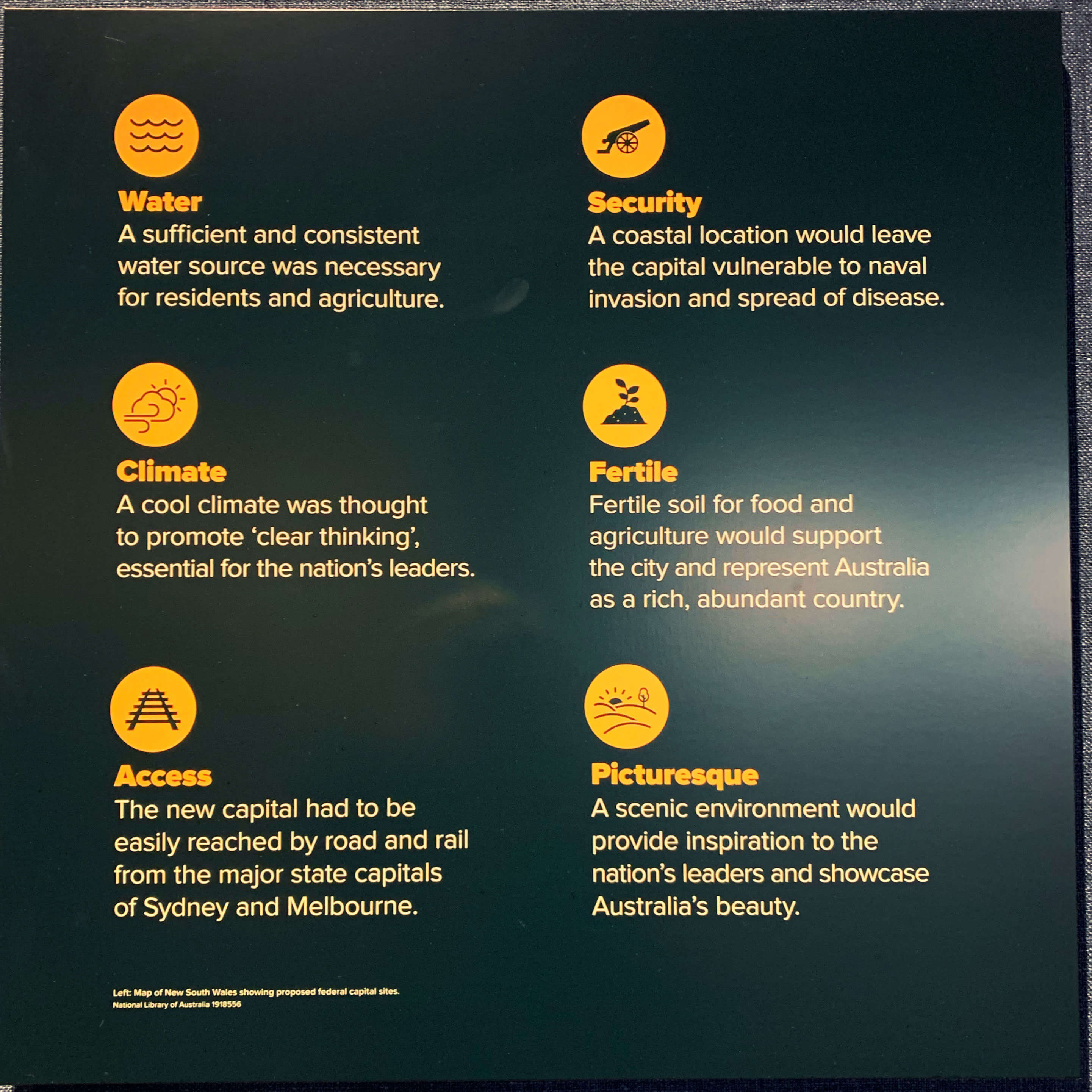
Canberra is a planned city. When the government decided that neither Sydney nor Melbourne can serve the purpose, they weighed various criteria to choose the capital city. With sufficient resources for agriculture and cultivation, natural scenery that’d attract visitors and locals alike, a secure landmass away from the coast and naval invasions, and an accessible location from all over the country, Canberra became the ideal capital. As I read through each point in favour of Canberra, I found myself nodding in agreement. This is a great place. And the best part—not many people have discovered it yet, giving it an excellent population balance.

Selection criteria for Australia's capital city
Selection criteria for Australia’s capital city

In the exhibition is a large 3D model of Canberra’s layout, lit up, and highlighting the geometrical marvel that the city is built upon. The parliament building is on top of a hill. Looking right across from the top is the national war memorial serving as a constant reminder of the consequences of any decision made inside the parliament. Branching away from the centre are the main roadways—the spines for the many suburbs woven around them. From above, Canberra looks like a spider’s web. It’s well spread out and yet interwoven to make sure you can drive from one corner of the city to another in 30 minutes or less.

And then there’re the lakes. Although artificial, Canberra’s primary lakes, Burley Griffin and Ginninderra, complement the many natural forests around the city. Footpaths go around the lakes and the bridges over. It’s as if no humans can ever disrupt the calmness of the lake or disturb the babbling ducks in it. Looking at the Lake Burley Griffin through a window, I wondered how much the city’s designers (Walter Burley Griffin and his wife Marion) would’ve appreciated and yearned for nature that they decided to plot such big lake right in the middle of the city.

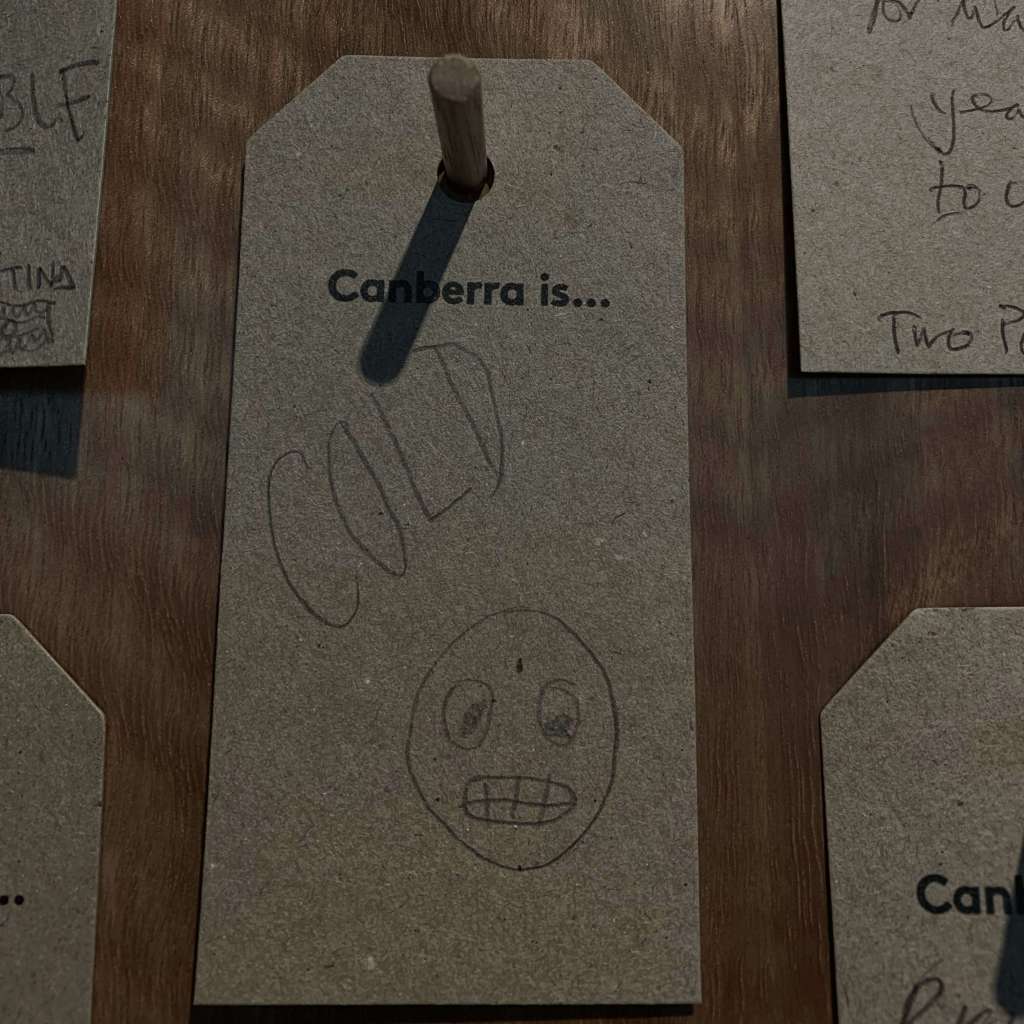
  • What is Canberra to you?
  • What is Canberra to you?
  • What is Canberra to you?
  • What is Canberra to you?

Sure, Bryson was right in a few aspects—the shops close at 5 and the night scene is still quite bleak, but this is the bush capital. If you like yourself some greenery, Canberra won’t disappoint.

Parting thoughts: Never judge a place based on a few authors’ descriptions. Everything is subjective.

The explorer

Going on for and wide
chasing new horizons
speaking unknown tongues
asking strangers for the way
walking by the sidewalks
observing others on her path
befriending some street dogs
waving to women in stores
running up the mountains
waving to young shepherds
laughing at the frolicking sheep
reaching the top in ecstasy
gasping though, and heaving
willing still to traverse all over
enduring the shadeless seas
exploring unchartered territories
reading, she goes everywhere
being despite in a merciless cast

Versatile

During sibling wars
a child’s bat it becomes

On icy cold days
a holder of hot beverages

On sleepless nights
a companion for open eyes

When confusion clouds
a comforter for sought minds

At a loss for gifts
a lifetime purpose it offers 

If a question strikes
a resounding resource it’s 

On them tired moments 
a beckoning pillow it makes

When challenged by techies
a living breathing thing it proves

So if you ask me why books
a truer friend there seldom is