

Bush fire-smoked sunsets?
Weather on hormonal spell.
Climate change… What now?
Bush fire-smoked sunsets?
Weather on hormonal spell.
Climate change… What now?

While the rest of the world awed and dropped their jaws at the extravagance erupting from high-rise buildings, the fireworks prancing across the skies, and as the earth slowly wound its way towards midnight and crossed over, Australia was burning.
As waves of flame and smoke toppled over farms, bushland, helpless cattle, homes, cars, light poles, and traffic signals, the world’s tallest building, the Burg Khalifa in Dubai, was plastered across people’s social media feeds, it’s slender figure lighting up, plush, colourful streaks chasing their way to the top. It was the new year. It only made sense for everyone to celebrate the birth of a new decade.
Why even the Opera House in Sydney burst with bubbling joy and glory. To keep up with the tradition and the expectations, organisers had spent months mulling over creative ideas together, contemplating, creating, testing, and synthesising to put together a 15-minute show that the entire world would speak of for weeks.
However, amidst all of this hoopla, many Australians had to witness a lifetime’s worth of possessions and passions slip away through the cracks of nature’s devilish dance.
Since early August, bushfires have ravaged throughout New South Wales, and yesterday, with temperatures going up to 49-degree celsius, many small towns across Victoria were engulfed in the fires as well. Ghastly winds didn’t help, feeding the flames, testing volunteer firefighters, killing residents, and melting road signs. Major highways were closed. Zoos and wildlife sanctuaries turned to social media to recruit volunteers to host animals temporarily, and some of the wildlife we’ll never know the predicament of.
When new year’s eve came to a close, I was home watching and inhaling the smoke riding into Canberra on the wind. Overnight, many fire alarms in establishments in the city went off just from the smoke. The sun rose reluctantly, puffy and swollen with redness, searing through the orange cloud cover that’s now become the new normal. The air quality recorded this morning was 16 times more than the hazardous. As the day progressed, it grew to over 23 times more than safe breathing conditions.
About two years ago, before relocating, as I researched lifestyle here, my heart skipped every time I read an article or a Reddit thread broadcasting Canberra’s envious blue skies and expense of light. And now, I walk outside and feel my heart sink deep into the haze that clings to the peeling gumtrees, envelops the croaking cockatoos, and shatters dreams.
It’s a new year. I hope it’s not too horrible.
Photo credit: Twitter account of the City of Sydney.
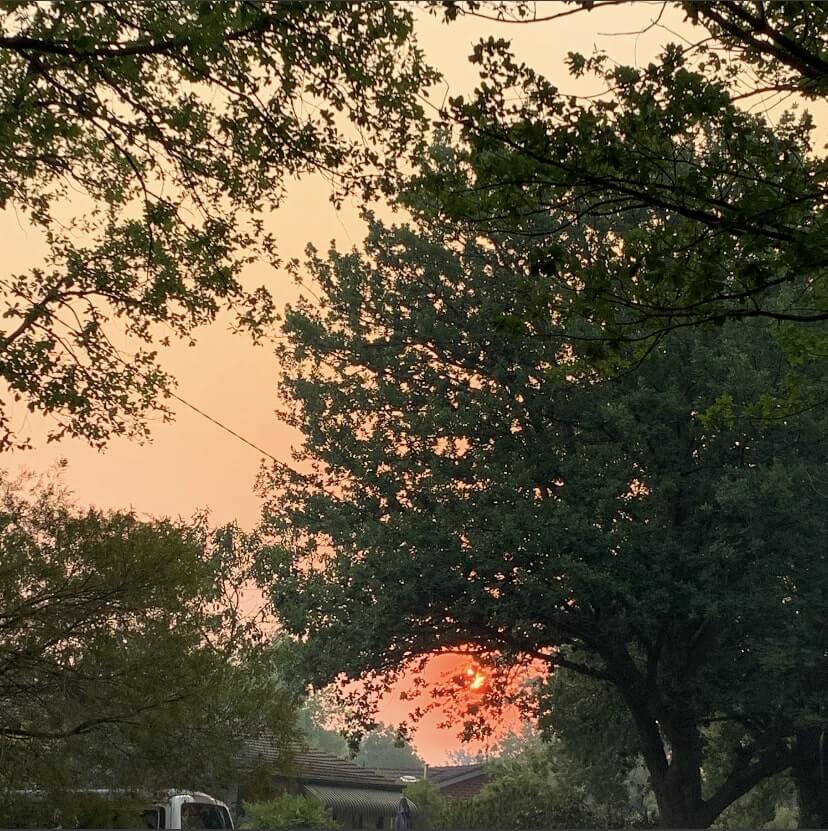
A show-stopping scene:
nature’s thanks to humankind—
for global warming.
Photo: The bloody Canberra sunset from a couple of days ago. The redness is a direct result of the smoke that wafted into the city from the bush fires lapping up forests and natural reserves not far away.
“We think most of the animals were incinerated – it’s like a cremation, […] They have been burnt to ashes in the trees.”
Sue Ashton, President, Koala Conservation Australia.
Source
That line jumped out at me as I scrolled through today’s news. For a while now, most of New South Wales, Australia, has been burning. As of early morning today, a million hectares of land has burnt down, a number greater than the previous three years of bushfires combined. And it’s only spring. Bushfire season is only beginning in this part of the world, and even before its proper entrance, greedy fires are lapping their way into people’s homes and lives.
Yet, somehow as I read multiple articles mentioning three deaths and over a 150 destroyed homes so far, it didn’t hit me as hard as the incinerated koala bears. Though I haven’t lived through many global disasters, I have seen and heard of enough violence and terrorism to develop a mild numbness to human deaths. To me, it always felt like one group of humankind is always paying for the mindless blunders of another.
This time, however, it wasn’t just the humans. This time, for the first time in a long time, vulnerable nature is suffering from its own wrath. That article put it well too. The precise choice of words got me unawares, gripping my throat, crushing, pulling the air out of it in such a slow motion that I wished it would hurry up and get it over with. The casualness of that word threw me off balance. It made me breathe in so sharply that my eyes teared up from the pressure and the pain that shot all the way through my body.
Words are powerful. Saying that over 300 harmless, helpless, animals were crisped while they clung to their homes, paints a picture so vivid that readers would relive the moment again and again. It was strong, writing. As a writer of things myself, I admire the gallantry of whoever wrote that speech.
As a reader, listener, it triggered me. It’s made me abhor the world we live in. Although my mind accepts the direness that’s become the new normal in the state, my heart still clenches to think that at this rate, koala bears could be extinct in 30 years.
It’s scary to imagine a species that I’ve admired, photographed, and smiled at, would die out right in front of my eyes, and I wouldn’t be able to do anything about it.
The state government has declared emergency for the first time since 2013. According to meteorological forecasts, tomorrow (Tuesday) will cause more damage than we’ve seen so far. Greater Sydney, NSW, and parts of Queensland are expecting extreme bushfires—in addition to the 60 that’re still uncontained. Over 500 schools will be closed. Millions are evacuating to safer areas. High temperatures, low humidity, ghastly winds, and catastrophe await the state as it spends another sleepless night.
And someone said the climate’s fine.
 The Chaos Within