O Alquimista

“When you want something, all the universe conspires in helping you to achieve it.” 

~The Alchemist~

Well, that’s the subject matter of  ‘The Alchemist’. It’s a story, simply portrayed; a story that conveys a not-so-simple message in a way that anyone can understand.

This is the tale of a young shepherd by the name of Santiago, who follows his recurring dreams all the way to Egypt and back again. His encounters with an old king, love, fears, an  alchemist and others carry the story.

We all have or would have had deep desires and ambitions. We abandon our desires for the fear of not being able to achieve it and then regret our decisions throughout our existence. Santiago was different. He gave up his comfortable life and became a shepherd for his love of travelling.

The best part of the story, in my opinion, is the fact that it gives a great piece of advice to all aspirants: “Listen to your heart.” It’s simple, yet powerful. The heart, like the brain, ‘is a many layered thing’ and has the ability to lead the body in the right path. (That is, if your heart is in the right place!)

It really is a book that should be read, enjoyed and passed on.

I’m just plainly glad that I read this story (even if it were only an abridged edition). It changed my life for the better. I have a feeling that, had I read the story earlier in my life, it would have had a better impact on me, but it’s never too late to read.

Second Time Around

Which book would I want to re-read for the second time? That was the prompt a few months back. Re-reading? I can name a few. I read books but I don’t own much, and of the few that I have at my disposal, the book that I’ve read on multiple occasions is ‘Harry Potter and the Philosopher’s Stone’.
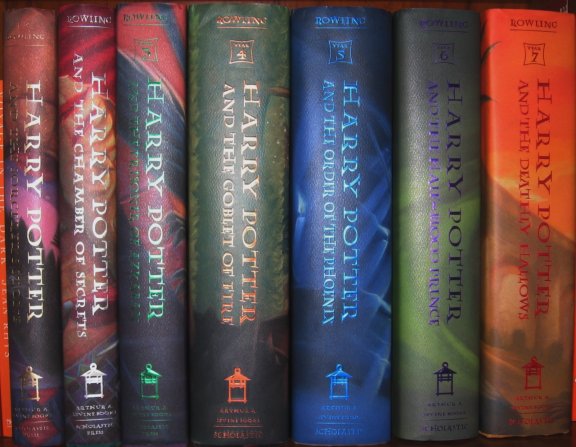
Harry Potter:

I got ‘Harry Potter and the Philosopher’s stone’ from a cousin and I have read that book almost twelve times now. Though I don’t have the others of the series, I’ve read them more than once too. The series actually made me recommend it to some of my other friends, who thoroughly enjoyed it. I read somewhere from a HP fan that Harry Potter has lessons for generations. A lot of fans say that, and people might think that Harry Potter is a school text-book. I see the books as an account of the lives of a few teenagers and the transition they undergo over the years and how events mould their characters effectively.

Wikipedia says that according to Rowling, ‘death’ is the underlined theme of the series, but one can quite easily identify other dominant themes like, adolescence, friendship, power-hunger, confronting fears, making choices, obsession. It’s the presence of these wide topics that make the series an interesting read, and in the words of most fans, a lifetime’s lesson.

Throughout each chapter of every book of the series, JKR’s mystical storytelling tactics are prevalent and urge the reader to have the pleasure of a second-time read.

Even now, after many years of having read the books, whenever I feel like I’m having a bad day, Harry Potter helps. Sometimes people around us – Harry Potter haters – seem to think that Harry Potter is only for children; they are of the opinion that it’s just a fantasy tale of a few troublesome teens. Yes, they are not perfect; there are a few flaws in the books, I don’t deny it; but I have to add that it introduced me to the pleasure of reading and writing.

Though a whole lot of people enjoyed HP, similarly, a large people criticized it as even foolish and unnatural. I just have this to say: Harry Potter is a novel that could be enjoyed only by those who would allow themselves to be lost in a powerful den of words. Only those who are willing to convince themselves to believe wholeheartedly in the impossible and to find solace in it, will enjoy the series. Those who seriously want to dwell only on reality; those who deny to let in the subtle and fantasy-like emotions, are never going to enjoy a book such as this. Also, in my opinion, the reader has to place himself in between the characters to appreciate JKR’s words.

Something I really enjoyed about the books is that they were not too descriptive. There were a lot of vivid descriptions, yes, but the thing was  that some parts and scenes of the story were left to the readers’ imagination.  I like the kind of stories that respect the readers’ imagination. I’m not sure if that was the reason for my liking the series, but it certainly was one of the reasons.

Reading Harry Potter is like dwelling in a completely different world; a world that you wouldn’t want to come out of. A world where an entirely different lifestyle exists. Once in, I wouldn’t want to come back to reality that has, nowadays, become more far-fetched than Harry Potter‘s world of magic itself.

All the world’s a stage

Copy of seven ages of man

All the world’s a stage,
And all the men and women merely players:
They have their exits and their entrances;
And one man in his time plays many parts,
His acts being seven ages. At first, the infant,
Mewling and puking in the nurse’s arms.
And then the whining school-boy, with his satchel
And shining morning face, creeping like snail
Unwillingly to school. And then the lover,
Sighing like furnace, with a woeful ballad
Made to his mistress’ eyebrow. Then a soldier,
Full of strange oaths and bearded like the pard,
Jealous in honour, sudden and quick in quarrel,
Seeking the bubble reputation
Even in the cannon’s mouth. And then the justice,
In fair round belly with good capon lined,
With eyes severe and beard of formal cut,
Full of wise saws and modern instances;
And so he plays his part. The sixth age shifts
Into the lean and slipper’d pantaloon,
With spectacles on nose and pouch on side,
His youthful hose, well saved, a world too wide
For his shrunk shank; and his big manly voice,
Turning again toward childish treble, pipes
And whistles in his sound. Last scene of all,
That ends this strange eventful history,
Is second childishness and mere oblivion,
Sans teeth, sans eyes, sans taste, sans everything.

— Jaques (Act II, Scene VII, lines 139-166)

The seven ages of man, as told by the man who celebrates yet another birthday today.

Alright, he’s done that for years now and will do so in future as well. That’s not the matter. No. I am not going to write another blissful blog post about how Shakespeare influenced the language and literature that we hold dear. That’d be a crappy and boring read; too many people would be doing it. Having read that excellent speech recorded in the pages of literature, I’d be surprised if you are even reading this. That’s the point. Shakespeare’s words need neither prologue nor epilogue. Thus, I wind up.