
No bird sang sweeter,
than his child, his pearl, his world
voicing her first word.
I’m home alone, marvelling Pirates of the Caribbean for the uncountable time. My room mates have left for their hometowns and so have my colleagues and friends.
Today is Diwali or Deepawali, a special Indian holiday. People working away from their hometowns throng home to spend the day with family. Most religions celebrate this day as the day good destroyed the evil in the world.

Yet it’s ironic that we celebrate the end of all evil by spreading more evil.
We all love spending time with our families, sharing a meal, and smiling at the kids who run around the neighbourhood fighting over candy while parents share a drink. That’s how foreigners see Diwali. It’s a day of joy and sweets and all things nice. There’s no evil in that.
So it would seem.
Diwali is the festival of lights. And the reason: We celebrate the day lighting firecrackers and scaring the crap out of our domestic animals. It’s common for people to have cows and buffalos as pets, along with dogs, cats, and fish. And while I enjoy Jack Sparrow’s adventures in my room, I hear these bigger animals wailing in fear as the fireworks go up a little too close to their feet.
As I shake my head disgusted at parents who let their kids torment animals, my phone lights up with flash news: “Fire in Gujarat’s fireworks shop, over 10 people dead.” Every year, Diwali brings a handful of fire accidents in fireworks shops. And every year people debate whether we should continue selling and manufacturing fireworks because of all the death and destruction. And yet, year after year, people light up their stash of smoky hell, laughing at lights and lolling like maniacs.
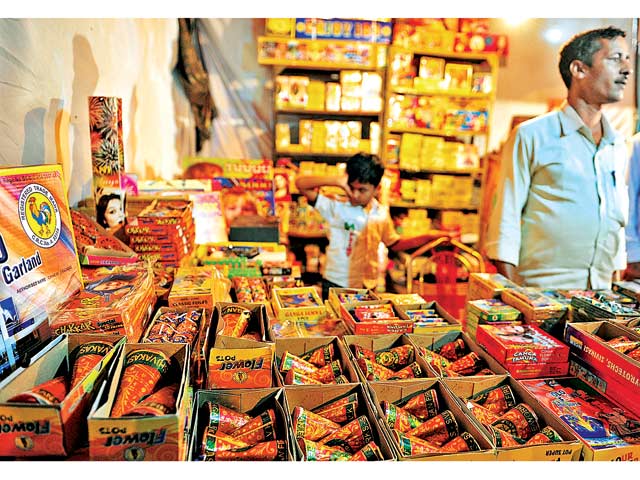
There’s more to Diwali than killing lives and scaring animals, though. Fireworks are expensive. And every household with children or light-liking adults spends about $30 in fireworks. Not to mention other expenses like buying sweets and savouries and new clothes for the entire family. These don’t come cheap. Tis the season where employers give employees a Diwali bonus, too.
On the day of Diwali, people wake up early, clean up real good, wear new clothes, have breakfast, and go outdoors to light up fireworks. An hour or two later they’d break for coffee and snacks. Then again, they go back for more fireworks. and in between the festivities, comes other traditions like visiting neighbours and friends to give away snacks, and all-day feasting in cholesterol-full foods. The whole day wanes, and we call this the single biggest festival of the year.
However, like all things Indian, there’s also a counter-culture to this Diwali madness. There are some who don’t throw money away on fireworks or shopping. They don’t spend all day indulging guilt-free on guilt foods, laugh at animals cowering in fear, or trigger heart attacks in patients in a nearby hospital.
These are the ones who see festivals as a chance reconnect with their family without tearing other families apart. We are the misfits, the tradition-less, and the unholy. We call Diwali the festival of darkness because we are the ones who care for the greater good.

Sometimes being an average Indian means that you don’t tell your parents about what you want. What if they couldn’t afford that toy motorcycle, and by asking you’d only make them guilty?
It happened to me. Growing up, I never had the courage to tell my mother I needed my own space. We lived in a two-bedroom apartment and I had to sleep with my parents since my older brother, who had a lot of studying to do, needed the other room for himself. And the worst part of it was my parents thinking it was alright for a twelve-year-old girl not to have her own room.
But it felt weird to me. I was a loner, and I liked spending the day lying on my stomach with my face glued to the Chronicles of Narnia. I’d stay up all night, leaning on a wall beside my bed, inhaling page after page of Harry Potter. And when I wanted the lights on, my parents wanted the lights out.
Sure, I could’ve sat in the living room with my book. But it wasn’t the same as snuggling in a smaller room that I could call my own. It bothered me that I never had a little special place I could crawl into when Hedwig died and the world paused for a moment. It made me crave privacy like it was a heard-to-find gem.
But then I grew up and things seemed to brighten up. I got a job in a bigger city so I had to move out of my parents’ house. And because I was going away to an unknown city, my parents suggested moving into a hostel where I would have some company to understand the pulse of the bustling city that was so much unlike our modest one. I couldn’t afford to get a place of my own, anyway. So I agreed and stayed in a hostel room with three others.
And just as I had imagined, I had the company. But I soon realised that hostel was worse than sharing a room with my parents. Perhaps it’s just me, but after a long day at work, I’d like to come home and crawl into my bed with warm cocoa, soulful music, and a racy book. And instead, I’d come walk into a room full of chattering people trying to drown the television that screened the vanity in reality shows. Privacy still eluded me.
After much self-contemplation, I decided to move out of the hostel and even congratulated myself for being such a grown up and making my life decisions myself. And so I told my parents I considered getting a place of my own. I knew it would cost me a little more than sharing a room with three others. But at least it would be mine. My parents disagreed.
And they had their reasons, too: It’s unsafe for a twenty-one-year-old to live alone in a city she’s lived for three years already. That’s when I understood. According to them, I hadn’t moved out of their house at all. I had only moved away from home. My hostel life had been a temporary arrangement because I worked in a different city from my parents’. They even volunteered to move into the city to live with me. That way, the whole family could be in one place, they calculated.
I heard my clarion there.
I loved them, yes. But I had already spent a childhood living under my parents’ shadow, and I wasn’t going to spend my adulthood doing the same. So I tried explaining. But I had never told my parents what I wanted before, and it wasn’t easy to start doing it. I appealed to them that I needed my alone time. And they responded with rolling eyes and a statement: “Girls your age shouldn’t live alone.” So I decided to give up explaining.
It was time to take a more radical approach. I told them I’m moving out from the hostel. But I also decided they meant well worrying about my safety. So I made a compromise; I’d rent a two-bedroom apartment and share it with two of my colleagues. This time, however, my colleagues would share one room and I’d get a room of my own.
Telling my parents what I wanted was hard. But it was easier once I had reached my tipping point. And that point came when I read a chapter from Virginia Woolf’s A Room of One’s Own. What a woman.
In the age of technology, people force themselves to adhere to their 8-hours-a-day routine. Something’s wrong with that setup.
People want to snooze and wish it were a holiday. They long to lounge on the sofa and snack on beer and pizza.
But reality hits hard and so does work pressure. Walking into office has become as taxing as walking for exercise.
The growing pile of papers on their desks makes brains decay. They know their lives are headed nowhere. Something’s missing, they know that, but they know not what.
So they look for happiness anywhere they could find it. They crave elation; a high beyond stacks of tasks. And they find it. Some find it in coke, some meth, or food, whiskey, tobacco, even — they ache for high, and find addiction, instead.
Getting high transcends to losing consciousness. Laughter becomes torturous, and confidence, a long-lost relative. Solitude reeks of isolation and loneliness gnaws at them even in a group.
But as the weekend wanes and Monday appears, the clock ticks again and responsibilities rise. They master the art of being busy, too occupied even to notice the sunset. The kids yell into the phone, and the spouse wonders aloud if they’d have a house of their own. The father pops in to say hi, complains about his own wife and, wants a recliner for Christmas. Then walks away waving in the air.
The week goes by and Wednesday arrives, along with lengthy memos and unfinished tasks. And they go round in circles reaching nowhere. Trying to please the spouse, the father, and the neighbour, they fail through and through. Life goes on, competing with dad next door, or mom across the block, wondering what relatives would say about that new shirt, or how colleagues would react to the tie clip.
They lift weights heavier than themselves. Providing for all others except themselves. Who’d blame them for kicking back with a cold beer? As the weekend begins again, they run up the mountain out of breath. From growing up to growing old, a life so clocked they’ve found nothing to make them high.
A team outing, a friendly dinner party, and a social drink — to avoid judgement. They look up to society, to accept them, to feel inclusive. And if that means they have sacrifice beer for something stronger, so be it. Yearning to belong, they’re looking for recognition even in the canon’s mouth.
Until one day it all stops. One day, when life flashes before their eyes, all they’d see is disappointing years, outlining work schedules and weak-kneed drinking parties. That day, they realise they’ve lived life playing roles. From a schoolboy and a young lover to a soldier, and to a father, they’ve played each of the seven roles but lived through none of those.
They’d realise: They’d spent their time making their teachers, parents, spouse, children, friends, and even their grandchildren happy. And when they see they haven’t seen their highest point of happiness, it’s already too late. We are they.
Unless we stop now.
Unless we shove the elephant in the room, it won’t move away. Unless we reflect now, we’d have nothing to reflect on later. Unless we find our high now, we never will.
Try something new for the first time. Wake up an hour early. Watch the sunrise. Take a walk. Talk to a stranger. Pet a dog, or sit on a bench.
Reflect.
Chase a squirrel to amuse yourself. Read a book to a child. Play the piano. Write a letter to your fist crush. Give it to your spouse instead. Ruffle your kid’s hair, and flash a smile to Maintenance Bob. Hit the gym. Eat some candy, forget the alarm for a day. Skip the tie for work one day, laugh without reason, reason without cause.
Somewhere down the lane, you’d have found something that made you high.
And when you do, hold on. Once you’ve seen the little joys of life, the things that make life worth living, you wouldn’t go back to the dark chasm of self-hatred.
You’d sleep better than you ever did. You’d read and write and laugh and sing like you don’t give a damn. The world may cringe, the world may judge, but you’ll have changed. Because when you’ve found your true high, you’ve found a way to accept yourself.
And as life flashes before your dropping eyes, nothing else would matter.
Here in India, we love our status. Nothing matters more to a parent than getting their child married into a family that’ll fit their own.
The lower status marries within the lower status. And the higher marries within the higher. And the middle — the backbone of society — marries within the middle. However, as the backbone of our society, the middle class is divided as upper middle and lower middle, again with the same rules. However, on a few rare cases, the middle lands with a high-class family that would take them.
It’s an abomination to even suggest a union between families of major status differences.
It’s the norm. We revere our ‘class’ififcation so much that the happiness between a couple is more a matter of money than a matter of the heart.
Plus, marrying out of status is a moral sin. You wouldn’t be able to show your face at a family gathering without your relatives whispering behind your back. Oh, the embarrassment!
And it’s not just a one-time insult, either. These reunions happen at least once every year. People would cast a mixed couple out of the “community,” and no matter how much they insist they’re happy, no one would trust them.
Tsk tsk. How could they be happy with someonKeep to the Statuse other than their own?
Our narrow elders wouldn’t hear of such nonsense. Plus, they’d have plenty of rational reasons too.
For example, at a mixed-status wedding, the bride/groom from the higher status should bear all expenses, including, food, decorations, makeup, cameramen, DJs, and the cleanup crew. Because, well, their spouse is less wealthy. And then the post-wedding rituals like holy (read pricey) contributions to the relatives and the spouse’s family.
And if the higher status fails their duties, it would disrupt the couple’s happiness. Yes, in India, we measure the success of a marriage based on the money given away.
And that’s why you should marry only within your status level. That way, both parties would share the expenses, like the wedding invitation, the house for the couple, the washing machine, the blender, and even the vessels. The bride’s father would pay for the groom’s car (because he has a long commute to work), and the groom’s mother would help the bride peel onions in the kitchen. Give and take and win for all.
That’s all there is to marriage. It’s a union of two families from the same status so that they can give and take as equals, and profit from it, too.
And all that talk about two hearts binding? That’s just a myth.
 The Chaos Within