An extreme society, narrated

It’s not the first time that I’ve felt this way. It’s not the first time that a book has taken over my entire soul, twisted it, wrung it, and then left me on the counter struggling to unravel myself. But The Handmaid’s Tale did that a lot harder than the other books I’ve read so far.

The Handmaid's Tale

A few days ago, I wrote about a book that confused me, that left me with so many unidentifiable feelings. I was referring to this one. And now that I’ve finished reading it, I can assert that I’m still lost in an ocean of emotion.

A colleague asked me what this book was about, and it took me more than a few moments of staring behind his ears and then some more into his expecting eyes to reply I didn’t know how to explain it. I don’t.

But what I do know is what I felt reading The Handmaid’s Tale. A close friend recommended the book and I obliged. So even as I flipped the cover I knew I’d like the book. I read through the first few pages, and grew confused with every paragraph I read. Who’s this woman, trapped against her will? And why has she accepted her fate without rebellion? Those were the two questions that popped into my head right at the onset. And they remained unanswered throughout the forty-six chapters of the book.

The story is set in a time and place that I didn’t recognize. It wasn’t historic and most characters seemed aware of modern social niceties. Which was good, except for the fact that there was this woman—the protagonist, the narrator—who lived in a closed room much like a prison cell. She had a red uniform and a constant veil over her eyes and head preventing her from looking at others or others from looking at her. She didn’t choose this life, but she didn’t protest against it either. It was her home, and she was a handmaid to a Commander. Her sole duty was to bear children for the Commander, and she had three years to do it. If she failed, she’d be cast aside to a worse fate. A mistress, she says she would’ve been in olden times.

She went to a school where she had to learn to live as a handmaid. She had classmates — other handmaids in training — and yet none of them were young women. They were all middle aged-women, I later learnt, who had led different lives before.

Every page I turned told me something new about this unfamilar world I was venturing into. And the confusion kept me going until all the pieces of the puzzle unravelled before my eyes, leading me to the final few pages — historical notes.

Part of it reminded me of Inception, the movie. A reality and a woman pining for the past. Her past, her life and society of the past is now the reality for me the reader. And so, it felt as if I was reading the life of a woman in the future. But it wasn’t too far into the future because they still had normal television sets and simple cars. It seemed so much to me like the present. Although it was also an alternate reality—no one in their right mind would stifle a woman as a mere container to bear children, at least not in this century.

The further I read, the more I understood what had happened. And that terrified me to the bone. An ordinary woman snatched away from her husband and child, stripped from her ability to live as an independent, and thrust into becoming a utility. And the reasoning: men and women were too busy with their own lives that they didn’t want children anymore. Ha, I mused before my recognition gave way to more terror. That’s what’s happening in our world right now. In the story, birth rates plummeted. In our world, it soon might. In the story, their solution is to force women to give birth. In our world—?

At that moment, I realised that The Handmaid’s Tale could one day become my own. We could walk into a future like that. After all, it’s not unheard of—we’ve seen polygamy in history, maybe that’s the future as well. Maybe, like in the story, we’ll have a bunch of gun-held ruffians walking into a workplace threatening to shoot down the manager unless he dismisses all his women staff. Maybe one day these ruffians would incorporate new laws and bring The Republic of Gilead into existence.

It does seem far-fetched, and even neurotic to an extent, but then again, so’s everything in the news every day.

“Superlative exercise in science,”

Angela Carter calls this book.

It is. In every sense. But it’s also an enjoyable read. I don’t believe that Gilead would one day become a reality, but I do believe that Ms. Atwood has covered the essential mentality of our flippant society. This book will make every woman’s eyes roll in wonder, it’ll inflame her ego and dignity. But it’ll also leave every reader a little scared. It’ll haunt me for the rest of my life, but it’s also one of the best books I’ve read. No regrets.
From apprehension to appreciation

I never liked the idea of travelling to or living in Bangalore. From what I had heard, the city is so full of corporates and colleges, with traffic unmoving and pollution unforgiving.

However, ask anyone who’s lived in Bangalore for more than a year and the first thing they’d say is how social the city is. For a lover of the all-night dancing, all-day drinking, and endless cash flow, Bangalore is paradise.

And so when I had to be in Bangalore for a business trip, I wasn’t too excited. Sure, I thought, I’ll have great food and maybe steal a drink. Aside that, I didn’t know what to expect from Bangalore — a city of people from all over the nation, mingling over south Indian breakfasts and east Indian lunches.

I was scheduled to fly with a colleague at 7:30 in the morning, reaching Bangalore in an hour, and begin work at 10. We were attending a job fair (which is a story by itself) and time was paramount. Everything started out well: I met my colleague at the airport well ahead of time but as we checked in our baggage and went up to the boarding gate, a cold voice spoke over our heads: A woman announced that our flight was “delayed due to technical issues” and would depart, instead, at 9 am.

Airport waiting lounges are the worst, I realised as I slopped over a tiny chair, stifling my yawns, trying and failing — again and again — to connect to the airport wifi. I was growing horny and the food counters at the airport stores required a senseless tongue.

By the time we landed in Bangalore, we had already missed the start of the conference. Plus, we had another forty-five minute drive to the venue from the airport. Sucking up disappointment, I looked around the airport.

Even at that moment of annoyance and irritation, I couldn’t help but notice how chilly Bangalore air felt against my skin. Even though monsoon had just begun, Chennai weather still lingered in summer. Bangalore, on the other hand, had taken to the rainy season in far more enthusiastic manner, with temperatures as low as 22 degrees. For someone who had flown in from 32 degrees, the first breeze of Bangalore was miraculous. In spite of my apprehension, I smiled. And hugged myself a little. What a great climate for a nature walk or a mountain hike!

Just then a cab pulled up in front of us. We had to get to work. We drove along without much traffic — it was a Saturday morning with motorcyclists heading towards the nearby Nandi Hills. As we rode alongside the bikers, I felt a pang of jealousy. I would’ve given anything to be on one of those bikes myself. Alas, while they rode on leaving me almost turned on, our driver turned left taking us towards work.

It was the most hectic day of my life. Between the moment we entered at around eleven to the minute we left at around half past six, we didn’t have a single break. We were spoke with potential over-enthusiastic candidates all day. I could neither talk to my colleagues or walk up to them. The morning went by without us noticing it, as did the afternoon and evening. We were aware we were entitled to lunch, tea, coffee, and biscuits, but we weren’t aware when it was time for lunch, tea, and biscuits.

At the end of all, I was too tired to do anything other than kick off my shoes and cuddle up in bed. But my mood changed when we entered our hotel. If it hadn’t been a business trip, I wouldn’t have been able to afford such a four-star luxury hotel. I gawked at the interior of the reception, awed by the sculptures, curved cushions, and the 42-inch television.

Walking into my room, I had to make an effort to behave. As soon as the usher left, I let my glee loose and my jaw drop. It was ultimate sophistication — I had crossed the border from having what I needed to having what I didn’t need, but want.

This slideshow requires JavaScript.


A gorgeous double-bed, a small chair with a stool to prop up my legs, a working desk with a comfortable chair, a personal 42-inch television, and a minibar with soft drinks, chips, and a Snickers bar all well above MRP and exclusive of taxes. I knew better than to touch any of those — but I still had a good time caressing the luxury I knew I didn’t need. And when I turned to the bathroom, I saw my wildest dreams realised: a glass bathroom with fancy fittings holding organic soaps.

I had forgotten the growling in my stomach until my colleague called me for dinner. Not in the mood to head out, we headed inside the hotel restaurant instead. Having already seen the reception and my own room, the restaurant wasn’t much of a surprise.

menu
Even the menu had to be artsy.

I scanned the menu many times before deciding to let myself go, and pick a splurge. I decided on salmon wondering how well it’d pair with a beer. I spent about two hours at dinner, nibbling my salmon, biting into sourdough bread, sipping ice-cold beer, and conversing with my colleague. We spoke about work, and yet I was surprised how enjoyable a hearty meal made our conversation.

When I went back to my room, my double-bed beckoned me. I turned away from it — just for a while, I told myself — as I cuddled up in the cushioned chair with a book. I had to leave the following afternoon, and so I wanted to experience every part of the room I had. Reading a wonderful book, I didn’t know when I fell asleep. When I jerked awake, it was 2 am, and I moved over to the bed. Cuddling the soft white pillows, heavy quilts blanketing me, I bid Bangalore a good night and lost myself under the covers

I know business trips aren’t meant to be fun, but that doesn’t mean you can’t have fun.

Gone too soon

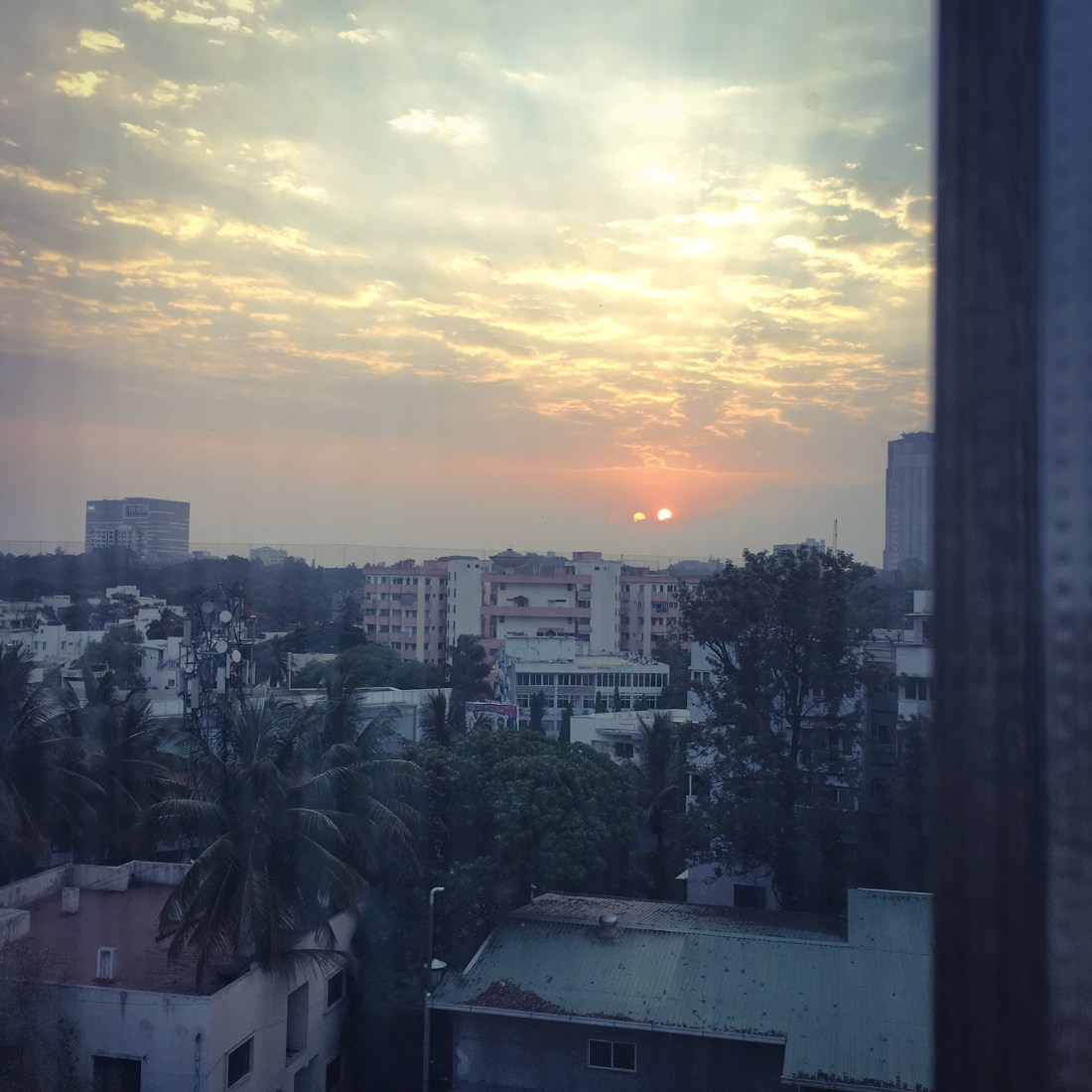
The funny thing about nature is that although it’s everlasting, most of it’s phenomena aren’t. Take the sun, for instance. It rises each morning and sets each evening, and yet no two sunrises or sunsets are the same. Every day, every moment is all new. If that’s not transient what is?

transient
The sun and its momentary reflections.

Reading now

reading

Books never cease to amaze. I’m reading such a book at the moment—one that came with trusted recommendation. I’ve been reading it far longer than my usual pace, but I attribute that to work and insufficient leisure. Nevertheless, it’s the first time that reading a book for a prolonged period hasn’t bothered me. Other times it happened, I got bored and lost my involvement soon enough. This one, however, keeps me coming back every evening, even if it’s only for a couple of pages.

Somedays I don’t even have the time to read through and appreciate an entire chapter. Even then, the narrative is captivating enough to grip my curiosity. It’s not a detective story—there’s no Sherlock-like whiz running around in handsome overcoats solving crimes and annoying cops all over the place. It’s not a romantic comedy with a bride to be, a confused groom to become, and fidgety bridesmaids arguing over nail colours. It’s not even adult fiction with the heroine trying to battle her adolescent pangs and a drug addled mother. All those story lines are common—I’ve seen them in movies, I’ve heard about them from friends who’ve been to the movies, and I’ve read them myself or reviews of such books.

The one I’m reading now, however—which shall remain unnamed until I finish it—is about a woman and how she’s accepted what’s become of her reality. And each page leaves me a terrified. So much so that I turn the page by instinct to find out what happens next. I relate to the main character, but it’s the last thing I want to do. I don’t want a life like hers and yet I can feel her terror, her disgust, and her mindset carrying over to my own. When she squirms, I do too. When she glows for the tiniest of victories, so do I. As she turns away from the people who command her, as do I. I feel her and know her as if she’s me. And in the fleeting second in between turning the page, I wonder—in terror—she could well be me. And that’s what keeps me going, wanting to get to the end of the story.

Despite my eagerness to know what happens at the end of the story, the build up so far also has me apprehensive. What if it doesn’t end well? I won’t want to read through, to live through, this woman’s life only to figure out that she ends up with what she endured: disappointment. And so a part of me wishes this story would go on, that the weirdness would continue—ironic though it seems.

Stay tuned for more detailed observations.