
The Midnight Snack

When she walked into the threshold, she stepped into the unlit “World of Clink Clanks”. She looked down and could make out the outline of what she knew were her hands. She flexed them and gasped as her gold ring glittered suspended in mid-air.

The room was silent except for the occasional throat clearing and the clackety of ceramic on ceramic, which seemed to come from somewhere beyond her vision.

On one corner stood a man behind a counter with a light bulb over his head. He seemed out of place, shuffling with his foot, wringing his hands nervous to get away. She wouldn’t have noticed him if it hadn’t been for the light, but she could see his look. It was a familiar, the look of a man on his first day in a job. He flashed her a warm smile as she approached him, and she returned it without hesitation.

She felt none of the warmth herself, though. It bothered her that the inside mimicked the darkness that enveloped the outdoors. And it didn’t help that the street lights had died.
She steadied herself long enough to walk into the range of light coming from the counter. The employee seemed confident and asked what he could get her. She looked around the counter at all her favourites: mustard, ketchup, parmesan, salami, sausages, and on the other side, five kinds of bread.

“I’ll have a hot dog with parmesan and extra mustard, please.” He nodded and asked her to wait. And as he gestured towards his right, she noticed a small table lit with a single candle. It was just enough for her to figure the outline of a round table draped with a red cloth. She took her place at the edge of the seat. The next moment, the young man at the counter came over with her hot dog, placed it in front of her, and left to man his station.

A chilly breeze grazed her ear, making her shiver. She should’ve stayed home and made instant ramen. Her stomach growled again. As she signed, reaching for her meal, blinding lights flooded the entire restaurant, and Sinatra began singing “The way you look tonight” in the background. By the time her eyes adjusted to the lights, her best friend had come from nowhere and stood before her. She now saw the restaurant was empty and much larger than she had imagined. About thirty round tables lay vacant, expecting to groan with food. She raised her eyebrows at him. He was her best friend and her longest friend. He smiled, his blue eyes glittering with joy.

“I don’t want you to eat alone ever again.”

And he went down on a knee.
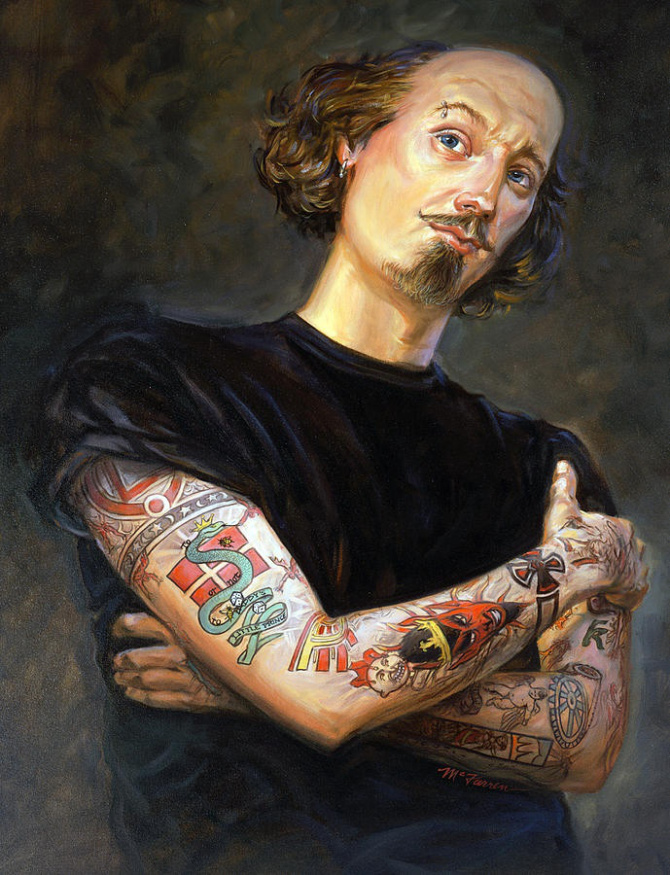
Why You Shouldn’t Study Shakespeare

will

Some of us, more than others, have taken those Shakespeare lessons in school a little too close to heart. So much so that we decided to delve deeper into the man’s mastery with words, words, and more words.

Shakespeare was the father — or one of the fathers (with the utmost respect to Homer and Johnson and Marlowe) — of English literature. And that’s one of the reasons people study Shakespeare; he’s done most of the heavy lifting already. When you study Shakespeare as a subject, you don’t have to create anything from scratch. There are no eureka moments. (As the ignorant people would say, but that’s for another time.)

As a student, you’d have to memorise the structure, the poetry and find the prose that’s hidden within. It’s not medical science, it’s not astronomy, and it sure as hell ain’t math.

At least in India, studying Shakespeare is transferring the textbook onto your answer sheet. Once you’re done, you’re ready to graduate with a degree in Shakespeare. That’s our education system — it’s all text and nothing more.

That’s why it’s so sexy — because it’s easy. Literature students thrive in repetition, and the concept of repeating book words appeals to housewives who’re busy with kids running around the house. It appeals to their husbands who advocate women education and empowerment. It appeals to the losers who can’t do math and science at school. Because, well, let’s face it, people think it’s easier to count metre and Iambs than it is to count metre per second. And who’d want to fumble with computer programmes when they could just scribble lines of rhyme “as defined in the textbook?”

Plus, in Shakespeare, you’re studying plays with words and words with plays; tone and tenor, method and manner. All that sounds far easier than calculus.

Here’s another reason people study Shakespeare: It sounds exciting in the preface of the textbook, but when you flip the cover and cradle the pages, you’ll stare at opinions. Not prose, not poetry, just random interpretations of Bard’s rhetoric.

Your question paper wants observations of moderators, not your own. You think you’re studying Shakespeare when, in fact, you’re studying summaries of the original piece that — this is called irony in literature — never made it the text.

That’s what they do to you when you want to study Shakespeare. They make you study the ones who’ve studied Shakespeare, and not Shakespeare himself. They divulge the amateur as the master; a blunder if there ever was one.

Alas, a formal study of Shakespeare includes none of his actual works and all of misleading citations and cheap caricatures. And to continue studying Shakespeare would endanger our minds, and force us into thinking like the wannabes desperate for a sliver of Shakespearean glory. We’d limit our thoughts and diminish our ability to differentiate witty wit from winding word choice.

And that’s why you should never study Shakespeare. He wasn’t meant to be studied. He was meant to be experienced.

His works are to laugh at, to cry over, and to pine about with bottles of wine. Shakespeare, the man, stomped on rules. He cut licences from rule books. He had a way of doing things, of seeing things. And you won’t get that by reading what others say he says.

You won’t see it when others tell you. You will see it when you see it for yourself. Shakespeare speaks to the reader, textbooks speak at the reader.

You’d study for the marks, but you experience for the thrill it gives you. Shakespeare visualises life and body and love and beauty — he talks human traits. That’s not something to study, that’s the essence of life you inhale, that’s what pierces you, transcending emotions that translate into words.

Studying Shakespeare sticks words to your head. Experiencing it tugs at your heart.

A Thing of the Past

The best things in life are often in the past. Only we humans reminisce and yearn for what we once had.

I’m only human.

I’d never say no to a road trip. On one such trip, we headed to Pondicherry to celebrate my parents’ anniversary—away from all our negative relative trouble.

On the way, I found, dangling from my brother’s rear view mirror, my peace.

a-thing-of-the-past-peace

Let’s Talk Money

Some say money is irrelevant, and there are things more important in life. Like human relationships, for instance. Or trust or humility.

Which is all fine, but how often do we find ourselves starving and rummaging amidst pennies, while staring through the window of Subway or Starbucks?

At that moment, nothing matters more than a few currency notes. Never would we appreciate paper more than we would then. It’s just paper, but it’s also the world. No one’s got time for humility when they’ve got a rumbling tummy.

It’s not as if Subway would handover a sandwich to an under-nourished kid living on the streets. Or as if Santa would bring us lifetime supply of basic necessities for Christmas if we’re good this year.

Life’s not school where the teacher would give you a gold star for attending class every day. Nor does life give you a tree of golden leaves you could pick any time you want some.

Life is harsh. While for some it’s painful to live without familiar faces around them, for some others living is painful in itself. No single mother who scrubs pans to feed two sons and a daughter would declare money is irrelevant. When you’ve been alone, penniless, and helpless for far too long, family and human relationships mean less than rain water puddles.

Life is ruthless. Every 20 something graduating with a degree he didn’t want in the first place, buckles under the weight of an education loan that’d tie him to a desk job for the next ten years.

Life is mischievous. It gives you countless options and yet stumps you with a catch. You could be a doctor, a teacher, an artist, even. But before you become anyone, you need to turn out your pockets to our great education system. And then frees you up to do that creative writing course you yearned for.

Catch, though: The Humanities are dead. You go down that path, and you’re future’s lost for ever. The Dead Poets Society makes it worse.

No one struggling to keep their head above water would say money is secondary. Sure, we all know the importance of being a good citizen, and that our values matter more than our lives. But when it comes to reality, nothing is louder than the voice of money.

Besides, if you notice, almost all those who care naught for money have too much of it already. We hear only their voices. Because when you’ve never struggled to make ends meet, when you’ve grown up oblivious of a Pay Day loan, money isn’t the most important thing in life.

Mission Momo

I have a thing for momos. It’s a traditional Tibetan steamed or fried dumpling made with flour and stuffing.

And it stuffs my heart with so much joy, it’s comfort food on a whole new level. A friend introduced me to the momos and ever since I’ve been scouring restaurants nearby looking for the perfect plate of momos.

And last weekend, I hit the jackpot. I found a place called the Tibet Memorial Restaurant. Well, it had Tibet in the name, so it had to be good. Sure enough, their’s was by far the best momos I’ve had in my area.

endless-quest

I’ve had tasted better momos in Darjeeling, though. But it could be because a colder climate complements the puff of steam that streams out when you bite into a momo.