An Undeniable Obsession

I have a problem. Rising or setting, I can’t get enough of the sun. I wake up at 5, just to catch the sun rise. And, sure enough, more than once my colleagues have caught me peeping through the window at the sun retreating behind dusky clouds.

I don’t understand why I care so much. After all, the sun rises and sets every day. And it will continue to do so for at least the next few million years, I think I read somewhere.

But I still feel weird when I miss the sun in all its glory. From the pink  morn streak to the golden glaze at mid day, all the way to the fiery orange later in the day—I wonder why people aren’t as excited about the hundred shades of the sun as they are about just half of Grey.

During a trip, we had to get ready at 3.30 in the morning to see a special sunrise. And guess who became the human-alarm to make sure everyone got ready on time?

I was all set — at 3.15 — eager to see the sun again. People were skeptical though. It’s just the sunrise, they said. Nothing they couldn’t see back home, in photos, and HD movies. What’s so special about the sunrise in Sikkim that we had to wake up even before dawn cracked?

I didn’t care. If it’s the sunrise, I can even stay up all night if I have to. In hindsight, every tired blink was worth it, even though my eyes puffed up in redness.

We weren’t used to that temperature. We wanted nothing more than to curl up in everything thermal we could find. But we stood, waiting for the sun to show his face.
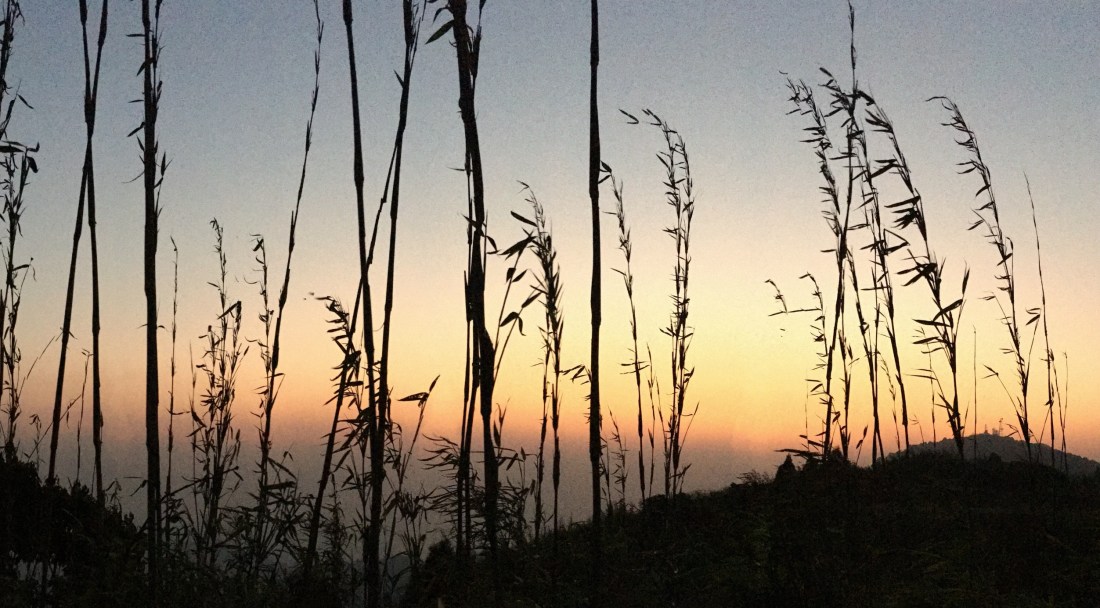
sunrise 1

It was a special place:  Kanchenjunga, the third highest mountain in the world, stands in the border of India’s Sikkim and Nepal. And we stood somewhere in between the Kanchenjunga and the Himalayan range. I got goosebumps just knowing that, let alone the cold.

The sunrise point lay about 30 minutes’ drive from our hotel, and when we got there, an old woman came toward us from what looked like the outline of an old shack. Trudging along, she clutched a flask of hot coffee and cups the size that disgraced a coffee-fanatic. Nevertheless, we welcomed the drink with more than open arms; it was too cold to whine.

Within the next 15 to 20 minutes, the place flooded with light, and tourists with unmanageable cameras. We stood as close as the bamboo plants along the mountain’s perimeter let us. The old coffee lady came back for another round, and though the sun hadn’t yet shown up,  we could see that the shack we saw earlier, was, in fact, a shop selling woollen clothes. It seemed like the old woman and her family had taken responsibility of ushering us annoying tourists.

And so we waited. I wore two pairs of socks — a woollen and a thermal. My woollen cap and hooded sweater, kept my ears warm enough. But my gloves wasn’t wool enough to endure icy streaks that pricked at my skin. When I realised I couldn’t take photos with them on, I decided that had to come off.

For about 2 hours straight , I clicked at will. From the mildest purple, to the half-faded pink behind bamboos. My fingers had become so numb that the touch-screen wouldn’t even work. It was one of those days I hated myself for loving the technology. It took me more than a few jabs to get more photos.

sunrise 2

And then at about 5.30, the sun started to rise. And that’s when we realized many young tourists had headed towards a cliff-like part of the mountain for a closer view. We weren’t cowards. We ran. We climbed those tiny mountains, and walked towards the sun that was now on level with our eyes.

It was a beauty.

All the gold in the world wouldn’t make up to even one ray of that golden-orange.

I felt fulfilled. I stood there, basking, while my friends took selfies with the sun. I had gone beyond photos. I stood in the moment and, for a moment, that’s all that mattered.

Two weeks later, as we sat reminiscing, one of my friends revealed the blunder we had made that day. The sun wasn’t the specialty of the region at all. It was the way the sun’s rays reflected off the mountain on the opposite side. Our driver had ridiculed us (yet another reason to learn the local language), musing why we had to come all the way to see the sunrise we could see at home. It was all about looking in the opposite direction. And we didn’t know.

But no matter what you do, nature gets the final word. Because that day, for some weird reason, the special reflection that drew scores of tourists, didn’t happen. Even for those who knew where to look, it was just another day where they had their backs turned as the sun rose. At least we faced it.

Speaking of Food…

When I returned from my trip to the Himalayas…

No, not the Himalayas. I just wanted to see how it looked in print. I do sound more holy.

Anyway, when I returned from my trip to Sikkim and West Bengal, the weather was only the second thing people asked me about.

“How was the food?” That was the first question. And I had to take a moment to think. In all those five days, I had never thought much about the food. And then I realised, we didn’t eat much at all.

We travelled instead.

We had breakfast and dinner at the hotels we stayed at. But lunch was often a no-affair.

But from what I saw, West Bengal was abundant in chapatis and naans. They are both flatbreads made from whole wheat flour and self-raising flour. As for the sides, all I could see (and care for) was chicken. It’s the most popular dish that warms you up from within. Apart from that, we saw plenty of lentils. Known as dhal, the protein-rich yellow goodness is always a feast — for the eyes as well.


chicken-and-dhall
Chapatis with dhal and chicken.

We stayed two nights each in Gangtok and Darjeeling, and both hotels served the normal stuff we eat at home. Though I have to give a special mention to bread, butter, and jam. Oh, and cereal. That was a part of our breakfast on all of the four days we spent there. It’s yet another one of those things that the westerners left us, that we couldn’t outgrow.

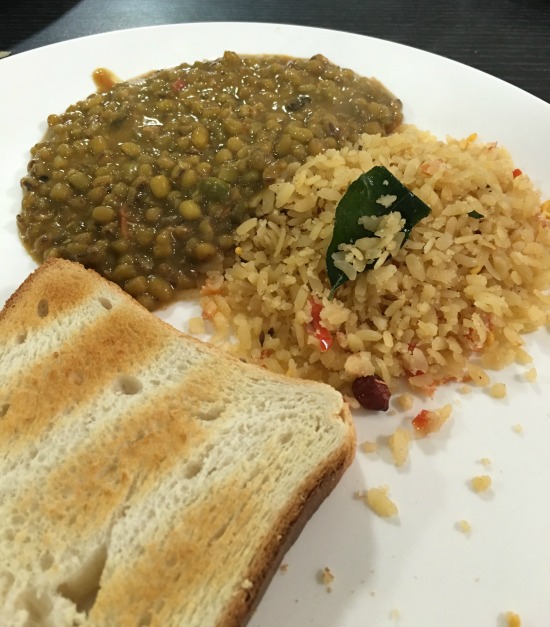
But they also served something to remind us of home. At least until we put it in our mouths. The green gram gravy. One of my favourites. The creamy green grams, mixed with sharp garlic, translucent onions, and indivisible spice — I was all ready devour when my friend exclaimed, “It’s sweet!”

In one heart-stopping moment, the balloon within me deflated. People there add sugar to some of their gravies, and I was unaware.

green-gram-gravy-poha
Bread with green gram gravy. And poha.

And then there was poha. Another familiar item. It’s dried and flattened rice grains, which is soaked in water, drained, and cooked in oil with onions, chilies, curry leaves, and a few spices. It wasn’t sugary, and that was a relief.

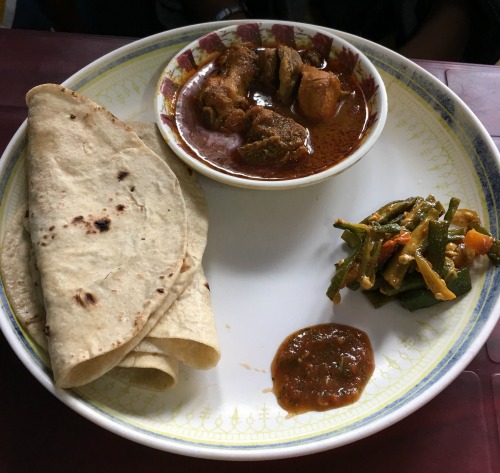
A local favourite, I hear, is the ladies finger, also called okra. Locals call it bhindi, and fry it with onions, tomatoes, and spice to make a semi gravy. Bhindi masala, they call the dish.

chapathi-bhindi-masala
Chapatis with chicken, bhindi masala, and hot chutney.

And then (trust me I’ve been dying to write about this ever since I started this post), momos.

I have a friend, who’s from Tibet. Who introduced me to momos in the best possible way: She made beef and chicken momos for all our friends. It was the first time I tried the traditional Nepali dumpling.

So when I heard we’d be going to Darjeeling (which is not far from the Tibet and Nepal border areas) I could only think of momos, and my friend. I pledged to myself I’d eat nothing but momos.

But you know how pledges go, I had to settle for sweet buffets instead.

Nevertheless, I tried momos thrice during the trip. The first in a small place called the “Cafe 14 Thousand.” Why the name, I have no idea. We had to climb about 300 meters of a snow-capped hill in Nathu La pass. And this “cafe” sits halfway through the climb. It was more of a shack, and since we were a few of the early climbers, it had plenty of breathing space. They served coffee and momos.

When I saw the little dumplings stuffed in a glass bottle, for an instant, I became the monster staring at the cookie jar. And I’m not ashamed. We bought one plate, which had about seven to ten momos. I took one look at them, and another of my inner balloons deflated. They were so tiny, with far less stuffing than what’s acceptable. My momo-friend would have disapproved — I did.

I had forgotten on important thing: Though momos were a local favourite, Nathu La pass was a tourist destination. Over one thousand vehicles cross the pass every day, including Sundays. Everything there is commercial. My fried made momos because she wanted to show us why she loved them so much. These sellers make momos because it’s their business.

But the chutney, or the sauce, was superb. It was spicy enough to de-numb my teeth and send some electric heat to by fogged brain.

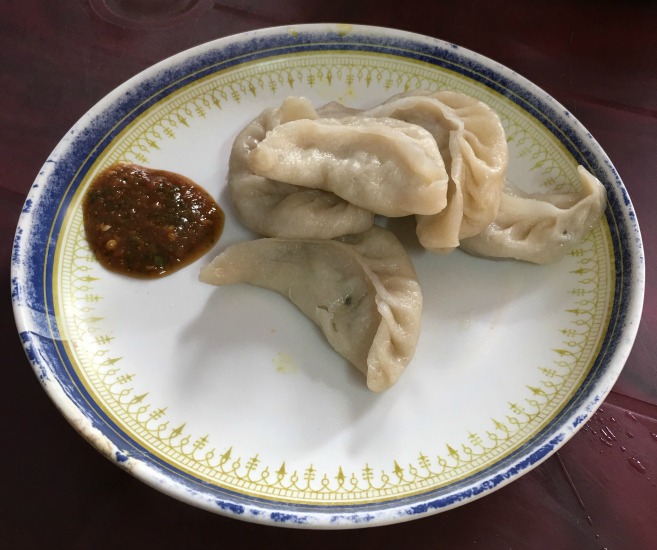
I did another momo-tasting in a small restaurant in Darjeeling. These momos were bigger than the ones in Cafe 14 Thousand. As for the chutney, it was again a spice-fest, so nothing to complain.

momos
Momos with hot chutney.

So about the food in Darjeeling, you get familiar food, in unfamiliar flavours. But it sure is worth a try. After all, what’s life without some variety?

As for the most important thing in all of Darjeeling — the tea — I’ll have to write a separate blog post.

Once in a lifetime

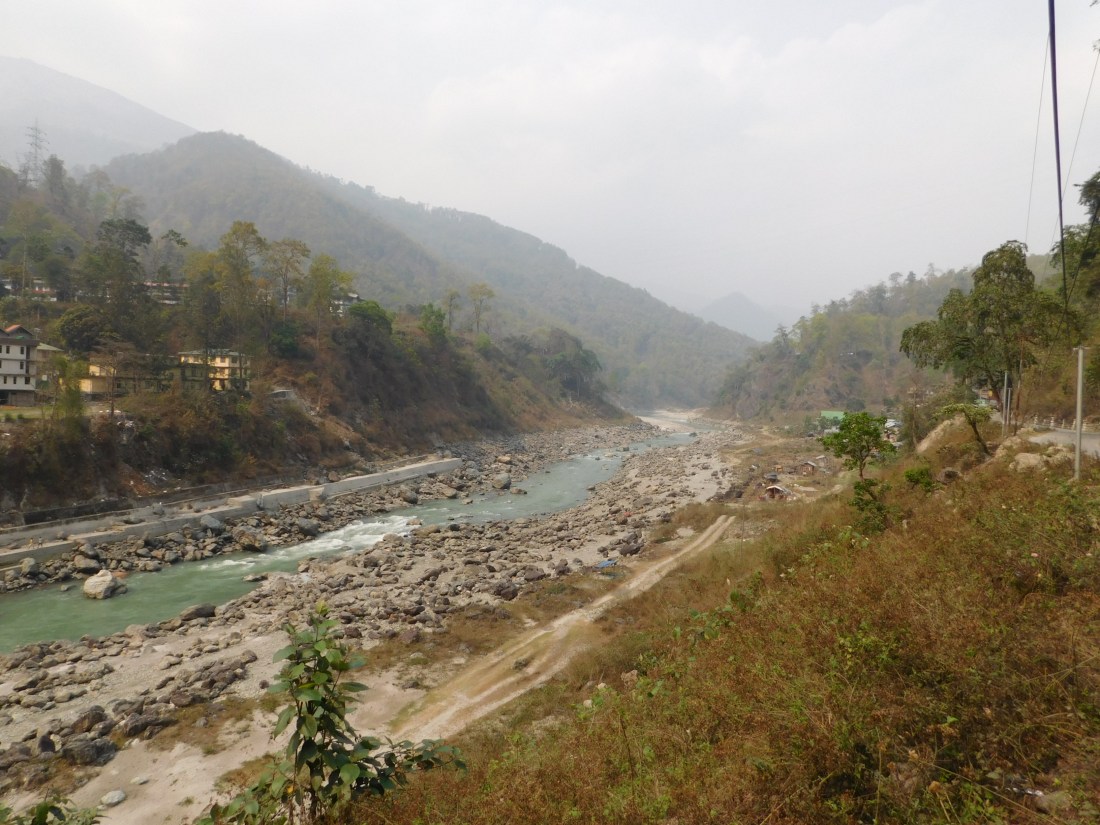
Teesta lake.JPG
Teesta lake, runs between Sikkim and West Bengal.

Last week, I took a break from my routine and went on a trip to the eastern part of India.

It was the state of Sikkim, famous for turban-clad gentlemen and multicoloured bead chains. With a budget I wouldn’t have spent if it hadn’t been an office team-trip.

Nevertheless, even though I was surrounded by my colleagues and their families, I still revelled every minute.

I tried river rafting, an experience I wasn’t so keen on during discussion, but cherish now. But what’s weird is that I didn’t realise how thrilled I was while in the raft. Sure, the ice-cold water splashing over my head, chilling every nerve of my body was fun — and even a little shaky. I laughed harder than I had in a long time, and I knew that. I smiled and waved at the camera, despite my camera-shyness. For the first time in my life, I became someone I didn’t know I already am.

That was the best part of the whole three kilometres on the raft: I was someone else altogether – in such a beautiful way. The entire 30 to 45 minutes were candid moments I’d never forget.

All this, I realised only when I saw the video of myself, being myself. I rafted not only on the lake that bridged two great Indian states (West Bengal and Sikkim), but also through my consciousness to self-realisation.

From 33˚C to -6˚C

It was the best day of my life. It was the day I stood at the base of a near-frozen lake, with the cold piercing through every nerve of my body.

It was still the best day of my life.

Having lived all my life in a 30-above temperature, the sudden shock of falling ice and heat was more than just a life-altering experience.

It was the day I felt proud of myself: I had made it without falling ill. You’d think it’s easy climbing a tiny hill of about 300 meters — so did I — but it was far from easy. Despite a pair of normal socks, a pair of woollen ones, another pair of thermal socks, and rubber boots, I could barely feel my feet. My woollen gloves and the rented rubber ones didn’t stop my hands from going numb.

And we had a half hour to climb uphill and come back down before we ran out of oxygen. It was a battle against time and nature’s most freakishly beautiful phenomenon.

I don’t exaggerate.

When ice shards sting into flesh that’s only accustomed to heat, you’ll know what you’re made of.

And I realised I am made of stern stuff. I don’t just survive, I enjoy. And that revelation means more to me than anything else.

And that’s why it was the best day of my life.


Wonder what the hell I’m talking about? Details and photos coming soon.

To Love Returnest

“I’m so glad you came back.”

Clutching her translucent hand, he walked into the ocean.

Alone.

to love returnest