Good morning, midnight

Don’t ever write sentences in fragments.

That’s got to be the primary advice anyone gives a writer. Even though it sometimes makes sense to break up a thought into shorter and snappier phrases. In a story, in particular, it helps convey the narrater’s emotions and thought process. 

But—

It’s still a fragment. Therefore, it warrants ceaseless scorning from those who label themselves as writing gurus and advocates of good writing. 

Well, tell it to Jean Rhys. Because she shoves her finger at all the writing rules I grew up reading and fearing I’d accidentally break.

Not long ago, a friend of mine handed me her copy of “Good Morning, Midnight” and declared it was a brilliant book. Oh well, I mused. This was, after all, a person who loved and cherished Jean Rhys as an author. Of course, she’s biased in her opinion of the story’s likeability.

I still chose to give my friend and her favourite author a chance. What’s the worst that could happen?

Jean Rhys was a Dominican-born writer who grew up and lived in England for the most part. I’d already read her Wide Sargasso Sea (and written about it), the prequel to Jane Eyre, and loved how complementary Rhys’ version was to Bronté’s. I enjoyed the mellow writing style, the sheer distancing between characters and their points of view, and the easy-to-read prose. Despite the sadness that leaps through the words, it’s still the kind of book you can read at a noisy bar without getting distracted.

And that’s what I expected when I opened “Good Morning, Midnight.” Something about the blurb of the book indicated to me that it’s the story of a prostitute, and I stepped into the narrative expecting depression, sadness, and self-hatred. Instead, Rhys threw at me a cold stream of consciousness—an account of incidents narrated so blandly that they jumped out at me. Conversations in reported speech. Reporting of meetings and bar scenes as if seen from the outside. It was a woman recounting her mundane existence in such chilling prose that grips you by the throat, leaving you gasping for air—a taste of what the character herself experienced at the time.

To say it’s a good book is an understatement. To say Jean Rhys has done a great job is a disgrace to her writing. Every scene is in the present tense, enhancing the realness of the situation. As a reader, you’re not listening to the story from someone who witnessed it. Instead, you’re in that moment looking into the mysterious life of this Pernod-driven woman who lands herself in pitiful circumstances without the least foreshadowing. Even though, as a reader, you’re aware you’re at a vantage point and that none of the ongoings can affect you, you do end up hurt—connecting with the protagonist, feeling her and the molasses-like darkness that engulfs her everyday life.

“But they never last, the golden days. And it can be sad, the sun in the afternoon, can’t it? Yes, it can be sad, the afternoon sun, sad and frightening.” 

Good Morning, Midnight – Jean Rhys

Jean Rhys brandishes excellent writing in your face, making you rethink every rule in the books. People cringe at repetition and incomplete thoughts. And yet, Jean takes it all along for a ride, plays around with regulations as they were a toddler, twisting and twirling, doing as she pleases.

And when you finish the book, you’ll realise Jean was an incredible writer. She not only captivates but also tells the story in a way that involves readers without involving the narrator. It’s quite a masterpiece. It’s a wonder why this book isn’t as celebrated as Wide Sargasso Sea.

What the hell am I’m trying to say? Just read the damn book, if not already. You won’t be sorry.

The Story of English in 100 Words

I love book titles that jump out at me. It’s not easy to think up an evocative phrase or name that’ll stand out in the mass of dusty shelves of non-fiction, hardly grazed by regular readers who’d rather wallow by a willow on the wonderful world of fiction.

That’s why The Story of English in 100 Words caught my eye. Even more thought provoking was the size of the book, for I’d thought even Frankenstein-like font wouldn’t require 200 pages for a 100-word book.

Good work, David Crystal. You had my attention. 

I flipped open the book to realise that the author had used misleading phrasing as a tactic to grip his reader—a curious use of the language he was just about to embark decoding. It wasn’t the story of English in 100 words, but rather the stories of 100 English words. 

And then it made sense. In a way, in a crude and uncanny way of speaking of words and usage, the author was right: by telling the stories of 100 exemplary words, he’d hoped to explore the evolution of English itself. So in a way, that title wasn’t such a bad choice.

Curious.

I’d have preferred a more direct one, though.

That said, the book is still an engaging read. As I browsed through the words and the narrative associated with each, I saw that the author had strayed away from strict research and technicalities to take a more relatable approach.

Here and there, strewn like breadcrumbs on lasagne, were the author’s observations about a certain word. For a student referencing it hoping to find matter for an assignment, the interjecting musings may be a hindrance, but for a language enthusiast who picked up the book because of its captivating title, they were fodder for thought.

For instance, 

We have to be especially careful when it comes to the adjective’ arsy’.

In Britain, the word means ‘bad-tempered’ or ‘arrogant’, as in “We get the occasional arsy customer in here.”

In Australia, the word has developed a positive meaning, ‘lucky’: “That was an arsy goal.”

It’s wise to pay special attention to who’s speaking before deciding what to make of “You’re an arsy bastard!”

Throughout the book are little gems like this that smile at you from behind the veil of informing. Of course, the author does record origins of the word where applicable, and the background story of how it fell into regular speak.

Words like doublespeak, Twitterverse, arsy, doobry, blurb, and a multitude of exciting others make you go, “huh,” and look away from the book to stare at the trees passing you as you sit on a long bus commute, thinking, mulling over what you just read. There’re stories about words like “muggle” and how J.K. Rowling toppled its meaning from a drugger—as was the accepted meaning in the 20th century—to mean a person without magical (or special) powers.

This is a lighthearted book. Though its an intense concept—exploring the history of certain quirky words and how life has folded them into our everyday batter and banter—the author does a great job of keeping it readable and level headed, even for the casual reader in the street. 

Osho’s Book of Man

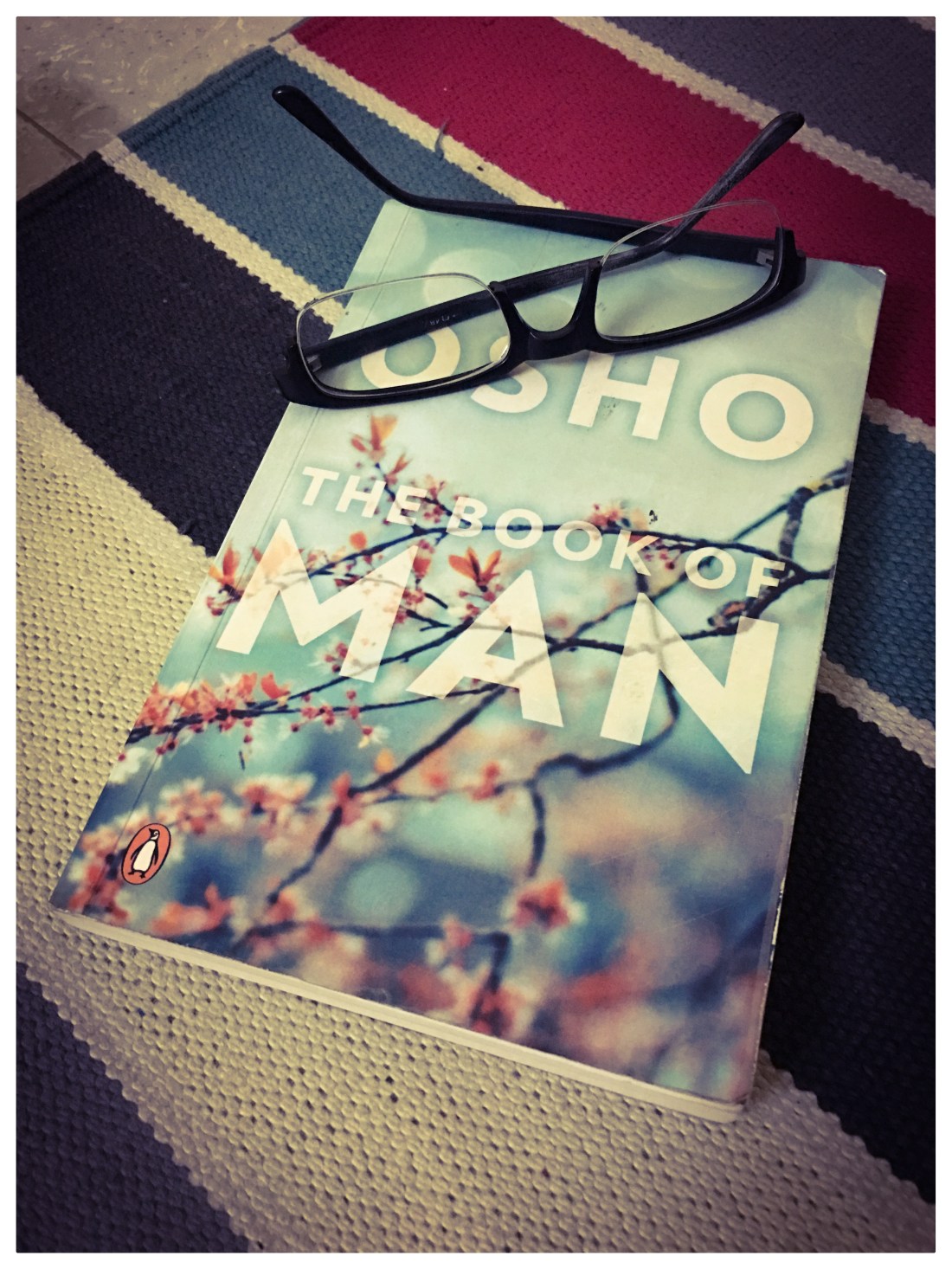
I never imagined I’d find a book that I liked and disliked in equal measure. But then I read “The Book of Man” by Osho. He’s a famous Indian godman, and until a few moments ago, I didn’t know he was also a dead man.

I had read quotes of Osho before, and so the idea of reading a book meant for men excited me. But I also wondered how preachy the book would be. I knew that Osho was a Zen master and his disciples were abundant, so I was a little apprehensive I’d find something on the lines of the “do this in life and you’ll have everything you need” dogma.

The first thing that stood out to me in the book is its Contents page. Before I read any book, I go through the chapter names. I try to extract the essence of a book just by looking at the way the writer names their chapters. In this book, Osho addresses various issues from a man’s perspective; from facing the mother to serving the wife, from marital affairs to soulful meditation — every chapter is a name of the various roles a man has in life. Some of the names are, The Zorba, The Macho, The Playboy, The Politician… you get the idea.

It’s a lot similar Shakespeare’s “Seven Ages of Man” except Osho takes a more detailed view of things. Just the few pages amazed me. Simple narrative, great advice, amusing anecdotes brimmed throughout. It was an easy read, also because of its good print and fine paper. And even though I wasn’t the “intended” audience, I enjoyed the book nevertheless.

Reading through these chapters, I realised not just the truth in Osho’s words but also that I agreed with his points of view. To me they seemed obvious, something I already knew deep within my mind. And it made it all the enjoyable to turn page after page.

For example, the idea of raising a child terrifies me. Children are perceptive, they observe so much and learn all they know from what they see and hear. One wrong move by the parent and a child has a wrong idea rooted in its mind for life. And that’s why I try to stay away from kids, even when colleagues bring their kids to work. What if I’m having a bad day, and blurt out something I the kid shouldn’t hear? Of course, it could be just me being me. Not many of my friends think the same way — they love kids, they play with kids, and they never over think it as much as I do. That’s why I almost yelled out in agreement when I read passages like this:

“Children are very vulnerable because they are born as a tabula rasa — nothing is written on them, their minds are pure. You can write anything you want on the child.”

To me, Osho said all the right things, and my first impression of the book and the man soared through the skies.

Commenting about fasting, he says that there’s no point in it. He goes on to say how the world reeks in poverty and starving people while we have all the food and still fast — just for the attention it brings us. Here Osho picks on Mahatma Gandhi.

“Mahatma Ghandi had everything available to him, although he lived like a poor man. One of his intimate followers, a very intelligent woman, Sarojini Naidu — has a statement on record that to keep Mahatma Gandhi poor, they had to spend treasures on him. It was not simple poverty, it was a managed show. He would not drink milk from a buffalo because it is rich, rich in Vitamin A and other vitamins. He would not drink the milk of a cow because that too is rich, and poor people cannot afford it. He would drink only the milk of a goat because that is the cheapest animal and poor people can afford it. But you will be surprised; his goat was being washed twice a day with Lux toilet soap!”

Wikipedia says Osho was an outright critic of Gandhi so I understand the hatred. But this is a powerful moment; a lot of people revere Gandhi and try to live like he did. The writer has scattered the whole book with truths like this, truths that makes the reader cringe.

Excited, I read on. About sixty pages into the book, I stopped. Something had changed, and it was a change too jarring to ignore. His tone became more opinionated, losing sight of reason. Not a god-loving person, he attacks religion and social customs. I do it, too, so that’s not weird. But what was weird, though, is that he lashes out against Christianity and the holy trinity. And to make it a more distributed criticism, he names a few Hindu beliefs silly, too.

As he goes on, some of the claims become narrow and even absurd.

Speaking about homosexuality,

“Homosexuality is a necessary phase in the growth of a man or woman[…] So drop any attitude about homosexuality; that is nothing but the propaganda of the ages. Nothing is wrong in it, it is not a sin. And if you can accept it. And if you can accept it, then naturally you will grow out of it and you will start being interested in women, but you have to pass through it.”

That was painful speed-breaker moment. I read on, though, because I wanted to see where he went with these claims. Turns out, no where.

The quote had a disclaimer about Osho’s four stages of sexual growth: auto-sexuality in a child, homosexuality which precedes heterosexuality, and then the last phase of going beyond phase — brahmacharya.

By that time, I had lost interest in Osho. I had thought his observations were relatable, yet revolutionary in a way. But it turned out that I don’t have the maturity to accept all his teachings. My perspective had changed, and I grew disappointed.

In hindsight, I don’t regret reading the book. Well, there were moments I wished I hadn’t, but there were also moments I cherish. In short, this book sparked such conflicting emotions in me. I wouldn’t recommend this book to anyone, because most of it is too subjective. Also, the writing is almost terrible. As a reader, it turned me off. I began wondering why Osho made the same point in three different sentences. As a web copy writer, I twisted in my seat at the repetition in the book — it was far from thoughtful. If I had edited the manuscript, I would’ve cut out at least 70–80 pages.

Oh, and Osho also wrote a book for women, titled The Book of Woman. And yes, of course, it’s pink.

What is a book to me?

When reading a novel, a short story, or a work of non-fiction, I don’t think about anything other than the story that the words in front of me tell me. I don’t care how the writer felt when they conceived the idea, how they strove to string words with words, how inviting the couch seemed when they had work to do. I don’t think about the trauma, the self-doubt, or the fleeting convictions a writer endures before they even get through the first paragraph of what they’ve imagined as a five hundred-page New York Times bestseller.

Holding a book, caressing the hardcover, flipping over to read the blurb, I’ve never even spared a thought about how a writer looks at their book. Published writers, I found out, have varied perspectives about their books. For some it’s a task — a taxing, yet compulsory process they need to endure to hear themselves speak their minds. For some others, like Anne Bradstreet, it’s like giving birth. I came across her poem where she says what it means to her to write and sell a book.

Thou ill-formed offspring of my feeble brain,

It took me a while to understand the depth of her emotions, to appreciate her attitude. She extends the metaphor throughout the poem, addressing her book as a mother addressing her child. She apologises for her maternal instincts, for fussing over her child, for washing its face to make it presentable—for being a mother like any other.

I washed thy face, but more defects I saw,

And rubbing off a spot still made a flaw.

I stretched thy joints to make thee even feet,

Yet still thou run’st more hobbling than is meet;

I had always imagined, if I ever published one, that I’d be happy to put my book out, to let the world see and drop its jaws in awe. But Anne Bradstreet has a different view. She’s sad that she can’t afford a better overcoat for it, she doesn’t want to cast it away and force it to fend for itself. She wants her brainchild to live in grandeur and splendour—all the things a mother wishes for her child.

In better dress to trim thee was my mind,

But nought save homespun cloth i’ th’ house I find.

She’s helpless, a mother struggling to make ends meet, dabbling in poverty, hurting because she’s unable to supply for her child. However, though hesitant, she lets go in the end — because she has to. At last she accepts reality, gives in because the only way for her to live is to send her child out the door.

This is a wonderful poem to read again and again. Here’s the whole of it, if you’re interested.

The Author to Her Book – Anne Bradstreet

Thou ill-formed offspring of my feeble brain,
Who after birth didst by my side remain,
Till snatched from thence by friends, less wise than true,
Who thee abroad, exposed to public view,
Made thee in rags, halting to th’ press to trudge,
Where errors were not lessened (all may judge).
At thy return my blushing was not small,
My rambling brat (in print) should mother call,
I cast thee by as one unfit for light,
The visage was so irksome in my sight;
Yet being mine own, at length affection would
Thy blemishes amend, if so I could.
I washed thy face, but more defects I saw,
And rubbing off a spot still made a flaw.
I stretched thy joints to make thee even feet,
Yet still thou run’st more hobbling than is meet;
In better dress to trim thee was my mind,
But nought save homespun cloth i’ th’ house I find.
In this array ‘mongst vulgars may’st thou roam.
In critic’s hands beware thou dost not come,
And take thy way where yet thou art not known;
If for thy father asked, say thou hadst none;
And for thy mother, she alas is poor,
Which caused her thus to send thee out of door.

Interpreting maladies, and stories

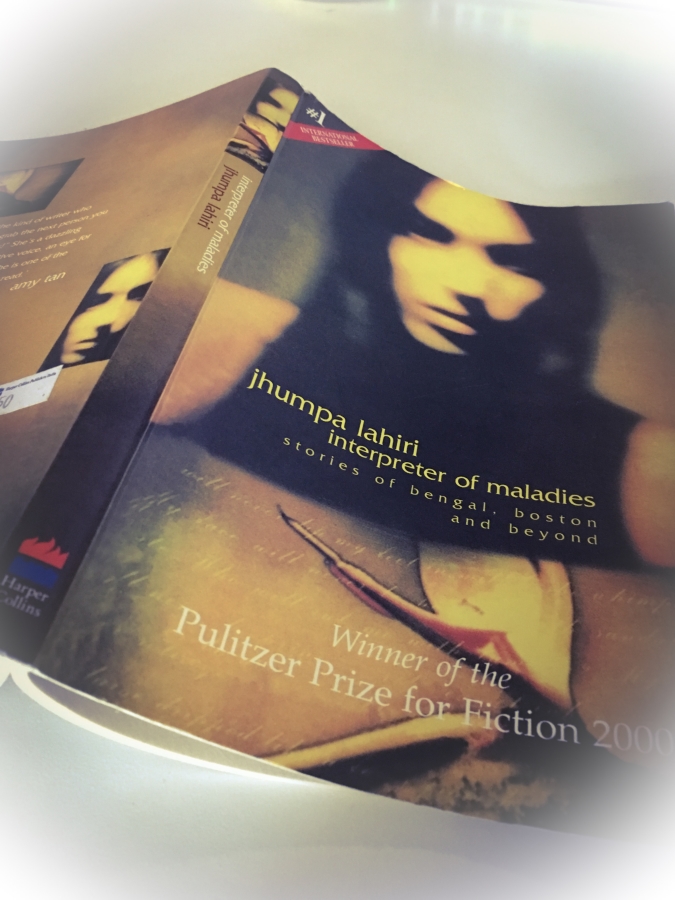
I’ve always been a little doubtful of authors with Indian names. A little racist, I know, but having read a few Indian authors whose regard for English was far less than decent, I didn’t feel too guilty about myself either. However, I also know there were some exceptional Indian authors. I’m making a list and a recent entrant is Jhumpa Lahiri.

I have to say, I love her name. I love the way in rings in my ears, and rolls off my tongue. He family must’ve had a great sense of rhythm and respect for the listener. Perhaps that’s why Jhumpa Lahiri’s writing is also so aware of the reader’s mind and how her words would echo in their heads.

“Unsavoury sorts murmured indelicacies at cutlet stands”

Interpreter of maladies is a collection of short stories, some of them based in Bengal, some in Boston. What’s weird about this book is that though relatable in so many ways, Lahiri’s settings and her characters are yet un-relatable in many ways, too.

For example, she narrates the story of a young Indian-American couple. Their tour guide in India muses about their clothing, their relationship with each other and their children, their attitude towards natural beauty and photographed memories. And all the while, he makes judgements, often accurate, about how unhappy the couple are in their marriage — he observes like an old woman does with her hunched shoulders and ever-munching betal-stained mouth. The guide in the story is relatable because he’s a bit like an old woman, but he’s also un-relatable in many ways because he’s attracted to the young American woman he’s hosting. He contemplates his own unhappy marriage and compares himself to the young woman and her husband. He knows she’d go back to America in a week, and still he imagines — of writing letters to her, of nurturing a friendship with her, of explaining his job of interpreting maladies. All these qualities in a tour guide, who himself grew up wanting to be a scholar in five European languages, is a little unconventional, a surprising edge to a typical Indian character. And that’s what Lahiri does so well in her stories. She’s singled out some of the most common characteristics in Indian culture, spicing them up with unexpected behavioural patters to weave characters that refuse to leave the reader.

As a reader, you can’t help but appreciate Lahiri’s subtleties. In another story, Lahiri narrates the life of a young Bengali woman suffering from an unknown disease. Her neighbours talk about her behind her back and spread gossip, yet some offer to help. Referring to the women’s chattering, Lahiri paints a vivid picture so familiar to every Indian: “News spread between our window bars, across our clothes lines, and over the pigeon droppings that plastered the parapets of our rooftops.” That’s the India I grew up in, and yet, when reading Lahiri’s description, I can see the women gossiping along, drying their clothes under the burning mid day sun.

Another great aspect of this book is that the author herself has experienced both the worlds she describes. And I think that’s what makes some of the stories in this book, the stories that take place both in America as well as in India, so vivid and unforgettable. Some even outline regrettable, cringe-worthy incidents. What appears common in America in the late 60s is still taboo in some parts of India. This is an exchange between a mother and a daughter:

“It is improper for a lady and gentleman who are not married to one another to hold a private conversation without a chaperone!”

“For your information, Mother, it’s 1969. What would you do if you actually left the house one day and saw a girl in a miniskirt?”

Mrs. Croft sniffed. “I’d have her arrested.”

Mrs. Croft is a 103 year-old woman who cannot accept a man and woman speaking in private. And for that, her daughter mocks her — in 1969 America. The saddest thing, though, it’s 2017 and some Indians still cling to the same belief. The regrettable reality is that some parts of the world are yet to catch up to the sensibilities of equality and modern civilisation.

It’s things like these that make Jhumpa Lahiri’s collection of short stories a precious read. As an Indian, I loved reading narratives that I could relate to and smile as I recognised behaviours. As a person familiar with some ways of American life, I could sympathise with the feelings and emotions that the foreign characters portrayed. In sum, none of Lahiri’s creations are over-the-top unimaginable — they’re simple people living simple lives, who invite readers to share a few days in their lives. Interpreter of maladies is a wonderful read.