Why You Shouldn’t Study Shakespeare

will

Some of us, more than others, have taken those Shakespeare lessons in school a little too close to heart. So much so that we decided to delve deeper into the man’s mastery with words, words, and more words.

Shakespeare was the father — or one of the fathers (with the utmost respect to Homer and Johnson and Marlowe) — of English literature. And that’s one of the reasons people study Shakespeare; he’s done most of the heavy lifting already. When you study Shakespeare as a subject, you don’t have to create anything from scratch. There are no eureka moments. (As the ignorant people would say, but that’s for another time.)

As a student, you’d have to memorise the structure, the poetry and find the prose that’s hidden within. It’s not medical science, it’s not astronomy, and it sure as hell ain’t math.

At least in India, studying Shakespeare is transferring the textbook onto your answer sheet. Once you’re done, you’re ready to graduate with a degree in Shakespeare. That’s our education system — it’s all text and nothing more.

That’s why it’s so sexy — because it’s easy. Literature students thrive in repetition, and the concept of repeating book words appeals to housewives who’re busy with kids running around the house. It appeals to their husbands who advocate women education and empowerment. It appeals to the losers who can’t do math and science at school. Because, well, let’s face it, people think it’s easier to count metre and Iambs than it is to count metre per second. And who’d want to fumble with computer programmes when they could just scribble lines of rhyme “as defined in the textbook?”

Plus, in Shakespeare, you’re studying plays with words and words with plays; tone and tenor, method and manner. All that sounds far easier than calculus.

Here’s another reason people study Shakespeare: It sounds exciting in the preface of the textbook, but when you flip the cover and cradle the pages, you’ll stare at opinions. Not prose, not poetry, just random interpretations of Bard’s rhetoric.

Your question paper wants observations of moderators, not your own. You think you’re studying Shakespeare when, in fact, you’re studying summaries of the original piece that — this is called irony in literature — never made it the text.

That’s what they do to you when you want to study Shakespeare. They make you study the ones who’ve studied Shakespeare, and not Shakespeare himself. They divulge the amateur as the master; a blunder if there ever was one.

Alas, a formal study of Shakespeare includes none of his actual works and all of misleading citations and cheap caricatures. And to continue studying Shakespeare would endanger our minds, and force us into thinking like the wannabes desperate for a sliver of Shakespearean glory. We’d limit our thoughts and diminish our ability to differentiate witty wit from winding word choice.

And that’s why you should never study Shakespeare. He wasn’t meant to be studied. He was meant to be experienced.

His works are to laugh at, to cry over, and to pine about with bottles of wine. Shakespeare, the man, stomped on rules. He cut licences from rule books. He had a way of doing things, of seeing things. And you won’t get that by reading what others say he says.

You won’t see it when others tell you. You will see it when you see it for yourself. Shakespeare speaks to the reader, textbooks speak at the reader.

You’d study for the marks, but you experience for the thrill it gives you. Shakespeare visualises life and body and love and beauty — he talks human traits. That’s not something to study, that’s the essence of life you inhale, that’s what pierces you, transcending emotions that translate into words.

Studying Shakespeare sticks words to your head. Experiencing it tugs at your heart.

The Gandhi Zone

I didn’t realise for a long time how much we, as an Indian community, use Gandhi’s name on everything. It’s become so common that from being a credibility-booster, it’s become a marketing ploy. Like some low ball technique we use to get our way in the world. Or as an excuse to take pride in our stupidities.

“In the land of Gandhi!” they say. Or proclaim, in fact. In the land of Gandhi, we did this, and that, and all other things we didn’t do.

Which is fine with me, except that we’ve exhausted the name now. In futile attempts to show how much we adore the man, we even named streets after him. And in more cases than one, M.G.Road is a city’s official shopping zone.

There was one in Darjeeling too.

MGRoad 1

It’s amazing how the name “Mahatma Gandhi Road” is a shoppers’ stop when the man himself advocated ultimate simplicity. Guess it’s just another of our inherent paradoxes.

As I walked along M.G.Road, I saw all the things Gandhi stood against, while he himself stood next to a fountain, as erect as a guard.

Watching him watch the tourists, I remembered studying in an old school book that he preached simple attire. Whereas in M.G.Road, people ogled at woollen sweaters, silken scarves, and sleeveless dresses studded with little stones that mirrored the chandeliers.

There were bakeries stuffed with all things self-raising, and salty, buttery goodness. And sweet shops showcasing the pride of West Bengal. While stacks of shops sold home-made foods, there were cafes and snack stalls too. Some places sold tea, some coffee, and some places just disgraced the emotions of tea and coffee.

MGRoad 2

And of course, countless liquor stores luring in the fancy folk who preferred things stronger than a simple cuppa. Oh, and tobacco too.

In the middle of all these, stood Gandhi’s figure, deep in observation. Not that he could do anything, of course.

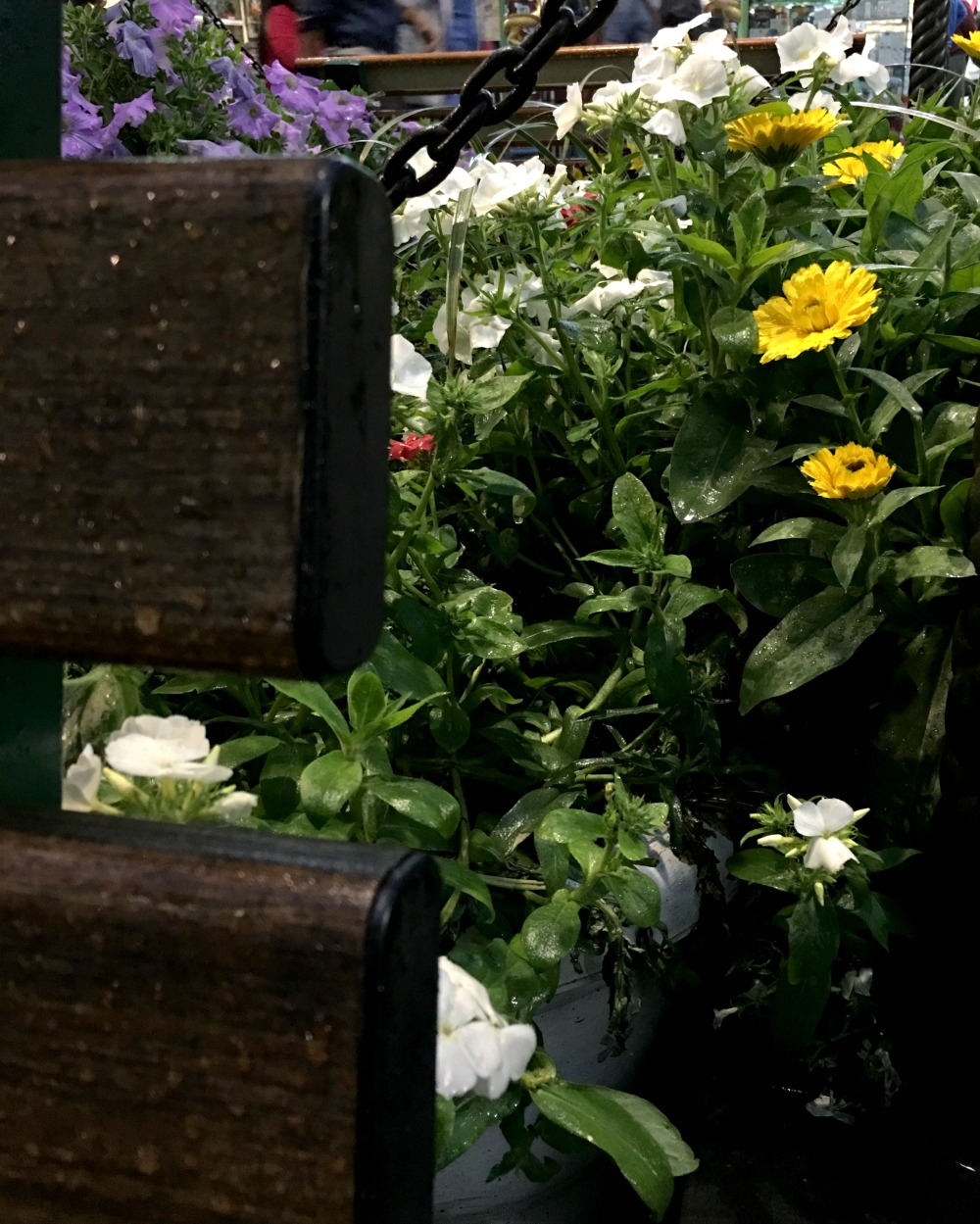
And then — the flowers. So may flowers. So many colours, so many shades, so many tiny petals bearing tiny leftover droplets from the rain of just moments before.

MGRoad 3

It was a magnificent sight. Even for me who hated shopping in every sense of the traditional word. I loved walking through that street. And the best part of it all: The street is always closed to vehicles from late in the day to later on in the evening. That made it all the more welcoming. With the rain adding a dash of chilliness to the cold breeze, the smell of someone’s strong cigar wafting through the air, the steaming cup of tea in my hands, and the bunch of friends ready to laugh at a good joke — what more could I have asked for?

The Dhabba Experience

Dhabba

I hadn’t heard of this restaurant before my team mates told me we were going here for a team treat.

A bit of digging told me there were 10 of the same restaurants and that they serve good seafood. A lover of prawns, I set my mind.

Even as we got in to the cab, I could feel my insides expanding with excitement. I was a little ashamed too, it was just food after all. But again, it’s food!

I was all ready; my phone was fully charged and so was I. As we got down from the cab, I started clicking pictures of the surrounding. I was going to write an impressive review- complete with photos and all.

It was a large extravagant area – for a restaurant. Felt like walking into a huge holiday resort in the making. There was a big play area for kids and even a separate section of the restaurant for pure vegetarians. Sadly though, it was too hot for a soul to enjoy the slides and rides.

We walked inside and my excitement settled a little – we were finally there. It was now all about food.

We took our seats – three tables of it and I began looking around. It is a Punjabi restaurant and to reinforce the mood were paintings of Punjabis – beautiful work by the way. The ambiance within the restaurant was perfect – almost empty. Which is unsurprising considering it’s somewhere in the middle of nowhere – on the highway. There were a couple of small groups, and they were quiet too. The lighting was mild – not that it needed much, it was in the middle of the day. And being so, it was so hot outside but so cool inside. The tables were of stone and with the air-conditioning set at 18 degrees, the atmosphere was welcoming.

The service people were a little less welcoming though. Can’t blame them too, they were probably shocked to see a group of 15 people thronging into their restaurant with no regard for, well, anything.

Anyway, without much ado, we ordered.

We began with hot and sour soup. I’m not much of a soup person, but I loved it.

They didn’t have many of what we hoped to have – like the tandoori momos for instance. I was looking too forward to tasting that. We ordered prawns salt and pepper, fish fingers, mutton something and a couple of chicken somethings for starters.

chicken
The starters

None of them was spicy enough for me, but the taste was good. Prawns salt and pepper was a bit too salty with too little pepper, but I’d surely recommend this place anytime.

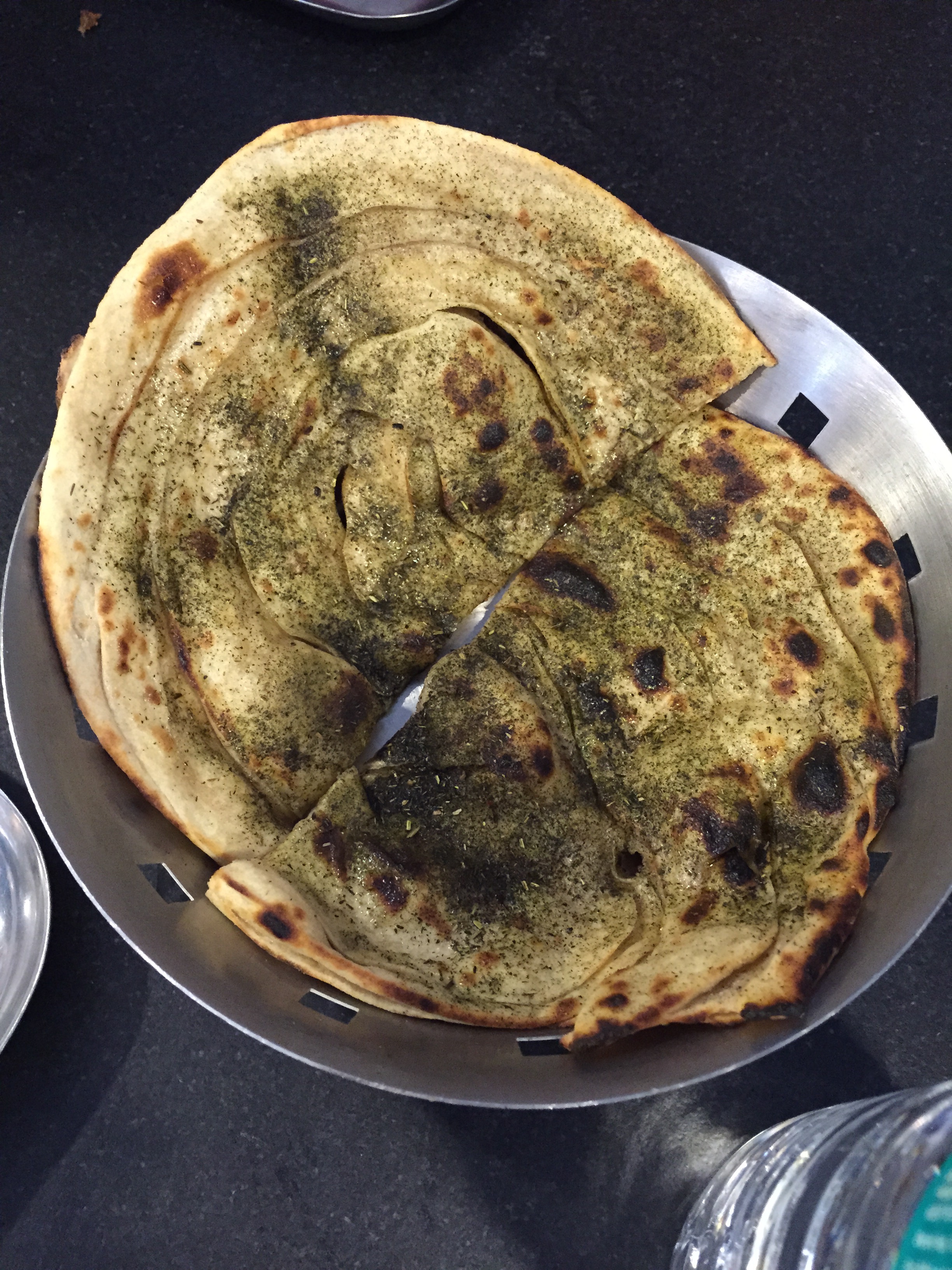
Moving on to main course, the biriyani was dry, I heard. I didn’t try the biriyani but the taste was good – judging from the way my team mates devoured. Another friend mentioned that the fried rice was great too, but I’d vouch for something else. My love for the greens tempted me to order pudhina (mint) paratha, and it surprised me, as always. But thankfully, it did not disappoint. It didn’t look too appealing; my team mates’ eyes widened at the sight of it – not to mention that my jaw dropped. I recovered soon enough though.

pudhina paratha
Pudhina paratha

It tasted good – the pudhina powder added a little bitterness, just the way I like it. To accompany the paratha, I had ordered prawns chettinad masala and a chicken dish – I forgot the exact name.

The menu was so extensive and the names of the dishes were difficult to remember. The best thing though was that the taste was worth remembering.

At the end of it all, I decided to top it up with lime soda. Because I suddenly remembered that I had been suffering from an upset stomach for a couple of days. Just the day before I survived on liquid salts.

Coming back to the lime soda, it was too salty for me – pungent. But it did do its duty; I digested it all without much trouble.

Anyway, my colleagues ordered a variety of ice cream, gulab jamun, milk shakes and funnily enough – carrot halwa.

Ha, that carrot halwa! Not to taste; reminded me of sweet paan.

With an unmistakable burp, our treat ended and we walked out, satisfied and satiated.

After a few minutes of idling and selfie taking, we re-boarded our cab and came back to office – only to look forward to going home.

Click to add a blog post for Dhabba Express on Zomato

P.S: My very first restaurant review. Any thoughts, folks?

Experiencing Indo Soul

The previous piece I wrote about Indo music, was about Karthick Iyer’s single. After all the mixed feelings that song had on me, I got hold of the rest of the album. My first impression wasn’t at all that great. Which is a great sign. I’m not easily impressed; it took me over three months to fall in love with my favourite musician’s latest album (now though, I can’t get enough.)

Boundless
Boundless is a boundless musical blend of the miruthangam and some devilish strings. It’s a small song; just two and a half minutes. But throughout, you’ll experience so many emotions go back and forth. I didn’t hate this song, but it didn’t awe me either. In fact, with the strange beginning, I thought my audio was faulty; it didn’t seem appropriate to begin a song with a music that painfully reminds you of this.

TV_noiseAfter the initial shock however, the music gradually pulls you into the song. Not to mention the artsy crescendo. Out of the blue, the miruthangam rises and suddenly from nowhere come the strings to blend in so well that you can actually feel the pull. And the repetitive beat that starts at 1.50, and lasts for a few seconds — wow. I don’t like lengthy musicals — except in extremely rare circumstances. And I’m certain that I wouldn’t have liked this song one bit if it had lasted any longer. This song just proves that you don’t need much time if you know how exactly you want your audience to feel.

Clown Junket
I can’t say it enough, but I am a string lover. The guitar and the violin are one thing, but the bass adds another dimension altogether. Though it’s a part of the violin family, both the cello and the bass are much deeper than the violin and viola. And that’s the magic of this song. It’s a beautiful song, but the first two minutes were too slow. You’re left to wondering what exactly is happening. It might put you off, unless of course, you decide to listen through. Once you wait for the second half, you wouldn’t regret it, I’m sure.

The introducing of the violin into a well set tune was beautiful. The violin just waltzed into the mass that was bass, and fit right in. And the touches of miruthangam here and there – perfect accompaniment to the classical tune. Every time I hear it, it feels a little odd that the violin should blend classical and western, but I’m getting used to the idea — and I’m starting to like it too.

Mid air
No beating around the bush — this song just gets right into business. And I like that. Perhaps to make up for the slow songs in the album — nevertheless, it’s gets off to high start and maintains the energy throughout. Just listening to this song, I can picture it bringing modernity to our traditional society. I love the fact that the bass and the miruthangam get a lot to say along with the violin and guitar. The guitar interlude – brilliantly brings in a little western touch to the classicism.

This is a great song with an amazing blend of both worlds. It’s a bit long though — it would’ve been more powerful had it been a little shorter. This song reminds me of old television advertisements — can’t pinpoint which exactly though. Weirdly though, this song made me nostalgic.

A Saranga Convergence
Love the beginning — great slow start of the violin. The first 30 seconds were awesome, but then he let it slide a bit. He brought it back at 1.40 though – with powerful strings and strong miruthangam. Loved the transition at around 2.40 where the drums take and hand it over to the guitar, and then coming back to the bass. And then the vocal just blooms out of nowhere. It was such an unexpected surprise  — though it lasted a bit longer than I expected. Nevertheless, I truly enjoyed the equal distribution of instruments in this song. Maybe because it’s a lengthy piece, but it wasn’t tiring — just a lot of smoothness, one or two glitches here and there, but overall, nice to listen.

Loved the ending as well — smooth. Gave me the mental picture of a cherry sliding off a melting ice-cream cone. ;)

Rejoicing in Raguvamsa
First 50 seconds – pure classical treat, and an incredible transition to the percussion — loved every bit of this song. Beautiful bass solo at 2.40, and nice takeover of the miruthangam assisted by some classy percussion. And yet another beautiful ending. Karthick has found himself a versatile team; three strings, a classic miruthangam and a totally western electric guitar.

Combined, these instruments do such a great job to captivate the listener. And the team’s done it so well. There’s so much room to experiment, to succeed and to make mistakes as well. This is a great album to listen and to keep. It’s not the perfect collection of songs; there are some parts I could live without, and some I couldn’t. Team Karthick Iyer Live knows their audience, and they’re not trying to please everyone. And that’s the way to go.
Oxygen

Discovering Indo Soul

When it’s the strings, I am easily hooked. I am a guitar lover. I can not resist the strumming. And I can’t get enough.

It’s not just the guitar though. I saw David Garret perform the Pirates theme song, and it hooked me. Aside the talent — which is abound — Garret’s stage presence and the way he caressed the violin impressed me.

It was an old video on YouTube, but I felt the passion oozing from him.

Ever since, I kept an open mind. I am all ears for anything strings.

And this song is all about strings. But I still doubted the blending of genres. Why would anyone do that?

I later realized that it could be done, and done right.

When I first heard about Karthick Iyer’s music, I was’t sure. A fusion of Western and Carnatic? Is it worth it?

But I didn’t want to judge too soon — that never works.

I took a deep breath — and listen to the song.

Hmm. Not too great…

And again.

Ok, maybe…

And yet again.

What the — ?

I listened to another song of Karthick’s and I liked that. Now I had to figure: did I like just that song, or Karthick’s style in general?

Loop. Because I had to decode this.

To strip to the details —

The song is a blend of English and Tamil lyrics. When there’s no lyrics, there’s the Carnatic touch. Which not everyone would appreciate. As someone who’s learnt classical singing, I see the beauty of Swaras in a song, but people might consider it noise.

But that’s negligible, for two reasons.

One, Karthick’s voice is so deep and clear when he touches those notes, that it’s so good to hear.

The second, the instruments are awesome.

I raised the volume and closed my eyes, trying to drown the voice and focus on the instruments. The transition from western to classical instruments is so smooth, you can’t help but appreciate it. Particularly shifting from the Mirudangam to the guitars three minutes into the song — artful.

It’s the kind of music you’d expect on a long drive, when all you see in front of you is an endless stretch of highway tar.

Karthick’s voice drips Indianism, and he hasn’t tried to mask it. His vocals are clear and deliberate. His English pronunciation though, is a bit unheard of — perhaps an influence of his visits overseas.

The tune made me wonder. English lyrics in Carnatic tune? Haven’t heard much like it, nonetheless, it’s powerful in certain areas. Definitely serves the purpose.

I slept on it, and a couple of days later, I caught myself unconsciously humming this song.

That’s when I realized: I’ve heard enough to look forward to the rest of the album. I’m curious to see what Karthick’s team is capable of. The album, titled IndoSoul, launches on the 13th of June in Chennai, India.