
Elite gala once,
communal indulgence now
Christmas is for all.
The best thing about 2017 is that I had a lot of new experiences. I had the opportunity to step out of my comfort zone and find new zones I’m comfortable with. Thanks to an official trip, I managed a week of personal travel. It was the best of all that happened to me this year. It taught me a side of myself I didn’t know I had. It taught me to plan, to organise, and to communicate with other people. It gave me survival skills, nurtured my negotiating skills, and taught me the true value of good companionship. Travelling solo left me craving more.

Alki beach had been a feast to sore eyes. Having spent the entire morning taking in the ocean, I wondered what other unique local sights Alki offered. Though I only asked for directions, a wonderful woman—Kate—sympathised with me as I lamented missing the Alki Point Lighthouse tour. To satiate my cravings for luscious history, she suggested I visit the Log House Museum. She gave me directions and landmarks and I, unsure what I’d find, walked a few blocks down the beach to the Log House Museum of Alki.

It was more like a cottage. From afar it was quaint, nestled within a garden of fresh flowers and lots of greenery. A sign hung from the roof, of the two-storey building, almost hiding in plain sight. A flight of wooden steps led to an old fashioned door. As I approached the door, a sign explained how Alki is the birthplace of Seattle. Reading it, I understood that Alki—like most of America—was home to natives for hundreds of years before an unidentified landing party transformed their lives. The Denny Party landed in 1851. For a few years they tried transforming Alki into a profitable and habitable place for them—much like the city of New York on the other side of the country. Soon realising the futility of this venture, they built downtown Seattle, instead. And so began another era, the era of an unassuming port becoming Seattle.

I’d been in the museum for less than five minutes—I hadn’t event gone inside yet—but then and there I knew I’d come to the right place. Thanking Kate for her excellent guidance, I walked in through the door to meet an excited volunteer. He explained to me how one of the early settlers of Alki, the Bernards, had built their home. In 1902 they’d fused the styles of a modern summer cottage with comfort and luxury. The result was the Fir Lodge. Over the course of 90+ years, the log structure had been home to hundreds of people. It is now a restaurant. Made from Douglas fir logs, a portion of the Fir Lodge is the carriage house, which is the current museum. The Southwest Seattle Historical Society renovated it in 1995, and opened it to the public in ’97 on the 146th anniversary of the landing party.
Taking in all these scraps of history, a sense of self-importance and awe spread within me. All I’d done was listen to a man talk about incidents of yore, and that’d given me goosebumps already. To make the experience even more worthwhile, he welcomed me to look around at the exhibits: original photographs from the various families that had lived in the exact space I stood at. Aside from photos were also snippets from letters that passed between members of the families—letters of love, letters of pain, and even some letters that lamented loss of their homes.


For the second time that day, I felt glad to have found accommodation in Southwest Seattle instead of downtown. I wouldn’t have otherwise visited Alki, and would’ve missed out on all that I shouldn’t have. Standing over the past lives of so many people, observing what was once theirs, leaning on the walls they once leaned on, and tracing their footsteps, I’d walked into a well-preserved monument that initiated the boom that’s Seattle. As exciting as downtown Seattle was, the modest museum at Alki was a treasure cove of the humble beginnings of a city that’s now a world icon. Not only was it fascinating to encounter such a culture-rich monument, but it was also so moving to realise that even though we evolve into something much larger and different from our roots, it’s those roots that bind us to the world.
I left the museum a little overwhelmed, but as I walked around the log house onto the street, I knew I’d made value of my time in Seattle. I didn’t splurge, I didn’t shop around aisle after aisle, I didn’t bring back material things for anyone, but I brought back memories and stories worth a lifetime. That’s priceless.
My first day in Southwest Seattle, I woke up shivering. It was cold and the last thing my tired feet wanted to do was venture out on its own. But I’d never felt more excited to do that exact thing.
Rain, though forecast, wasn’t in the picture. That boost my morale just enough for me to get dressed and follow the map to the nearest coffee shop. Since I’d already gulped down a mugful of my host’s fresh brewed coffee, I picked up a ginger molasses cookie from the cafe to nibble on during my ride to Alki beach.
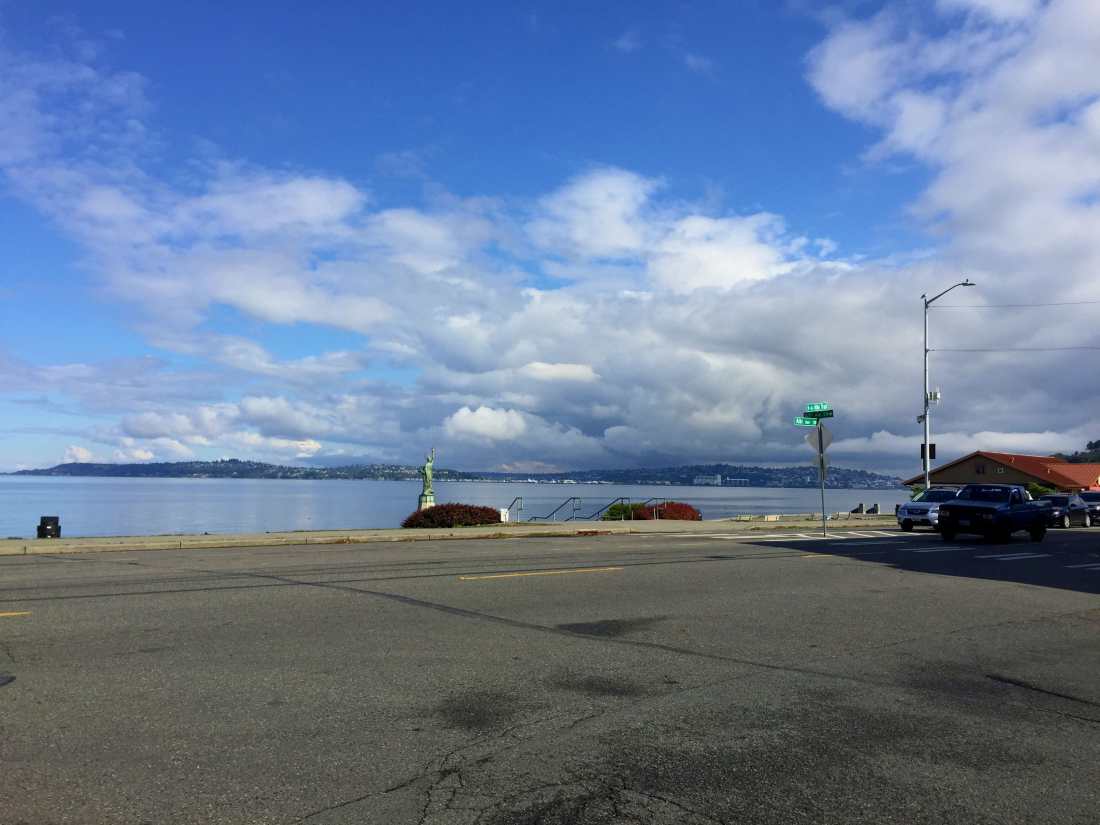
When I got off the bus at Alki, it was about 10 am. The sun streamed through silver-lined clouds and I—feeling warm and idiotic—removed the heavy woollen jacket my host had lent me. Walking towards the beach, I paused face-to-face with the Statue of Liberty. Although my general knowledge told me the sight belonged a five-hour flight away, my eyes had me doubting my mind. When I approached the statue, however, things came into better focus.
The miniature Statue of Liberty in Alki beach is one of 200 across the nation. Back in 1950, according to the inscription on the statue, the Boy Scouts of America celebrated its 40th anniversary with a campaign called Strengthen the Arm of Liberty. They made replicas of the statue in New York, erecting them in 200 cities across the US including in California and Oregon—two states I’d visited before Washington and yet had no idea about this piece of history.


Although the inscription didn’t admit it, it was obvious that these stamped copper statues aren’t perfect replicas. Regardless of its minor flaws, however, the statue stood tall and proud, welcoming proud natives, sceptic perfectionists, and awestruck tourists alike. I lingered by the statue, musing on the magnitude of its significance. A local significance that’s diminished because of the iconic Space Needle. Folks touring downtown Seattle would seldom consider travelling over 45 minutes to stop by Alki. I wouldn’t have, I realised, if I’d found accommodation in the heart of the city. As I walked down to the beach, breathing in the fresh scent of the ocean, I felt thankful that my host lived in the South West where people’s hearts were as wide as the streets.
The vast ocean opened up in front of me, a calm blue spreading its serenity within me. Not a being was in sight, except for tiny ducks frolicking along the shore. Below my feet pebbles personifying perfection and imperfection scattered about raising a crescendo in the wake of my footsteps. Inhaling the freedom that a vacant beach offered, I walked along the shore, looking far and beyond, admiring the pointy Needle, and smiling at the only other person on the beach who crouched looking for pebbles. Feeling nostalgic myself, I stooped and grabbed a few pebbles. As I gathered them in my hand, I felt an immense sense of importance. It was as if I tried to capture a part of my trip to take home to my parents. As though I tried to solidify an intangible experience, in a feeble attempt at preserving it forever. How often we do that, I wonder now. Unsatisfied with the moment we’re in, we all try to monumentalise something that we should, instead, internalise.

Not thinking about all of that, however, I choose four unique looking pebbles to travel back with me to India. Stowing them away in my backpack, I continued along, my head to the right, towards the sea. Its surface remained pure and undeterred as a ship or two sailed on, casting a mild grey smoke and a great wild impression. At the end of the beach, I knew, was the Alki Point lighthouse. Marking it as my destination, I walked on savouring my every step on the pebble-laden shore. After about 20-30 minutes my view on the left changed from the open street to mansions and palaces. Huge beach houses towered with no sign of habitation. It surprised me that people would build houses in such close proximity to the ocean, and I started wondering how the salty soil supported such structures. Buried in my own thoughts, I continued straight ahead stepping over seaweed and sea shells.

As I approached the end of the beach, the top of the lighthouse came into view. Seeing it, I felt let down. I’d imagined the lighthouse as a towering cone, higher than any other building in the vicinity. What I saw, instead, was a tiny peak peeking a little above the rest of the houses around it. Confused, I reached the end, only to realise that the shore ended with a fence on my left and rocks in front. I had no choice but either to turn back or climb over into—it was clear—private property. Curiosity replaced my excitement. From where I stood, there was a large wall fence around the lighthouse, an obvious attempt to keep visitors away. Turning away, I walked back to where the line of houses began. That’s when I noticed them: multiple notice boards marking the area as a private beach. Where the street ended to my left, the public beach also ended. From that point forward, leading up to the lighthouse was private property that I’d trespassed on. Laughing at my absent-mindedness, I recalled I’d seen the backside of houses with paddle boats and ocean gear. I’d thought they were touring businesses or local guides.
Getting onto the road, I entered the residential street. Now on my right were the entrances to the houses I’d seen from the beach. As understanding dawned on me, I sped up hoping to see the entrance of the lighthouse, too. When I approached the tower, though, I saw a large bolted gate with a massive sign on it. Moving closer, I read the notice.
The Alki Point Lighthouse belonged to the US Department of Homeland Security, and the lighthouse quarters is now the residence of the 13th District Commander, also the senior Coast Guard Officer.
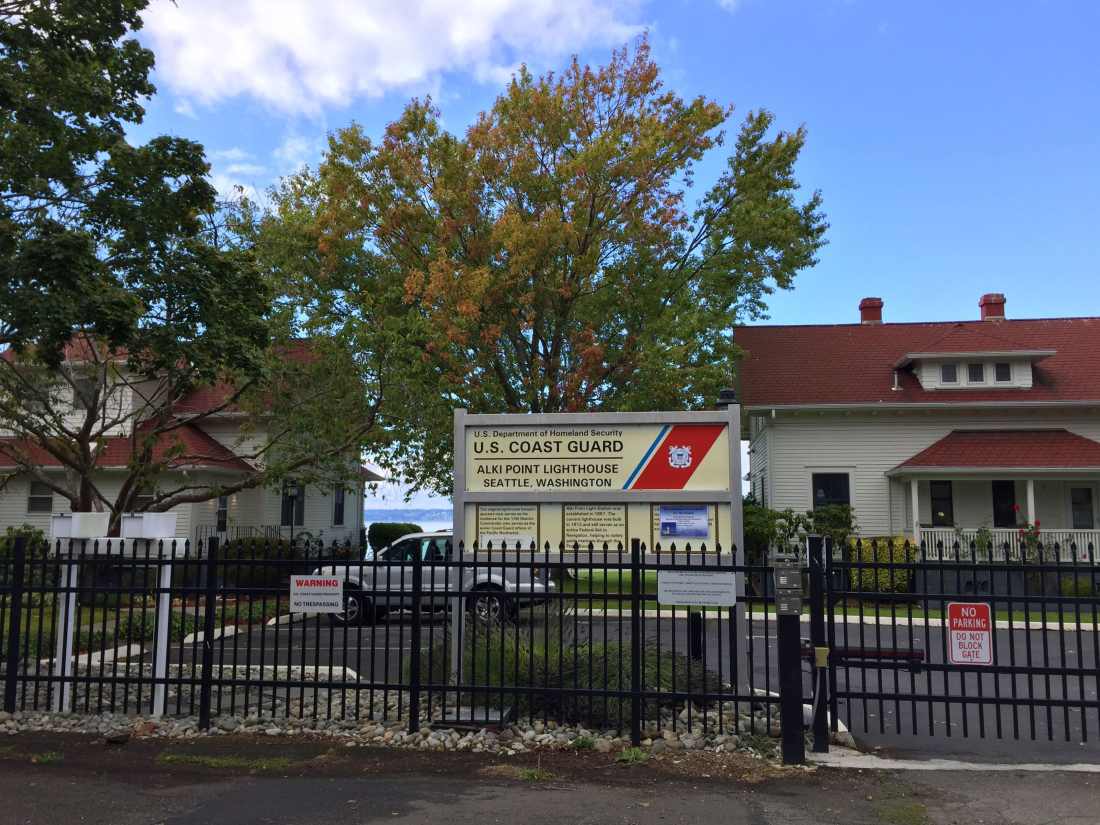
To douse my already sinking emotions, another informed that tours had closed for the season. The lighthouse was now someone’s home, and I’d be wrong to disturb the family while they enjoyed breakfast in peace.
Looking at the sign, I felt so upset. Once a national monument, a tourist attraction, is now out-of-bounds. The lighthouse that once served as the beacon for every ship gone astray, as the pride of the local population, as the treasure that made Alki so special, was now an abandoned tower in the middle of a home. It made me wonder how inevitable change is in our lives. Although we try to cling onto fleeting time, it goes by and what remains is often old stones and faded memories.
With that, I turned away. I hadn’t seen the last of Alki.
She cruised along the highway, a yellow streak shining through the chilly wintry mist. As I waited at the curb for a cab, she soared, teasing my emotions. A mild breeze swept up in her wake, caressing my cheek as I gaped after her. I watched transfixed as she turned, and past me in one swift motion. I yearned to face her. I pined for her to halt so I could examine her. I craved to stroke her hood, to run my fingers along her curves, to sing her elegance.
Speeding up, the yellow beetle vanished out of sight. Pity.
 The Chaos Within