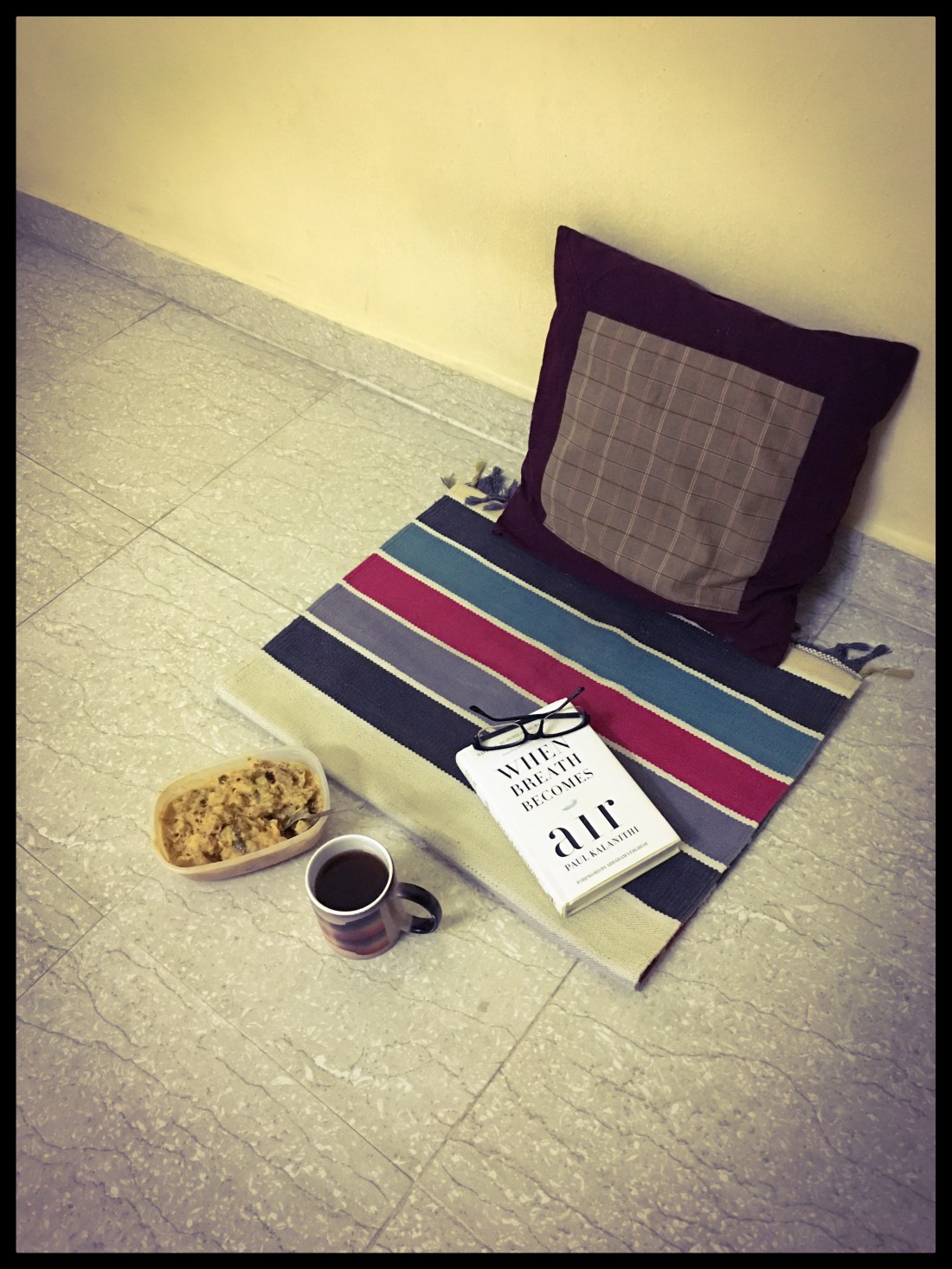
What is a book to me?

When reading a novel, a short story, or a work of non-fiction, I don’t think about anything other than the story that the words in front of me tell me. I don’t care how the writer felt when they conceived the idea, how they strove to string words with words, how inviting the couch seemed when they had work to do. I don’t think about the trauma, the self-doubt, or the fleeting convictions a writer endures before they even get through the first paragraph of what they’ve imagined as a five hundred-page New York Times bestseller.

Holding a book, caressing the hardcover, flipping over to read the blurb, I’ve never even spared a thought about how a writer looks at their book. Published writers, I found out, have varied perspectives about their books. For some it’s a task — a taxing, yet compulsory process they need to endure to hear themselves speak their minds. For some others, like Anne Bradstreet, it’s like giving birth. I came across her poem where she says what it means to her to write and sell a book.

Thou ill-formed offspring of my feeble brain,

It took me a while to understand the depth of her emotions, to appreciate her attitude. She extends the metaphor throughout the poem, addressing her book as a mother addressing her child. She apologises for her maternal instincts, for fussing over her child, for washing its face to make it presentable—for being a mother like any other.

I washed thy face, but more defects I saw,

And rubbing off a spot still made a flaw.

I stretched thy joints to make thee even feet,

Yet still thou run’st more hobbling than is meet;

I had always imagined, if I ever published one, that I’d be happy to put my book out, to let the world see and drop its jaws in awe. But Anne Bradstreet has a different view. She’s sad that she can’t afford a better overcoat for it, she doesn’t want to cast it away and force it to fend for itself. She wants her brainchild to live in grandeur and splendour—all the things a mother wishes for her child.

In better dress to trim thee was my mind,

But nought save homespun cloth i’ th’ house I find.

She’s helpless, a mother struggling to make ends meet, dabbling in poverty, hurting because she’s unable to supply for her child. However, though hesitant, she lets go in the end — because she has to. At last she accepts reality, gives in because the only way for her to live is to send her child out the door.

This is a wonderful poem to read again and again. Here’s the whole of it, if you’re interested.

The Author to Her Book – Anne Bradstreet

Thou ill-formed offspring of my feeble brain,
Who after birth didst by my side remain,
Till snatched from thence by friends, less wise than true,
Who thee abroad, exposed to public view,
Made thee in rags, halting to th’ press to trudge,
Where errors were not lessened (all may judge).
At thy return my blushing was not small,
My rambling brat (in print) should mother call,
I cast thee by as one unfit for light,
The visage was so irksome in my sight;
Yet being mine own, at length affection would
Thy blemishes amend, if so I could.
I washed thy face, but more defects I saw,
And rubbing off a spot still made a flaw.
I stretched thy joints to make thee even feet,
Yet still thou run’st more hobbling than is meet;
In better dress to trim thee was my mind,
But nought save homespun cloth i’ th’ house I find.
In this array ‘mongst vulgars may’st thou roam.
In critic’s hands beware thou dost not come,
And take thy way where yet thou art not known;
If for thy father asked, say thou hadst none;
And for thy mother, she alas is poor,
Which caused her thus to send thee out of door.


Inspiration

“Notorious stab at discrediting our culture…” the editor read aloud. With an impassive look, he cast Darcy’s article on his desk, along with countless papers lined with fine print. He had leafed through them all, but still hadn’t picked his copywriter when he picked up Darcy’s commentary on a teenager’s now-viral YouTube rant.

Darcy gulped. Had she nominalised a verb, perhaps?

Notorious,” he lingered, letting it ring through the otherwise silent room.

‘…mass murderer Sirius Black,’ her mind recalled the day she had learnt the word. But he smiled, “Great work.”

One story had birthed a new generation of storytellers.

Nicely saying

Nicely Said

When you’re a copywriter at a corporate, some things you pick up overtime. But even after being on the job for four years, there are still some things that you’d pick up only from far more experienced teachers. This I realised halfway through reading Nicely Said: Writing for the Web with Style and Purpose by Nicole Fenton and Kate Kiefer Lee.

It’s unlike me to read a book titled as such, because I’ve always nurtured a distrust in “how-to” books. This one, however, was a present. It was a present from a few writer friends I hold in high regard. So I decided to keep my mind open and delve into what Nicole and Kate have to say.

“Whether you’re new to web writing or you’re a professional writer looking to deepen your skills, this book is for you.”

That was the blurb of the book, a simple, typical one-line description for so many guide books that often fall short of their expectations. It seemed far-fetched, as if anyone could tell anyone else how best to write copy for the web when no one—including the web readers—knows what works and what doesn’t.

There’s no one way to write. There’s no right way, perfect way, or a way that makes the most impact. Writing is a variable in every sense. The audience varies, the style does, and so does the purpose. How then, could anyone pinpoint one perfect method?

Many books assert that they’ve figured out the one greatest way of writing. This book doesn’t.

The book doesn’t say what to write, but it says how to go abut thinking about what to write. And that’s where this book stands apart from the rest of the sheep. The authors illustrate the process of writing for the web, using an example throughout the book so that’s easier to follow.

They ask some important questions. Who would write for the web? Possible answers include, bloggers trying to hone their writing, freelancers selling their services, and copywriters employed in business. Though they all have different targets of varying complexity, all categories have one thing in common: the medium they choose to write in. When writing for the web, clarity matters, because no matter who the audience is, they’re always on the verge of closing a tab, impatient to move on to the next tab.
In such a situation, Nicole and Kate say how a writer should focus on delivering their message.

As a copywriter in business, I’ve always followed a similar principle: tell readers who we are, what we do, and how we could help them. Then add a section explaining why they (as buyers) should choose us over our competition. That’s the template—a fool-proof guide to writing About pages and sometimes even landing pages.

But this book made me think further: we tell readers who we are, but we also need to tell them who we are not. That doesn’t come from words, but from tone. For example, we’re professional, but we’re not against good puns. We are consistent, but we don’t spam your inbox with ten emails a day. We’re serious, but we don’t hate contractions. All these come from the way we write our copy, not from what we write in our copy.

Those are the kind of lessons that Nicely Said outlines. The book doesn’t come right out of the dark to illuminate magical truths and best practices, but it narrates the minute things that we often miss when writing for the web. The little things that matter, the finer aspects of helping the reader understand our message a couple of seconds faster, of respecting the reader’s time, of being a good host to website visitors—these are a few of the things that make a good copywriter. And the advice this book contains suits anyone, even those who only write Facebook statuses.

Give this book a shot. Chances are, you’ll cherish it as much as you’d a dictionary. I do.

Hit jackpot

jackpot

I’ve never had any strong opinion about lottery and jackpot, except that I knew it was a dangerous addiction. I didn’t have any friends or relatives under the habit, and so I never had to think about it either. Until yesterday.

A close friend sent me a message. He had won about $260, and he had spent less than $3 for the ticket.

My first reaction was joy beyond belief—elation. I felt as if I had won the money myself. But the next moment, surprise took me over. It struck me as weird how easy it had been for him to win so much money. It was like pocket money for him now, and it came from working zero hours, spending almost none of his effort. It was no-sweat cash.

And that made me realise how hard I work for the money I make. I love my job, I look forward to Mondays as much as I do to Fridays, and yet, I work harder—much harder—than he does to make almost the same as he does. And to cap it, he had just won an additional jackpot that doesn’t even count as part of work.

I wasn’t jealous, I knew him too well to feel any bitterness towards his luck. And besides, when you’ve got a lot of debt to pay off, you can never have too much luck or money. And I knew he had debt, and so, good use for that money.

Despite all that, though, I still couldn’t accept the concept of a jackpot. It’s so unfair. Unfair to the hardworking, to the ones clocking eight hours a day at work and another hour or two at commute, unfair to the labourers, those working with heavy machinery, people waking up at 3 in the morning to serve hangry passengers in railway stations. If only they had the luck.

Perhaps that’s why the lottery lures us common folk. The possibility—if only. We yearn for whatever little luck a tiny piece of multi-coloured paper would sway our way because our lives hang in dire circumstances we crave to unhinge. Maybe lottery addiction stems from the desire to do more, to have more, in life.

Which leads me to believe that no one is happy with what they have. No one’s satisfied enough, seeking the bubbling reputation, even if it takes them to the canon’s mouth. We’re all reaching in the dark, hoping to grab the light that would light up our lives, free us of our debts, give us a bigger car, a faster laptop, or a smarter phone. Pity, though, that we lay so much of our life on a piece of paper that—as much luck as it brings—may as well fly right out of our reach.

When arts and science collide

As an arts student in school, I had a hard time mingling with the science kids. For them, I was the one who read literature, making fiction the reality of my life. Whereas they micro-examined every organism, demystifying the nature of life. For them, I was nothing but a flimsy girl who walked around with her head in the clouds. My, they were so arrogant at times.

Most science students had the same egotistic attitude, and I so I began hating the elite that was science. Pity, since I enjoyed drawing sketching the heart, naming its parts, and narrating the story of how during inhalation, oxygenated blood runs through the veins, reaching every organ while deoxygenated blood travels through in the opposite direction. It was fun to create poetry about the body—for which I had to know about both. It wasn’t meant to be, though, because I didn’t want to become a bully as they.

I held on to literature, letting science off.

When Breath Becoms Air

And so when a friend recommended a book written by a doctor battling lung cancer, I hesitated. Did I want to read a fantastic, ego-filled book about how medical practice taught this doctor the fleeting nature of life?

My friend insisted, and I decided to give Paul Kalanithi’s When Breath Becomes Air, a try.

Just a few pages into the book, I realised I had been wrong about the author. He wasn’t just a doctor, but a literature major before he ventured into medicine. It was the first time I had heard of a doctor being sympathetic to those dabbling in the fictitious world of literature trying to reveal to the rest of the world that books speak reality, even though they guise as fiction. Paul not only studied literature, but used it as a coping mecanism during his treatment. He was a man of science and facts, but even he needed poetry and prose to survive.

According to the book, Paul loved writing, and reading the book, it’s evident that he did. I breezed through the book taking in all the emotions of a dying man speaking about death and disparity with indifference. In the first half of the book, Kalanithi talks about his journey from a literature student to a medical resident. He narrates his days and nights at the hospital tending to sick, even delusional patients. He writes about his fascination, how he approached anatomy classes, how the blade sliced through the belly of a pregnant woman as his attending doctor performed a C-section, he describes the pounding of a patient’s heart when they had cut through him to operate on the lung, he reminisces an incident when an annoying patient—who had to be conscious while Paul removed a tumor from his brain—swore at the doctors throughout the process urging them to get the stupid thing out of his head. As a reader, I felt myself crooning for most of Paul’s patients, and wishing that last one had died. Paul narrates such powerful stories, that you can’t help but emote along with him.

As a neurosurgeon, Paul speaks of the subtleties of the brain and the care that goes into each surgery. He speaks of the process in such a delicate manner that you, as a reader, can feel the sensitivities involved. As a writer, Paul employs the simplest of language, basic sentence structures, easy vocabulary—all of which makes for a needle sharp impact. The writing is straightforward and factual, the matter he writes about is moving and stiking. As a combination, the book is a joy to the beholder.

The second half of the book is more about Paul himself, about how his life, as a surgeon and as a husband, changed after his diagnosis. He speaks of his waking days and wakeful nights. He speaks of chemo and the pain that pricks at his spine, he speaks of discussing symptoms with fellow doctors, he speaks of his tears, of his fears, of his marriage, and the birth of his daughter.

I’m glad I read this book. It wasn’t life changing, it wasn’t a pool of advice, it wasn’t dramatic, mystic, or any of those things. Instead, it was simple, it was honest, and most of all, humble. And that makes When Breath Becomes Air a worthy read.