Talk about style

A while ago, I complained that an instruction book I was reading then had no creativity in its narrative. That was a pretty big accusation, considering the author of that book is Seth Godin and it was—needless to say—a bestseller. Although the book had wonderful advice, a pleasing layout with big headings and small, bite-sized paragraphs, even a bunch of clever wordplay strewn across multiple pages, the fact remains that “Tribes, We Need You to Lead Us” was a dull read for me.

I had then dismissed most guide books as dull as Seth Godin’s. I knew they were helpful and worthy in their advice, but I also realised that those aren’t books I’d read for pleasure. They were more like necessary evils you’d have to tolerate because they, in their own weird way, improve your life. And that’s how I had concluded my experience with instructional books that had blurbs saying, “Must read for every marketer” or “best financial advice for the average tax payer.”

It was with almost the same mentality and expectation that I picked up “Style — Ten Lessons in Clarity and Grace” by Joseph M. Williams. It was a part of my reading library at work and I picked that particular book because it had big fonts and reasonable spacing in the margins. Oh, and also because it was nice to caress the thick, white paper between my fingers. Aside from its aesthetic appeal, I expected nothing. That’s why the book caught me unawares spreading within me inexplicable joy, leaving me flicking through the pages to read more.

For the first time in a long time, a how-to-like textbook gripped my interest. It was about writing, and the author explains, with examples, why and how some sentences work and some don’t. Throughout the book, the author speaks of clarity and good sentence structure, which is all classroom stuff; to take it a notch further, however, he also speaks about the ethics of writing and how sometimes, you have to sacrifice clarity and concision because there’s more at stake.

Every teacher teaching writing would say clarity and brevity is the soul of a good piece. It’s important to empathise with the reader, giving them what they need to know, being mindful of their time. Williams agrees, and explains how to write for the reader, but in 10 lessons, 2 two epilogues, an appendix, and a glossary, he also admits that he can’t say how to identify the best way to write. There are no absolute rules to writing because it depends on the purpose, on the audience, on the writer themselves. And unlike so many books and articles that advise on writing, this book addresses that reality of writing.

In addition to the juicy meat of the book, Williams introduces quotations throughout. Every lesson, every chapter, begins with at least three famous sayings relating to the subject he’s about to discuss. To my surprise, some of those words were so witty I laughed out loud. I couldn’t remember the last time I had done that reading a how-to book.

All these were great things about the book. But the greatest thing was the writing itself. It’s not easy to write about writing in a way that readers, who are writers themselves, understand the writer’s intent—a feat that Williams has managed to achieve in an almost effortless way. That’s the actual lure of the book. Anyone who’s written anything knows that easy reading is damn hard writing, and the fact that this book is super easy to read says a lot about Williams as a writer, his process, and his dedication to revise and rethink every first instinct. For me, perhaps that’s the success this book has garnered.

It’s a glorious read for anyone interested in writing. However, for random readers looking to increase their “read” library in Goodreads, it’s just another instructional book.

Nice rice

I grew up eating rice and all things rice-based. It’s the staple of where I live and it isn’t uncommon for people to eat it three times a day. Except that it made me sick—not in the literal sense, but because I’ve eaten so much of rice already, I can no longer stand the thought of mashing up the soft grains between my fingers, mixing it up in spicy gravy before wholfing it down like a starved dog.

After doing that for more than fifteen years, I got bored. And just when I thought nothing rice-based could surprise me, I had sushi.

Sushi madness

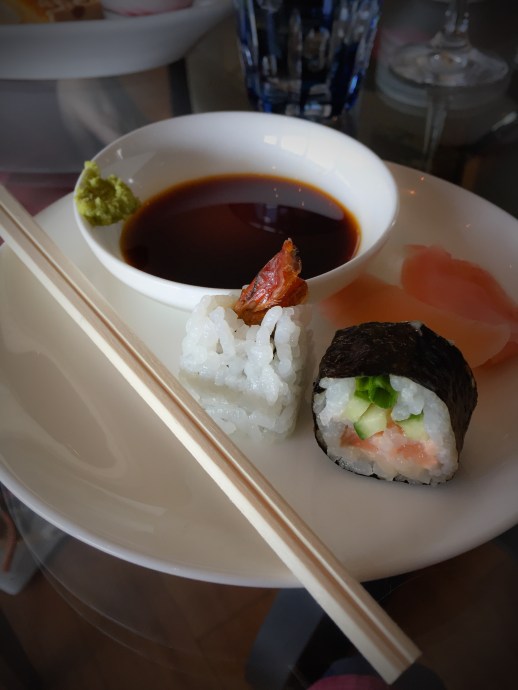
I was out for lunch with friends when I saw sushi for the first time without through a camera lens. In a large platter were tiny, delicate, rice rolls, wrapped in a black parchment paper-like, yet edible, material. Some of the rolls had the wrapper, some didn’t. Some had mild pink salmon peeking out, some had cucumber slices while some others had the tail of a fried shrimp jutting out of the top. My eyes popped at the shrimp tail and I reached out for one (okay, five). The waiters had left tongs nearby so we could serve ourselves and save ourselves an embarrassing encounter with chopsticks.

However, I had to take a pair of chopsticks back to the table with me because it would be silly to eat sushi with my hands or—the horror—a spoon. Along with the sushi rolls, the waiters also put a tiny bowl of soy sauce and a plate with green paste and picked ginger, all the while staring in apprehension at this weird woman who preferred to eat sushi without knowing how.

Back at the table, I eyed my sushi rolls wondering if they would fill me up. Five seemed too few. I spilt my chopsticks and one of my friends adept with the tool taught me how to hold it. I had thought rolling up rice between my fingers was funny enough, but chopsticks took it to a whole new level. When I managed to grip the chopsticks and grab a roll, I felt like a champion. The Japanese have a divine approach to food—healthy, colourful, and so damn hard to get hold of.

I picked up a non-wrapped, cucumber-peeping roll, and before it could fall off my chopsticks, I put it in my mouth. A burst of flavour met my unsuspecting tongue. Soy sauce and wasabi were a weird combination. I love spice so the wasabi wasn’t too spicy—but its flavour surprised me nonetheless. It was hard to imagine something so green, so pleasing to the eye, could be ruthless to some palates. And then there was the ginger, pickled ginger that stung my tastebuds making me reach out for more even without me realising it. Every bite I took unravelled the packed rice and the cucumber within, while the flavours of the soy sauce, wasabi, and the pickled ginger seeped through exploding in a nonsensical, yet wonderful, sensation in my mouth. I kept chewing, trying to get through to all the different tastes that the tiny sushi roll had dropped in my mouth.

I next went for a shrimp roll. It was the same thing all over again, but with the crunch of a shattering shrimp tail and chewiness of salty sea weed.

Despite its tininess, I couldn’t eat more than three because the rolls had a handsome portion of rice with a lot packed within.

At the end of the day, though, I had developed a new kind of love for rice—rice to me is no longer just boiled grains soaked in steaming, tangy, gravy as I had eaten all my life, but rice is also a delicacy and a supple bundle of surprise that’s small on the outside and big on the inside.

Of poetry

I adore poetry. I try writing poetry, too, from time to time, but I fail almost every time. I still try, though. It’s such a disciplined and sensual form of art that I know I want to get it right some time or the other. How much command over the language a poet must have to express limitless vision in limited words.

It all started when I read Tennyson’s Charge of the Light Brigade. From there, my craze only magnified as I read Wilfred Owen’s Anthem for Doomed Youth and Dulce et decorum est. Those three war poems changed the way I see words and respond to their lure—it’s weird how war is always the starting point of enlightenment.

Once I understood the underlined meaning in these poems, I wanted more. I was addicted, and was desperate to quench the dryness that these poems left in my throat.

I had read poetry before, of course. I had read some of Shakespeare’s sonnets, and yet, these poems were different. Reading Shakespeare requires effort sincere effort and interest. These poems, though, thrust themselves at me. I didn’t have to know the details of war to understand its effects as told by Tennyson and Owen. They inflamed a strong passion in me for simple, yet well-articulated words.

For instance, this one in particular:

“Dulce et decorum est pro patria mori.”

Which translates to: “It is sweet and fitting to die for one’s country.” Ah, the intensity of those words—coming from a soldier nonetheless, who knows what he’s talking about better than anyone else ever would. But what makes it even better is the placement of the phrase: “The Old Lie:”

“The Old Lie: Dulce et decorum est pro patria mori.”

The entire poem walks us through a vivid description of the war zone, and then, we get to the end where the poet claims that all the bullshit stories we tell young soldiers are empty words; lies. Poor Owen, he must’ve believed them all, like the rest of the lot. What a great poet he turned out at the hospital, before recovering and heading to the battleground again.

But that’s the power in good poetry: When said “write”, a writer writes, but a writer who said it right, writhes the emotion out of readers.

Wilfred Owen was one such writer. He made me, the reader, feel what he felt. The pain, the anguish, the heartbreak, and the loss of hope—I felt them all because the poet put them in such an artistic narrative. And that’s why we should read good poems, because like John Keating says, we need science and business to sustain, but we need poetry to live.

And what would we do if not live?