It’s June now, but I’d still like to think March was recent. Having said that, I’d give anything to revisit my recent visit to the western borders of India. I’ve written quite a lot of my travels, and spoken about it even more. To be honest, I brought back over a thousand photos, and I needed a way to flaunt them.
But it wasn’t just about the charming sights and endless stream of photos. There were so many new things I had to get used to, and I did. It wasn’t easy being thrown into a vehicle with five others and travelling uphill with my head swirling. But I got used to it. I had no choice, but I enjoyed it too.
And we travelled with kids. Small kids, infants, even. That was my tipping point. I wasn’t keen on having kids on the trip, because they have a tendency to ruin it for the rest of us. And sure enough, there were a few tears, a few tantrums, and plenty of throwing up incidents I’d rather erase from my memory. It’s not something I liked or would recommend, but I got used to it. I just had to accept the fact that we were a party of twenty four, including three senior citizens and five kids, braving a temperature as low as -6˚C.
I hated having to give up the window seats and making small conversation every time we stopped for tea. But when I look back at the whole trip, I have nothing but memories I cherish. I enjoyed every bit of it. It was hard at first, and I had my own inertia to overcome, but once I did, I saw how beautiful even mundane things like a steep U bend became. It brought me closer to the people I travelled with. I hadn’t expected to meet a sixty-five year old eager to jump into a freezing lake. It showed me a different side of the people I thought I knew. I hadn’t liked the idea of travelling with my colleagues’ parents, but I had judged too soon. Because by the time we returned, they had became as close to me as my own parents.
Amazing how man’s thirst to conquer the gods led him to the aircraft. Once a phenomenon, is now so commonplace that people resort to cotton buds, ear plugs, and constant whining about the noise.
It’s weird, flying.
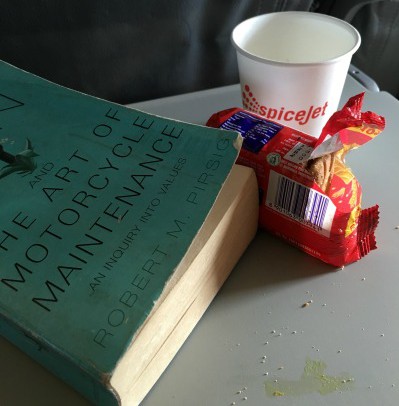
It was weird to sit in an airplane, typing away on mobile — while I longed for the familiar pen and paper. It was weird to write, when I had prepared to read.
But the weirdest thing: I didn’t feel any stress, awkwardness, or discomfort. Not even mild irritation. Which was good, because I get irritated, a lot. Around unmanageable kids, in particular.
But what did I feel?
I heard a mild hum ringing throughout the craft. I felt a morsel of sound reverberating through to the end of my spine. My eyes grew groggy — was it the flight or something in the water I drank?
Every new sensation, every breath made me wonder: Could I stand the cold? After all, our destination was snow. And then I looked at the people in my group, those who carried one-year-olds without the least worry about their immunity and teeth chattering, and I realised: I could make it safe.
A monotonous voice announced something neither I nor she understood. Something lit up over my head. It was the “fasten your seatbelt” sign. Someone said something about a landing. The air hostess continued her impassive narrative into what looked like a telephone receiver.
We were about 10 minutes behind schedule, I heard. It’s the 21st century; air traffic is a valid excuse.
For some, the experience was one of a lifetime. It showed too. Kids shouting, restless toddlers trying to evade their parents’ grasp, teenagers gulping, and a few bold faces skimming through newspapers that flashed, “Egyptian aircraft hijacked.”
I mused at the cabin crew. For them, it’s a job. Just another day, just another flight, with just another bunch of fliers. People ogling at them, taking photos without the courtesy to ask first, pointing fingers, and passing lewd comments were all part of the job profile.
What’s not part of the profile, however, is understanding smiles, good afternoons, and sincere thank yous. They aren’t used to it. They don’t even expect humaneness from the countless so-called humans they serve all day, every day. And that’s the saddest part of their job. You can’t blame them for throwing a nonplussed look at you when you smile and greet them good morning.
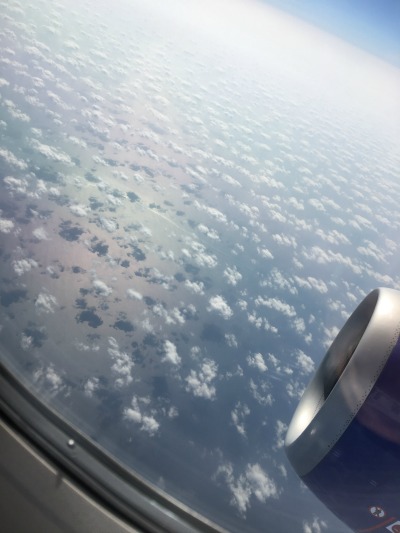
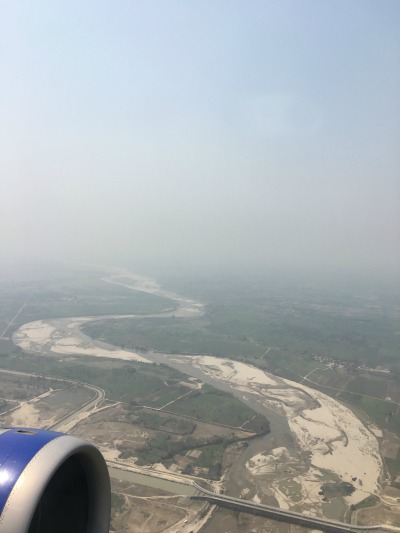
And then, I felt it. The rumbling had grown louder, so loud that it rang through the craft, and even within my ears. I peered past my co-passenger — who disgraced the window seat playing solitaire on her phone — and saw, looming near, winding sand lakes that, in a while, became tiny squares of brown and green.
With another shudder, the plane shook. From outside, the sun streamed into my face, lighting up the aircraft with a natural glow that all the fluorescent bulbs could never achieve.
With a final thud, we touched down. And I reached down to pick up my phone from the floor.
No, not the Himalayas. I just wanted to see how it looked in print. I do sound more holy.
Anyway, when I returned from my trip to Sikkim and West Bengal, the weather was only the second thing people asked me about.
“How was the food?” That was the first question. And I had to take a moment to think. In all those five days, I had never thought much about the food. And then I realised, we didn’t eat much at all.
We travelled instead.
We had breakfast and dinner at the hotels we stayed at. But lunch was often a no-affair.
But from what I saw, West Bengal was abundant in chapatis and naans. They are both flatbreads made from whole wheat flour and self-raising flour. As for the sides, all I could see (and care for) was chicken. It’s the most popular dish that warms you up from within. Apart from that, we saw plenty of lentils. Known as dhal, the protein-rich yellow goodness is always a feast — for the eyes as well.
Chapatis with dhal and chicken.
We stayed two nights each in Gangtok and Darjeeling, and both hotels served the normal stuff we eat at home. Though I have to give a special mention to bread, butter, and jam. Oh, and cereal. That was a part of our breakfast on all of the four days we spent there. It’s yet another one of those things that the westerners left us, that we couldn’t outgrow.
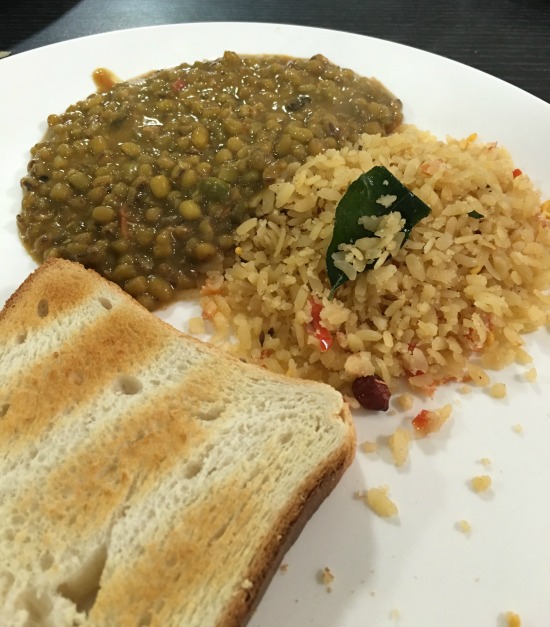
But they also served something to remind us of home. At least until we put it in our mouths. The green gram gravy. One of my favourites. The creamy green grams, mixed with sharp garlic, translucent onions, and indivisible spice — I was all ready devour when my friend exclaimed, “It’s sweet!”
In one heart-stopping moment, the balloon within me deflated. People there add sugar to some of their gravies, and I was unaware.
Bread with green gram gravy. And poha.
And then there was poha. Another familiar item. It’s dried and flattened rice grains, which is soaked in water, drained, and cooked in oil with onions, chilies, curry leaves, and a few spices. It wasn’t sugary, and that was a relief.
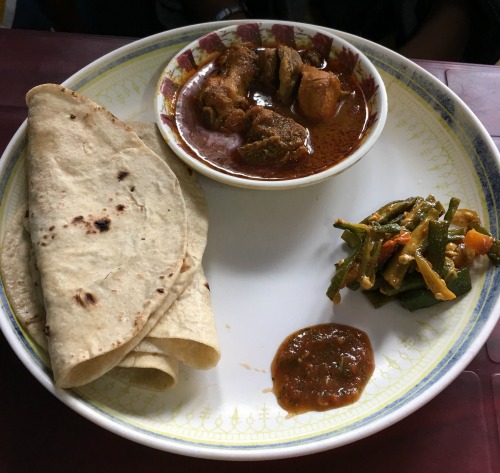
A local favourite, I hear, is the ladies finger, also called okra. Locals call it bhindi, and fry it with onions, tomatoes, and spice to make a semi gravy. Bhindi masala, they call the dish.
Chapatis with chicken, bhindi masala, and hot chutney.
And then (trust me I’ve been dying to write about this ever since I started this post), momos.
I have a friend, who’s from Tibet. Who introduced me to momos in the best possible way: She made beef and chicken momos for all our friends. It was the first time I tried the traditional Nepali dumpling.
So when I heard we’d be going to Darjeeling (which is not far from the Tibet and Nepal border areas) I could only think of momos, and my friend. I pledged to myself I’d eat nothing but momos.
But you know how pledges go, I had to settle for sweet buffets instead.
Nevertheless, I tried momos thrice during the trip. The first in a small place called the “Cafe 14 Thousand.” Why the name, I have no idea. We had to climb about 300 meters of a snow-capped hill in Nathu La pass. And this “cafe” sits halfway through the climb. It was more of a shack, and since we were a few of the early climbers, it had plenty of breathing space. They served coffee and momos.
When I saw the little dumplings stuffed in a glass bottle, for an instant, I became the monster staring at the cookie jar. And I’m not ashamed. We bought one plate, which had about seven to ten momos. I took one look at them, and another of my inner balloons deflated. They were so tiny, with far less stuffing than what’s acceptable. My momo-friend would have disapproved — I did.
I had forgotten on important thing: Though momos were a local favourite, Nathu La pass was a tourist destination. Over one thousand vehicles cross the pass every day, including Sundays. Everything there is commercial. My fried made momos because she wanted to show us why she loved them so much. These sellers make momos because it’s their business.
But the chutney, or the sauce, was superb. It was spicy enough to de-numb my teeth and send some electric heat to by fogged brain.
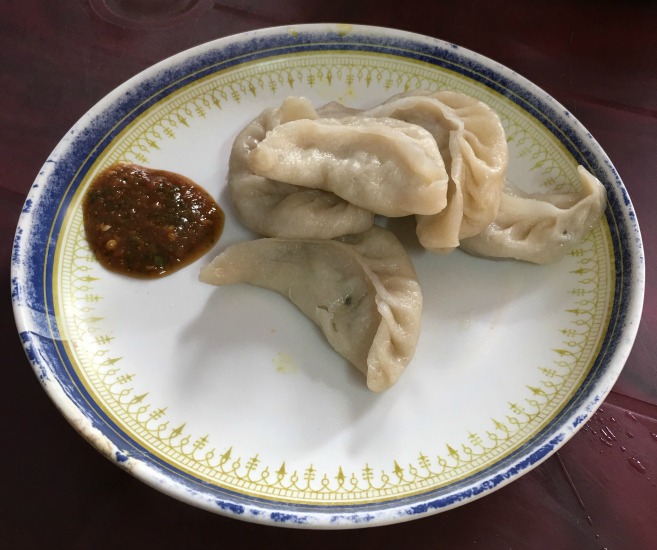
I did another momo-tasting in a small restaurant in Darjeeling. These momos were bigger than the ones in Cafe 14 Thousand. As for the chutney, it was again a spice-fest, so nothing to complain.
Momos with hot chutney.
So about the food in Darjeeling, you get familiar food, in unfamiliar flavours. But it sure is worth a try. After all, what’s life without some variety?
As for the most important thing in all of Darjeeling — the tea — I’ll have to write a separate blog post.
The temperature had fallen below zero degrees celsius. Our driver had been fidgeting for the last one hour. He was a native, he climbed these hills every day for a living. A professional cab driver, with a skin thick enough to withhold falling snow and selfie stick enthusiasts. We were late to leave our previous destination, the Nathu La pass, the trade border between India and China, and the visibility grew worse even as we descended.
I sat snuggled in a sweater too big for me, wearing three layers of socks, rubber boots, and gloves that had given away to the cold. The only solace: My woollen cap protected my ears. I had never loved that cap more before.
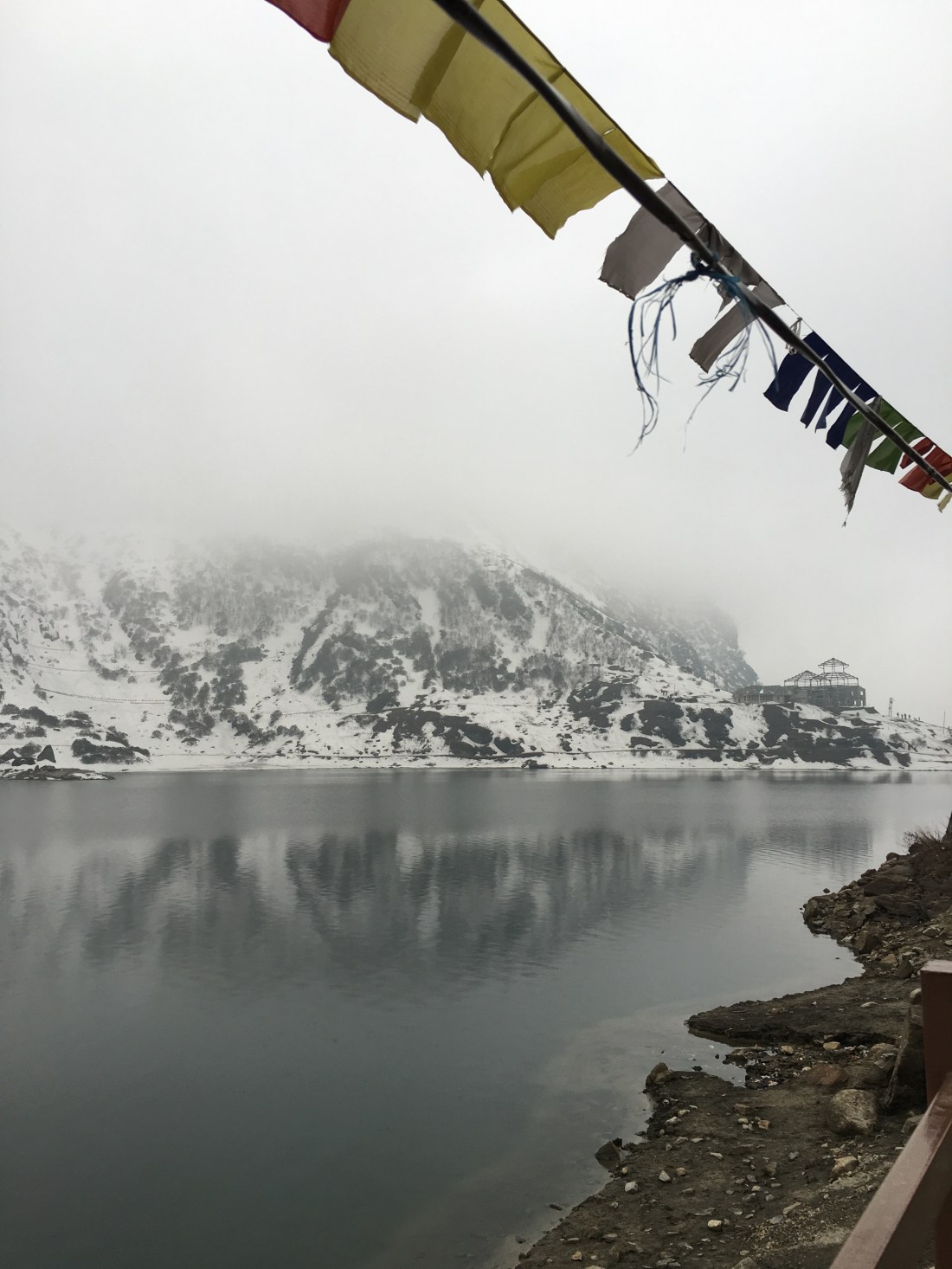
And all of a sudden, the cab stopped. Out the window, I saw an expanse of white all around me, spotted with a few black rocks that peeked through the snow. Then I turned to the other side, and there lay, the Tsmongo lake.
My first thought: It was the most beautiful thing I had even seen. In hindsight, it was one of the most beautiful things I had seen that day. It was a feast bigger than I could comprehend in one look.
I lost my breath for a while. In the beauty of the lake, but even more in its endurance. As the chilly breeze swept past me, my bones tingled in tune to the ripples in the river. Surrounded by mountains of snow, with more snow just beginning to fall, the lake remained unfrozen. I don’t understand how, and I don’t want to either. It’s just one of those natural phenomenon that’s best left unexplained by over-enthusiastic humans and their inhumane science.
Tsmongo Lake, Gangtok.
“10 minutes.”
Our driver gave us generous time to get out of the cab and breathe in as much as we could.
For the first time in three hours, all the blood rushed to my feet and I almost jumped out of the cab.
It’s a famous spot, and there were no shortage of walking sweaters and hoodies. Of the six in our cab, only two of us got down to greet the cold. And boy, what an experience that was.
I still felt the cold piercing through my skin, but I had grown accustomed to it. A few more days there and I could have endured at least a small part of what our cab driver did.
Anyway, we walked over to the metal bars that stood between us and the lake. Hanging over it were so many tourists capturing moments to bring back home and tease their friends. I couldn’t pass that opportunity. So I hung over the bars to get a few brag-worthy shots myself.
Meanwhile, my friend was taking photos as well. He asked me stand still as he clicked. I wasn’t too keen on posing on purpose, but did so anyway and, in turn, asked him to do the same. Courtesy, you know.
As I stood there, a few snowflakes fell on me. And despite my grown-up stance, I held it in my finger with a clumsy look and a lopsided smile. I was holding a snowflake!
Once our ten minutes was up, we packed ourselves back in the cab, and headed downhill with almost no idea of what’s going ahead of us.
I had never liked standing behind a line. Why would anyone draw an imaginary barricade between themselves and the world beyond?
Having lived all my life in the southern part of India, I had often crossed district borders. But the thing with that is that it had no restrictions whatsoever. Just once when in school, I travelled to Kerala — another state altogether.
That’s all the border-crossing I had done. But where’s the fun in doing stuff without a rebellion?
For the first time in my life, I experienced snow. And though I wore three layers, the cold still got to me. But here’s the best part: I climbed a three-hundred-metre snow hill to look down at the most amazing sight in my life. The Chinese border on my left and the Indian on my right.
The temperature was -6˚C. But it had nothing to do with the goosebumps that rose on my skin. My deepest desire stared back at me through the mist, and I stood transfixed in joy and pride.
That day, I realised I had just crossed off something in a bucket list I didn’t even remember making. That day, so many childhood memories came rushing back to me. I relived that warm summer night — I was only five — when I first told my mother I’d like to someday stand in between two countries. With one foot on one country and the other on another.



 The Chaos Within