What if—?

Institutions and rules keep us in check, and tell us what we should and shouldn’t do. Without a religious belief watching over us we’d run amok with madness.

But what if we wake up one day having no memory of a god or religion? What if they never existed?

Well, we won’t have violence in the name of god, for sure. People will be fighting because they’re hungry.

We won’t have loud bells claiming to wake the lord, and waking up the whole street instead.

Men won’t need wear saffron dhotis for three months in the year. Imagine not living in a neighbourhood where the men are all clad in eye-numbing orange every day.

And women won’t have to cover their heads every time they go out. Hats will become a lifestyle choice. And I can wear a scarf to without being called out.

Oh, and we won’t have discrimination in the name of godmen. Sadthus and gurus will be out of business. Holiness would mean… nothing.

Footwear will become comfort, and people won’t torture themselves in the name of devotion.

Flowers will bloom and fade away, intact in plants. Slaughtered meat and alcohol won’t be part of a traditional offering—just Thanksgiving dinners. Or brunch.

Piercings will be a hippie thing—not a god thing.

What if we told the whole world that god and religion don’t exist?

Well, people just might go crazy.

Different is courage

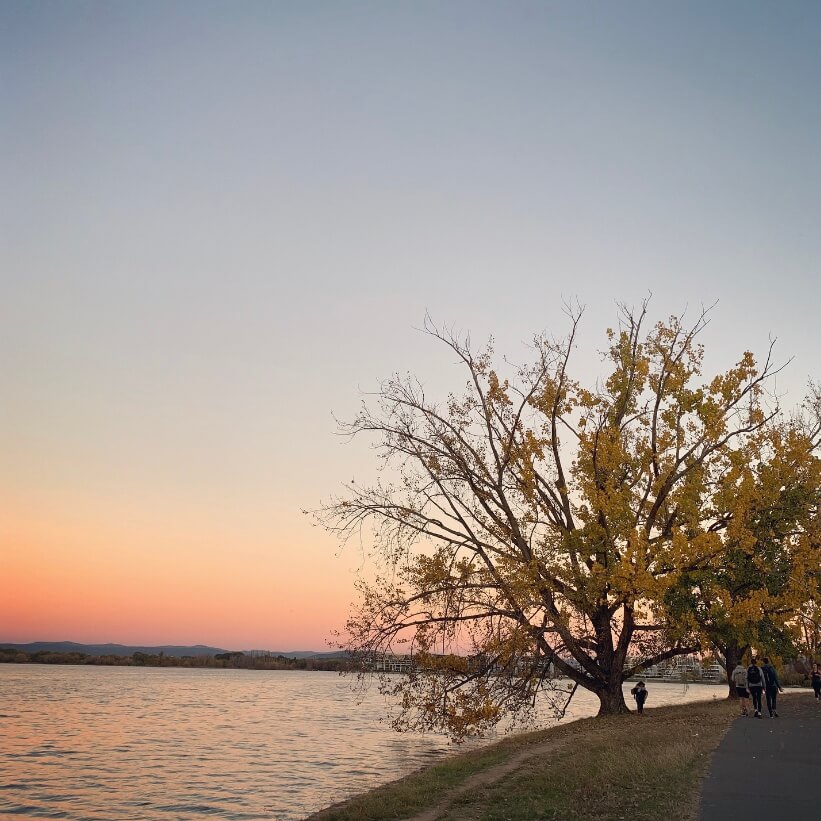
Australian National Botanical Gardens in Canberra

Fear less though alone

it’s the odd ones that stand out

a lesson from plants


Photo: Australian National Botanical Gardens in Canberra, ACT

Ya alright, mate?

I haven’t talked about it much, but about three weeks ago, I moved to Australia. From south India. It took me two years to get a resident visa, and I was beyond thrilled when I saw the visa grant letter in my email.

I was at work at the time, and I galloped to the restroom so I could punch my fist in the air without alarming those around me. It was, after all, a life-changing moment and I had every right to celebrate—even if it meant shouting out inside a bathroom cubicle to muffle my jubilance.

After spending a month with my parents, consoling and convincing them that I’d be fine without them watching over me like hawks, I landed in Australia happy and dog tired. Having flown for almost 17 hours, excluding transit, I was too stupefied even to express my joy and excitement. I sat in the car on the ride home, staring at nothing in particular, unable to muster words, breathing just like another vegetable on the counter.

Jet lag, some people would call it. I wouldn’t, but I also don’t know what it was. Even for a few hours afterwards, I felt as if things were happening too fast for my puny mind to comprehend. I sometimes still stare into space, my mind wandering, unable to believe that I now live in the first world.

It’s natural. Culture shock affects us all in different ways, and this is how it is for me. For the first few weeks, I lived with Indian housemates who’d lived here long enough to become accustomed to the lifestyle. As for me, even my first experience in a supermarket was overwhelming. Although I’ve seen first world supermarkets on my trips to the US, I wasn’t browsing as a resident; I was just a visitor looking for snacks.

And even though there’s plenty of large chain supermarkets in India where I came from, the ones here are so much bigger and have much more variety.

There’s so much variety that it’s insane. I was walking down the aisles, browsing and musing…

There’s canned tomatoes, canned organic tomatoes, canned crushed organic tomatoes, sun-dried tomatoes, un-canned whole tomatoes, un-canned sun-dried tomatoes, red tomatoes, green tomatoes, and prepackaged tomatoes.

And I’m just cooking for one. I lost the will to use tomatoes.

But that wasn’t all. Take carrots, broccoli, or just peas for goodness’ sake. They’re fresh and whole; prepackaged in bundles; bundled and frozen; chopped and prepackaged; chopped and prepackaged in individual steam bags; and even boiled and ready to eat in packages.

And what a fool I’ve been all my life—I used to buy carrots, wash them in salt water, peel, and chop them before throwing in the pan.

Nowadays, it’s just as easy as buying frozen vegetables and microwaving it for lunch.

I did prepare myself for this move. I mean, I dreamt so much, planned and planned for almost two years. But I wasn’t ready for this.

I’m still lost for words at how much things have changed. This isn’t jet lag—this is a lifestyle, mate.

Hold the brakes

I don’t take breaks often. I’m so used to working 12 hours a day and still being available for questions after hours. What’s more, I’ve spent entire nights working, forcing myself not to fall asleep and ignoring the rest my body needed. All because I felt work was my primary concern.

And then I moved across the world. I relocated to Australia, and for the first three weeks, I had to put a pause on my work. I didn’t want to, of course. But I had no choice—I didn’t have a laptop. I felt crippled, but I had to deal with it in silence. It’s only for a few weeks, I assured myself, even though my inner self rejected all assurance. Regardless, being helpless about the situation, I realised one important thing about myself and my work.

I was way too uptight.

Having worked for almost six years without a proper vacation, I didn’t even know what it meant to be free and rid of work pressure. For the first time in a long time, I couldn’t do anything about the work that remained back in the office. My managers were so understanding and supportive. And to be fair, there was already a well-equipped team covering for me. And most of my tasks weren’t urgent either—they could wait well until settled and was ready to take over again.

And yet—it bothered me that I couldn’t work. That’s when I understood how much I was addicted to my job. I work as a marketer and writer for a software company. My everyday tasks involve creating content, reviewing, managing social media and customer support, and answering any questions the new members in our team had. I was missing all that action, and it made me uneasy.

To my utter surprise, however, I survived. I got through over three weeks of doing nothing, and I was still sane. In fact, not only did I spend three weeks unscathed, I was relieved even. It was the first time I wasn’t feeling overworked, and with every passing day, I sensed, as the temperature fell, I also cared less and less about my work. I still appreciated and loved my job, but unlike before, I wasn’t consuming me. I started to see work as just that—work. I realised I could have a complete and enjoyable life outside of work, which I was once so obsessed with and dependant upon.

So—take a break. Please do. It’ll help you distance yourself from your fixations and see that the sky is far brighter than you’ve seen. But then again, I moved to Canberra, and of course, the sky here is bluer than Chennai, south India, (where I lived before) could ever imagine.

Troubling lovebirds

As I stare at the blank page on my laptop, I can’t help but get distracted by the birds chirping away in front of me. My new life in Australia started pretty well with great housemates and a cold Autumn. One of my housemates breeds lovebirds—not only because she likes them but also because they make good money.

She’s been doing it for a while now, and so it wasn’t my place to comment or raise eyebrows. She’s even sold a few birds, for about 20 dollars each.

Not a bad deal, I thought when I first heard of it. But the more I observe, the more I’m reconsidering. The marketer in me has begun evaluating the return on my housemate’s investment. Considering bird feed, the cage, nursing the eggs, nurturing the young, the cleaning efforts, and the constant attention, breeding and maintaining birds is an arduous task for which 20 dollars seems a laughable loss.

But it’s her business, and she’s been doing it long before I was in the picture. So I held my silence.

However, as I watched the birds today (for lack of anything else to do), I started wondering why people paid, however much they did, to own these birds. Why would anyone pay money in exchange for years of caring and, in a sense, servitude to birds they could crush in seconds?

Beauty—that’s the obvious answer to most problematic questions. But that can’t be all.

Some people, like my housemate, look at it from a severe business perspective. Of course, she loves the little chirpers and caresses them in her palms, cooing and cuddling even when not so appropriate. She likes spending her time with and for them. But when it’s time to give them up, she’s ready for the next batch.

Some others treat bird raising as a hobby. But even they who look at bird raising as a pleasurable activity still spend a lot of time, energy, and money on maintenance—which makes me wonder why. Why would they expend so many resources to observe caged creatures that grow so finicky the moment you make a sudden movement around them. I only switched my crossed legs, and the two birds in the cage wailed out as if I were slaughtering them. Their behaviour is understandable, too. If I’d been locked up all my life and only given food on certain days and times in a day, I’d become paranoid also. I’d feel so tortured in my mind that I won’t be able to think straight or trust anyone enough to share a conversation.

How is it then, I wonder, still watching the flustered birds, that someone who acquires these birds, makes them sick, and gains pleasure in watching them every day isn’t a troubled soul themselves?