It Goes On

They hadn’t seen each other in years.

Life had taken a sharp turn from college into reality. They were both salaried employees at different multinational corporations. Their income and expenses tallied on most months, while payday loans saved some days. They’d wake every day and make mental to-dos with the morning coffee. They turned on autopilot to greet colleagues with a “good morning” a “hi there” and a “nice seeing you” — without even seeing who they’re saying it to. Headphones had become the lover that never disappointed. Caffeine was the impetus as the day waned. Free dinner at work with colleagues compensated the lack of company. Home had become an empty room with a vacant chair and a mug with morning’s coffee dregs. They took Facebook to bed and woke up next to a harmless-looking space grey metal block.

And then came the acquisition.

Life took a sharp turn from reality into a harsher reality. They had become salaried employees at the same multinational corporation. Their income and expenses tallied on most months, while payday loans saved some days. They’d wake every day and make mental to-dos with the morning coffee. They turned on autopilot to greet colleagues with a “good morning” a “hi there” and a “nice seeing you” — without even seeing who they’re saying it to. Headphones had become the lover that never disappointed. Caffeine was the impetus as the day waned. Free dinner at work with colleagues compensated the lack of company. Home had become an empty room with a vacant chair and a mug with morning’s coffee dregs. They took Facebook to bed and woke up next to a harmless-looking space grey metal block.

But they’d sometimes smile at each other over the vending machine. They weren’t in love anymore, just in denial.

What’s the Point of a Wedding?

I was at work trying to write a blog convincing business owners to buy our software. And as I sat staring at my blank screen, my mobile screen lit up. It was a message from my classmate. I picked my phone amazed because she hadn’t spoken to me since our reunion at school two years ago. I opened the message and there it was, in shiny font and bold letters, an invitation to her wedding the next day. Come to think of it, almost all of my classmates are either married or engaged to be married. Some have kids, even. It seemed like I am the only one writing about marriage and not, in fact, marrying.

It’s not as if weddings are easy. Apart from having to find the perfect match for your life, weddings are also weird in a way. In the way that they’re the epitome at displaying wealth. And I was lucky (or not) enough to see a few weddings myself.

I’ve sat listening to grooms ramble about the all-important wedding outfit. The bride’s saree had cost him five months’ worth of salary. Plus five additional sarees that the bride should wear on the same day — one for each wedding ritual. I listen because the funniest part comes at the end of that story: the bride wouldn’t wear those sarees ever again — they’re too heavy and uncomfortable for everyday use.

Then come the miscellaneous expenses like makeup and hairstyle, hall and stage decoration, food and lodging for the guests, train or air tickets to and from the wedding location, snacks during the commute, tea, coffee — with Boost or Bournvita for those who drink neither. And the booze. By the end of that list, the couple would have lost two years of their savings preparing for one day of supposed-celebration.

And if that wouldn’t turn them off, the in-laws have their own demands — not actual demands, but more of obvious stuff the couple would need to move into their new home. Some call these “gifts” while some say dowry. “Gifts” include furniture, jewellery and investments, air conditioner and washing machine, and the essentials like carpets, curtains, and pillow cases.

And then comes the big day, the wedding day. The bride and groom wake up from yet another night of beauty sleeplessness to pressure. While the heater gets ready, a final checklist would come to light.

Shopping-done. Extra gold coins, done. A variety of lip-smacking food, done. And after a shower is the “getting dressed for the wedding” part. That’s when they’ll realise: No matter how much they pressed on the buttons on the air conditioner’s remote, they’re still burning up from the heat and beads of condensation sliding from their temples.

A tiny makeup glitch, safety pins that have gone a wandering, borrowed bangles that shrunk overnight, anything could make them cry. And with five pounds of heirloom jewellery, two and a half pounds of designer saree, and the curious case of the missing bobby pins—tensions are high. And when they think it couldn’t get any worse, the bride’s father would walk up to the groom and voice his displeasure about the drunken best man.

If they’d thought weddings are fun and full of life, they’d soon wish to just get it over with.

That’s the problem with a big fat wedding; on the day of it, the bride and groom are no longer love birds. They’re not the passionate pair, but just tired folks who want to sleep.
Weddings are meant to help them start their life anew. It’s a day to celebrate two souls that agree to sacrifice their tastes and the preferences for the greater good. Marriage is a promise they make to themselves to approach one person’s problem as it’s the other’s and drive through it as one.

As for weddings, they’re just a day to deck up in jewellery and spend the day gossiping. There’s no point in them and I’d rather not go to such a wedding, even though I got my invitation on WhatsApp the previous day.

The Twentieth Century

Here in India, we love the West. And by West, I mean the Western culture — or what we think we know about it. As technology crossed the seas and landed the television in an otherwise untelevised society, we became adept at making Friends our weeknight companions. We went from staring at stars in the sky to staring at stars on the screen.

While we indulged in “Seinfeld” and “The 70s Show,” and laughed at Homer’s jokes, the British came over telling us to “Mind Your Language.”

And we thought that was funny. Every time a funny episode aired, we’d huddle around and gape at white women sporting little black dresses and short shiny skirts. And as time went by, it didn’t feel awkward anymore. The white men in the sitcoms didn’t think it weird, so perhaps it isn’t.

Our women tried fancy clothes and our men tried perfumed sprays. Oiled hair became gelled hair, and the once turmeric-clad skin now looked “up to ten years younger.”
Thirteen-year-old girls went to school instead of their mother-in-law’s house. They learned to do their homework rather than their home work.

India — or a part — of it, saw a whole new world blooming under the influence of the West. There was a time when we got goosebumps as the hero and heroine made eye contact, but now, not even public display of affection (or PDA!) makes us flinch.

And we have fewer 19-year-old mothers cradling 2-year-old children. The system of the woman in the kitchen and the man on the porch reading a newspaper made less sense to a breed of youngsters born in a new era.

We’re now in a world of promise and freedom of thought. From being a suppressed generation of youth, we’ve embraced the wisdom that came with booze and books. We learned, and we craved for more. We adopted new ways and gave way to newfangled emotions.

We fell in love with the modernity that the West showed us. And we shunned the peculiarity that home instilled in us.

From being a society that had its eyes cast down, we began looking up at others. We started talking to the others, dating, falling in love, and did everything else we hadn’t heard of before. Arranged marriages are no longer the norm. We’ve dabbled in life and experienced things we’ve seen only in sitcoms before, like nuclear families, sex before marriage, pregnancy before you’re ready, miscarriage, abortion, divorce, and — distortion of reality.

We thought we had become forward. We thought we had it all figured out. We thought we’d become trendy folks, that we’re revolutionary, that we’d gained the right to free speech and opinionated blog posts.

We love the West because we think it changed our thinking.

It didn’t. The West changed our thinking about thinking. We think we’re more open-minded and free . We live in fallacy. Because, every day, at least one person undergoes harassment and abuse because of our “modern thinking.”

It’s not the fancy skirt, and it’s not the drinking. It’s the thinking.

We’ve adopted many important practices from the West, but we missed the vital ones. Sex is fine but talking about it isn’t. We don’t have sex education in school but encourage aborting unwanted pregnancies. We say love is universal but *gulp* men holding hands? We talk about the wage gap in careers and ignore the chore gap at home. We think like the West, and we stop at thinking. Thinking is no good unless we do something.

It’s the twenty-first century. But for most of India, it’s still the twentieth. We’ve moved on from vintage to montage, but most people live under taboos and traditions. We’re nowhere close to the West of twenty years ago. We are not modern. We just live in a fake version of reality that we created to feel good about ourselves.

Even though we haven’t moved on since Friends, the world has. Sure, technology will bring us closer to the West, but we need more than ideal ideas and tall talks.

Otherwise, we’re just a powerful society clueless about the power they hold.

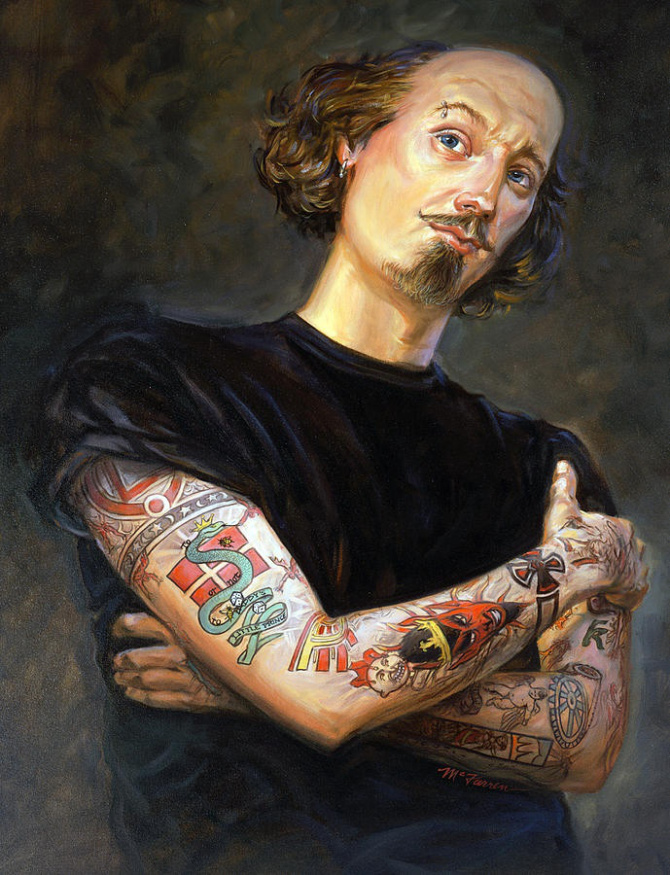
Why You Shouldn’t Study Shakespeare

will

Some of us, more than others, have taken those Shakespeare lessons in school a little too close to heart. So much so that we decided to delve deeper into the man’s mastery with words, words, and more words.

Shakespeare was the father — or one of the fathers (with the utmost respect to Homer and Johnson and Marlowe) — of English literature. And that’s one of the reasons people study Shakespeare; he’s done most of the heavy lifting already. When you study Shakespeare as a subject, you don’t have to create anything from scratch. There are no eureka moments. (As the ignorant people would say, but that’s for another time.)

As a student, you’d have to memorise the structure, the poetry and find the prose that’s hidden within. It’s not medical science, it’s not astronomy, and it sure as hell ain’t math.

At least in India, studying Shakespeare is transferring the textbook onto your answer sheet. Once you’re done, you’re ready to graduate with a degree in Shakespeare. That’s our education system — it’s all text and nothing more.

That’s why it’s so sexy — because it’s easy. Literature students thrive in repetition, and the concept of repeating book words appeals to housewives who’re busy with kids running around the house. It appeals to their husbands who advocate women education and empowerment. It appeals to the losers who can’t do math and science at school. Because, well, let’s face it, people think it’s easier to count metre and Iambs than it is to count metre per second. And who’d want to fumble with computer programmes when they could just scribble lines of rhyme “as defined in the textbook?”

Plus, in Shakespeare, you’re studying plays with words and words with plays; tone and tenor, method and manner. All that sounds far easier than calculus.

Here’s another reason people study Shakespeare: It sounds exciting in the preface of the textbook, but when you flip the cover and cradle the pages, you’ll stare at opinions. Not prose, not poetry, just random interpretations of Bard’s rhetoric.

Your question paper wants observations of moderators, not your own. You think you’re studying Shakespeare when, in fact, you’re studying summaries of the original piece that — this is called irony in literature — never made it the text.

That’s what they do to you when you want to study Shakespeare. They make you study the ones who’ve studied Shakespeare, and not Shakespeare himself. They divulge the amateur as the master; a blunder if there ever was one.

Alas, a formal study of Shakespeare includes none of his actual works and all of misleading citations and cheap caricatures. And to continue studying Shakespeare would endanger our minds, and force us into thinking like the wannabes desperate for a sliver of Shakespearean glory. We’d limit our thoughts and diminish our ability to differentiate witty wit from winding word choice.

And that’s why you should never study Shakespeare. He wasn’t meant to be studied. He was meant to be experienced.

His works are to laugh at, to cry over, and to pine about with bottles of wine. Shakespeare, the man, stomped on rules. He cut licences from rule books. He had a way of doing things, of seeing things. And you won’t get that by reading what others say he says.

You won’t see it when others tell you. You will see it when you see it for yourself. Shakespeare speaks to the reader, textbooks speak at the reader.

You’d study for the marks, but you experience for the thrill it gives you. Shakespeare visualises life and body and love and beauty — he talks human traits. That’s not something to study, that’s the essence of life you inhale, that’s what pierces you, transcending emotions that translate into words.

Studying Shakespeare sticks words to your head. Experiencing it tugs at your heart.

Out of Nowhere

It was the last place I expected to see so much water. Deep inside Thekkady’s forests lie a few tea estates, and nestled within them is this lake.

I don’t know its name, I don’t know where it begins or ends, I don’t even know if it’s a lake at all. But as the cold breeze gushed over and I pulled my sweater closer to myself, I couldn’t resist the ripples spreading through.thekkady-lake