The National Botanical Gardens of Australia

I’ve been to quite a few botanical gardens in the past, and it was with that arrogance that I went into the Australian National Botanical Gardens. After all, it’s just a garden, I thought. What could be new?

Australian National Botanical Gardens - gift shop
Australian National Botanical Gardens – gift shop

It turns out that the Australian Botanical Gardens pay more attention to aspects of Australian geography and heritage. As I walked into the gardens, I first passed the gift shop, which—like any other gift shop—carried extensive and expensive trinkets for the tourist soul. Even though I didn’t purchase anything, I spend a good 15 minutes walking around, admiring local handicrafts. I had no idea how much the indigenous people’s artwork and culture permeated the Australian lifestyle. Despite battling discriminatory issues, Australia as a country makes conscious effort to recognise and even promote its indigenous roots.

After shuffling through coasters, notebooks, and bookmarks engraved with local birds and wildlife, I was ready to see the actual gardens.

National Botanical Gardens

Unlike the other gardens I visited, the Australian National Botanical Gardens appeared smaller by area. Looking at the map, I realised there’s a single main trail that went through the whole garden—ideal for people who just wanted to walk. For the others, the plant seekers, plenty of subordinate trails led from and across the main path. It was great because I could follow any trail to the smaller lawns and picnic areas, and still get on the main trail to continue through the garden. Here and there, leading from the main path were smaller and more concentrated enclosures—like the rock garden, the rainforest gully, the eucalyptus lawn, and the red centre garden.

Each of these gardens had one common aspect. The rainforest gully, for instance, showcases plants and creepers from Tasmania, the coldest and greenest state of the country. Even as I walked through the plants that spread their branches over my head, I could feel the temperates falling and the chilly breeze kissing my cheeks.

When I stopped at the rock garden, looking around trying to find my way back onto the trail, I got lost amidst rocky plants. Weird enough, however, despite seeing nothing but identical rocks, I felt a serene calmness overcome me. I was lost, but happy about it too. My heart skipped with joy looking at the odd plants that clung to the rocks—their life depends on them. Humans are the same. Even though we don’t realise or acknowledge it, we hold on to nature because our lives so depend on their survival.

That thought became even more profound when I arrived at the red centre garden. A massive landscape spread in front of me, its red sand, dry plants, and searing radiance almost blinding my eyes. It wasn’t a hot day—it was the ideal temperature for a day out. However, the moment I saw those desert plants and their habitat, I saw a tiny sample of the real heat that the Outback gets throughout the year. Everywhere I turned redness stared back, reflecting the emptiness of the landscape. To my surprise, though, the garden also featured a massive structure of a lizard native to the deserts. Here and there were also busts of smaller animals that call the desert home. Walking around the garden, I realised that even a lot of Australian children don’t see or experience the Outback—which makes up for almost one-fifth of the entire country.

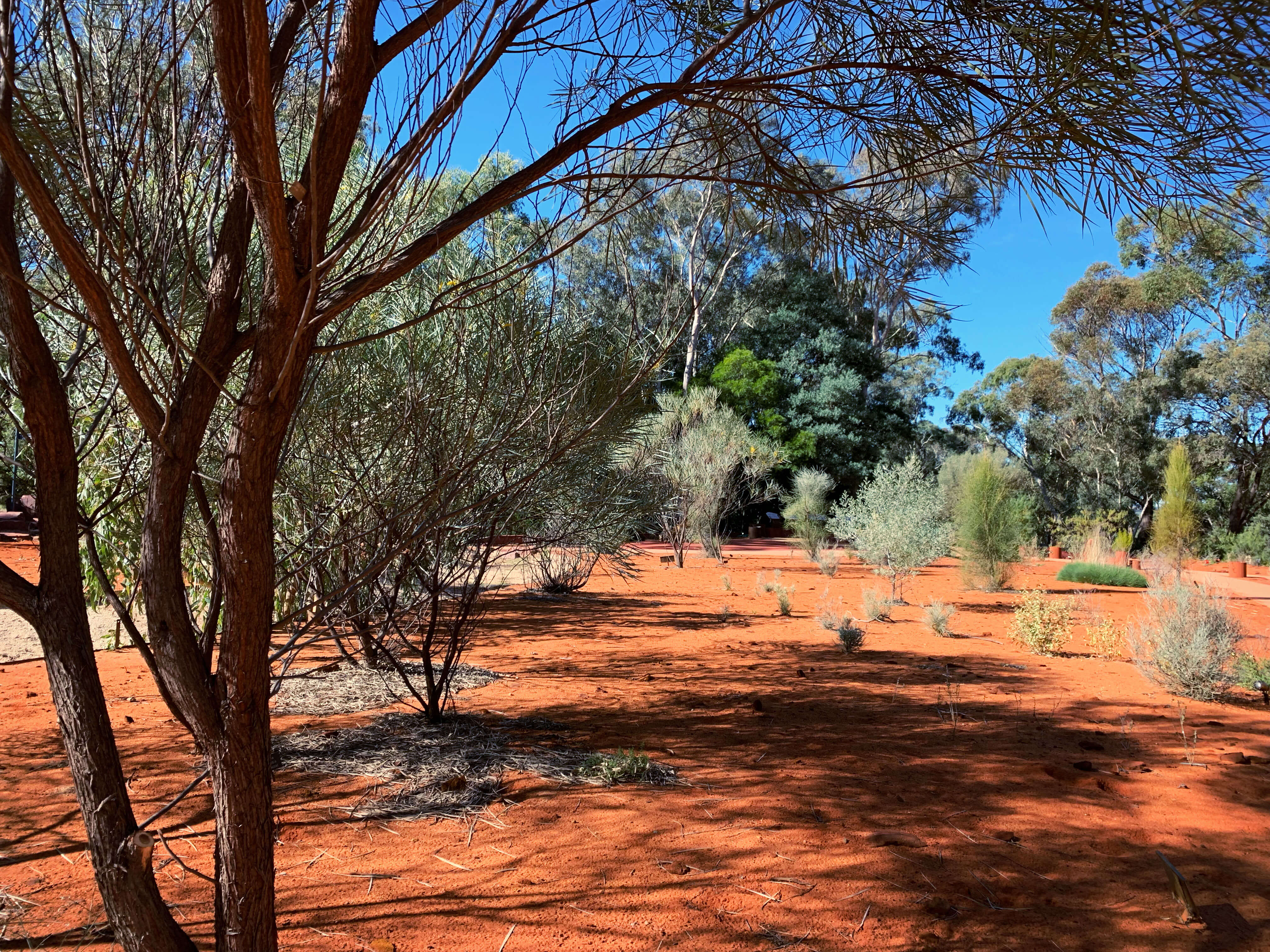
As I headed back to the main trail, I couldn’t help but wonder at the marvel that is Australia. In a single garden, I managed to observe the various temperatures, plant life, and lifestyles that this country contains. I enjoyed the afternoon exploring the gardens. And each moment will remain in my mind just as pleasant as the herbs and eucalyptus plants, just as incredible as the rancid cacti, and just as beautiful as the chilling rainforests.

What if—?

Institutions and rules keep us in check, and tell us what we should and shouldn’t do. Without a religious belief watching over us we’d run amok with madness.

But what if we wake up one day having no memory of a god or religion? What if they never existed?

Well, we won’t have violence in the name of god, for sure. People will be fighting because they’re hungry.

We won’t have loud bells claiming to wake the lord, and waking up the whole street instead.

Men won’t need wear saffron dhotis for three months in the year. Imagine not living in a neighbourhood where the men are all clad in eye-numbing orange every day.

And women won’t have to cover their heads every time they go out. Hats will become a lifestyle choice. And I can wear a scarf to without being called out.

Oh, and we won’t have discrimination in the name of godmen. Sadthus and gurus will be out of business. Holiness would mean… nothing.

Footwear will become comfort, and people won’t torture themselves in the name of devotion.

Flowers will bloom and fade away, intact in plants. Slaughtered meat and alcohol won’t be part of a traditional offering—just Thanksgiving dinners. Or brunch.

Piercings will be a hippie thing—not a god thing.

What if we told the whole world that god and religion don’t exist?

Well, people just might go crazy.

Hold the brakes

I don’t take breaks often. I’m so used to working 12 hours a day and still being available for questions after hours. What’s more, I’ve spent entire nights working, forcing myself not to fall asleep and ignoring the rest my body needed. All because I felt work was my primary concern.

And then I moved across the world. I relocated to Australia, and for the first three weeks, I had to put a pause on my work. I didn’t want to, of course. But I had no choice—I didn’t have a laptop. I felt crippled, but I had to deal with it in silence. It’s only for a few weeks, I assured myself, even though my inner self rejected all assurance. Regardless, being helpless about the situation, I realised one important thing about myself and my work.

I was way too uptight.

Having worked for almost six years without a proper vacation, I didn’t even know what it meant to be free and rid of work pressure. For the first time in a long time, I couldn’t do anything about the work that remained back in the office. My managers were so understanding and supportive. And to be fair, there was already a well-equipped team covering for me. And most of my tasks weren’t urgent either—they could wait well until settled and was ready to take over again.

And yet—it bothered me that I couldn’t work. That’s when I understood how much I was addicted to my job. I work as a marketer and writer for a software company. My everyday tasks involve creating content, reviewing, managing social media and customer support, and answering any questions the new members in our team had. I was missing all that action, and it made me uneasy.

To my utter surprise, however, I survived. I got through over three weeks of doing nothing, and I was still sane. In fact, not only did I spend three weeks unscathed, I was relieved even. It was the first time I wasn’t feeling overworked, and with every passing day, I sensed, as the temperature fell, I also cared less and less about my work. I still appreciated and loved my job, but unlike before, I wasn’t consuming me. I started to see work as just that—work. I realised I could have a complete and enjoyable life outside of work, which I was once so obsessed with and dependant upon.

So—take a break. Please do. It’ll help you distance yourself from your fixations and see that the sky is far brighter than you’ve seen. But then again, I moved to Canberra, and of course, the sky here is bluer than Chennai, south India, (where I lived before) could ever imagine.

One day

A great monument of our time
pictured vague in historical texts
an obligation as a child in school
who called the third world home
a land far away from the others
living life unheard of and ignored
a curious kid in skirt and shoes
with wide eyes, wondering mind
learning from cheap illustrations
and hoping, one day, of seeing
the greatest of all architecture
towering proof of bygone culture

gushing back are those memories
as I see the tower crumble, again
its flying buttresses doubling over
losing strength of years conserved
trembling, tumbles the great spire
with it does all dreams of one day

Troubling lovebirds

As I stare at the blank page on my laptop, I can’t help but get distracted by the birds chirping away in front of me. My new life in Australia started pretty well with great housemates and a cold Autumn. One of my housemates breeds lovebirds—not only because she likes them but also because they make good money.

She’s been doing it for a while now, and so it wasn’t my place to comment or raise eyebrows. She’s even sold a few birds, for about 20 dollars each.

Not a bad deal, I thought when I first heard of it. But the more I observe, the more I’m reconsidering. The marketer in me has begun evaluating the return on my housemate’s investment. Considering bird feed, the cage, nursing the eggs, nurturing the young, the cleaning efforts, and the constant attention, breeding and maintaining birds is an arduous task for which 20 dollars seems a laughable loss.

But it’s her business, and she’s been doing it long before I was in the picture. So I held my silence.

However, as I watched the birds today (for lack of anything else to do), I started wondering why people paid, however much they did, to own these birds. Why would anyone pay money in exchange for years of caring and, in a sense, servitude to birds they could crush in seconds?

Beauty—that’s the obvious answer to most problematic questions. But that can’t be all.

Some people, like my housemate, look at it from a severe business perspective. Of course, she loves the little chirpers and caresses them in her palms, cooing and cuddling even when not so appropriate. She likes spending her time with and for them. But when it’s time to give them up, she’s ready for the next batch.

Some others treat bird raising as a hobby. But even they who look at bird raising as a pleasurable activity still spend a lot of time, energy, and money on maintenance—which makes me wonder why. Why would they expend so many resources to observe caged creatures that grow so finicky the moment you make a sudden movement around them. I only switched my crossed legs, and the two birds in the cage wailed out as if I were slaughtering them. Their behaviour is understandable, too. If I’d been locked up all my life and only given food on certain days and times in a day, I’d become paranoid also. I’d feel so tortured in my mind that I won’t be able to think straight or trust anyone enough to share a conversation.

How is it then, I wonder, still watching the flustered birds, that someone who acquires these birds, makes them sick, and gains pleasure in watching them every day isn’t a troubled soul themselves?