Alicia’s counsellor remained impassive. It wasn’t the first time a child blamed an unsupportive family. But Alicia was different. She hadn’t attacked her parents or run away. She had, instead, hurt herself.
Her parents wanted a boy who’d bring home the Olympic dream. Alicia, however, had dreamt of bringing home the Pulitzer. When her father enrolled her for basketball, puny Alicia had to become athletic. With protein and unprescribed drugs for breakfast, she was ready in months.
Every time she dunked victory, she dunked her passion down, too. Now five years later, banned for drug abuse, Alicia dreamt no longer.
When I was in Pleasanton, my friend and travel partner took a weekend off for Chicago to meet with her friend. That gave me two whole days for myself. And what else would I do than explore the city of San Francisco?
Although I’d hit a lot of popular places the last time I was there, I missed on one important monument: The Golden Gate Park. So I went there that Saturday morning.
The moment I entered the park, a smile came on to my lips—a bunch of kids skateboarded on the street leading to the park. It was a pleasant sight, for I had never seen such effortless skateboarders on street without being afraid of getting hit by a car. In fact, it was the first time I walked without the fear of motorists.
Before going further, I calculated how much time I should spend in the park. Little did I know then how big the park is. My first stop was the Botanical Garden. As I paid for my entrance ticket, the gentleman at the counter handed me a map of the garden and informed me that the 55 acre-garden hosts plants from all over the world. My heart skipped a beat as I heard the number—there was no way I’d cover all of that within the time I had planned. With a skeptical mind, I stepped into the garden.
The entire garden was categorised by region. On my right was Australia and to my left was South America. I went by what was right by me. The deeper I went into the garden the more fascinated I became of the plants. Time came to a stand still and I no longer worried about rushing off to the next place. The scent of living, breathing, greenery convinced me to linger in its essence and absorb the goodness it emancipated.
This slideshow requires JavaScript.
I walked along from region to region, stepping over Peru, walking through the Andes, and swerving around Africa. I stopped at the Redwood Forest and went round and round in search of the Moonlight Garden before realising I had already been there. Name cards lined each plant and tree but none made sense to me. I was no Botany student, and I didn’t know the medicinal values pertaining to the plants. I was, instead, a backpacker, a nature lover, a passionate greenery-seeker who was more than happy to stand amidst teak woods a hundred years old. I cherished the feeling of past, present, and future life all around me. I felt elated.
Somehow it seemed unbelievable that people would flock to such a tree abode when they could be elsewhere doing something else. What I loved most about the garden was the lack of people. Even though there were many explorers like myself, the garden was so huge that I seldom came across them. Although the Botanical Garden was meant as a place to appreciate wild in its wilderness, I realised that garden authorities had to do something for people to visit. That’s why the Botanical Garden has special clearings, tree stumps, and benches—so that people could pose with plants. Perhaps the authorities thought that would be a way to attract more visitors. At least that’s how it seemed to me.
Whether or not the tactic works, it also seemed to me a little pathetic. It’s sad that we have to resort to such measures to appreciate nature. It’s sad that there aren’t many people who’d value the wilderness for what it is. And I know for certain that most people who visit natural reserves and gardens go for the photos.
My suspicion became a conviction by the time I left the Botanical Garden and entered the Japanese Tea Garden across the street. The difference was unmistakable, and it was evident even at the price of the entrance ticket. It was only a dollar more, but as I paid I sensed that the woman at the counter was bored. It wasn’t a mark of how tough her job is, but instead, a mark of how tired she was of talking nice to tourists. When I turned to the garden, I saw an abundance of people amidst manicured plants.
This slideshow requires JavaScript.
To be fair, the plants were mesmerising. But about ten minutes in the garden, I couldn’t wait to get myself out of there. Every side I turned a couple or a group posed with the shrubs. And the plants, too, seemed pruned for pictures. People rushed to reserve their spot near weird-shaped plants. Although the plants radiated a calming sensation, mingled with it came unwanted and palpable excitement that didn’t originate from me.
I’m not against photo taking, for I took plenty myself. But it’s the excess touristy behaviour that made me uncomfortable. Nevertheless, I spent over an hour walking around, musing. With far fewer people, the garden would be a wonderful spot for a quiet afternoon. Not only was it domesticated, but it was also lush. Looking at the photographs I took there, I can’t believe how charming the entire garden is. Sure, I still feel it’s commercialised but it’s also a wonder.
It’s the first time that I can’t decide whether I like a garden. In every other circumstance, I would brim with compassion. Regardless of what I felt, though, the garden is a favourite place for both locals and tourists alike. In fact, a friend living in the Bay area mentioned to me that she adored the Japanese Tea Garden—she speculated it was the weekends that drew the crowd. Perhaps she’s right. Perhaps I chose the wrong day.
But my day wasn’t over yet, for I explored the Golden Gate Park further. More about all that in a part 2 of this post.
For decades now people consider the Golden Gate Bridge as one of the greatest monuments in the United States. It’s the identifying icon for every soul living in the Bay area. Not only is the Golden Gate Bridge the most photographed bridge in the world but it’s also one of the most overrated.
Yes, I said it.
Having grown up listening to so much hoopla about the bridge, there was no way I’d skip the bridge during my visit to San Francisco. Besides, a trip to the Bay area is incomplete without a lame photograph reminder of the bridge. And now that I have plenty of photos to prove I’ve been there, I’ve also acquired some knowledge about the Golden Gate Bridge that’s made it less impressive in my mind.
The Golden Gate BridgeTo be clear, I don’t hate the bridge. And no, I didn’t hear some grotesque story about the bridge’s history. But I did realise that the Golden Gate Bridge isn’t the only awe-worthy construction in the city. In fact, there are more attractions in San Francisco than people give it credit for. Speaking of bridges, though, there’s the Bay Bridge.
When I first saw the Bay Bridge, I was still high above the sea level. I stared down at the bridge through the window in my flight. From up there, I, like so many other tourists before me, mistook the Bay Bridge to be the Golden Gate Bridge. After all, a typical misinformed tourist to San Francisco only hears about the towering Golden Gate Bridge that they have to see. My neighbour in the flight explained my blunder to me, and to pacify me, he also commented I shouldn’t feel bad because so many people make the same mistake as I. That only made me feel smaller.
The Bay BridgeEven when I trudged to the Coit Tower about a week later, I saw the Bay Bridge more times than I did the Golden Gate Bridge. It was so massive that it popped up at every clearing. The Golden Gate Bridge, on the other hand, was shrouded in mist.
The more I learnt about the Bay Bridge, the more I felt bad for the injustice we’ve inflicted upon it. The bridge is the direct road running between the cities of San Francisco and Oakland. It’s a two-deck bridge that carries upto 260,000 vehicles a day, and was opened in 1936—about 6 months before the Golden Gate Bridge.
The Bay Bridge’s international orange-coloured rival, on the other hand, has always been the perfect spot for tourists and suicidal folks alike. And the fact that the mist from the ocean’s heat hides most of the bridge from view is only an additional attractive feature.
I won’t deny that the Golden Gate Bridge is beautiful. I will look at it all day if I could. But I will also look at the Bay Bridge all day. If I had to choose, I’d choose the Bay Bridge just because it’s more interesting. It’s interesting how much we humans under appreciate it despite the fact that it’s as deserving as the Golden Gate Bridge. It’s much like an under valued older son in a family of two boys.
During my trip to Pleasanton, California, I spent a few days exploring the city of San Francisco. Travelling from a developing country all the way up to a developed one such as the USA, I had no idea what to expect except awespiring sights.
When I stepped out of the Embarcadero Bart station and stepped into the streets of the city, I as if I’d walked into a science fiction movie about the future. On either side of the street towered buildings of all sizes and shapes. Posters and banners accompanied the buildings on high pedestals. The street below my feet lined with rail tracks while the sky over my head bore cable car lines. Pedestrians navigated between one another and skateboarders swerved through strollers. Down the street from where I stood, a clock and a sign announced the city’s name in all the grandeur it deserved. Further down was my first peek of the ocean and the supposed sea lions that attracted millions to the piers each year.
This slideshow requires JavaScript.
My friend and I (for she was with me) had planned to take on a hop-on-hop-off bus tour. We reached the rendezvous point, met our bus driver, and got our tickets. We hopped on hoping to see the whole city in a day. Little did I know then that I’d have to come back twice more and still see only a fraction of the city.
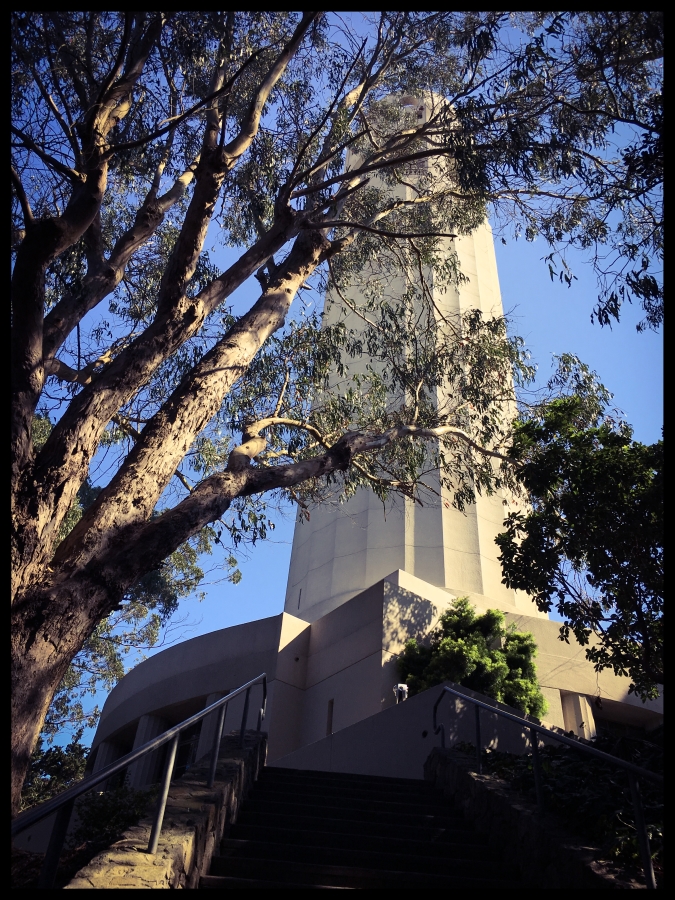
Our first stop was Washington Square. Although I had no idea about the church there, it came as a pleasant surprise of architectural marvel. I didn’t want to spend too much time there, though. I was more keen on the Coit Tower because I’d read that the views are beautiful. And so we trekked to the tower navigating with the maps on my phone. In hindsight, going up the tower was the most touristy thing I had done in my trip, but the journey towards the tower was more satisfying than waiting for the other tourists to give us space at the tower’s window. Despite all the research I had done, I had no idea that San Francisco was all hills. So the path to the tower was strenuous than I’d expected—although enjoyable in every sense. By the time the views took my breath away, I felt glad I’d pursued the trail.
Coit Tower
Back on the bus, we heeded the tour guide’s commentary about Union Square when my friend’s eyes gleamed at the looming buildings. On every side, towering glass structures brimmed with people carrying big brown bags and smug looks. It was the shopping zone of San Francisco. We hopped off, me as an accompaniment. As a heroine in a flimsy movie about an ignorant girl from the visiting the city, I felt overwhelmed by the masses. Containing the balloon of fear that welled up within me, I followed my friend into Macy’s. Unmistakable and intimidating, it was the first building we saw. Inside was a different world altogether. From the breeze that kissed the back of my neck, I’d walked into a rush of people breathing down each others’. Perfumes and deodorants blended while excited voices echoed through the hallway. From a little bakery on the left wafted the scent of warmed butter and chocolate chips. With so many people and too much adrenaline, the place was too annoying for me to enjoy. But it was what it was: a shopping destination for every person. For someone who hates shopping, though, it was pure hell.
While my friend shopped around, deciding, I lingered in a corner passing judgements about the city I now stood in. It was easy: The city is big. Far too big, in fact, touristy, and vain. I didn’t like the city. It seemed to me as if people in the city only cared about living a high life and having fun. Nothing about San Francisco seemed soulful, and I accepted it as a fact I couldn’t change.
So without much hope or excitement, I followed my friend on to our bus, We stopped again at Painted Ladies. We walked up a hill and through a valley of lusciousness before some ancient architecture made my jaw drop. Even as I walked through the park to the houses, I felt my ideas about the city transform into something more liquid. The city didn’t feel hard and cold anymore. I was now at the other side of the city—the side that I could relate. Standing atop the little hill, I looked all around me in shameless greed to take in the beauty of the buildings. The Painted Ladies, I had read, referred to the more than 45,000 houses built in San Francisco between 1849 and 1915.
This slideshow requires JavaScript.
They resembled Victorian and Edwardian architecture and were famous for their many paint colours. The weather had become chilly and as I hugged at my sweatshirt, I felt a rush of love towards the sight I faced. An inexplicable joy ran through my body and at that moment, I felt immense joy realising that the city of San Francisco had something for everyone.
Back on the bus I was trying to understand my change of opinion when our next stop arrived: Haight Ashbury. I wasn’t interested at first, but decided to check it out anyway. And I’m thankful I did. From the strict and straight lives of the city mongers, I had moved into the world of hippies. Even as our bus rode down the street, my pulse quickened and my face cracked a smile. The buildings sported graffiti, people wore their hair long and in colour, and some even skipped while walking. Just looking at them boosted my energy, and I had a compulsive urge to hop off the bus.
This slideshow requires JavaScript.
Walking down Haight Street, I saw quirkiness and unruliness etched in every corner. A sense of rebellion hung in the air making me smile to myself like a maniac. Compared to the corporatism that lived on the other side of the city, here was the soul I searched for. Getting coffee from one of the shops, I stared at signs in most shops and peeped into some.
Evening was upon us and it was time for the next big thing on our list: The Golden Gate Bridge. It’s the ultimate tourist destination, and like any obedient tourist, we headed towards it. Although the Golden Gate Bridge is the most photographed bridge in the world, it’s just another bridge. The Bay Bridge is far more impressive, older, and longer than the Golden Gate Bridge. But despite all of its fascinating qualities, The Bay Bridge has always been under appreciated. What’s sad though, is that most tourists misinterpret the Bay Bridge to the Golden Gate Bridge. Funny how humans conform to the most popular opinions.
This slideshow requires JavaScript.
We saw both bridges, and couldn’t keep our cameras off them. My sensible brain concluded that no matter how many pictures I took, I’d still find better photos online. It was a mere waste of time, but even then, my heart wouldn’t agree. From every corner I could, I clicked away at random.
That’s one of the curious things about San Francisco: It’s almost always filled with tourists making all the wrong assumptions, taking the wrong turns, walking in bike lanes, and gawking at the towers when they should be looking at the street they’re walking on. But even so, the city bore all nonsense with patience. Locals didn’t seem perturbed by the annoying straddlers who had taken over their city for a weekend. They, instead, went about their daily business, with mild smiles on their lips amused at all and the two Indian women trying to decode MUNI.
“We need to act now. For too long now, we’ve talked about saving our planet without doing anything about it.”
Jane had had enough. Her teacher had vouched that the documentary was worthy of her while. It wasn’t. It was just a rant about ancient humans. She sighed. Things had changed now.
Factories were organic now. They manufactured oxygen for trees and people. Vegan pills were meals, fruits superfoods, and meat non-existent. The weather remained temperate, ice solid, and volcanos dormant. For once, the air was clean and so were governments.
Life in 3017 was much different from life in 2017. Promising?