Don’t study English literature

Quora has become a place where you can ask weird questions without worrying about sounding foolish. For instance, I was surprised when I saw that someone had asked why they should study English literature at all.

Having just completed my bachelor’s degree in English literature, I almost laughed out loud. When it comes to studying literature, there are more reasons to avoid it than there are reasons to embrace it.

Literature, like medicine and engineering, isn’t for everyone. When you study literature, you become the dorkiest person in your social group. Friends and family make all sorts of assumptions. Your friends think you’re scared of sharp tools, bad with numbers, and worried about sun exposure. They judge you as introverted and that you’re lazy to leave the couch. Oh, and you’d love your coffee black and might be a good chef, too.

You didn’t get enough marks to enrol in engineering. You can’t get an equation to equate. You’re just a smart mouth who plays with words and thinks they’re cool. You’re too dumb to memorise clinical terms or understand chemical reactions.

You like the smell of old books, instead.

Lots of graduates nowadays don’t get jobs, but as a literature grad, you won’t even find a job description that matches your expertise. No employer thinks that someone who’s spent years poring over Shakespeare and Coleridge and Yeats could offer anything valuable at brainstorming sessions inside corporate cubicle farms. Good luck finding a job and keeping it for more than a week. And retirement is a luxury you can’t afford.

That’s how most of society sees us literature majors — that we’re too weak to live in the real world because they dabble in the glories of the past.

Humanity hates us Humanities folks because we look back and ponder on the evils we’ve etched in history. Nothing much has changed since the Victorian Era. If you’ve studied the Humanities, you should know that in the real world humanity crushes humanity.
That’s why you shouldn’t study literature. You have nothing to gain from it. You get a zero return on investment, unless you count the glasses you’d be wearing by the time you graduate and the social awkwardness that clambers onto your back every time you leave home.

To everyone wondering aloud why they should study literature, I’d say don’t. If you must have a solid reason, reasoned out, mapped out, and planned out, you shouldn’t be studying literature anyway. Because no one should study literature unless it calls out to them. Remember, literature chooses the student.

Points of view

I write a lot of short stories. I even tried writing, what I’m now almost embarrassed to call, a novel. (I was young and determined and I took up the NaNoWriMo challenge.)

But in almost all of the stories I’ve written so far, I’ve gone for the third person narrative. Something about “I” and “me” and “myself” makes me uncomfortable. “She” and “he” and “they” seem easier and natural. Which is fine, I know, except I’m now reading a first-person book, and it’s changed the way I look at the first person narrative.

As I read through the first few chapters of the book, I decided I didn’t like the writing or the flow of the narrative. When I was about to dismiss the author as not my type, I realised that the first person narrative had influenced how I saw the author himself.
That struck me.

I knew nothing about the author and his style of writing. But here I was judging his way of work from just one of his books. I was wrong. A person and a piece of work are two different things.

In the first person for instance, the writer isn’t the author at all. The writer is the narrator, the character. And in the book I am reading, the narrator and the character is a twelve year-old, delusional kid. No wonder I didn’t like the writing—why would a kid, troubled and a smoker, running away from school mind proper grammar and decent vocabulary? What I had considered—for a split second—as a failed writing style soon made me realise that it was indeed brilliant characterisation.

With that revelation, I read on, learning more about the kid and nothing of the author. It’s not the story of a kid as told by an adult, but a story of a kid as told by the kid himself. And that’s where the author struck a chord. He masked himself as a child going into the his mind, abstaining, all the while, from his own adult instincts. That’s hard work. It’s hard, when you’re writing in the first person, to ignore the inner self that nags at you to tell your character to just shut up and grow up.

It’s easier to write in the third person; he called her, she answered him, they fell in love, and then out of love.

But the first person is more effective. I now see how the child’s character develops, what he expects from his life, what the author has in store for him, and how both ‘he’s—the author and the kid—respond to their entwined life.

Some say the third person point of view is the all-knowing, god-like personality. But reading through this particular book, I now think the first person author has more control than the third person author ever will. While the third person author knows what every character is thinking and feeling at the same time, the first person author not only possesses a single character transforming their life from the inside out, but also alters every other character in the story. A first person author is not just the writer, they are the protagonist, the soul of a story, the one person who can change their own life and the storyline as well.

It’s a challenge to write in the first person. A challenge I’d like to take up sometime.

Talk about style

A while ago, I complained that an instruction book I was reading then had no creativity in its narrative. That was a pretty big accusation, considering the author of that book is Seth Godin and it was—needless to say—a bestseller. Although the book had wonderful advice, a pleasing layout with big headings and small, bite-sized paragraphs, even a bunch of clever wordplay strewn across multiple pages, the fact remains that “Tribes, We Need You to Lead Us” was a dull read for me.

I had then dismissed most guide books as dull as Seth Godin’s. I knew they were helpful and worthy in their advice, but I also realised that those aren’t books I’d read for pleasure. They were more like necessary evils you’d have to tolerate because they, in their own weird way, improve your life. And that’s how I had concluded my experience with instructional books that had blurbs saying, “Must read for every marketer” or “best financial advice for the average tax payer.”

It was with almost the same mentality and expectation that I picked up “Style — Ten Lessons in Clarity and Grace” by Joseph M. Williams. It was a part of my reading library at work and I picked that particular book because it had big fonts and reasonable spacing in the margins. Oh, and also because it was nice to caress the thick, white paper between my fingers. Aside from its aesthetic appeal, I expected nothing. That’s why the book caught me unawares spreading within me inexplicable joy, leaving me flicking through the pages to read more.

For the first time in a long time, a how-to-like textbook gripped my interest. It was about writing, and the author explains, with examples, why and how some sentences work and some don’t. Throughout the book, the author speaks of clarity and good sentence structure, which is all classroom stuff; to take it a notch further, however, he also speaks about the ethics of writing and how sometimes, you have to sacrifice clarity and concision because there’s more at stake.

Every teacher teaching writing would say clarity and brevity is the soul of a good piece. It’s important to empathise with the reader, giving them what they need to know, being mindful of their time. Williams agrees, and explains how to write for the reader, but in 10 lessons, 2 two epilogues, an appendix, and a glossary, he also admits that he can’t say how to identify the best way to write. There are no absolute rules to writing because it depends on the purpose, on the audience, on the writer themselves. And unlike so many books and articles that advise on writing, this book addresses that reality of writing.

In addition to the juicy meat of the book, Williams introduces quotations throughout. Every lesson, every chapter, begins with at least three famous sayings relating to the subject he’s about to discuss. To my surprise, some of those words were so witty I laughed out loud. I couldn’t remember the last time I had done that reading a how-to book.

All these were great things about the book. But the greatest thing was the writing itself. It’s not easy to write about writing in a way that readers, who are writers themselves, understand the writer’s intent—a feat that Williams has managed to achieve in an almost effortless way. That’s the actual lure of the book. Anyone who’s written anything knows that easy reading is damn hard writing, and the fact that this book is super easy to read says a lot about Williams as a writer, his process, and his dedication to revise and rethink every first instinct. For me, perhaps that’s the success this book has garnered.

It’s a glorious read for anyone interested in writing. However, for random readers looking to increase their “read” library in Goodreads, it’s just another instructional book.

Of poetry

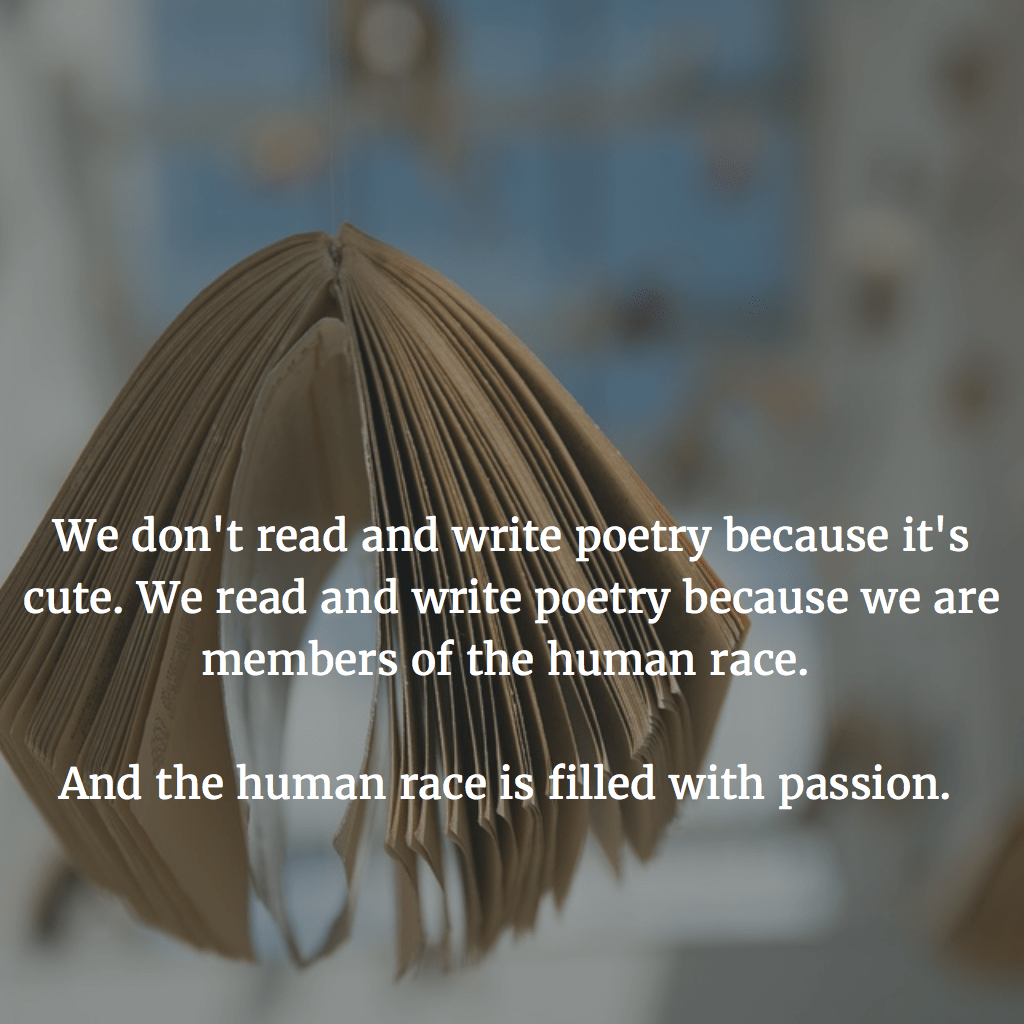
I adore poetry. I try writing poetry, too, from time to time, but I fail almost every time. I still try, though. It’s such a disciplined and sensual form of art that I know I want to get it right some time or the other. How much command over the language a poet must have to express limitless vision in limited words.

It all started when I read Tennyson’s Charge of the Light Brigade. From there, my craze only magnified as I read Wilfred Owen’s Anthem for Doomed Youth and Dulce et decorum est. Those three war poems changed the way I see words and respond to their lure—it’s weird how war is always the starting point of enlightenment.

Once I understood the underlined meaning in these poems, I wanted more. I was addicted, and was desperate to quench the dryness that these poems left in my throat.

I had read poetry before, of course. I had read some of Shakespeare’s sonnets, and yet, these poems were different. Reading Shakespeare requires effort sincere effort and interest. These poems, though, thrust themselves at me. I didn’t have to know the details of war to understand its effects as told by Tennyson and Owen. They inflamed a strong passion in me for simple, yet well-articulated words.

For instance, this one in particular:

“Dulce et decorum est pro patria mori.”

Which translates to: “It is sweet and fitting to die for one’s country.” Ah, the intensity of those words—coming from a soldier nonetheless, who knows what he’s talking about better than anyone else ever would. But what makes it even better is the placement of the phrase: “The Old Lie:”

“The Old Lie: Dulce et decorum est pro patria mori.”

The entire poem walks us through a vivid description of the war zone, and then, we get to the end where the poet claims that all the bullshit stories we tell young soldiers are empty words; lies. Poor Owen, he must’ve believed them all, like the rest of the lot. What a great poet he turned out at the hospital, before recovering and heading to the battleground again.

But that’s the power in good poetry: When said “write”, a writer writes, but a writer who said it right, writhes the emotion out of readers.

Wilfred Owen was one such writer. He made me, the reader, feel what he felt. The pain, the anguish, the heartbreak, and the loss of hope—I felt them all because the poet put them in such an artistic narrative. And that’s why we should read good poems, because like John Keating says, we need science and business to sustain, but we need poetry to live.

And what would we do if not live?