When I leaned over from my seat trying to catch a glimpse of the sight outside, people thought I had gone mad. Who would stare out the solid glass while flying above the clouds?
I would.
And only because I was clinging to the window shade that I could see more than I could grasp in one look. Good thing I had my camera.
No, not the Himalayas. I just wanted to see how it looked in print. I do sound more holy.
Anyway, when I returned from my trip to Sikkim and West Bengal, the weather was only the second thing people asked me about.
“How was the food?” That was the first question. And I had to take a moment to think. In all those five days, I had never thought much about the food. And then I realised, we didn’t eat much at all.
We travelled instead.
We had breakfast and dinner at the hotels we stayed at. But lunch was often a no-affair.
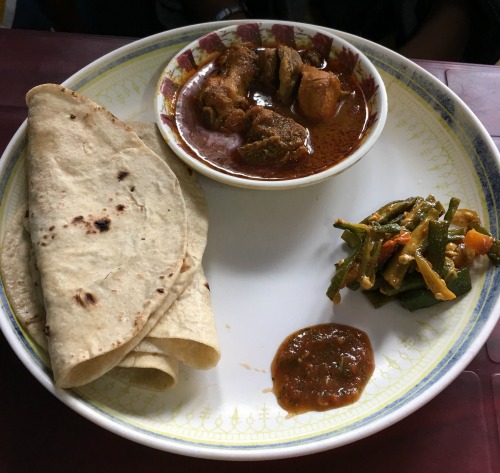
But from what I saw, West Bengal was abundant in chapatis and naans. They are both flatbreads made from whole wheat flour and self-raising flour. As for the sides, all I could see (and care for) was chicken. It’s the most popular dish that warms you up from within. Apart from that, we saw plenty of lentils. Known as dhal, the protein-rich yellow goodness is always a feast — for the eyes as well.
Chapatis with dhal and chicken.
We stayed two nights each in Gangtok and Darjeeling, and both hotels served the normal stuff we eat at home. Though I have to give a special mention to bread, butter, and jam. Oh, and cereal. That was a part of our breakfast on all of the four days we spent there. It’s yet another one of those things that the westerners left us, that we couldn’t outgrow.
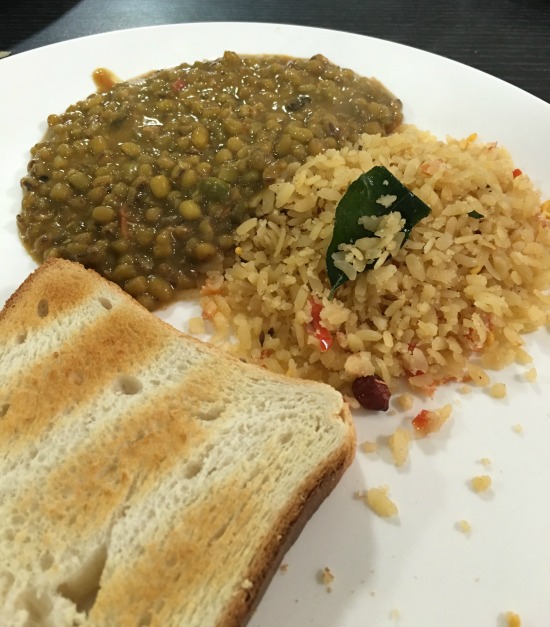
But they also served something to remind us of home. At least until we put it in our mouths. The green gram gravy. One of my favourites. The creamy green grams, mixed with sharp garlic, translucent onions, and indivisible spice — I was all ready devour when my friend exclaimed, “It’s sweet!”
In one heart-stopping moment, the balloon within me deflated. People there add sugar to some of their gravies, and I was unaware.
Bread with green gram gravy. And poha.
And then there was poha. Another familiar item. It’s dried and flattened rice grains, which is soaked in water, drained, and cooked in oil with onions, chilies, curry leaves, and a few spices. It wasn’t sugary, and that was a relief.
A local favourite, I hear, is the ladies finger, also called okra. Locals call it bhindi, and fry it with onions, tomatoes, and spice to make a semi gravy. Bhindi masala, they call the dish.
Chapatis with chicken, bhindi masala, and hot chutney.
And then (trust me I’ve been dying to write about this ever since I started this post), momos.
I have a friend, who’s from Tibet. Who introduced me to momos in the best possible way: She made beef and chicken momos for all our friends. It was the first time I tried the traditional Nepali dumpling.
So when I heard we’d be going to Darjeeling (which is not far from the Tibet and Nepal border areas) I could only think of momos, and my friend. I pledged to myself I’d eat nothing but momos.
But you know how pledges go, I had to settle for sweet buffets instead.
Nevertheless, I tried momos thrice during the trip. The first in a small place called the “Cafe 14 Thousand.” Why the name, I have no idea. We had to climb about 300 meters of a snow-capped hill in Nathu La pass. And this “cafe” sits halfway through the climb. It was more of a shack, and since we were a few of the early climbers, it had plenty of breathing space. They served coffee and momos.
When I saw the little dumplings stuffed in a glass bottle, for an instant, I became the monster staring at the cookie jar. And I’m not ashamed. We bought one plate, which had about seven to ten momos. I took one look at them, and another of my inner balloons deflated. They were so tiny, with far less stuffing than what’s acceptable. My momo-friend would have disapproved — I did.
I had forgotten on important thing: Though momos were a local favourite, Nathu La pass was a tourist destination. Over one thousand vehicles cross the pass every day, including Sundays. Everything there is commercial. My fried made momos because she wanted to show us why she loved them so much. These sellers make momos because it’s their business.
But the chutney, or the sauce, was superb. It was spicy enough to de-numb my teeth and send some electric heat to by fogged brain.
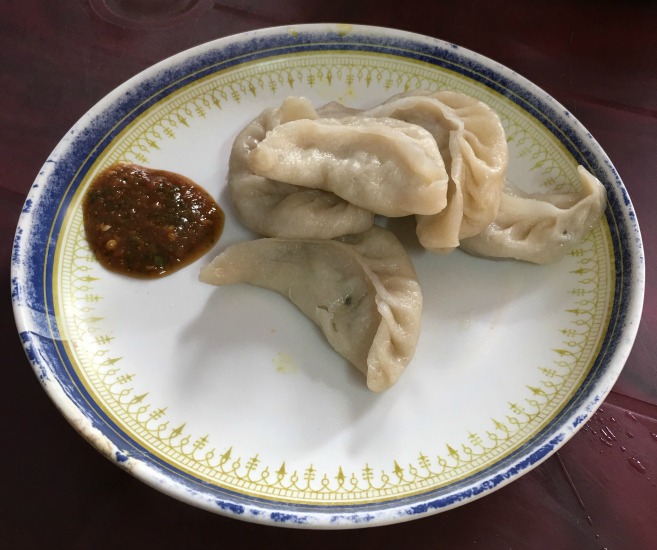
I did another momo-tasting in a small restaurant in Darjeeling. These momos were bigger than the ones in Cafe 14 Thousand. As for the chutney, it was again a spice-fest, so nothing to complain.
Momos with hot chutney.
So about the food in Darjeeling, you get familiar food, in unfamiliar flavours. But it sure is worth a try. After all, what’s life without some variety?
As for the most important thing in all of Darjeeling — the tea — I’ll have to write a separate blog post.
I had never liked standing behind a line. Why would anyone draw an imaginary barricade between themselves and the world beyond?
Having lived all my life in the southern part of India, I had often crossed district borders. But the thing with that is that it had no restrictions whatsoever. Just once when in school, I travelled to Kerala — another state altogether.
That’s all the border-crossing I had done. But where’s the fun in doing stuff without a rebellion?
For the first time in my life, I experienced snow. And though I wore three layers, the cold still got to me. But here’s the best part: I climbed a three-hundred-metre snow hill to look down at the most amazing sight in my life. The Chinese border on my left and the Indian on my right.
The temperature was -6˚C. But it had nothing to do with the goosebumps that rose on my skin. My deepest desire stared back at me through the mist, and I stood transfixed in joy and pride.
That day, I realised I had just crossed off something in a bucket list I didn’t even remember making. That day, so many childhood memories came rushing back to me. I relived that warm summer night — I was only five — when I first told my mother I’d like to someday stand in between two countries. With one foot on one country and the other on another.
It was the best day of my life. It was the day I stood at the base of a near-frozen lake, with the cold piercing through every nerve of my body.
It was still the best day of my life.
Having lived all my life in a 30-above temperature, the sudden shock of falling ice and heat was more than just a life-altering experience.
It was the day I felt proud of myself: I had made it without falling ill. You’d think it’s easy climbing a tiny hill of about 300 meters — so did I — but it was far from easy. Despite a pair of normal socks, a pair of woollen ones, another pair of thermal socks, and rubber boots, I could barely feel my feet. My woollen gloves and the rented rubber ones didn’t stop my hands from going numb.
And we had a half hour to climb uphill and come back down before we ran out of oxygen. It was a battle against time and nature’s most freakishly beautiful phenomenon.
I don’t exaggerate.
When ice shards sting into flesh that’s only accustomed to heat, you’ll know what you’re made of.
And I realised I am made of stern stuff. I don’t just survive, I enjoy. And that revelation means more to me than anything else.
And that’s why it was the best day of my life.
Wonder what the hell I’m talking about? Details and photos coming soon.
I’ve been writing for a bunch of different audiences for a while now. And I realise why a writer needs to write for herself.
We know: Writers write.
But to whom?
Most often than not, writers write for someone they don’t know. In case of a blogger, the audience is their readers.
But for a writer working for a corporate, the audience is much wider, ranging from tech experts, to teachers, and even doctors. And oftentimes, the writer is so focussed on conveying a point to so many people, that she forgets that there’s reader within starving for attention.
When we write, we talk. We convey out thoughts to another person in such a way that we hope they understand. But do we even understand ourselves? Do we ever feed our own soul?
When we’ve been writing for so long for others — to meet criteria that fit external causes, to write in a way that others would agree or appreciate — that we lose our sense of personality.
We become writers who write what needs to be written. In other words, we write whatever we need to, to get the point across. Or, being honest, to pay the bills.
What’s then, the difference between someone who chose a professional career because that pays more and a writer who chose to write because she wanted to write?
If a writer is to survive (soul-wise), she needs to write something other that what others tell her to write. A writer needs to write imperfect prose. Because no one who writes for themself cares how it reads, it’s all about communicating your deepest desire; not just getting the right tone, the right call to action, and the perfect sentence length to match the design.
And sometimes, a personal journal is the way to go. Think about the days when you could just go, “Dear Diary, Jane was mean to me today…”
There’s something reassuring about writing to yourself. Because when you write to yourself, you write for yourself.
When you just let go of all the restrictions of a writing job, you understand there’s a whole world of ways to say the same thing. It gives you a shift of perspective your narrow-minded job would never approve of.
And that’s the beauty of it. When you’re just writing to make yourself smile a little wider each day, you see that it doesn’t matter what others think of your writing. It doesn’t matter that the word choice is a little awkward or the pun is too abusive, or, that your sentence has no emphasis at all.
Because when you write for yourself, you’re free to write.



 The Chaos Within