Let It Go

November 24th 2013. The day I felt most proud of myself. It’s still unmatched.
let it go

That was the day I finished my first draft of my first full-length novel. I had taken on the National Novel Writing Month challenge and succeeded. We went to the beach that day, and I soaked my feet in the salty depths of the ocean, while my heart soared beyond the setting rays of gold.

I had completed the longest writing project I had undertaken. And every one else my age was shuffling about, preparing for the semester exams. Fifty thousand words in less than thirty days — I still look at it as my biggest achievement.

And like every NaNoWriMo participant, I pledged to myself not let go of my work. I promised I would edit my draft, and then edit it some more, until it’s good enough for the eyes of a professional editor. I made a plan, I sketched out how I’d work and planned to get my novel published within a year.

In the days that followed, I tried editing, but I kept dozing off on my laptop. I kept telling myself I deserve some rest. Three years later, I’m still editing my draft. But I rested way too much. Now every time I open up my draft, I stifle a yawn.

I’ve come to a bitter realisation. My novel is boring. If I can’t get through it myself, how’re others supposed to?

So I forced myself to make it more interesting. I tried reworking one sentence in one chapter at a time. But it was hard. I had put it to rest for far too long that I had changed so much from the person I was when I wrote it.

I had been in a writing job, and when I look at my draft now, I can see all the blunders I couldn’t see before. I had grown as a writer and an internal editor, and as the person I am now, I can’t revive that piece I wrote three years ago.

I am now a mature writer, I know the perils of using too many passive sentences, the rules of a semicolon, and the effect of an adverb-stuffed piece of writing. And then I see my own work, and feel dejected. I see all the mistakes I now try to avoid. And when I set out to correct them, I feel like I should rather scrap the whole thing and rewrite it. Even the plot seems too weak for a reader to get through third chapter.

So now, it lays there. Taking up most of the my storage space on Evernote. I don’t think reworking the story would do any good. Perhaps I should just let it be. As a reminder of my dedication. As a testament to my ability to show up everyday and write. It’s one of those things you don’t brag about but swell as you think of it.

So, I’m ready to let it go. I tried publishing it on my blog for National Blog Posting Month. I got a few regular readers, a handful of likes, and a couple of comments. But that’s all. Maybe it’s time to put it to sleep, and try again. I’ll try another NaNoWriMo, another story, another fifty thousand words. And maybe this time, I’ll write it proper and edit it sober.

Live, Learn, Pass It On

I’ve always loved to talk about formal education. Or the futility of it, rather. And I enjoy people who talk about it too. But Sir Ken Robinson isn’t just another person talking about how education ruins our lives.

He’s British. That matters, but only because the accent mesmerises me. There’s more to this TED talk than a flawless speaking style.

John Lennon said, “Learn to smile as you kill.” Perhaps, Sir Ken Robinson took this to heart. Because throughout the video, he never once stops smiling. He’s not angry; he’s not biting his tongue to keep himself from swearing — though I would’ve enjoyed it — at schools that forbids children to dance without thinking, making them memorise theorems instead.

His words are brilliant.

“The education system has mined our minds in the way we strip mined the earth.”

Defining the body: “It’s a way of getting their heads to meetings.”

Here’s a small request: Please spare 20 minutes of your day for this talk. It’s so good, you’d never regret it. And maybe some time, even we could influence a child to draw out of the dotted lines.

Over the Block

One day, I woke up, got ready for work, walked all the way, and switched on my computer to realise I couldn’t write a word.

the office

And that depressed me more than anything else.

Because I was stuck. It wasn’t a new feeling, of course. But when you’re getting paid to write, you can’t complain of bad days. I couldn’t bear the creeping guilt that gripped my throat forcing me to stare at the page that refused to fill up by itself.

Every new mail was torture. Every new chat message, every request added to the burden. I hated myself for being at work and not working. For not being able to work.

Some people played carrom in a corner. Their “boss” had taken the day off, so they had a field day too. They triggered my already-short temper; they laughed in high spirits while I tapped away on my Mac trying to make something sensible.

Yet some others packed their stuff, calling it a day. They had worked for eight hours straight scrutinising their code, evaluating, and reviewing their program. And here I sat too guilty to even open Buzzfeed.

Then there were the others who always had too much to do than they could ever manage. They had their eyes glued to their screens, shoulders hunched towards the black (square) hole that seems to vacuum them into its depths.

And here I was, wondering if I should add an extra tablespoon of peanut butter in my toast every morning. Even after four cups of coffee, my page was still blank. One of my friends understood. Or at least thought he did.

“Shit happens, dude.” he said, ruffling my hair and winking at me as if that should reassure me. That never reassures me. Not being able to do the only thing (I pride) I can do is not a case of shit happening. It’s more like the case of my entire life becoming a pile of shit.

Still, nothing. I looked through the window. We were high up on the twelfth floor, and the minuscule world below me seemed immaterial. Hundreds of vehicles, carrying thousands of people, trudged their way through jammed streets. Each honking as if the world blow up unless they had their way. But I slumped like a blob of pudding without the inspiration to write even a rhyming couplet.

I turned to the heavens for a hint. For a flash of enlightenment, something to help me unstuck myself, and restart my work. I saw what I see everyday: The sun giving away all her glory to anyone who cared to appreciate. It was cloudy like any other day. Yet the sun shone through all that clouded her vision.

And I wondered: Why couldn’t I write a piece that would shine through the same cloud that protects it?

I wondered. Still, nothing more than this.

The Rope Car Ride

“Oh, rope car. Would’ve been a great experience, huh?”

When I heard we’d be riding on a rope car, my imagination went wild. For about five seconds, every thriller and every adventure movie I had ever sat through flashed in front of my eyes. I thought of heroes hanging on a rope so weak that it would give away at any moment. And that image disappeared to be replaced with famous love scenes set in a fancy snow-capped mountain with the heroine banging her fists against the car’s glass while her evil father’s hunch men tortured her lover down below. I could even see her tears freezing in the icy cold.

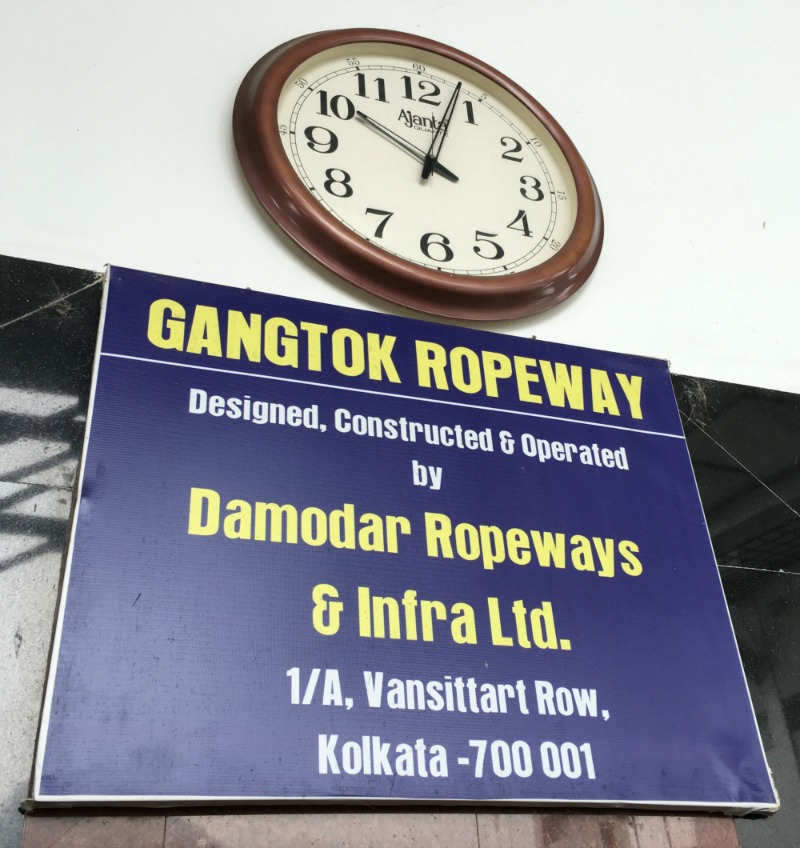
ropeway

So when they told us to get on board, I shivered a little. From uncontrollable thrill. But as we approached the car, I saw that it showed no signs whatsoever of having carried a distressed Juliet pining for her Romeo. Why, it was just a hallow red box with glass panes for windows!

We climbed in and the guard locked the door shut. I looked around, it wasn’t what you’d call an average car. It was more like a small railway compartment. Only a little cleaner. Otherwise, it had similar flooring, the unmistakable “No Smoking” sign, and the — all-too-familiar — congestion.

They allowed about 20 people into one car. We all had some standing space and had to make some more to reach out for groupfies. I turned my focus to what mattered more: The experience of riding a rope car.

The noise gave it away. We were about to soar.

The me within me — the one who isn’t embarrassed to squeal in excitement or applaud in enthusiasm when in public — stood on the tip of her toes. This was bound to be a treat.

My friends had been shifting about talking in such excited tones that we didn’t realise when the car began moving. When we did, however, it was like someone had grabbed my treat away. We felt close to nothing. We were so-called soaring slower than my slowest walking pace.

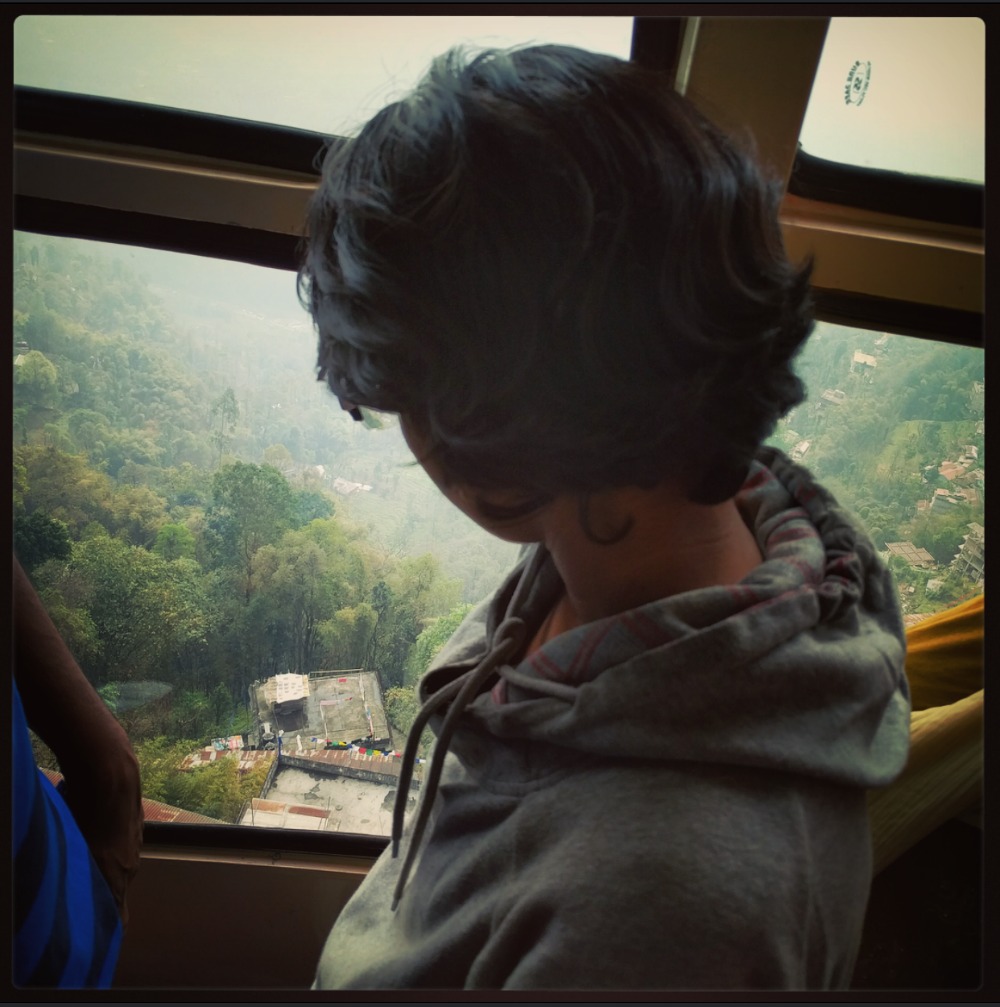
But, I stuck to my corner, hoping to look down at the beautiful world below. I felt like the all-seeing, as if I couldn’t even miss that little girl in her school uniform being mean to a squirrel.

But I couldn’t see all.

rope car

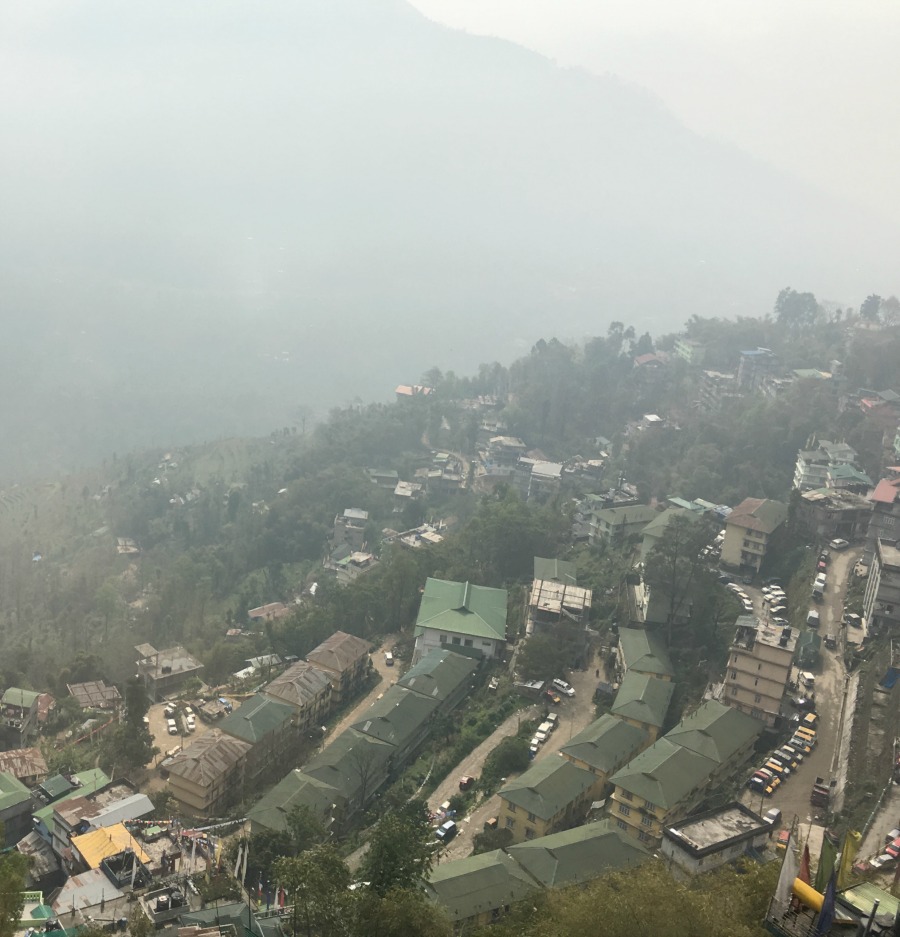
All I could see was asbestos roofings and garbage strewn all over the land. It wasn’t worth standing by the window. There were no flowers and no lush greenery. The movies had misguided me. Again.

It was painful to look at the harsh reality of that corner of the city. It was all the more difficult to digest the sight because I know Gangtok is a tourist destination.

up above

But it is a city like any other. And where there are people, there’s bound to be a face you don’t see in brochures. Because that’s inevitable. People being people isn’t a pretty sight.

Having replayed that entire day in my mind, I turned to my father, and his question.

His eyes had lit up in awe. He looked thrilled at the idea of skirting through the sky, defying all known laws of gravity and Earth-binding responsibilities.

I looked into those ageing, black holes and replied, “Hell, yes!”

I Fell in Love with Writing. Again.

I love my life. Because I write for a living, and writing is my passion. Sometimes I write good stuff, and sometimes crap I’m not proud of.

I fell in love with writing.jpg

Whatever I write though, I edit. People say crisp sentences are strong, and have a stronger impact in the reader. And that’s why I taught myself to “kill my darlings.”

And during one of my self-editing sessions, I fell in love with the language all over again. Because I learnt an important lesson: Longer sentences can be strong too.

I had this sentence.

Writing is one thing technology can’t conquer, because writing is human.

My internal editor went berserk, and we ended up with this.

Writing is human, and technology can never conquer it.

At first, both sentences made perfect sense to me. And then I read and re-read them aloud. And that’s when it hit me.

Everything about these statements was different.

Writing is one thing technology can’t conquer, because writing is human.

The sentence starts with “writing”. That says writing is important. And then it says why writing is important. Because it’s the ‘one thing technology can’t conquer.’

It’s ‘the one thing.’ That’s to say, writing is beyond all things technology can conquer. We acknowledge the power of technology, but declare writing is more powerful. And why is writing so powerful? Because, ‘writing is human’.

When you connect writing with being human, it’s clear that technology isn’t. It’s emphasising the obvious. But at the end, writing seems in the better light, because we can relate to it as human — that it’s the one thing unhuman technology will never conquer.

There’s emotion in this sentence. There’s human.

And then there’s this.

Writing is human, and technology can never conquer it.

The sentence, again, starts with writing. But, instead of a period there’s a comma — a pause as if we’re waiting for something important — and then comes the phrase, ‘and technology can never conquer it.’

I read this line, and realised: I had combined writing and human in one phrase, and added technology in the immediate next. It had deteriorated the power of writing which was evident in the previous version. The emphasis, now, had shifted to the word “technology.” But as a reader, I’d be reading out ‘technology can never conquer it,’ in just one breath — not a breath-taking line.

I had confined the most important part of the sentence to the first line, and made it sound bland. With the comma, I had brushed aside the human element in writing, and focussed on technology instead. And that had made the whole sentence more of an observation than an emotion.

Sometimes, we say things in an impulse, in an emotion. And sometimes, this spontaneity needs much editing before anyone sees it. But in some odd cases, we just over-edit. That’s what happened to me.

I wrote, I rewrote, I read, and re-read my words. And when I saw the difference, I felt a rushing love towards the English language. How can a language be so beautiful, and so complicated at the same time?