The Holiday Staple

November’s just gone by and December’s just stopped by. It is the holiday season; we eat a lot and talk a lot, without ever a mention of our weights. It’s the time of  colder nights, boozy days, and guilt-free indulgence.

Nothing’s more indulging than some good ol’ chocolate. Besides, it’s not this time of the year without it.

its-not-this-time-of-year-without-chocolate

Breaking Inertia, a Cookie at a Time

On my first trip to Pondicherry, I had gone with my over-protective parents and my over-supportive brother. And so, we had to stick to the basics; we didn’t experiment with new cuisine, we didn’t have ice cream, we didn’t stay out after eight, and we never skipped breakfast.

This time, however, I went with a friend. It was easier to try various foods with her than it had been with my parents. She was much more adventurous than I, daring to drink orange juice just fifteen minutes after a cappuccino. And though I preferred to savour the lingering effects of my cortado than to wolf it down with sugary juice, I didn’t say no to trying new cookies. Vegan, they were, and chocolatey.

breaking-inertia-vegan-chocolate-cookies

Perhaps that doesn’t read as dramatic as it sounded in my head, but that’s because, for me, veganism is an expensive affair. It’s something I’ve always wanted to try. But where I live, being vegan costs you at least double of what being non-vegan costs. It’s a treat I couldn’t treat myself to too often. I can afford it once a while but making it a lifestyle — just for the sake of an adventure — isn’t wise.

In Pondicherry, however, we found a bakery that sold vegan chocolate cookies. My eyes bulged at the name tag while my heart soared at the price tag. It wasn’t too pricey. I bought a pack, because no matter how it tasted, I knew I’d appreciate it.

I don’t like sugary stuff, but I’m always game for chocolate cookies. And making the perfect dough and baking the perfect delight is an art I’m trying to understand. So when I saw the vegan cookies, I grew curious, not just for the taste, but also for the ingredients. Since vegan diets shunned cow milk, I wondered if they had used coconut or almond instead. And I wondered which butter they would’ve used. And the sugar — did they use brown, white, fine, caster — perhaps stevia, or agave?

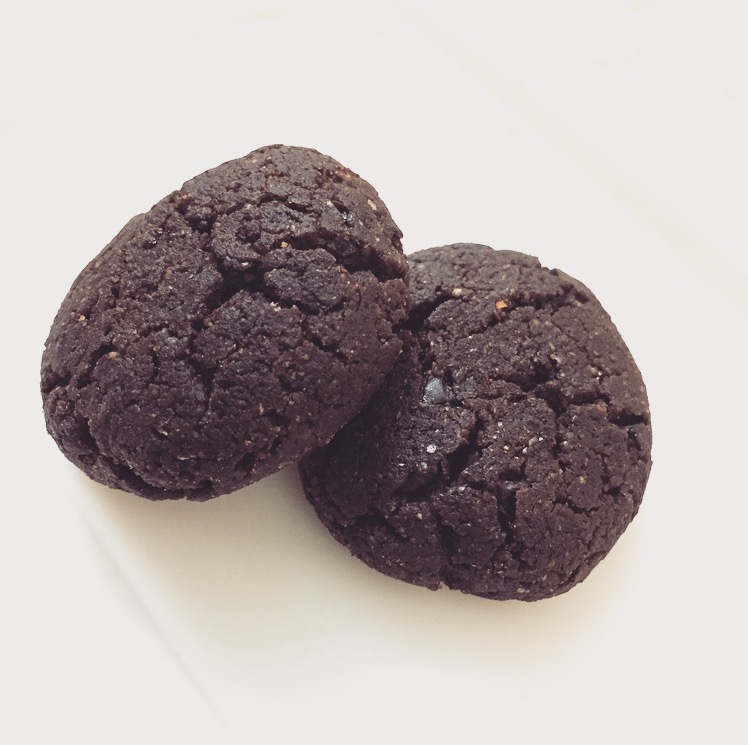
With questions buzzing in my head, I picked up a single cookie and held it in both my hands. It was much smaller than a standard cookie. And yet, the cracks on the surface intrigued me. It seemed dry, and cookies are either chewy or crumbly. I wondered which category vegan cookies fell into. Holding the cookie in my fingers I tried to break a piece of it. It didn’t budge. It didn’t crumble. Chewy then, I decided and gave it a little more pressure. A small brown piece broke off of the cookie.

I looked at the other piece and saw that the inside was also pretty dry. It had no Instagram-worthy chocolate sauce oozing from within, and neither did I see chunks of chocolate chips broken in half. It was plain, and it looked dry.

I put the piece I had prised away, into my mouth. My first thought: it had no overwhelming sugar. It wasn’t mushy, it wasn’t hard. It wasn’t too dry either. As I bit into it, I could chew the buttery flour while the cocoa flavour seeped down my tongue. It felt rich like a brownie, and the crumbly-chewy texture lingered long after the piece had gone down my throat. And then I realised that they hadn’t used any sugar or artificial sweeteners. They had, instead, used honey.

Huh, I thought to myself. Honey. It made sense. Honey makes everything it touches a little chewy and sticky. Perhaps it had made the cookie how it was.

I grew curiouser and curiouser. Perhaps another bite of the cookie would clear it up. And it did. It was honey, I concluded.

Unless, it was something else similar to honey, something I couldn’t recognise. Another one wouldn’t hurt anyone, I thought and grabbed a second cookie. And then a third. And a fourth. And before I knew it, I was down to the last cookie, and I still had doubts. But I knew one thing for certain: I loved the various flavours that vegan cookies blew up in my mouth.

It was worth another trip to Pondicherry.

An Unforgettable Ride. One I’d Rather Forget.

On a normal day, there’s not much to say about a two-hour bus ride. Unless you’re already late and have less than twenty hours to explore a city of French croissant, Italian pasta, soulful coffee, and sinful chocolate.

In that case, a two-hour bus journey is one hell of a ride.

When it comes to planning and preparing an itinerary, everyone’s an expert. We aren’t any different, my friend and I. We’d planned to leave at 7.30 am, and I even chipped in saying we could leave earlier, too, if we could manage to. By the time we reached the bus stop at 8 am, we’d already missed a few buses that would’ve gotten us to our destination on time. When we, at last, boarded the bus towards Pondicherry, we took a deep breath. It seemed like we had crossed one great barrier: waking up early when the chilly December fog still pressed onto our bedroom windows.

And then came the next barrier: The great Indian problem of over-population and the people’s urge to travel. Squishing ourselves in between giant arms and travelling bags, we got tickets to what we knew would be the final stop of the bus. We had a long way to go and the crowds seemed unwilling to thin out. We stood for a while, jumping up and down to the speed breakers on the road, and dancing to and fro as the bus swerved to avoid potholes.

About a half hour into the ride, we found a seat. Being gracious and accommodating, I offered it to my friend, preferring to stand myself. Most people disapprove when I stand and hold on to a seat handle, but I had always felt comfortable standing. After all, when you’re five feet tall and sitting on a seat that’s your eye-level, you get to see a lot of stuff that you’d rather not. I love staring out the windows, but on an aisle seat, all I see is big butts. And I cannot lie that I don’t mind.

And so, I stood, jerking this way and that and looking at the watch whenever I could risk taking my hand away from the pole that I clung to. The first time I checked, it had been only an hour since we had climbed on. We had another hour and a half to look forward to, and I was looking forward to it less and less.

Meanwhile, my friend sat hugging her and my bags, looking as miserable as I felt. As we lumbered on, the crowd in the bus thinned and thickened from time to time. The scenery, however, grew greener; we were riding deep into villages.

But the more paddy fields we saw, the more skeptical my friend became. Perhaps, she doubted, the driver had taken a detour into all the tiny villages, dropping off and picking up villagers, and would take longer than Google’s fastest route. She checked the map, and sure enough, we were headed into a small unknown area that took us further from our destination. Estimated time was over another hour and a half.

She panicked. I was frustrated. So much so, that I couldn’t even bring myself to swear at the driver. I found a vacant seat by the window, grabbed it, and set to finish reading 1984.
My friend stood up from her seat, a valiant look in her eyes. She had decided to talk to the conductor. A minute later, she came back, a weird look on her face. She opened up Google Maps and checked the route again. We were just 20 minutes away. That was much sooner than we had expected in the first place.

She explained: Our driver had taken a route less travelled, a route that didn’t show on Google Maps. Technology still has a long way to go.

All of a sudden, the journey wasn’t tiring anymore. The roads had become smooth, a few grand old buildings whizzed by, a couple on the bus smiled at me, and soon, a woman showed us where to get off.

We had arrived. On time.

The Real World

Over the past few weeks, every colleague stopping by my desk would take a look at the book next to me and remark that it was such a classic story. I smiled when it happened for the first time. I had known that, of course.

And yet, as more people said the same thing over and over again, I began to get annoyed. I felt like an idiot because I hadn’t read the book for so long. It was 1984, after all.

The book, and not the year — in case you were wondering.

Now, however, I’m done. I’ve finished reading the book and I feel like kicking myself for not reading it sooner. Nevertheless, the book left me astounded, wondering if there was anything in my life that I think is true is indeed true.

It left me with a deep sense of insecurity and self-doubt. I do realise that it’s fiction, but it oozes reality in so many levels.

I’m a minimalist, but I would never apply the same minimal logic to words and human expression. When it comes to speaking and voicing thoughts, the more ways to say it, the better it is. But here’s what scared me: I agree that we should get rid of stuff that mean no meaning anymore. In that sense, when the concept of freedom itself is no more, it makes sense, in certain sense, to eliminate the word altogether — or forget that we even had such a word. But even to think, for a moment, that we don’t need freedom is a messed-up way of life.

And that’s what the book did to me. It messed me up. It messed with my head, and my ability to cope with the reality of the world. It’s possible that our world would become the next Oceania. The Party is, of course, just a bunch of power-hungry people craving to keep the masses out of their way and the working class in their wake. It’s the reality of every nation in the world. There’s just a tiny tipping point between a real party and the Party. Every day, we hear news of people gone missing, of people rebelling, of the rebels who died in battle, of torture and murder, even suppressed free thought. It’s all happening, each day all around us, right in front of us.

And yet, we call 1984 a fiction. It’s not. It’s our lives. Only, we love the Party too much to realise the truth and think for ourselves. In a world that still penalises people of other beliefs, advocates singularity, and abhors variety in even skin tones and vocal chords, it’s only a matter of time before two plus two become five.