The unexpected

Our world is full of tiny surprises. Each day I walk down the street, I see something new and eye-catching—a bud blooms while another flower dies nearby, a bee buzzes around my ear while a silent caterpillar crawls by my feet, a child waters her begonia while another picks a rose for her mother—it’s little things like these that bring out the beauty of living.

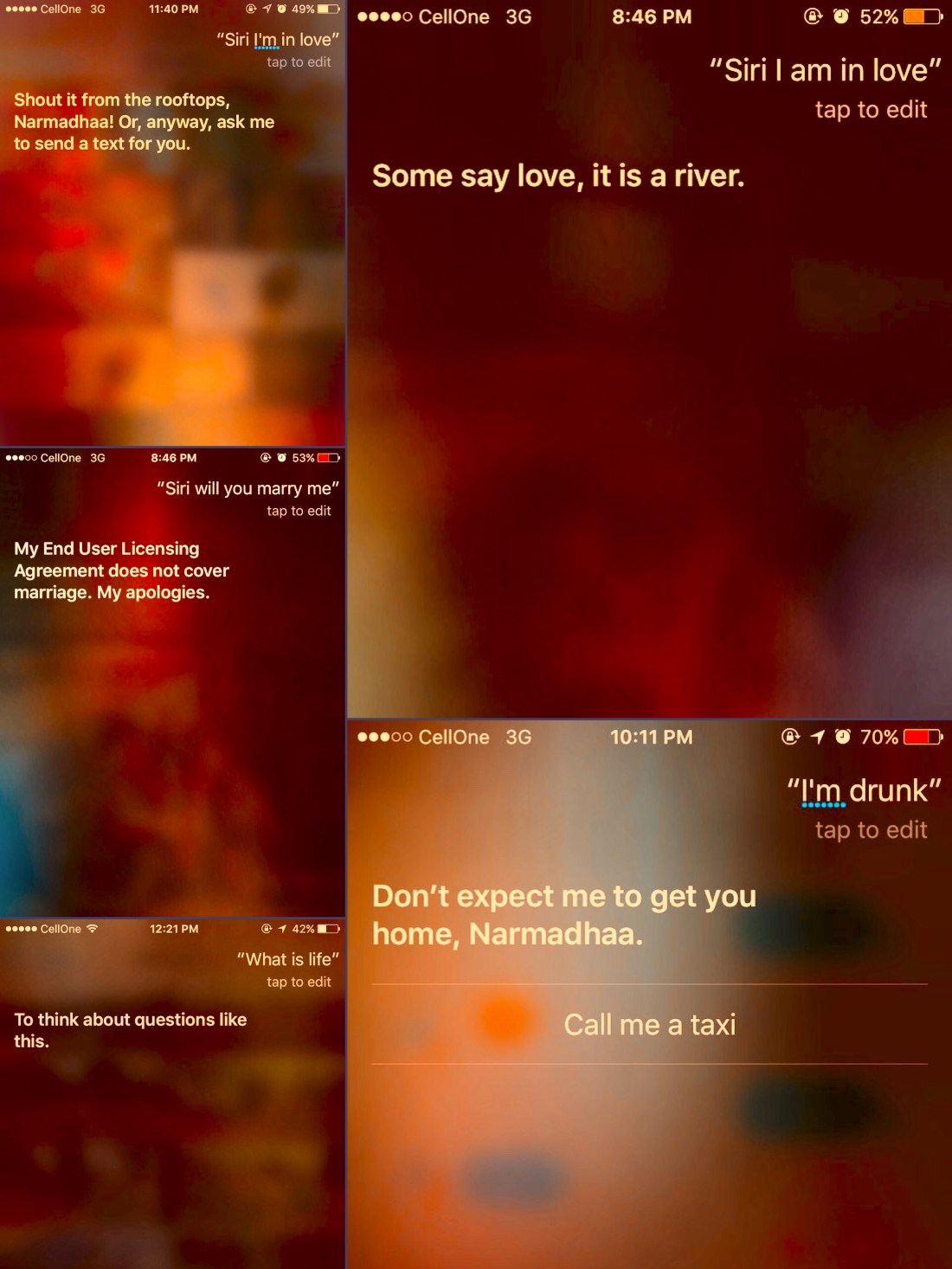
And then there’s Siri. Out of no where, Siri has the most surprising answers to the most uncanny of questions.

Nature makes life worthwhile, Siri makes technology.

Siri


Nice rice

I grew up eating rice and all things rice-based. It’s the staple of where I live and it isn’t uncommon for people to eat it three times a day. Except that it made me sick—not in the literal sense, but because I’ve eaten so much of rice already, I can no longer stand the thought of mashing up the soft grains between my fingers, mixing it up in spicy gravy before wholfing it down like a starved dog.

After doing that for more than fifteen years, I got bored. And just when I thought nothing rice-based could surprise me, I had sushi.
Sushi madness

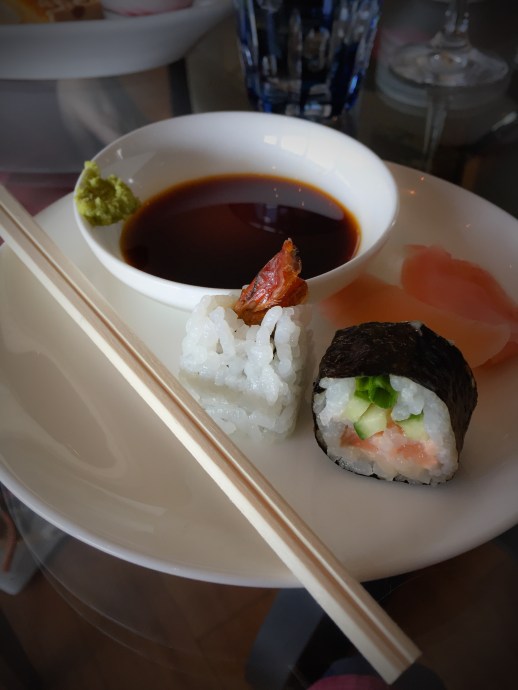
I was out for lunch with friends when I saw sushi for the first time without through a camera lens. In a large platter were tiny, delicate, rice rolls, wrapped in a black parchment paper-like, yet edible, material. Some of the rolls had the wrapper, some didn’t. Some had mild pink salmon peeking out, some had cucumber slices while some others had the tail of a fried shrimp jutting out of the top. My eyes popped at the shrimp tail and I reached out for one (okay, five). The waiters had left tongs nearby so we could serve ourselves and save ourselves an embarrassing encounter with chopsticks.

However, I had to take a pair of chopsticks back to the table with me because it would be silly to eat sushi with my hands or—the horror—a spoon. Along with the sushi rolls, the waiters also put a tiny bowl of soy sauce and a plate with green paste and picked ginger, all the while staring in apprehension at this weird woman who preferred to eat sushi without knowing how.

Back at the table, I eyed my sushi rolls wondering if they would fill me up. Five seemed too few. I spilt my chopsticks and one of my friends adept with the tool taught me how to hold it. I had thought rolling up rice between my fingers was funny enough, but chopsticks took it to a whole new level. When I managed to grip the chopsticks and grab a roll, I felt like a champion. The Japanese have a divine approach to food—healthy, colourful, and so damn hard to get hold of.

I picked up a non-wrapped, cucumber-peeping roll, and before it could fall off my chopsticks, I put it in my mouth. A burst of flavour met my unsuspecting tongue. Soy sauce and wasabi were a weird combination. I love spice so the wasabi wasn’t too spicy—but its flavour surprised me nonetheless. It was hard to imagine something so green, so pleasing to the eye, could be ruthless to some palates. And then there was the ginger, pickled ginger that stung my tastebuds making me reach out for more even without me realising it. Every bite I took unravelled the packed rice and the cucumber within, while the flavours of the soy sauce, wasabi, and the pickled ginger seeped through exploding in a nonsensical, yet wonderful, sensation in my mouth. I kept chewing, trying to get through to all the different tastes that the tiny sushi roll had dropped in my mouth.

I next went for a shrimp roll. It was the same thing all over again, but with the crunch of a shattering shrimp tail and chewiness of salty sea weed.

Despite its tininess, I couldn’t eat more than three because the rolls had a handsome portion of rice with a lot packed within.

At the end of the day, though, I had developed a new kind of love for rice—rice to me is no longer just boiled grains soaked in steaming, tangy, gravy as I had eaten all my life, but rice is also a delicacy and a supple bundle of surprise that’s small on the outside and big on the inside.

A reason to follow

“Love! That’s no reason to follow blindly. What if he gets bored with you and pushes you off a precipice or something?”

“He won’t.” Jess replied in earnest. Jason had already defended her once, and she knew he would forever.

On their first encounter, he saved her from a bully. He then went on his way, but she couldn’t. She stood there every day after that, and he smiled at her as he crossed. The simple friendship soon turned serious, and he took her to meet his parents. They refused. They didn’t want their son to bring home dog ticks.

Of poetry

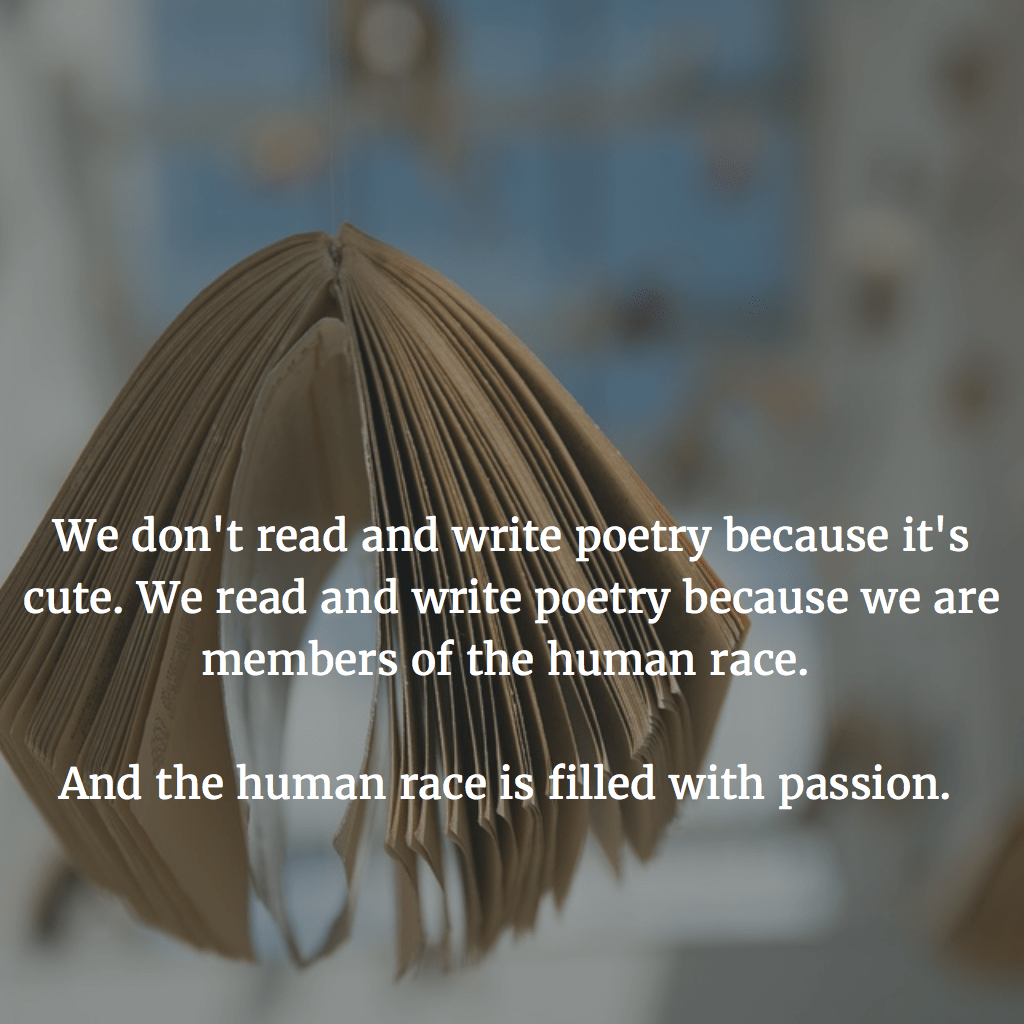
I adore poetry. I try writing poetry, too, from time to time, but I fail almost every time. I still try, though. It’s such a disciplined and sensual form of art that I know I want to get it right some time or the other. How much command over the language a poet must have to express limitless vision in limited words.

It all started when I read Tennyson’s Charge of the Light Brigade. From there, my craze only magnified as I read Wilfred Owen’s Anthem for Doomed Youth and Dulce et decorum est. Those three war poems changed the way I see words and respond to their lure—it’s weird how war is always the starting point of enlightenment.

Once I understood the underlined meaning in these poems, I wanted more. I was addicted, and was desperate to quench the dryness that these poems left in my throat.

I had read poetry before, of course. I had read some of Shakespeare’s sonnets, and yet, these poems were different. Reading Shakespeare requires effort sincere effort and interest. These poems, though, thrust themselves at me. I didn’t have to know the details of war to understand its effects as told by Tennyson and Owen. They inflamed a strong passion in me for simple, yet well-articulated words.

For instance, this one in particular:

“Dulce et decorum est pro patria mori.”

Which translates to: “It is sweet and fitting to die for one’s country.” Ah, the intensity of those words—coming from a soldier nonetheless, who knows what he’s talking about better than anyone else ever would. But what makes it even better is the placement of the phrase: “The Old Lie:”

“The Old Lie: Dulce et decorum est pro patria mori.”

The entire poem walks us through a vivid description of the war zone, and then, we get to the end where the poet claims that all the bullshit stories we tell young soldiers are empty words; lies. Poor Owen, he must’ve believed them all, like the rest of the lot. What a great poet he turned out at the hospital, before recovering and heading to the battleground again.

But that’s the power in good poetry: When said “write”, a writer writes, but a writer who said it right, writhes the emotion out of readers.

Wilfred Owen was one such writer. He made me, the reader, feel what he felt. The pain, the anguish, the heartbreak, and the loss of hope—I felt them all because the poet put them in such an artistic narrative. And that’s why we should read good poems, because like John Keating says, we need science and business to sustain, but we need poetry to live.

And what would we do if not live?