
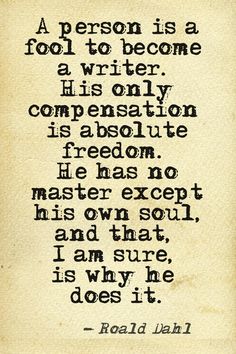
Sometimes all you need is assurance that your foolishness will pay off. And since it comes from Roald Dahl himself (or so I hear), it must be true.
What a comforting way to start the weekend!
Sometimes all you need is assurance that your foolishness will pay off. And since it comes from Roald Dahl himself (or so I hear), it must be true.
What a comforting way to start the weekend!

So many times in my life, I’ve felt it — that feeling of uncertainty, of not being sure of what to do, or how to do something. Anytime, any day, any where — there are doubts.
And then, from nowhere, comes clarity.
Sometimes, you just know what to do. You become so sure that you’re not even sure how you became so sure. You, who used to be so unsure of everything.
And that’s why I love Sylvia Plath.
I can’t even begin to say how much I relate to her words. I haven’t read one book of hers; just a few poems, but I already know she’s one of my favourites.
Every word, every syllable, is pure venom. Addictive, powerful and the only truth.

This quote so profoundly influenced me. It’s just a lyric from a song, but it’s the undeniable truth.
I’m a dreamer, and I’m happy that way.
But I sure won’t say no to something more than a dreamer!
The Unknown Citizen – W. H. Auden
He was found by the Bureau of Statistics to be
One against whom there was no official complaint,
And all the reports on his conduct agree
That, in the modern sense of an old-fashioned word, he was a
saint,
For in everything he did he served the Greater Community.
Except for the War till the day he retired
He worked in a factory and never got fired,
But satisfied his employers, Fudge Motors Inc.
Yet he wasn’t a scab or odd in his views,
For his Union reports that he paid his dues,
(Our report on his Union shows it was sound)
And our Social Psychology workers found
That he was popular with his mates and liked a drink.
The Press are convinced that he bought a paper every day
And that his reactions to advertisements were normal in every way.
Policies taken out in his name prove that he was fully insured,
And his Health-card shows he was once in hospital but left it cured.
Both Producers Research and High-Grade Living declare
He was fully sensible to the advantages of the Instalment Plan
And had everything necessary to the Modern Man,
A phonograph, a radio, a car and a frigidaire.
Our researchers into Public Opinion are content
That he held the proper opinions for the time of year;
When there was peace, he was for peace: when there was war, he went.
He was married and added five children to the population,
Which our Eugenist says was the right number for a parent of his
generation.
And our teachers report that he never interfered with their
education.
Was he free? Was he happy? The question is absurd:
Had anything been wrong, we should certainly have heard.
I had to study this poem for an exam, and only then did I realize its beauty. I read through once, and it just struck me unlike anything else I’ve read recently.
It’s the life of an unknown citizen.
It’s the life a person not unlike you and I.
It’s my life.
And then it hit me. I could live a simple life, an unknown, insignificant life and die the same way.
It’s the nature of life. There’s not much I can do about it.
Not everyone becomes recognized. Not everyone’s good under the limelight. Most of us end up as unknown citizens.
It’s a little sad when you think of it that way.
Nevertheless, Abraham Lincoln offers some solace,
“God must love the common man. He made so many of them.”
Well, whether we end up unknown or super-famous, it never hurt to try.
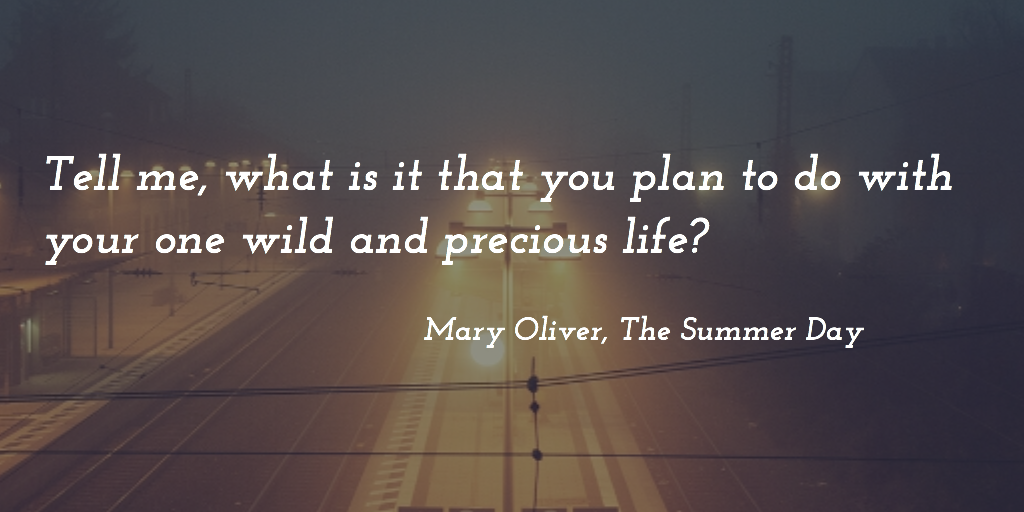
We all get to a point where we realize the truth.
One life. Wild and precious. Are we doing what we really want to do? Or are we just making excuses, and whiling away the time?
It’s a powerful question, isn’t it?
Amazing how it just comes out of nowhere and puts you off balance. In this race called life, what would we see if we stopped and turned around?
It’s the question to topple our lives. For the better.
 The Chaos Within