Unlikeable Reading

I’m reading “Tribes, We need you to lead us,” by Seth Godin. And I’m impressed with the way he’s written his text. It’s easy to read, full of matter, and so much inspiration.

And yet, there’s no excitement. At least not for me.

I’m surprised I didn’t realise this sooner, but every book I read for pleasure has a unique style and writing sense. And every book I read for knowledge lacks that element in every syllable.

Seth Godin’s book is great. I breezed through page after page without ever having to stop for a moment to appreciate the beatuty of his weaving — because there was none. His book is worth quoting, sure, but only for what he says; not for how he says it.

Then I understood why text books never get the appreciation they deserve. Who’d read a book that’s full of facts void of facets? But every school teacher insists on reading those textbooks, and likewise, every manager insists on reading “how-to-best-do” books.
The former will help get more marks and the latter, more strategies, and therefore, more money.

And yet neither of these make us skip a heartbeat, keeping us in mild excitement throughout the length of the book. These are more like medicines; a necessary evil. They communicate, but they don’t make us appreciate the art of communication. They convince because the name on the cover is already an established authority. No one questions it, no one contradicts it.

A lot of people I know who don’t like reading say so because they’ve never read anything apart from their school textbooks. No wonder they hate reading. If I had to read only titles that read “Ways to leverage your writing potential,” but have zero writing potential in them, I’d hate reading too.

But when reading for pleasure, everyone contradicts the author. Every reader, novice or expert, has an opinion to cast at the story. And that’s why writers adopt the more proven way of persuading readers. They makes us fall in love with what they have to say. Every sentence, every word choice is so deliberate that it sparks a myriad of emotions in us.

This brings me back to textbooks. If knowledge-intensive, preach-oriented books are interesting enough, perhaps more of us would enjoy reading. Perhaps then, we’d be happy to learn from what we read.

What do you think? Have you read instruction pieces with enjoyable narratives?
Tis a Sin

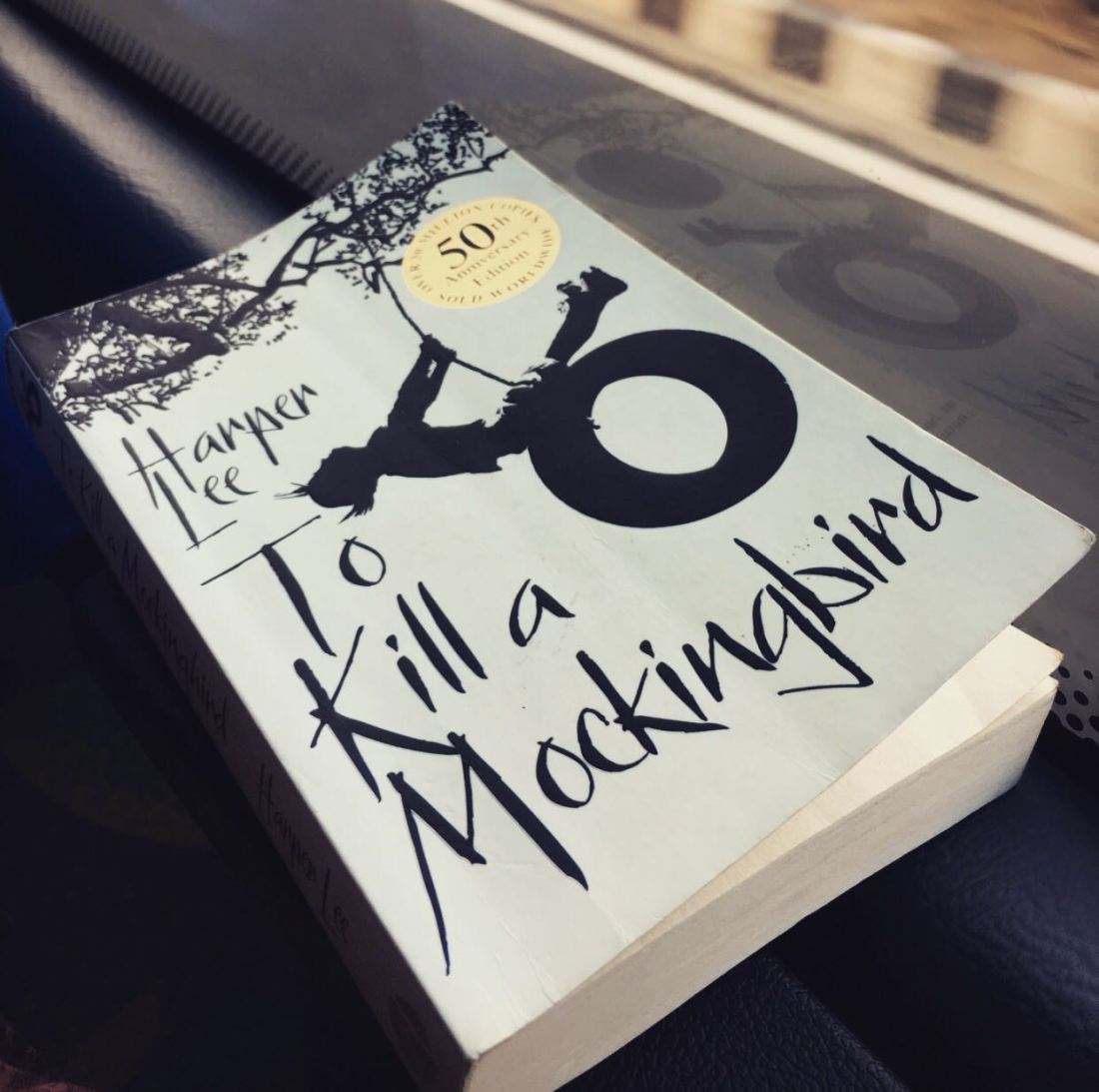
I’ve just finished reading a classic novel that I should’ve read ages ago. However, like so many other books, I took my time to get my hands on To Kill a Mockingbird. Needless to say, I regretted not reading it sooner. But there was also something different about this book than the others I’ve been reading.

To Kill a Mockingbird is a simple story. It has a complex plot that’s worth talking about for years together, but the story line was simple enough. Harper Lee had chosen a not-so-uncommon incident, and worked out a narrative around it. I didn’t realise it until after I finished reading it, but the entire plot wove around a single strand, one strong piece of gossamer that shone bright enough to attract and magnetic enough to keep me attracted through to the last page.

I can’t remember the last time I read a book so captivating, so relatable, and so enchanting. I loved the brother and sister. I loved how the brother would nag the sister saying she was becoming too much like a “girl.” Brothers do that, and not many books illustrate it as well as this one does. Throughout the story, the relationship between the brother and sister blossomed from childhood trebles, evolving into an everlasting bond of friendship and reliability. That’s how real brother-sister relationships mature, and I was amazed when I realised that no other book I’ve read (so far) ever mentioned anything like it.

Every character was a an entity in itself. Scout was an atom of energy, reminding me of my younger days when I frowned at pink flower frocks, picking, instead, a pair of comfortable overalls. Jem was a natural, a protective brother who watches out for his sister, loveable yet condescending at times — just like mine. As for Dill, he’s the kind of person we’d come across in life who has it all — or so it would see —  and yet, has nothing worth having.

Calpurnia, the beacon that lit up the Finch household, was the ever-smiling help at home that makes every child learn while they yearn for her cookies.

And Atticus, dear Atticus, what a father he made. Standing by the suppressed, jovial and just Atticus was the perfect protagonist. When he’s a typical father who doubts his parenting skills, when he demands the truth without raising a tone, when he caresses his daughter’s hair, when he embraces Jem’s adolescence — Atticus’s every action makes the reader love him even more.

How could anyone be unaware of such vivid writing and vivacious narrating? If it’s a sin to kill a mockingbird, tis a greater sin to let great works go unappreciated. At least now I can cherish it, late though it is.

Hold It Down

I sometimes read poetry, and often, I come across a poem that strikes me so hard that I have to save it, savour it, and share it.

One such poems, by Gina Myers, is Hold It Down.

When I first read the poem, I was so awed that I wondered why I hadn’t heard of the poet before. I studied literature, but I’m ashamed, neverthelss, to admit that there are so many popular writers I’ve never event heard of. I read, but I don’t read that much. I’ve felt small when friends talk about books and writers they cherish whereas I’m just lost.

Regardless, I read the poem again, and realised it didn’t matter that I hadn’t heard of the poet before; the poem speaks louder than the poet could’ve.

It’s a little long, but it’s worth it. Here it is from Poetry Foundation:

It’s 70 degrees outside but in the drugstore
Christmas music plays over the speakers as
I stand in line balancing my checkbook
in my head, stretching things thin until
my next paycheck when the rent is due.
The security guard cracks a joke, but
I wasn’t paying attention, so I just smile
& step forward in line. Images move
across the screen. When I think about money
it seems impossible. All over the country
people are moving into the streets
& we’re here in Atlanta starting a new life.
Darkness surrounds the latest revision
of our shared history. Everything clouded.
Yesterday 1 couldn’t tear myself from the news
& already today the events have been distorted,
the numbers downplayed. It’s late fall
& in the early morning crispness, the leaves
fall from the trees & cover the sidewalks.
This new feeling we lack a name for, struggle
manifested in the streets & in parks & on bridges
across the nation. The headlines read
“Protesters clash with police,” but as we watched
the live stream, we saw aggression only by officers
dressed in riot gear. We saw people tossed
on the ground, hit with batons,
a woman punched in the face, an eighty-four year old
woman’s face drenched in pepper spray.
The images endless in this land of the free.
I’m losing focus, distracted by the newsfeed
on the computer screen, hitting refresh.
The cat paws at my leg, demands its own attention.
This shift entirely unexpected but necessary.
Leaves blot the window. Every so often
I leave & start from scratch, imagine
damaged relationships & sick cities
where there was no damage & no sickness
greater than anywhere else. In Atlanta,
everyone drives. The bartender called us
“hardcore” when we said we’d walked there.
She said, “No one in Atlanta walks anywhere.”
Walking home from work in post-daylight
savings time darkness I pass no one on the
sidewalks. I pass the traffic backed up by
the stoplight. The weekend passes too quickly—
I wish it would last longer, which is what this all
is really about: time & my lack of control
over it, my inability to do what I want with it.
And there’s a greater futility at work
here too—a greater frustration in my inability
to control my environment or to stop my country
from killing its citizens. The police beat people
standing still, linking arms, holding cardboard signs.
Each day I think more & more about the past,
about where things began to go wrong, where I, too,
began to go wrong. Before I moved, before I
got sick, before I unfriended you on Facebook,
before I decided I no longer loved you,
before New York, before college—thinking back
to childhood when we could run fearless
through the neighborhood at night, when
we didn’t think about the future, when we loved
our country because we didn’t know better.

Gina is a modern poet. Perhaps that’s the reason I relate to her writing so much. The story and the panic-inducing lifestyle of a youngster is all too familiar. And as I read through the poem, words jumped at me making me feel it’s me she’s talking about.

We’ve all had that mid-life crisis moment, when we look around us feeling repulsive at the society we call home. People are mean — to animals and to each other. Just as we’re trying to figure out our purpose and way in life, we watch our fellows taking incredible measures to hurt each other, and that’s heartbreaking.

We look around us and wonder why the country’s gone to the dogs. We look at authority wishing they’d be less brutal, we look at weapon-wielding children and wonder where the flowers had gone to. It’s the reality of our lives, a sight that none of us wants to see.

Growing up is a curse. We’re forced to see things and know things, and understand situations we’d rather not. It’s disturbing and painful, making us wish we were kids again, when we loved without conditions because we didn’t know better.

This poem is the heart of a broken person. It’s the heart of every 21st-century person.

Cease, Cows, Life Is Short

Once in a lifetime, if you’re lucky enough, you manage to finish reading a book that’d make you wish you had read it sooner.

For me, it was One Hundred Years of Solitude.

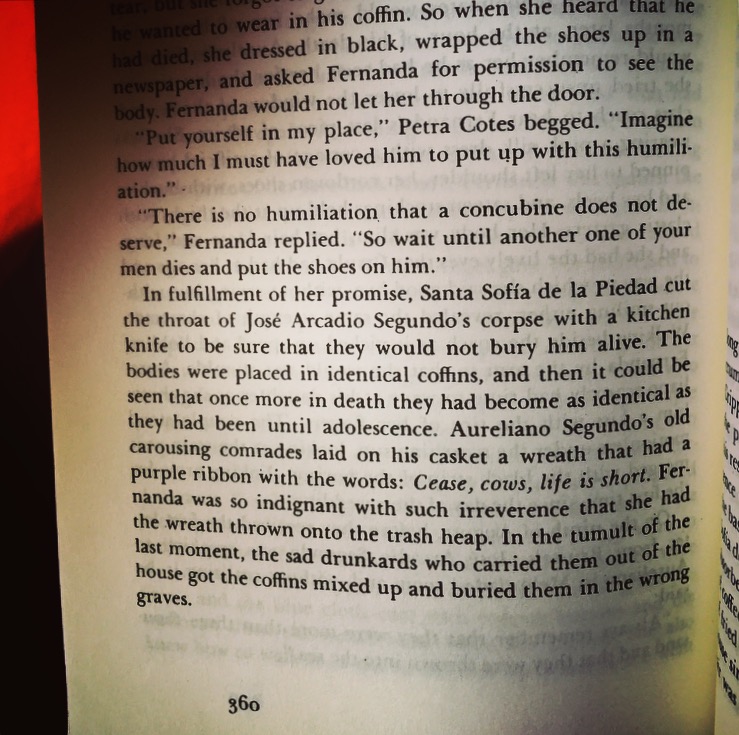
one-hundred-years-of-solitude-cease-cows-life-is-short

I had begun reading the book as soon as Amazon delivered it to me — about two years ago. Then we had a falling out. I read through about sixty pages before I realised it was too complex and too “out there” for my intellect. I felt intimidated. I couldn’t understand why I couldn’t understand the narrative. Maybe it was the fine print and the font that I didn’t admire, I told myself.

Thinking I’d read it later, I cast the book aside waiting for motivation to strike me hard enough to pick it up again. Some time that time, a friend wanted a book. I suggested One Hundred Years of Solitude, but I also warned her that it had given me a block. She took it nevertheless.

That was the last I saw the book until last month, almost a year and half later.

One cold morning a line from the story popped into my mind: “Colonel Aureliano Buendía was to remember that distant afternoon when his father took him to discover ice.” Even though the book had thrown me off, that queer line had stayed with me. That’s when I realised I should give the book another chance. I got the book back from my friend and dove in right away.

It took me a good one week to finish the book. I whizzed through over half of the story, slowing down as the narrative progressed. Many times, I went back two pages to make sure I followed which Aureliano did what. I had to scan the family tree hundreds of times before I understood who’s child Amarantha was and who her child was.

I speed-read some parts while I cherished other parts of the story. I stopped at beautiful turns of phrases, and gawked at clever word choices. And then I paused and took pictures when I saw words of wonderment.

When I did finish reading it, however, I wanted to kick myself. I chided myself for missing out on so much pleasure the first time I tried reading it. If only I had tried harder to endure the initial confusion, I would’ve enjoyed a glorious read much sooner.

Perhaps it was meant to be. Perhaps I couldn’t read it then because I wasn’t mature enough. Maybe now was the time I needed it the most. Just like the Buendía family had waited a hundred years to decode the prediction of their fortunes and misfortunes, I had let history repeat itself before decoding the joys of One Hundred Years of Solitude.


You should read this book, if you haven’t already. If you have, however, tell me, what was your initial reaction?

Making People

I felt god-like.

I injected emotions and stamina into nothingness to create Ben. I had complete control. I could twist his arm and his fate anyway I wanted. His life relied on my mood swings and caffeine intake. It was a responsibility I took light, though shouldn’t have.

Affection surged through me when I realised his evolution from a violent thought to a violent person.

I introduced Ben to my friend. Matt’s a lawyer, he knows people and what makes them tick. He’s had experience dealing with ruffians like Ben.

“Well, Matt?”

“Good. Except for one serious plot hole.”