The tension of opposites: Life is a series of pulls back and forth. You want to do one thing, but you are bound to do something else. Something hurts you, yet you know it shouldn’t. You take certain things for granted, even when you know you should never take anything for granted.
A tension of opposites, like a pull on a rubber band. And most of us live somewhere in the middle.
Morrie Schwartz | Mitch Album, Tuesdays with Morrie
I’m away on holiday for a couple of weeks, and until I get back with more haiku and photographs, I’m sharing some of my favourite quotes. Hope you enjoy!
Who doesn’t love a determined, self-sufficient heroine? One that doesn’t need saving from her male counterpart. Or even from herself—a common theme in feminist novels nowadays.
Tangent aside, a female lead who knows what she wants, accepts her hurdles, and yet still strategically perseveres towards achieving her passion is someone born for that. We often say talent is inherent. But everyone is talented in some way or the other. What matters is how much they invest in honing that talent. That’s the difference between Van Gogh and Random Dude. I bring this all up now because I’ve just read Book of Colours, an excellent historical fiction that celebrates a woman artist—or in this case, a limner.
I know how that sounds, but it’s not what you’d expect. It’s not the story of a young girl who finds her passion for art, grows up facing many challenges, and finally gets the recognition she deserves. That’s the equivalent of the ‘damsel in distress saved by the hero’ narrative—the typical, proven theory that satisfies the masses on any given day. Though such a plot has its place in novel writing, this one is way different.
It’s about a woman who’s painted all her life—from childhood, assisting her father, also a limner. Everyone around her knows her capabilities. However, she’s a 14th-century woman in England. Women of that period weren’t even allowed to read, let alone paint. This is the story of Gemma, the brilliant artist, and her husband, who’s also a brilliant artist, except he’s known nationwide for his talent. They receive a project to design and create a Book of Hours (an illustrated book of prayers) for a wealthy landlord far, far away.
But this is not the story of Gemma. The writer never once tells the reader that Gemma is the main character. You either realise it, or you don’t. Either way, you’ll enjoy the book.
As the story begins, we follow Will, a young artist running away from his hometown. He ends up working with the master limner and his wife, Gemma. From there, we watch as Will’s life unfolds—as he works with the couple on their project, how he becomes essential for the book and its owner, and how he blends into the family.
Our introduction to Gemma comes through Will’s eyes. And so we see her as a cold, doubtful woman who clearly hates him from the moment her husband invited him in. He’s shocked when he realises she paints, torn between her knack for translating words into pictures and the unacceptable reality of her being allowed to paint. And yet, between them grows a friendship that’s unlike any other. As highly-gifted artists, they spend a lot of time in each other’s presence, heads bent low, each immersed in their own battle.
Like all good characters, Will also evolves from a typical man who looks down on a woman painter to accepting her skill. But that transition is so artfully done—he doesn’t run into a raging feminist who changes his mind about women doing other than housework. He doesn’t have a flash of understanding about patriarchy that completely changes him overnight. Instead, it’s a gradual change of mind, a progression that’s incomplete even as the story ends. As a skilful limner himself, he admires Gemma’s talent.
For a long time, he believes she’s protected only by his and her husband’s silence. As someone who enjoys realistic characters, it was refreshing to see that Will still had a lot of room to grow. He’s not perfect, and that’s a perfect place to end his story.
Though Gemma herself goes through many changes as the story progresses, her situation largely remains unchanged—quite an unexpected ending for a character of that magnitude. She doesn’t get the recognition she deserves. Only the characters who knew about her passion for the art at the beginning know about it in the end—plus Will, of course. And yet, we see her evolve into a more complete and aware person. She’s another example of a realistic character—no drastic, dramatic incidents to topple her underlying beliefs. Every good change happens gradually. And that’s why this book is such a good read. The author has done one hell of a job, and I’m glad I read it.
I always knew I didn’t like ebooks. But common sense had to prevail, and so, like many of my friends, I caved under societal pressure to start reading books on my electronic devices.
Surprising even myself, I quickly read a handful of books. I was getting accustomed to the idea of pulling out my phone while waiting for the bus, while on the bus, and during boring conversations. And it was with that enthusiasm that I downloaded The Picture of Dorian Gray, the classic Wilde tale about a wild young man.
Two years later, having opened and closed it many times at bus stops and on sleepless nights in bed, I’d read seven chapters.
Forcing to refrain an eye roll when I mentioned I’d never read the book before, my good-natured friend offered to lend me her copy. It’ll help imagine our exchange if you know she’s English and a teacher.
Within 24 hours, I finished the book. I swear, ebooks are not for me.
Even though I’ve now moved on to reading my next book, Dorian Gray remains fresh in mind. When I was still reading it on my laptop, as a break one day, I looked up reviews for the book on Goodreads.
A tirade on Lord Henry showered upon me. People described him as pure evil for poisoning young Gray’s mind and heart. Dorian admits it himself suggesting the book Henry had given him had led him downhill. Sure, Henry is manipulative. But you could also argue that as the older man, he only took on a more protective role of Dorian, behaving much like an older brother or father would do . And he played that role well, too, scorning at Basil for professing his affection for Gray.
To me, though, Henry is a representation of our society. There’s nothing vile about Henry—he’s only a disarmingly accurate illustration of the many characters we encounter in everyday life.
This phenomenon stayed with me as I read through the book. The further I ventured, the more I liked him. He is toxic company in every sense, but at the same time, he’s also the overzealous relative who never misses a family dinner. He’s the type of friend we’d keep close even though we know they’re more harmful than helpful.
Henry is charming. Remember: Dorian is never bullied. Every idea and impression Henry instils in Dorian is the younger man’s asking. Not once do we see Henry apply force or forgery to get Dorian to do his bidding. Henry is a complex and well-rounded character, just as the ones we see in our lives. Is he detestable? Absolutely. But to call him evil is to limit his impact in the story. It reduces him to a mere two dimensional element.
Henry doesn’t just deserve readers’ hatred. He also deserves adoration, for he inspires in us, a deep-rooted desire to avoid people of his like.
As readers, we often blindly support the hero of a story, even though, as in this case, the hero is a weak-kneed and self-serving young man. This novel and Henry is a reminder to us that there’s more to people than what meets the eye. I mean, this guy’s a genius:
“When a woman marries again, it is because she detested her first husband. When a man marries again, it is because he adored his first wife. Women try their luck; men risk theirs.”
I think I write decent haiku. I take pictures of everything that makes me gawk, and then I twist them, interpreting them in my weird way. Sometimes I even manage to impress myself.
But I never thought of how my haiku sounds to others.
Now I know. Because I’ve read CT Salazar’s book.
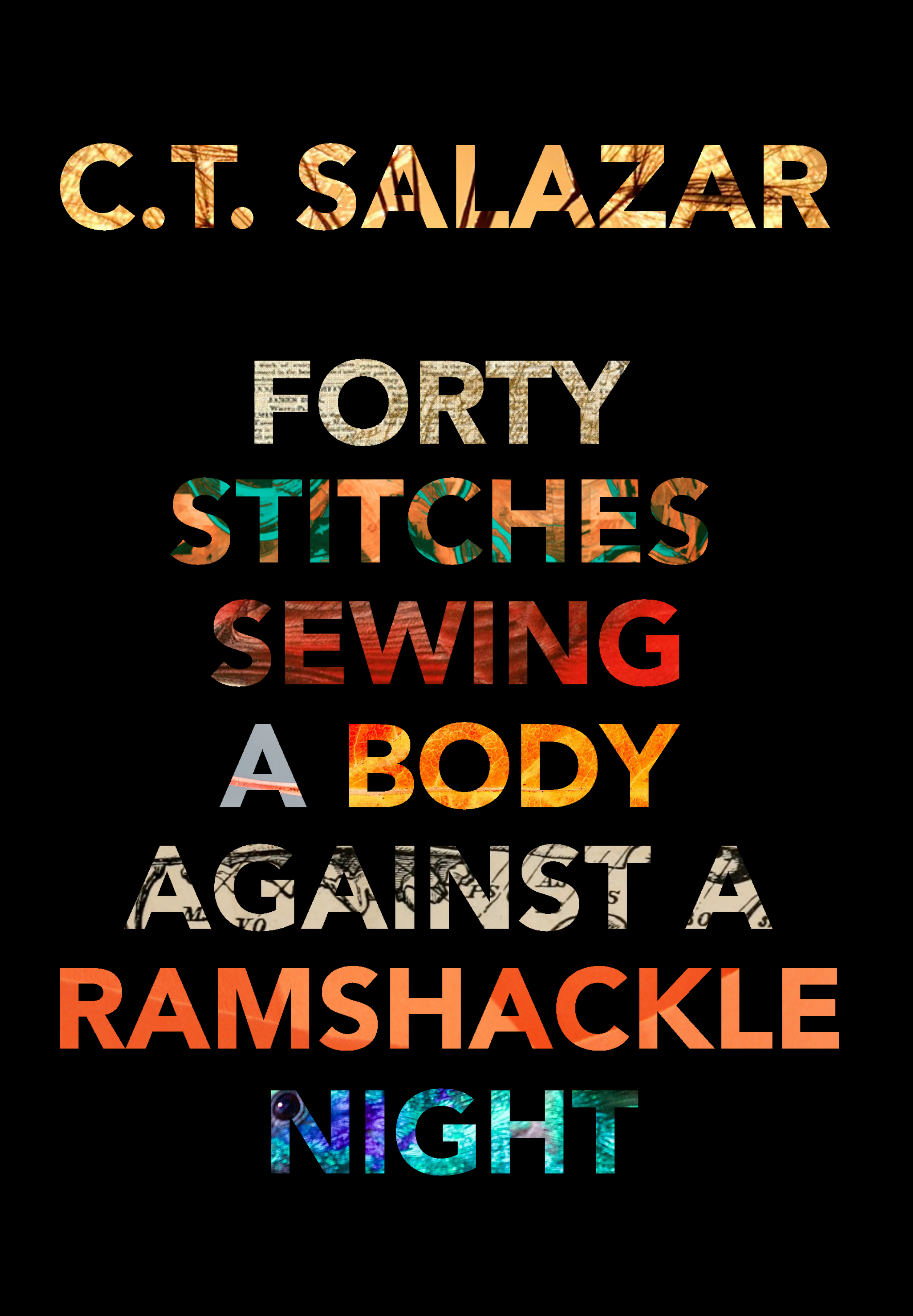
The title made me “ooh” and smile as if I understood what it was about. ‘Forty Stitches Sewing a Body against a Ramshackle Night’—hell yeah—this is my jam. I write haiku—I know exactly where this is going. Or did I?
Cover of CT Salazar’s book, Forty Stitches Sewing a Body Against a Ramshakle Night
It’s a compilation of forty short poems, a hybrid-haiku form which the poet calls ‘stitches’. See, I didn’t realise that when reading the book. And so when I did, much later, it was as if someone had turned the lights on, laying bare the contents that had been so artfully cocooned within the title.
Ah, the pleasures of decoding poetry!
That title paints a powerful image to hook readers. Just enough, but not at all. That’s the biggest advantage—and the problem—with writing haiku. Everyone knows (or thinks they know) what to expect, but they know nothing of what they’re about to read.
As a writer, you have to satisfy their wants—throw them a bone, if you will—and then when they think they’ve got the hang of what you’re saying, pull the carpet from right under their feet.
That’s what haiku is about. It embodies minimalism. It’s the ultimate form of contraction. Salazar does all of that. And then some more.
Opening the metaphorical pages, I thought I knew what style, tone, and tenor he’ll use.
I assumed.
One should never assume anything about haiku.
trimming your hair
in the bathroom          hundreds
of commas curl
No punctuation, no explanation, no direction for the reader.
Go figure.
But that’s what’s so beautiful about haiku—and Salazar’s haiku, in particular—it makes you see—really see—the small, everyday things in life. The next time I see a strand of hair on my bathroom floor, I’ll think of commas. (And then I’ll moan about losing said hair.) That’s what good poetry does to you—it leaves you with lingering moments.
As I read through the pages, more word treasures jumped out, shaking me completely off balance.
watched a cardinal
               fly through me—sorry
                               through a window
Like most poetry enthusiasts, when I came across e e cummings for the first time, I was fascinated. As an English student, I cringed—no capitalisations and no language order. But I adored his rebel blood. He broke the rules and still made all the sense in the world.
Salazar does too. I mean, look:
river river
we’ve both been
running
See? It’s subtle, it’s delicate, but it punches you in the throat, and as you temporarily recover from gasping for air, it hits you again.
I’ve read and reread this book plenty of times, and I still can’t quite put my finger on what exactly it’s about. Sure, I have five or six story lines running in my head, and every time I read the book, one of them seems to take precedence over the other.
However, as someone who writes a whole lot of haiku (or as I call it), I don’t mind if my readers don’t see what I see. That’s the beauty of any creative endeavour—it should always be open to interpretation. And so with Salazar’s book, even though I still haven’t cracked the code, I’m quite happy to revel in the pristine beauty of his words. After all, it’s not a test I need to clear—poetry is an artistic form of expression and food for the soul. And I will consume it in all greediness, inhaling it in gusts and letting it bloat me with pleasure.
I won’t lie. This book took me an embarrassingly long time to finish. Not because I’m a slow reader, but because, as is the case with so many books, I found it easier to put it down and not pick it up again. Another prominent book I did that to is One Hundred Years of Solitude, also by the same author. I might be sensing a pattern here…
Regardless, it didn’t help that the story picked up well into the story. It was designed to be a slow start, much like One Hundred Years of Solitude. It’s almost as if Marquez was testing his readers to see if they’ll hang around long enough, if they were loyal enough, to endure the creeping pace of the initial chapters before bestowing upon them some of the greatest and heart-wrenching prose of all time.
In other words, Of Love and Other Demons features beautiful writing—writing that will stay with you well after you finish reading the book.
“Disbelief is more resistant than faith because it is sustained by the senses.”
I’m not pious. And I don’t enjoy the company of people who shove their religious beliefs on others. This story is scattered with Christian beliefs and the ancient traditions of bishops and exorcism. Even though this book personifies everything I’m against, I cherished the way it’s done.
I mean, just read this:
“The bishop could not continue, because the thunder resounded over the house and then rolled out to sea, and a biblical downpour cut them off from the rest of the world. The bishop lay back in a rocking chair and was shipwrecked in nostalgia.”
Isn’t that beautiful?
I started reading this book before COVID-19 was born. And now, as I got to the last page of the book and rethink the narrative, I’m amazed at the uncanny and coincidental reference to today’s reality.
This is the story of a young girl who’s bitten by a dog with rabies. Unfortunately, she didn’t contract the disease, and that abnormality made those around her, subject her to eternal damnation.
Gabriel García Márquez has given us a wonderful tale in Of Love and Other Demons.



 The Chaos Within