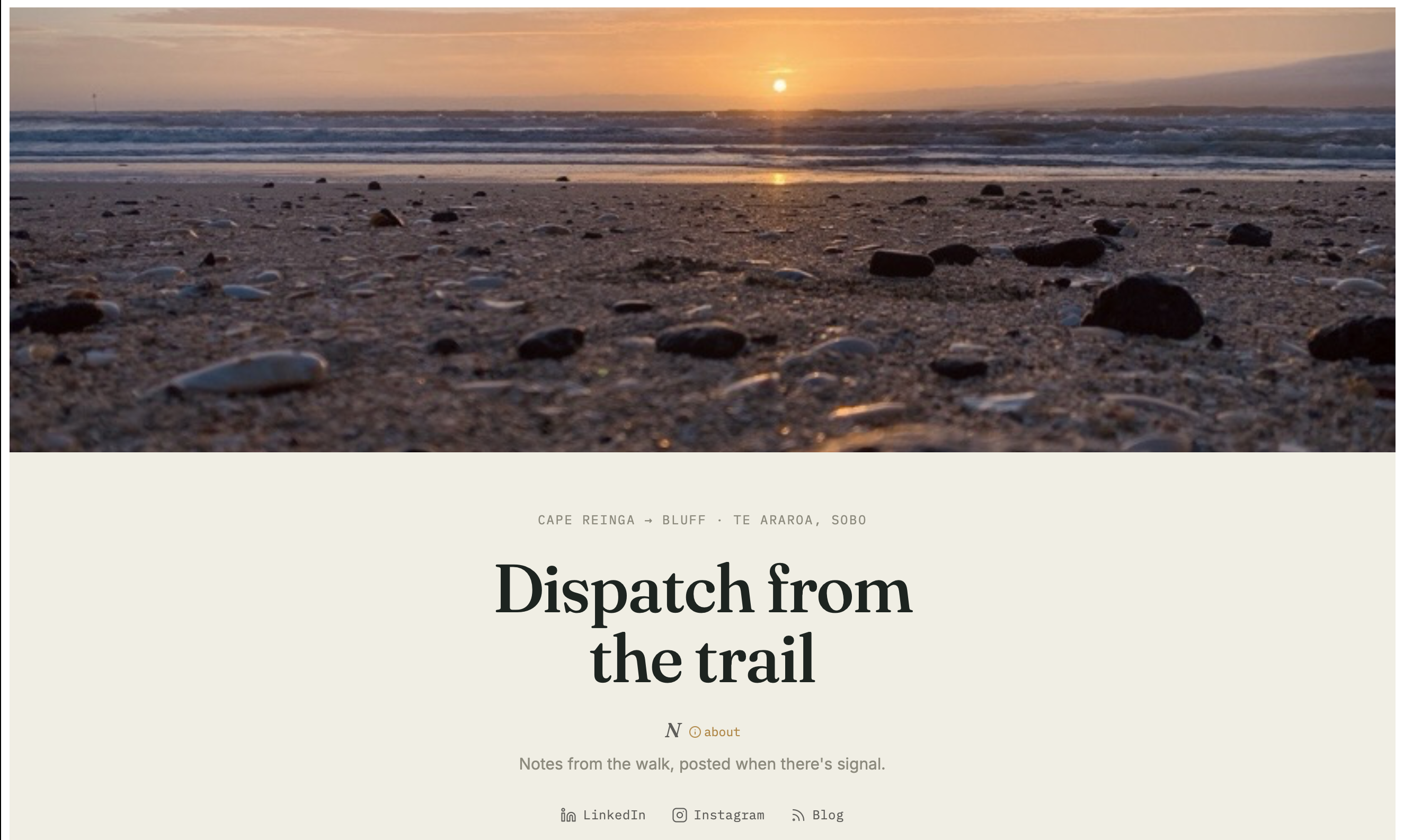

One of the things I’m extremely skilled at is thinking of a brilliant idea while doing something else more important. That’s how I came up with TA Dispatch, a live website I can publish my daily rambles on while walking Te Araroa, New Zealand’s long pathway that extends across 3000 kilometres, from the top of the North Island all the way to the bottom of the South Island.
I was already building a daily journaling app that’ll structure my entries, date and location tag them, and identify emotional themes in those entries. The plan is to someday write a series of articles or even a book about this trip. These structured notes would be good fodder.
But good fodder for me could also be comfort to Dad, who has no social media and so no way of following my trip. Of course, I’ll call and text him as often as I can, but I still wanted something he could bookmark, open every morning, and be reassured that I’m OK.
Dad is of a certain generation that never saw or heard of men speaking openly about their feelings, challenges, and insecurities. Since my mum died a couple of years ago, he’s spent a lot of time on his own, contemplating. He was still working through some of that shit when he got his own health scare, which landed him in hospital for an open heart surgery.
It really wasn’t the best time to tell him I’d be off into the wilderness for months on end. As if that wasn’t hard enough, I also had to watch him try and process the enormousness of the trail, of water crossings, and alpine tracks.
I mean, I was processing the scale of the trail, and I’d been wanting to do it for over 7 years. The man had just heard about it!
And so, TA Dispatch was born.
But it didn’t come out all perfect and blemish free. Until this point, everything was only about my personal preferences and habits. And that was hard enough. To create something for someone else, while also staying true to the essence of the project wasn’t straightforward at all.
The good thing is that I have a fairly good idea of what Dad would want. He’d want to see where I am. He’d want to see the surroundings, how big my pack is, what I’m eating, how much I’m walking every day, whether I’m injured at any point, and how I’m feeling.
There’s no way Claude and I could build something that’d encompass all of those, in the time we had. WhatsApp does a reasonably good job of covering most of those requirements. I already call him on it daily and send photos and videos. No use trying to wean him off WhatsApp and onto a different platform just because I built it. At the same time, I wanted something outside of WhatsApp, one I can use as a broadcast medium without having to add too many battery-consuming actions.
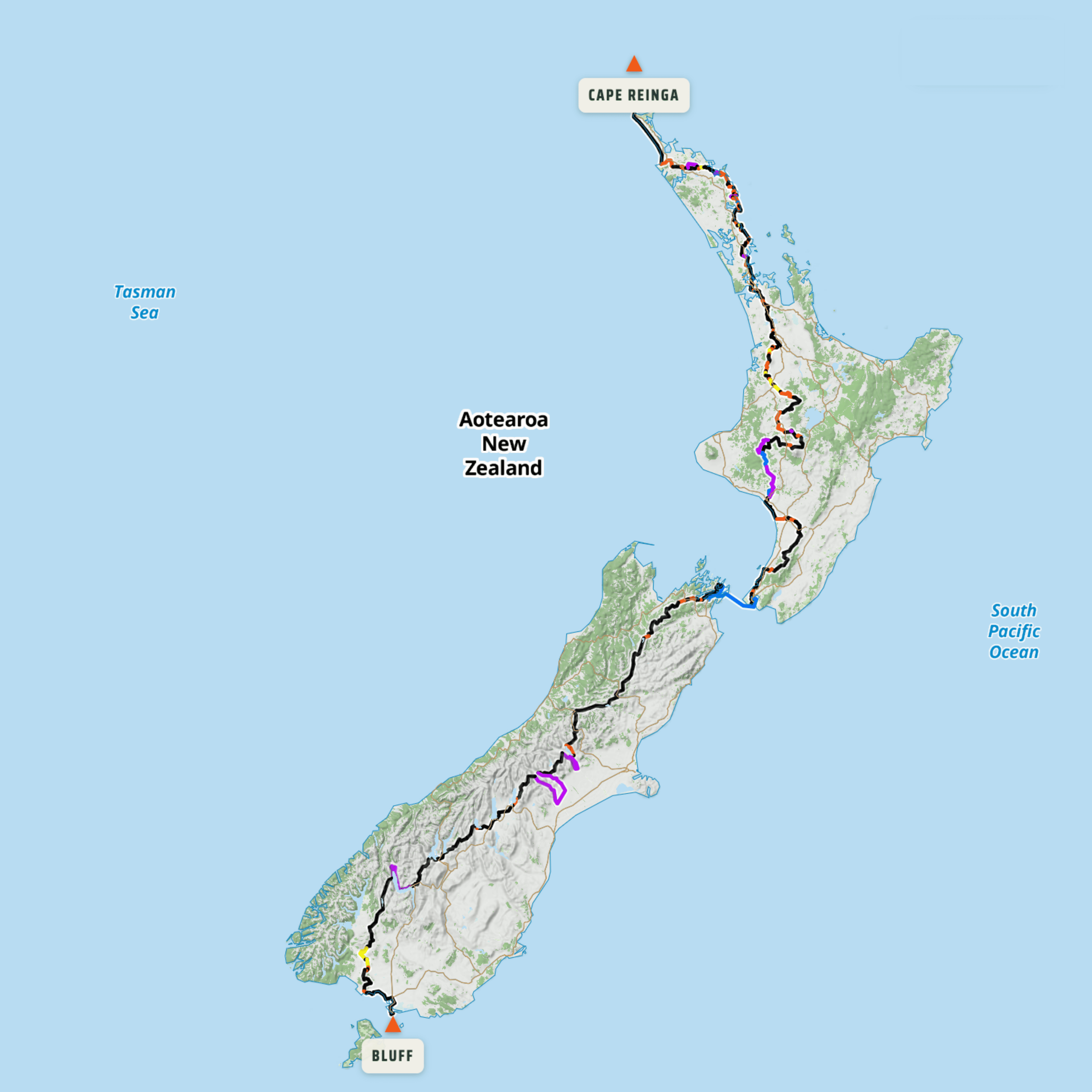
I decided on a simple webpage that’ll automatically publish entries from my notetaker/journal app. I’d already built most of it, so the infrastructure was there. All I had to do was choose a bunch of these entries and publish them to a different page. Then came the layout and content. I thought a progress bar would be cool—so Dad could see how far I’ve gone and how much further I still have to go. Then the idea evolved and I wanted to incorporate a progress bar on the New Zealand map. The idea was to have a lighter line marking the full trail, and a darker line over the distance I’ve covered.
Oh, but what if I don’t have internet connection over a long stretch?
The progress would stop progressing and Dad would panic as dads do. Intellectually, he’d know I’m probably off grid for a while, but that won’t stop him from conjuring scary scenarios in his head. So Claude and I decided to add a little section that addressed the elephant in the room. We titled it: “What no news means.” It was basically a block of text to tell Dad that if the progress bar stopped, it’s probably because I’m out of coverage area (which is rather common on the trail) and not because something had happened.
I told Claude to go off and make those changes. When it came back, I realised my theory didn’t translate well practically.
Claude wasn’t great at drawing maps. It wasn’t terrible; you could still tell it was the map of New Zealand, but it was more like a blob than a living, complex landmass that’s constantly shifting, growing, and shrinking.
I decided to scrap the map altogether. Seemed easier than re-prompting Claude to fix the map exactly as I wanted it.
Instead, I included the kilometre marker, captured from my phone’s GPS, and the name of the section for each entry. That way, he’d still know I’m making progress without a stalled map tormenting him. I also got rid of the “What no news means” section for good measure. A kilometre marker would always be “current” because it only publishes when I want to, and is within my control, but those kilometre markers aren’t accurate. They’re just a close estimate, enough for Dad to know which general area I’m in without my exact location.
The purpose was to build something that didn’t already exist in one form or another. For instance, I’ll be carrying a personal locator beacon, a safety device that can pinpoint my coordinates to the emergency services, in case disaster strikes and I need to be airlifted. So I didn’t want the page to be my locator. I factored in rest days and admin days in my broader trail estimate so that the page doesn’t have to countdown the days to my return. In other words, I wanted something that’d fill in the gaps without causing too much anxiety for Dad.
He’s a worrier and nothing I could say or do in these last few days leading up to the trip is going to convince him it’s all OK. Still, I couldn’t leave without giving him something to follow along.
In just a few days, I’ll know whether all the work, time, and energy I put into this thing is worth its salt. One way to find out.
—
This is post 5 of 5 of me using Claude Code to build an app for my Te Araroa hike.
Post 1: The notebook guy started it
Post 2: Who will I be on trail?
Post 3: Kill your darlings, they keep saying