Dealing with names

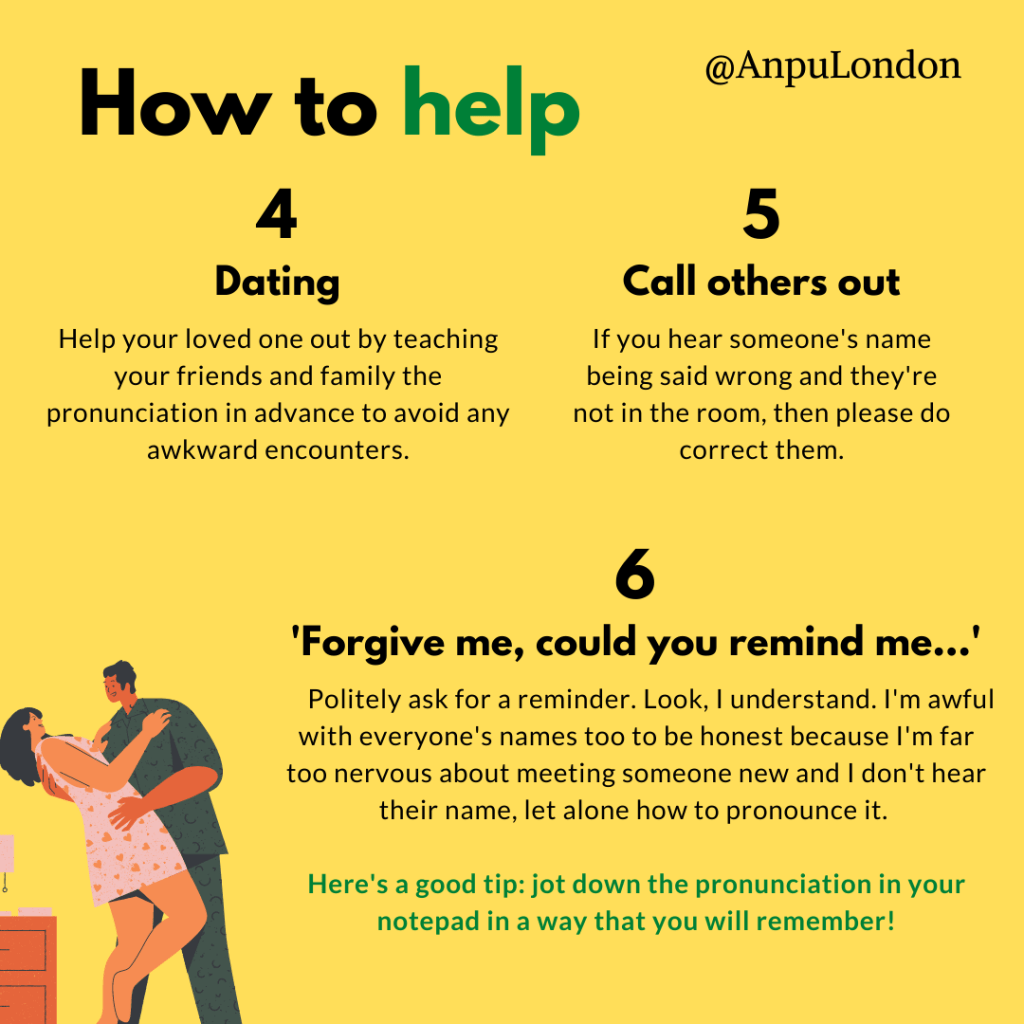
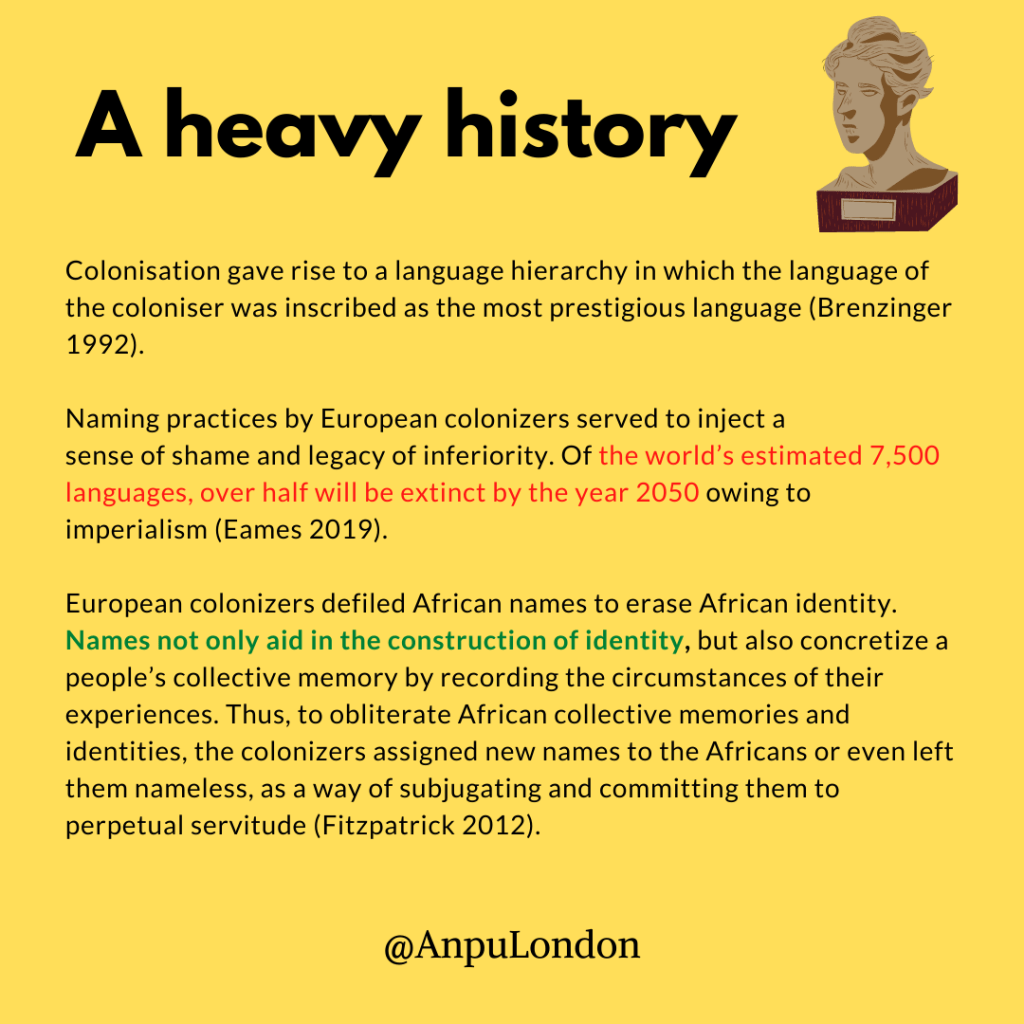
Please swipe through to view the full gallery. Artwork by Anpu, posted on Facebook.

This is fascinating to me. A lot of people in my life do all the right things, according to this artwork. And I appreciate it when people genuinely want to respect me and my ethnic name.

But I don’t care if you get my name wrong because I think we get too attached to names and labels and the cultural baggage that comes with them.

Colonisation created a global hierarchy. So did capitalism. Yes, it’s terrible that the world’s colonial history decimated hundreds of tribes and tribal languages. We should learn from that history. Languages aren’t meant to compete with each other for attention and recognition. Fighting for recognition doesn’t necessarily bring recognition. If we’re to live in one world together, we all need a common language to communicate. That means every one of us will have to make compromises. People like me, who aren’t native English speakers, may have to be ok with English speakers struggling with our names. The same way, English speakers will have to deal with a thick Indian accent if they want their software issues sorted and a rough African accent if they want their parents in aged care looked after. It’s called co-operative existence.

For me, a person is a person. As long as you’re polite and considerate and not racist, you’re fine. If you can’t remember my name, that’s ok. Because guess what, I often get Michael and Matthew mixed up. Beth and Beck are too much alike. By the time we get to Chris, Cris, and Kris, I’m dying. And don’t even get me started on Mick being short for Michael.

If you need an easier way to remember me, just ask. I’d do the same for you. We all take shortcuts sometimes.

Humans named things and each other so we can refer to them in conversation. That’s all. Don’t read too much into it. A name is a name. It’s not your soul. From where I come from, often, a name is a caste. It’s religion. It’s the foundation of hate crimes and human butchery. No one should strut around wielding it like a flag. That’s the kind of devotion that rips countries apart.

Names and labels are just signposts for a dirt road that’ll change and disappear over time. Just because no one will remember a dirt road 50 years from now doesn’t mean the road didn’t exist or serve its purpose. So what if you forget my name? For as long as my being was here and in your life, it’s served its purpose. That’s all we all are—signposts. Sometimes we have letters missing, sometimes we’re scarred or scratched, and some other times we’re just facing the wrong way. Regardless, here and now. If we are, we are.

What’s in a name when a rose by any other name would smell just the same?

Set me Free

Salvatore Striano quote from Set me Free

I haven’t met a Shakespeare fan I didn’t like. 

Dreamy fierceness oozes from his words like a tube of toothpaste, and make readers stick like mosquitoes on an oil plate.

And when two mosquitoes meet on oil plate, what else would they share than their love for wit that landed them there in the first place? 

It was with that curiosity that I picked up Set me Free by Salvatore Striano. The title itself wasn’t any different from the thousands that line the library aisle. It was the sub headline of the book that forced my feet to retreat and my hand to reach out: The story of how Shakespeare saved a life.

At that moment, I knew I had to read it.

Life got in the way, many times, slowing down my progress. And yet, I persisted—the deadline loomed and I didn’t want to be that person who extends a library book because they were too busy not reading.

I read in the bus, I read walking around the lake, I read in bed at night sipping black coffee.

This tale come from behind bars. It’s the story of a high-security, long-sentence serving prisoner in Italy. The narrator, Sasà—the prisoner himself—tells how he’s been a frequent visitor to jails since he was seven, walking us through various parts of his life leading up to the present. And all the while, he explains the realities of prison life, the solitude and hopelessness that hugs the air, and the spite that separates groups.

What’s Shakespeare doing in a place like this?

Saving souls, of course.

The narrator goes on to illustrate how one accidental play they put on opened the vault to an under-appreciated realm of sonnets and theatre. He reads Shakespeare, and with every play he finishes, Sasà feels himself glow and grow as a person. And in the end, the book closes with a hint of how even inside prison, lessons from good literature change and free people of their darkest despairs.

It’s a well-told short book.

However, at many instances while reading this book, I felt a tinge of irritation scratch the surface of my patience. For there are pages in the book that function, not as part of the story, but as the author’s opinion and observation of The Tempest. I scoffed, remembering CliffNotes. The narrator does this a lot—there’re chunks of references, poetic verses, and lengthy explanations of how and why Prospero forgives his enemies in the end. Sasà even argues with a fellow prisoner, who plays Prospero, for doing the character injustice.

As I read on, though, my annoyance melted. I grew intrigued at the narrator. For he’d internalised Shakespearean characters so much that he began identifying their real-world counterparts.

As readers, we see the plays help him discover his feelings towards the people in his life. His wife was like Miranda—loyal and pure. An older cellmate, a mentor and guide was Prospero—a father-like figure in jail. And he, the narrator, himself was Ariel. It becomes more than a role in a play, and we see how Sasà lets Ariel and other Shakespearean characters influence his own behaviour. Like an earthworm tossing out the dirt to let a breath of fresh air down the ground, these fictional men wade in and out of Sasà’s consciousness, picking out hatred and sadness, and replacing them with gardening, writing, and composure.

This is a small book. With a big takeaway. 

The more I recall incidents in the book, the more I understand the impact of these plays on the narrator. From being a thief, drugger, and gangster, he emerges as a poet, and a rather philosophical actor.

This is a good book. Give it a read.

What rules?

It was in an English literature class, while studying Shakespeare, that I first heard of poetic licenses.

Poets breaking rules.

Serious Chuck Norris GIF by hoppip - Find & Share on GIPHY
Source: Giphy

Writing as their heart desired. Morphing labels, forging words, scouring attention.

It fascinated me. I grew up learning to obey authority, as most of us did. And I followed devotedly, setting additional rules for myself.

I hated putting a foot out of line. Always submitted homework on time.

Though I loved restrictions, I also found immense joy in testing those boundaries. That’s why haiku as a poetic form attracted me. It threw a challenge: tell a story with limited words. Couldn’t resist.

I’ve been writing haiku for a while. And I’ve always vehemently stuck to the traditional pattern. A haiku is a Japanese form of poetry containing three lines in the 5-7-5 syllable pattern. That’s how I’ve always written it; that’s the only way I knew of writing haiku.

Until I heard of Haibun—a piece that combines haiku and prose, often in travel writing and autobiographies.

Haiga—a haiku accompanied by a work of art like a painting or photograph.

And haikai—linked verses relating to vulgar, witty, and earthy topics written by multiple poets.

And then I heard of “modern English haiku”.

Apparently, contemporary haiku in English uses a 3-5-3 syllable pattern (with exceptions, of course).

I also learnt that the longer version is more suitable for Japanese haiku because of the language’s natural rhythm.

Hmm.

So after being inspired by a bunch of modern haikus, I decided to give it a shot myself. Oh, well—it’s not breaking the rules if there’re no rules to begin with.

rebellion 
poetic license
now convention

Thoughts, friends?

Shakes

Shakespeare's Pub, Austin, Texas
Shakespeare’s Pub, Austin, Texas

Well, shaken or stirred

drama ensues, playwright drinks

what precedes the how

Evolution of a copywriter

All the world’s a stage
And all the men and women corporate players
They have their exits and their entrances
And one copywriter in their time plays many parts,
Their acts being many stages. At first, landing page writer,
Whining and sucking up to search engine’s demands.
Then the musing copywriter, with a wonder
And unsure morning face, creeping like snail
battling the block. And then the reviewer,
Sighing like furnace, with a woeful look
of enduring unendearing copy. Then a soldier,
The editor—full of strange rules, wired like a DJ,
Unperturbed, irritable, excited all in quick succession,
Seeking the bubble reputation
Even in the manager’s good books. And then a senior,
In fair round belly with experience underneath,
With eyes bloodshot trying shoes of formal cut,
Full of wise wit and modern puns;
And so they play their part. The sixth age shifts
Into the lean and pushback chair,
With spectacles on nose and munchies on side;
The youthful curiosity well satisfied, in a world growing
bigger than ad copy, evolving into testing,
Turning toward marketing, managing social
media and listening. Last scene of all,
That topples this strange eventful history,
Is second copywriting and mere simplicity,
Sans typos, sans click-baits, sans vanity metrics—well, almost.


It’s been almost five years since I started working as a copywriter. And during that period, I’ve had to play many different roles within my team. I was wondering how a copywriter is also a content marketer, a social media manager, advertising writer, script writer, technical writer, creative writer, and so much more, when I remembered one of my all-time favourite poems. The connection seemed only too obvious.