Dear Diary…

Writing in a diary is precious, isn’t it? The first time I realised its beauty I was reading The Diary of Anne Frank. Born into a Jewish family in Hitler’s Germany, Anne maintained a diary during the few years she and her family were hiding from captivation. Her father, the only survivor of the concentration camp that wiped out the family, published her diary. To this day it remains a stunning reminder and a heart-wrenching portrayal of the life of a teenager in wartime.

It was the emotions and the ultimate simplicity of that diary that inspired me to start writing my own diary. Every day I’d record my thoughts, frustration, observations, and general musings. When I looked at the entries months afterwards, I noticed a lot of silly mistakes. But I also saw a lot of potential and my true self coming out of the diary. That’s how I understood so many aspects and characteristics of myself. It was so sincere and so flippant that I saw myself for the first time.

I loved what I discovered so much so that I incorporated diary entries as part of a story I wrote. I had a couple of chapters dedicated to diary entries of my main characters. And I felt the difference, too. I dug deep into the character to extract their innermost emotions, because the diary of a character speaks truer words about them than the character themselves. It’s so because diaries are for personal readership. Anyone who keeps a journal knows that no one would and should read it but themselves. That gives them immense confidence to be themselves and let their guard down.

I did. That’s why I managed to impress myself so. It’s the same of anyone else. Because we know it’s private, we allow ourselves to be real. We charade our true emotions and opinions in public for fear of people hating or misunderstanding them. While we project what we want to project to the world, a diary is where we take a break and project our actual thoughts.

During a particular rough time in my life, I was so self-pitying. No one else who met me would’ve known that at the time. I didn’t realise it myself—until months later I read what I’d written in my diary. It’s such a harsh way of telling yourself who you are and I think that’s a pretty powerful technique in storytelling.

I just started reading a book that’s made up of nothing but diary entries. I’ve only read about 50 pages but I already see the depth at which a journal characterises the person. I see two different personalities in the same journal entry—one when the character narrates what they did in public, and the second when the character writes down how they felt at that moment. There’s a lot of interesting juxtaposition and a beautiful arc of a story.

Although it’s so good so far, I wonder if it’d get boring as the story progresses. Too much of a good thing, perhaps? I can’t wait to find out.

Only way forward

When nature redefines tragedy

and media recreates parody

no recourse have we to do

but redesign our strategy—

form and reform policies

and to reframe fallacies

trying to renovate lives

by relocating those hives

ever looking to rebuild future

forever striving to restore hope.

I wandered into a book store…

The day after I landed in Portland, I woke up to a cold, dull morning of about 11 degrees Celsius. For the first time in my trip, I felt scared to go out. Not only was the temperature colder than I’d ever been in, but experts predicted rains for an entire week—rains I wasn’t prepared for. I hadn’t even a raincoat with me and what I thought a sweater in India turned out to be a light jacket or a thick shrug in Portland terms. Perhaps Portland was a mistake, I thought to myself as I stood mulling over in the shower. I let the warmth of the water engulf over me, and watching the bathroom window fogging only made me feel worse about my decision.

Nevertheless, I was there. And there was nothing else to do but take what came. So shuddering to myself, I headed outdoors and felt the cold air sting my face. Although it wasn’t raining when I left my host’s house, I’d borrowed an umbrella anyway. And sure enough, as I approached the light rail station, it began to drizzle. A train arrived not long afterwards, and I rode to the infamous Powell’s Book Store.

I hadn’t researched the place, but I’d heard from my friends that it’s a book lover’s paradise. And so a little apprehensive of what I’d find there, I approached the store. It was quaint. It was as if I’d walked into the Gryffindor common room as described in the Harry Potter books. Not that the store brimmed with magic references and coloured scarves, but there was a mythical aura that emitted from the piles of books extending to the ceiling. It was a semi-wet day and the atmosphere within the store was calm and comfortable. People shuffled about in silence, some picking out weird covers, some leaning on shelves peering into parched pages, while most observed the display without comment.

I’d never seen so many books in one place. Aisle after aisle books rested stacked up in a neat order, enticing readers and antagonising me. I’d always thought of myself as a book enthusiast. I don’t read as much as most people I know, I know, but I do enjoy reading for the pleasure of it. However, as I looked at books I’d never heard of or had heard of but never read before, I felt like a fraud reader. Everyone around me seemed curious and excited to fill up their shopping carts (an old woman pushed a cart full of book worth $100), while I went back and forth like a pendulum trying to find one familiar book so that I—too—would feel as I belonged in a library of such grand scale.

Powell's Book Store 1

Drowning the self-hate that ballooned within me, I past the ten or so book shelves that stood in the area I entered the store. On one corner was the information desk and as I approached, a smiling woman behind the counter asked me if I was looking for anything specific. Reciprocating, I denied. She smiled back understanding—perhaps she’s seen a lot of indecisive folk in her time behind the counter. “Feel free to grab a map of the store and look around,” she advised before smiling again and turning to the next person in line.

Huh. So there’s a map for this place?

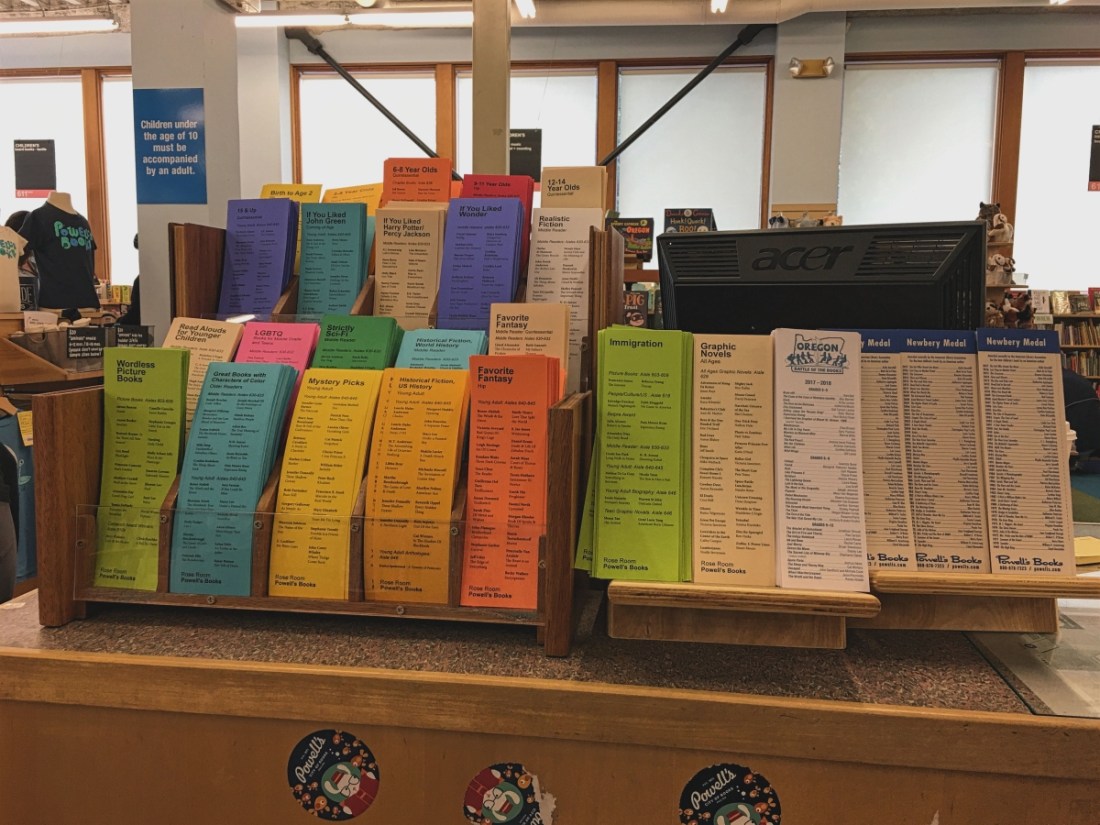
I opened the bookmark-like piece of paper, stunned to realise that the store contained nine colour-coded rooms, each hosting thousands of books in every category and industry imaginable. The building occupies about 1.6 acres of ground space and has over two million volumes. Though that information, and the visual representation of it, overwhelmed me, it also made me feel a lot better about myself. There’s no way that anyone in the world would feel like a know-it-all in this store. Everyone who entered would see how much there’s still to learn—maybe that’s why the store’s so popular. Every person I came across within the store had an excited gleam in their eyes. Not only are Portlanders well-educated folk, I observed, but they are also eager to explore and learn new things. As an outsider, I felt happy amidst a populace that was both intellectual and yet so ego-less and welcoming.

Powell's Book Store 2

While the though lifted my mood, my attitude shifted, too. All of a sudden, I felt curious and excited to see the rest of the store. I spent the next two hours combing through shelves in wonderment. It didn’t matter that I had no clue about the titles and the topics it covered. I felt pleased and humbled to exist in the presence of such knowledge. It made me crave reading more than ever. Everywhere I turned to, a book sat snug in a shelf, urging me to reach out. From deep astronomy to fantasy, from invasions to abrasions, from brush strokes to swimming stokes, the topics were endless. It amazed me how many undisclosed topics there are that more readers and writers should discuss.

Running into books, I hadn’t expected to run into so many conflicting emotions. Nonetheless, I walked out of Powell’s Books Store happy. Even though I had read almost none of the books on display, I’d learnt an invaluable lesson: You’re never too early or late to read.

All will be well

With rain drops dripping from her hair, flowing down her spine, and becoming one with her feet, she walked away as friends watched her. They knew her well enough to give her privacy when she most needed it.

Vehicles raced around her. Within, so did her mind. Not only had Jason had let her down, but also her story. As her publisher, he should’ve delivered on his promise. It had taken her six years to complete the book, which Jason had ended in months.

She went home, disappointment seeping through her veins. Yet her face remained impassive. With one physical book and thirty-seven ebooks, she’d been writing all her life. This wasn’t her first failure and it wouldn’t be her last—but it hurt all the same.

Taking a deep breath, she showered, and went into the kitchen. Expecting her stood a pot of tea—Akira’s panache.