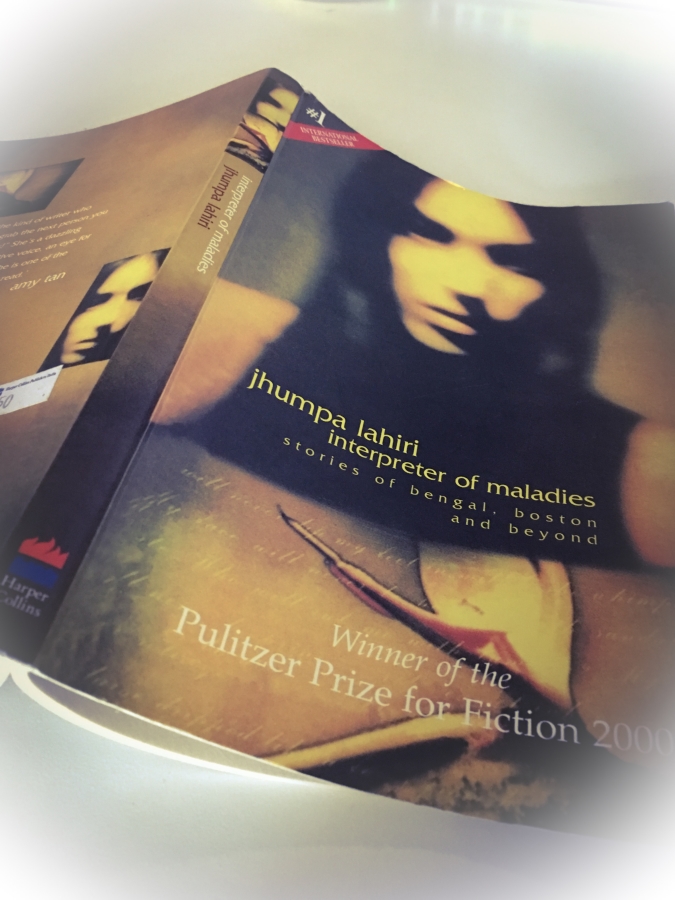
Interpreting maladies, and stories

I’ve always been a little doubtful of authors with Indian names. A little racist, I know, but having read a few Indian authors whose regard for English was far less than decent, I didn’t feel too guilty about myself either. However, I also know there were some exceptional Indian authors. I’m making a list and a recent entrant is Jhumpa Lahiri.

I have to say, I love her name. I love the way in rings in my ears, and rolls off my tongue. He family must’ve had a great sense of rhythm and respect for the listener. Perhaps that’s why Jhumpa Lahiri’s writing is also so aware of the reader’s mind and how her words would echo in their heads.

“Unsavoury sorts murmured indelicacies at cutlet stands”

Interpreter of maladies is a collection of short stories, some of them based in Bengal, some in Boston. What’s weird about this book is that though relatable in so many ways, Lahiri’s settings and her characters are yet un-relatable in many ways, too.

For example, she narrates the story of a young Indian-American couple. Their tour guide in India muses about their clothing, their relationship with each other and their children, their attitude towards natural beauty and photographed memories. And all the while, he makes judgements, often accurate, about how unhappy the couple are in their marriage — he observes like an old woman does with her hunched shoulders and ever-munching betal-stained mouth. The guide in the story is relatable because he’s a bit like an old woman, but he’s also un-relatable in many ways because he’s attracted to the young American woman he’s hosting. He contemplates his own unhappy marriage and compares himself to the young woman and her husband. He knows she’d go back to America in a week, and still he imagines — of writing letters to her, of nurturing a friendship with her, of explaining his job of interpreting maladies. All these qualities in a tour guide, who himself grew up wanting to be a scholar in five European languages, is a little unconventional, a surprising edge to a typical Indian character. And that’s what Lahiri does so well in her stories. She’s singled out some of the most common characteristics in Indian culture, spicing them up with unexpected behavioural patters to weave characters that refuse to leave the reader.

As a reader, you can’t help but appreciate Lahiri’s subtleties. In another story, Lahiri narrates the life of a young Bengali woman suffering from an unknown disease. Her neighbours talk about her behind her back and spread gossip, yet some offer to help. Referring to the women’s chattering, Lahiri paints a vivid picture so familiar to every Indian: “News spread between our window bars, across our clothes lines, and over the pigeon droppings that plastered the parapets of our rooftops.” That’s the India I grew up in, and yet, when reading Lahiri’s description, I can see the women gossiping along, drying their clothes under the burning mid day sun.

Another great aspect of this book is that the author herself has experienced both the worlds she describes. And I think that’s what makes some of the stories in this book, the stories that take place both in America as well as in India, so vivid and unforgettable. Some even outline regrettable, cringe-worthy incidents. What appears common in America in the late 60s is still taboo in some parts of India. This is an exchange between a mother and a daughter:

“It is improper for a lady and gentleman who are not married to one another to hold a private conversation without a chaperone!”

“For your information, Mother, it’s 1969. What would you do if you actually left the house one day and saw a girl in a miniskirt?”

Mrs. Croft sniffed. “I’d have her arrested.”

Mrs. Croft is a 103 year-old woman who cannot accept a man and woman speaking in private. And for that, her daughter mocks her — in 1969 America. The saddest thing, though, it’s 2017 and some Indians still cling to the same belief. The regrettable reality is that some parts of the world are yet to catch up to the sensibilities of equality and modern civilisation.

It’s things like these that make Jhumpa Lahiri’s collection of short stories a precious read. As an Indian, I loved reading narratives that I could relate to and smile as I recognised behaviours. As a person familiar with some ways of American life, I could sympathise with the feelings and emotions that the foreign characters portrayed. In sum, none of Lahiri’s creations are over-the-top unimaginable — they’re simple people living simple lives, who invite readers to share a few days in their lives. Interpreter of maladies is a wonderful read.

Inspiration

“Notorious stab at discrediting our culture…” the editor read aloud. With an impassive look, he cast Darcy’s article on his desk, along with countless papers lined with fine print. He had leafed through them all, but still hadn’t picked his copywriter when he picked up Darcy’s commentary on a teenager’s now-viral YouTube rant.

Darcy gulped. Had she nominalised a verb, perhaps?

Notorious,” he lingered, letting it ring through the otherwise silent room.

‘…mass murderer Sirius Black,’ her mind recalled the day she had learnt the word. But he smiled, “Great work.”

One story had birthed a new generation of storytellers.

Nicely saying

Nicely Said

When you’re a copywriter at a corporate, some things you pick up overtime. But even after being on the job for four years, there are still some things that you’d pick up only from far more experienced teachers. This I realised halfway through reading Nicely Said: Writing for the Web with Style and Purpose by Nicole Fenton and Kate Kiefer Lee.

It’s unlike me to read a book titled as such, because I’ve always nurtured a distrust in “how-to” books. This one, however, was a present. It was a present from a few writer friends I hold in high regard. So I decided to keep my mind open and delve into what Nicole and Kate have to say.

“Whether you’re new to web writing or you’re a professional writer looking to deepen your skills, this book is for you.”

That was the blurb of the book, a simple, typical one-line description for so many guide books that often fall short of their expectations. It seemed far-fetched, as if anyone could tell anyone else how best to write copy for the web when no one—including the web readers—knows what works and what doesn’t.

There’s no one way to write. There’s no right way, perfect way, or a way that makes the most impact. Writing is a variable in every sense. The audience varies, the style does, and so does the purpose. How then, could anyone pinpoint one perfect method?

Many books assert that they’ve figured out the one greatest way of writing. This book doesn’t.

The book doesn’t say what to write, but it says how to go abut thinking about what to write. And that’s where this book stands apart from the rest of the sheep. The authors illustrate the process of writing for the web, using an example throughout the book so that’s easier to follow.

They ask some important questions. Who would write for the web? Possible answers include, bloggers trying to hone their writing, freelancers selling their services, and copywriters employed in business. Though they all have different targets of varying complexity, all categories have one thing in common: the medium they choose to write in. When writing for the web, clarity matters, because no matter who the audience is, they’re always on the verge of closing a tab, impatient to move on to the next tab.
In such a situation, Nicole and Kate say how a writer should focus on delivering their message.

As a copywriter in business, I’ve always followed a similar principle: tell readers who we are, what we do, and how we could help them. Then add a section explaining why they (as buyers) should choose us over our competition. That’s the template—a fool-proof guide to writing About pages and sometimes even landing pages.

But this book made me think further: we tell readers who we are, but we also need to tell them who we are not. That doesn’t come from words, but from tone. For example, we’re professional, but we’re not against good puns. We are consistent, but we don’t spam your inbox with ten emails a day. We’re serious, but we don’t hate contractions. All these come from the way we write our copy, not from what we write in our copy.

Those are the kind of lessons that Nicely Said outlines. The book doesn’t come right out of the dark to illuminate magical truths and best practices, but it narrates the minute things that we often miss when writing for the web. The little things that matter, the finer aspects of helping the reader understand our message a couple of seconds faster, of respecting the reader’s time, of being a good host to website visitors—these are a few of the things that make a good copywriter. And the advice this book contains suits anyone, even those who only write Facebook statuses.

Give this book a shot. Chances are, you’ll cherish it as much as you’d a dictionary. I do.

Manipulator

“‘Mazing!” the boss appreciated. “This is such a great piece, Stan. I might give you a raise right away.”

Stan looked up. He hadn’t had a raise in two years because of ‘unfavourable economic conditions’. “Now?” His heart swelled, but the boss just smiled, and lifting his belly, waddled out the room.

Stan’s interns sat next to him. “It’s going to be okay,” assured Mark, a rich kid whose parents had “purchased” his internship.

“Well,” The boss had returned. “Wrap up that maze of an agreement. It’s brilliant—so binding that people wouldn’t know what hit them. Jackpot!” He exclaimed.