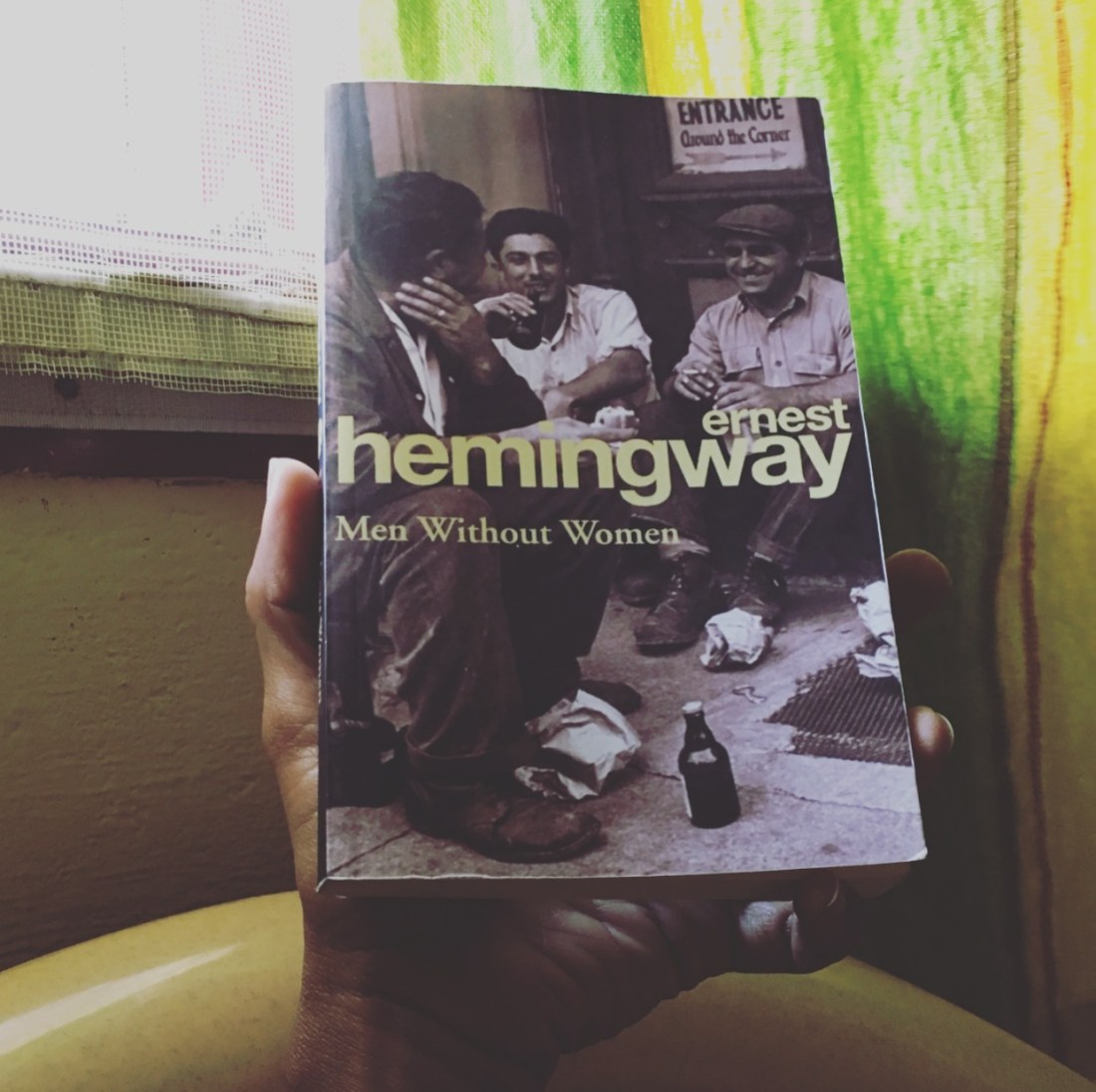
Men Without Women

men-without-women

When I first read it, the title bemused me. That’s not the kind of topic anyone at Hemingway’s time would’ve spoken about. Nowadays, sure. In the age of vapid vanity masquerading as fierce feminism, people would be more than happy to talk about men without women.

But Hemingway doing so? I wanted to go in and find out for myself why.

Like always, I read through the contents page. There were a list of lines that seemed like the titles of short stories rather than chapter names of a novel. Since the title on the cover felt like one for a novel, I hoped to read a thrilling tale of a group of men who lived without womenfolk.

Instead, I stumbled on many little stories and into the lives of many men whose egos, societal pressure, and selfish greed for power had hardened them. I had opened the book and fallen into a world of men, all of whom had no sense of what they were missing in life.

The book had a total of fourteen tales, and every one of them had vivid characters that jumped out at me. At least one character in a story refused to give in to his surroundings. I don’t know how having a woman in their lives would’ve changed their actions, but as a woman reading these men, I realised they were just jerks. And at some parts, their actions went beyond enlightening and entertained as well.

But it wasn’t all proud men wearing garlands of thorns. Some of the stories were a little dull, I admit. But every time I closed the book, thinking I’d read it later, the men on the cover called out to me. There was something about the picture on the cover, something about the three men smiling without a care in the world. As the book lay on my table, it made me wonder who those men would be and how the title of the book related to them. Men drinking and smoking, laughing and chatting — what did they speak of? Just the sight of the cover made me open the book again, hoping I’d find the answer in one of the stories.

I didn’t find the answer or the relationship between the title and the stories until after I finished the book. Two days after I had read the final story, it dawned on me how each story developed, and how every man in every story was walking proof of an empty life. And that’s when I appreciated the true power of Hemingway’s writing.

Whenever the plot vaned, Hemingway soared with the narrative. For a long time, I’ve basked in the image of Ernest Hemingway being an earnest writer. And this book proved it again. Some of the sentences and word choices popped out from print, making me gawk in awe at Hemingway’s simplicity with narrative. It’s unbelievable how basic words, with basic structure, can radiate depths of meaning. Such was Men Without Women — a joyous read.

What’s the Point of Blogging?

It’s been 5 years since I signed up for WordPress and for a long time, my blog remained vacant and without interaction. And then about three years ago, I got a job and with it, a flash of inspiration to blog more. Since then, I’ve been trying to keep up with life as it flashes by without me even realising it.

I love writing, and I love blogging about anything that strikes me. However, for a while now, I’ve been wondering: what’s the point of blogging?

My job revolves around writing. Copywriter, content writer, and all things words — that’s how I’d describe my work life.

I’ve gotten so deep into work that it’s morphed into my life. I’ve tried to keep my blog away from work, and I think I’ve succeeded. But after writing for and thinking about writing for 10 hours, coming home to do the same thing is a tad bit tiring. It doesn’t bore me, though; far from it. It just drains me. I seldom know what (else) to write, so I write what I like, like haiku, for instance.

It’s fun to play with words, decrypting tones and perspectives. It’s a challenge to tell an entire story in 17 syllables. A challenge I enjoy taking every single time.

That’s how I discovered the point of my blog: to enjoy myself. I didn’t realise it for a long time because, unlike most people, I had fallen in love with my job. My blog isn’t a coping mechanism; I don’t need it to vent my frustrations at work or complain about my boss.

I enjoy my job as much as I enjoy my blog. Happiness all around.

So is there any other reason to blog?

There is.

Just the act of blogging expands beyond self. It spreads my joy, transforming from simple joy into learning. A blog should thrill, give people a reason to come back for more. Just stringing clever wordplay doesn’t do much for anyone. Well, it does to some extent, but discussions, strong opinions, and experiences do more.

So that’s the point of blogging. Giving people a reason to spark conversations. That and a few haikus for myself. I can’t give up on that.


Well, that’s me. What do you think is the point of your blogging?

Write like Theatre

Practice is key. A performance artist doesn’t blow us away on a whim. No one can play a part for an audience unless they’ve played the part before. For the sake of one day’s show, performers practice for days, morning and noon, under lights and beneath makeup. Nothing goes out in one day and turns out successful.

A writer is also a performer. I write copy every day for websites, blogs, ads, and social media. But I never sit down in front of my computer and write the best line the first time. My best writing doesn’t pop out of nowhere; I need a warm up run first. Every day, I need to practice for show time before I dress up. I need a rehearsal, a prelude for what I’d do for the rest of the day. Because for a performer, every day is show day. For a writer, every day is a big day.

It may seem like theatre artists just breeze out and put on the best show of their life. But spontaneity is overrated. What appears spontaneous to the audience is meticulous practice on a day-to-day basis.

Theatre artists must practice every day before the show begins. And a writer must write every day before the day’s work begins. It’s a way to flex those stiff finger muscles and ease into the task of feverish typing that awaits them through the day.

Every morning, I practice on my blog. I write to get my thoughts under control. I write to bring motion back into my palms, to stretch my arms, and to get the shit out of my head. Then I edit. I go back to the first sentence and try to make it make sense. I catch a few typos and add a couple of puns. And once I’m done, I’m confident that I’ve practised enough to do more, and better, writing.

That confidence exudes at show time. Once artists are ready, they can walk onto the stage and put on a great show. Theatre or writer, toiling efforts behind the curtains — away from the world — makes successful whatever’s in front of the curtains.