It’s That Day Again

Last day of the month. And we all know what that means.

A month-long they spend toiling. Shuffling into the office each morning, hatred oozing from a not-so-cheery hello and the compulsion to work.

Every dying ember of a Friday afternoon would feel like the beginning of a carnival. And Sunday evenings, a dousing of spirits.

They bear it all because there comes a day — the last day of the month — when they would make up for all they’ve lost. A day to give money away to an unknown face behind computer screens and cash counters. A face, though smiles, relies on secret one-time passwords to check they aren’t cheats.

All that to acquire material stuff.

“A hat with a lion on it! I so need it to show off to my friends.”

“That grey converse looks good. I could alternate it with my blue and black ones.”

“Wow, I have a shirt that’d go so well with that scarf.”

“It’s almost December, shouldn’t I get a new pair of gloves? My old ones are…old.”

“He got a phone and I need to get at least a new cover for mine.”

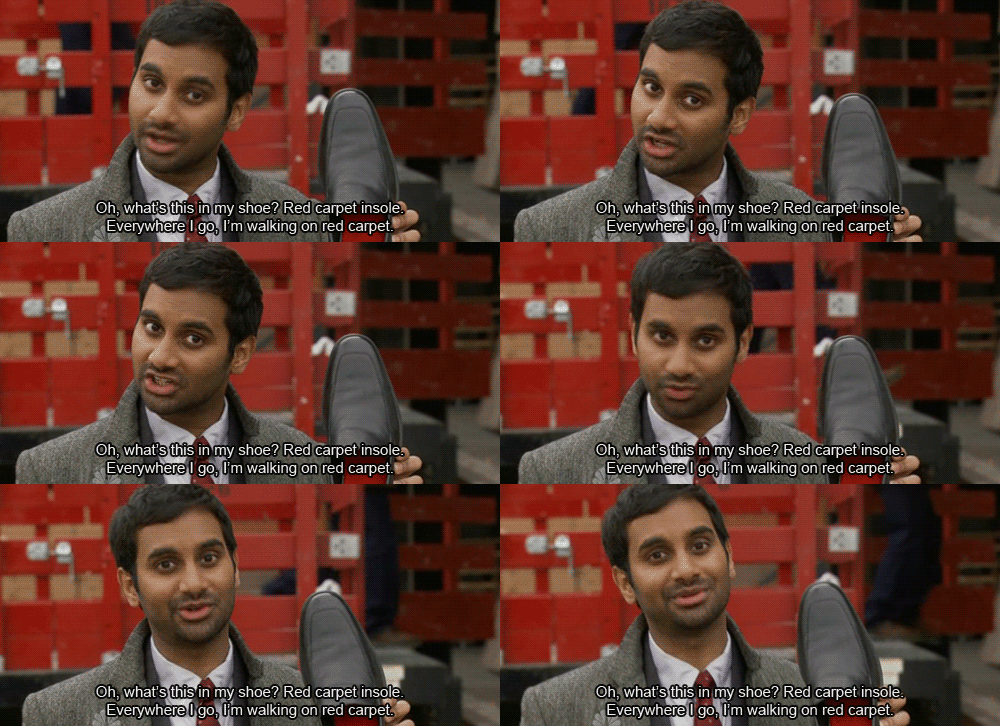
For the next two days, shopping malls and online sites will flood with young people. They’d spend hard-earned remuneration on flip flops designed like Mickey Mouse.

red-carpet

And as they surf stall after stall, retailers stalk them with delightful deals. Buy one and get something free. Ah, yes! I’ll take a pair of designer shoes, please. And a cake of soap to go with that. It’s good it’s free. I need that soap because I can’t get it elsewhere.

And since they bought something and got something free with that, they get another offer: Shop for more than 5 percent of your income and get 2 percent off!

Well, why the hell not?

At the end of the day, spending all that money makes them feel so much secure and good about themselves. If that’s what it takes to take on Monday at the work, then so be it.

The Lesser of the Two (D)evils

siblings

I don’t understand the American political scenario. Sure, I know Donald, and I know Hilary. As I typed their names, however, I realised that though Autocorrect knows Clinton it doesn’t recognize Trump.

Solace, at least I’m not the only one.

I don’t follow the debates on stage, and I don’t follow the debates behind the media scenes. From all I’ve heard and seen, both of them bicker at each other like siblings who can’t stand each other. And having an elder brother myself, I know that’s not pretty.

And to imagine they are representatives of the United States of America! From being a once-great country — looking at you Abraham — it’s funny how cheap US standards have become. Nevertheless, that’s how this pair is. You’d see sibling rivalry oozing between the two as they face each other, clinging on to their podiums.

I’ve tried and failed numerous times to fake interest in the matter, but I’ve failed every time. I just don’t care. Besides, the two of them only remind me of spoilt brats snarling at each other.

Donald Trump
He’s the younger sibling. Shouting is his way of handling an argument in which he doesn’t have a strong opinion (or a clue) about. He’s immature to engage in a conversation and has a lot of growing up to do.

If he takes his shouting it a little further, it becomes high-pitched wailing. He looks as if he’s ever-ready to start whining and moping. And when he’s not doing any of those things, he interrupts everyone else. He tries to override the other person by talking louder, harsher, and by repeating his weak statements.

And his idea of a healthy debate is to force people to hear him out.

Sounds to me like a schoolboy dying to get the world’s attention. And oh, he has incredible stamina. Hilary doesn’t have it, by the way.

Hilary Clinton
Going with the sibling theory, Hilary’s the older one. Compared to a six-year-old Trump, she’s a thirteen-year-old who’s just realised the power she exudes at home. Her parents trust her because she’s older than her brother, and therefore has more experience in society.

She just has to look them in the eye and remind them of previous occasions where Donald had been mean to her. And the best part — her arguments get stronger when she throws in real life examples of Donald’s bad mouth. It’s not that difficult.

All the girlfriends of the sister would help pick on her annoying, conniving, and thieving little brother. Remember, every woman Trump has insulted will vote this November.

And unlike little bro Trump, she doesn’t throw tantrums. She realises that by staying mute in the face of his outbursts, she’d come out looking good.

She never has to pull herself together to retort because when there’s a child such as Trump in the scene, no one expects the big sister to argue like a child, too.

Hilary is the mature one. She’s the bigger person. Trump makes a fool of himself even without her help. And she’s counting on him to ruin his candidacy.

Of all the people you could’ve chosen, America, you went for a pair of squabbling kids. Well done, and all the best with life after November.

Dear Colleague,

I just met you a while ago.

We stepped into the same lift. I was getting back to my place having escaped from an impromptu gossip gathering at the food court. It was 11.30 in the morning, and I had a memo to send out before lunch. That’s when I ran into you. And if I remember right, you were just signing into work.

I smiled. Not because I was happy to see you, but because I believed in keeping up with social niceties. I never thought for a second that you’d take it assume it was an invitation to make small talk. Alas, my bad.

Sure, I’d be thrilled to hear about your trip to the western coast of Australia. Oh, so they’re 6 hours ahead of us? Wow! Those bastards could’ve warned us about the twin towers, huh? I feigned laughter, forcing myself to look stupider than your narration.

And then I realised that the lift had stayed stuck on the 9th floor, and me with you.
As you moved on to the story of the lasagna you made last night, I chanced a glance at my watch. What had started as an innocent break had transitioned into forty-five minutes of wasted time. You didn’t notice, however, and I locked arms across my chest praying for the lift to move. I’d have only been happier if the lift had broken a chord and hurled us both to the ground. At least then you’d stop talking.

From the greasy dinner, you went on about your love life. Oh, why wouldn’t I love to hear how the hot guy on the block asked you out? And I’d be happy for you if the two of you hit it off well. No no, I care about your date night. And no, it wouldn’t be inappropriate at all for you to ask about his previous relationship.

I’m not sure if you had noticed my tortured smile, but I had one plastered on my mouth ever since my first smile. How I regretted getting into the same lift as you. But you go ahead. I’d love to hear you talk about… something.

And a while later, the lift started moving, taking me — a dragging inch at a time — to a place far away from you. We stopped on your floor, and you were oblivious as usual.

Isn’t this your stop? Oh, shoot! Shame I couldn’t hear more about your new boyfriend. He seems like a nice guy. Oh yes, we should catch up sometime. Coffee? Sure. This afternoon? Er, well, I can’t think of anything else I’m doing, so–ok. Ciao.

As the lift closed again, I breathed a sigh of relief. Before I knew it, the lift had reached the topmost floor — mine. I walked back to my place, too drained to finish that memo, but lunch was around the corner, and I had to get it done soon.

For the next fifteen minutes, my fingers flew over the keyboard. I hit send and leaned back on my chair when I heard my stomach rumbling.

Dragging myself to the lifts, I pressed the button for the ground floor. I had skipped breakfast and wish I hadn’t. As I walked into the dining hall, who should I run into but you!

Oh hello, how nice to see you again!

But I just met you a while ago.


Also published on Medium.

A Choice for Life

choice-for-life

Three years ago, I completed my schooling. I was ready to start spending my life writing away. I walked in to interview for an internship knowing I knew enough to crack it. And then came the question.“What do you want to do with your life?”

“What do you want to do with your life?”

It seemed obvious to me. After all, I had chosen to write and I interviewing for a writing job. Why then would they ask me what I want to do with my life? Not understanding what the world hurled at my face, I stifled my mirth at her question. But someone had to think straight and my interviewer and potential teammate worried I was throwing my life away.

“I want to write.”

And if there’s anything scarier than saying it, it’s doing what I said.

Writing, like art, is a hobby. No one believed I could do that for a living. It couldn’t be a career choice. At least not one that pays well. Most people I know who write, also have a day job that’s not writing.

They write when they can, they say. And that means they’d write something sometime in between 9 hours of work each day, 3 hours of Blacklist reruns, and a weekend filled with booze and buzz.

Still, when I said I wanted to write, I had no idea what that meant to me in the long run. And sure enough, my interviewer knew I didn’t. She tried to save me, help me see sense, and chase me off to get a degree in something I could fall back to when things turned nasty.

My family and friends couldn’t agree more. Almost everyone was certain my choice would go bad. I wasn’t too confident either. When negativity encapsulates you, knocking the breath off your ribs, you can’t help but give in. And so I told my father it would be temporary. Six to eight months — it was just an internship anyway. I’d soon know my standard and could go back to the typical career timeline of college after school.

I hated my first day at work. People were cold.

I was nineteen in a city too big for me to grasp, and worried I was too fat. My doctor had advised me to lose weight and my family to lose my job.

For my first assignment, I wrote a bunch of articles. My teammates suggested we print them out and mark the parts I should rework on. They ended up underlining almost all of my work. Except, perhaps, a few ands and ors.

I was furious. I had put my soul into words and an unknown person swept them all away as if they were flies on his cheese. He had no idea how long I sat in one place, stringing words together in proper grammar and (almost) precise punctuation.

No one had any right, whatsoever, to meddle with my writing. I had been writing personal blogs for two years before I started working. I had experience, and it annoyed me when they treated me as a novice.

According to them, everything I wrote was crap.

It took me more than 6 months to feel better about myself. They still pointed out faults in my work, but I had grown to enjoy talking about it. After I’d been around for a while, my colleagues were open to sharing their opinions, and I was open to listening. They helped me work out strategies, they gave me ideas, and I realised that no two people read a sentence the same way.

That was a revelation. I saw the marvels of varying perspectives and unintended interpretations. While some thought it was fine to end with prepositions, some people abhorred the idea. And as always, the Oxford comma sparked discussions that transitioned from face-to-face debates to chat messages well into the night. Some chose the Chicago manual style over the AP style guide. And some others just ignored everything passive.
And then I saw it: What’s crap for one person isn’t so for another.

Everything came down to perspectives. I had chosen a career that was so unstable and wavering that even industry specialists had made peace with their disagreements.
And while I sunk neck-deep in learning the nuances of a semicolon and wondering if I should use words like “nuances,” my internship ended and I became an official employee.
The city felt old now, and I no longer was nineteen or fat.

But my father remembered my promise and began nagging me. My life seemed fine at the moment but I should have something to fall back to — when things turn nasty. They wanted me to get a degree for a career I could live on.

For some weird reason, my family didn’t think I was already living. They acted as if all I had done was extend my internship. And so to please them — to get them off my back, rather — I signed up for a course in literature.

It seemed like the right thing to do. I wanted to write, and what’s more natural for a writer to study than good writing itself?

I thought myself mature, but I had been naive about the quality of our education system. It didn’t take me long to realise it was a waste of my time. My parents, however, were hell bent on getting me through the course.

As a result, my degree in literature killed my passion for conventional literary education. And in the process, it convinced me further that a piece of paper stamping me qualified for employment is just society’s way of circulating money.

It got me thinking. According to my society, a career in arts isn’t worth pursuing because there’s no future in it. As for Engineering, medicine, and now MBA — they are future-proof courses. Plus, they have a heavy “return on investment”. Nowadays people only speak in economic jargon because life’s all about what pays you well.

It’s funny because people are passionate when talking about Italian art museums and French sculptures, and how we should protect ours as well. But they also discourage any child who puts a brush or a pen to paper.

Alas, I’m not immune to the rest of the world and its changing fancies.

From my parents who think I’m in ruins and relatives who claim to love me, to people I called my closest friends, everyone’s told me I need a backup plan—any plan beyond my stigma for writing.

However, when people ask me what I want to do with my life, I still say the same thing: “I want to write”. I began as a content writer, and three years later, I’ve morphed into a content marketer. And that gives me hope. I may not become the greatest novelist the world has ever seen, but I’ve been writing.

Sure, life hasn’t been as perfumed roses. I’ve written plenty of poor prose and pathetic poems. But every time I sit down on a mission to tether words to meaning, and meaning to sentences, I feel the adrenaline pumping through my veins. And I realise: There’s a good chance I’d never become a published author.

There are countless writers out there with a passion for words and parents with money. And I see myself scavenging my purse for coins at the end of every month. My family could be right, and life may turn nasty; I never can be sure it won’t.

Nevertheless, one thing I’m sure of — as long as my lungs can hold air, I will write.


Cross-posting from my Medium blog.

A Lesson From a Friend

“So? She must’ve liked it.”

I sat chatting with my friend, A when another girl informed us that J had worn multi-coloured sneakers to school that day.

A brushed it off with a shrug and an uninterested statement. J was the class weirdo. She had moved in from another state and had a different way of doing things than we did. And it bothered most of us in class. All except A.

A would never comment on how J wore her pinafore, her hair, or how she’d crack her knuckles hard enough to crack them.

Even when the rest of the class huddled in a corner making crude jokes at J or sneering at her walk, one scathing look from A shut them up at once. She was the only person who didn’t join in. But she never told anyone to stop tormenting J either. I was her best friend, and I’d laugh at J too. She had even seen me a few times at it.

Still, she never advised me to stop or threatened to break my nose if I didn’t. Even when we hung out together — just A and I — she’d never mention J.

Though A made no violent gestures, she was always on J’s side, a silent supporter, watching her back.

As primary school went by, I got accustomed to A’s nonconforming behaviour. All the teasing made her uneasy and hated to disappoint A. I grew less thrilled about the “J’s a fool” club.

We moved through middle school, and then on to high school, but the name-calling didn’t change. I had, though. I couldn’t tolerate it. We weren’t friends or even lab partners, but J no longer was a weirdo to me. She was just J, my classmate.

And one day, just before the summer holidays began, A and I sat in class making plans for our vacation.

“Hey guys, we’re planning to dump mud on J’s head. Wanna come watch?”

Before I knew it, I had stood up with my hands clenched. I was ready to defend J even if it came to a fistfight.

She deserved respect, and I had grown up at last.