Second Time Around

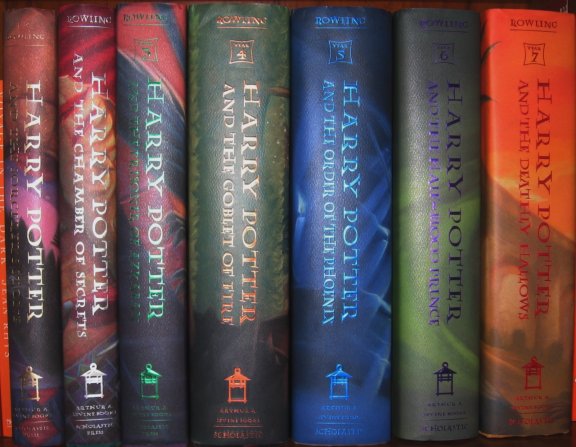
Which book would I want to re-read for the second time? That was the prompt a few months back. Re-reading? I can name a few. I read books but I don’t own much, and of the few that I have at my disposal, the book that I’ve read on multiple occasions is ‘Harry Potter and the Philosopher’s Stone’.
Harry Potter:

I got ‘Harry Potter and the Philosopher’s stone’ from a cousin and I have read that book almost twelve times now. Though I don’t have the others of the series, I’ve read them more than once too. The series actually made me recommend it to some of my other friends, who thoroughly enjoyed it. I read somewhere from a HP fan that Harry Potter has lessons for generations. A lot of fans say that, and people might think that Harry Potter is a school text-book. I see the books as an account of the lives of a few teenagers and the transition they undergo over the years and how events mould their characters effectively.

Wikipedia says that according to Rowling, ‘death’ is the underlined theme of the series, but one can quite easily identify other dominant themes like, adolescence, friendship, power-hunger, confronting fears, making choices, obsession. It’s the presence of these wide topics that make the series an interesting read, and in the words of most fans, a lifetime’s lesson.

Throughout each chapter of every book of the series, JKR’s mystical storytelling tactics are prevalent and urge the reader to have the pleasure of a second-time read.

Even now, after many years of having read the books, whenever I feel like I’m having a bad day, Harry Potter helps. Sometimes people around us – Harry Potter haters – seem to think that Harry Potter is only for children; they are of the opinion that it’s just a fantasy tale of a few troublesome teens. Yes, they are not perfect; there are a few flaws in the books, I don’t deny it; but I have to add that it introduced me to the pleasure of reading and writing.

Though a whole lot of people enjoyed HP, similarly, a large people criticized it as even foolish and unnatural. I just have this to say: Harry Potter is a novel that could be enjoyed only by those who would allow themselves to be lost in a powerful den of words. Only those who are willing to convince themselves to believe wholeheartedly in the impossible and to find solace in it, will enjoy the series. Those who seriously want to dwell only on reality; those who deny to let in the subtle and fantasy-like emotions, are never going to enjoy a book such as this. Also, in my opinion, the reader has to place himself in between the characters to appreciate JKR’s words.

Something I really enjoyed about the books is that they were not too descriptive. There were a lot of vivid descriptions, yes, but the thing was  that some parts and scenes of the story were left to the readers’ imagination.  I like the kind of stories that respect the readers’ imagination. I’m not sure if that was the reason for my liking the series, but it certainly was one of the reasons.

Reading Harry Potter is like dwelling in a completely different world; a world that you wouldn’t want to come out of. A world where an entirely different lifestyle exists. Once in, I wouldn’t want to come back to reality that has, nowadays, become more far-fetched than Harry Potter‘s world of magic itself.

The White Tiger

“All the world’s a stage” said William Shakespeare.

Here, Aravind Adiga, in his novice attempt at a novel, has illustrated the world as a jungle. Not much of a surprise; we meet animals on the streets everyday!

This story ‘The White Tiger’ is about Balram Halwai who is far more intelligent than his classmates and so earns the title ‘White Tiger.’ A white tiger is a rare thing that is born only once in a generation. Thus the name.

Unlike a typical intelligent schoolboy, Balram turns out a different person altogether. The reason is that he was from the Darkness. His was a poor family and he had to drop out of school early. Here’s the secret: India is the only country in which one can find two main partitions; Darkness and Light. The poor families in the ‘underdeveloped’ villages, (not ‘developing’ as the rest of the world calls it (or rather, villages that face barriers to development)) who have to struggle hard daily for half a meal and those who have to drop their children’s education to pay off debts, make up Darkness.

The rest of the world turns a blind eye towards Darkness.

This is the kind of story that helps readers realize the harsh realities of life and the author has made no effort whatsoever to diminish the harshness. It’s blunt and to the point; no beating around the bush.

Mr Ashok Sharma alias Balram Halwai,  a driver; a thief; an entrepreneur; a murderer and the White Tiger, on hearing the news of the Chinese Premier’s visit to India, writes a letter to him explaining the realities of India, which he wouldn’t otherwise know. He narrates his entire life story; the story of how a simple boy from Laxmangarh became the driver of a wealthy man in Dhanbad, his journey to New Delhi; the story of how Delhi corrupted his America-return master and himself, and his transition from a faithful servant to murderer and then an entrepreneur.

The author discusses the concepts of caste, poverty, weakness, vulnerability, corruption, freedom and mainly, the difference between Darkness and Light.

This is not a fast paced story, and I really enjoy some pace in the story. This wasn’t a polished and colourful story, it’s just a narrative of facts. If truth be told, the story didn’t appeal to me; seems hard to accept, maybe because the truth is always bitter or maybe because the incidents are similar to those I’ve seen in movies.

The narrative contains spoilers for those who hold India in sky heights. Nevertheless, the tale gives an insight into another India altogether; another India that lives so close to us, yet remains unnoticed.

P.S: It’s interesting to note that Balram, after slitting his master — Mr Ashok’s — throat and running away to Bangalore, takes up his ex master’s first name as his; he becomes Mr Ashok Sharma the successful entrepreneur.

The Village By The Sea

                 A story that portrays the typicality of Indian fishing villages and families.

~Anita Desai~

             Here’s a story that tells Indians about the fishing villages and the daily struggles of our fishermen’s families. The story revolves around a family of four kids, of whom three are girls. The mother is bed ridden and the father is a typical drunkard. Therefore the livelihood of the family falls in the hands of the eldest, Lila (14 years) and her brother Hari who is a year younger.  Each page is a lively portrayal of their efforts to upbring their family’s standard.

            The beauty of this story lies in its factual details and the simplicity of the characters. Devoid of basic needs, the two children never give up their family. They uphold the traditions and support their family at all times. The author has done a remarkable job in depicting a village in a beautiful way that remains in the readers’ hearts .

Lila is a young girl, just trying her best to retain her description as a typical Indian girl. Her passion for saris and bangles reflect her interests and knowing she can’t get many, she does well to give up her wants for the sake of the family. Similarly Hari also works hard.  Not having a fixed job, he does anything he can. He ploughs a non-fertile land, he does fishing by the shore and he climbs coconut trees to sell the coconuts for money.

Besides the family story, the author also illustrates the effect of urbanization on a small fishing village, Thul. This is a story which looks to educate about the destruction of our villages in the name of industrialization.

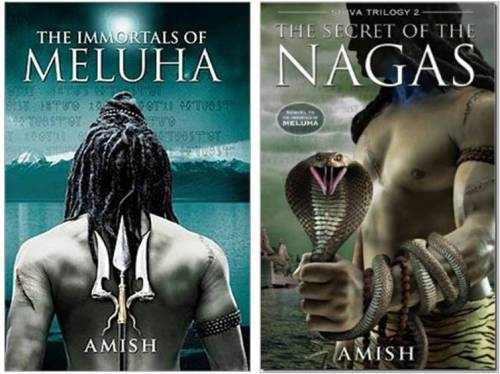
Shiva Trilogy

Get to know the 21 year old Tibetan immigrant whose destiny turned him into the Mahadev, The God of Gods.

Not every writer has the power to captivate the reader. It is an inherent talent that has to be developed. Amish – the first and latest Indian author I’ve read and I must say I was really stunned at the amazing narration of incredible imagination.

In my view, a good novel should be one that the reader can relate to. This is a challenge the writer has to meet, especially in the case of fiction. A fictitious novel needs something special if it has to impress the reader. The incidents in the story, descriptions, dialogues and characterization should be believable and realistic. Amish has met the challenge successfully.

The best part of this story is that we get to meet the “Mahadev” as a common youth, filled with young fantasies. He appears, to the reader, just like the boy next door.

“Some traditions are meant to be broken”

This trilogy is not completely the author’s imagination. It is centred on Hindu Mythology. Hence the characters and a few incidents are not unknown to the reader. The author has only said an already existent and over-told story in a new way with added spice. The new episode of Shiva’s life easily acceptable. The author has done a good job in introducing us to the youth who was praised as a Lord. (Shiva hated being called Lord – just saying!)