Tis a Sin

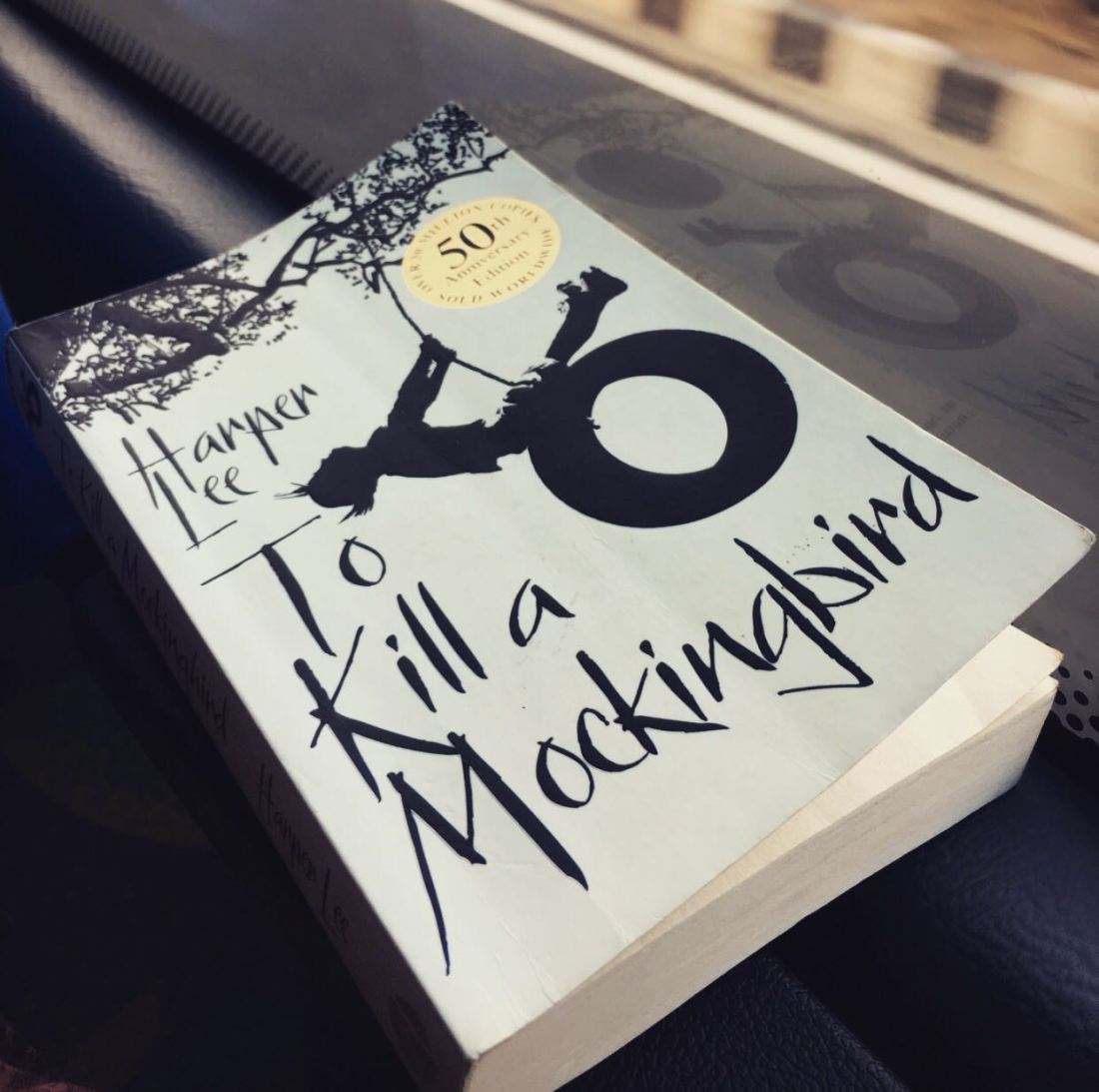
I’ve just finished reading a classic novel that I should’ve read ages ago. However, like so many other books, I took my time to get my hands on To Kill a Mockingbird. Needless to say, I regretted not reading it sooner. But there was also something different about this book than the others I’ve been reading.

To Kill a Mockingbird is a simple story. It has a complex plot that’s worth talking about for years together, but the story line was simple enough. Harper Lee had chosen a not-so-uncommon incident, and worked out a narrative around it. I didn’t realise it until after I finished reading it, but the entire plot wove around a single strand, one strong piece of gossamer that shone bright enough to attract and magnetic enough to keep me attracted through to the last page.

I can’t remember the last time I read a book so captivating, so relatable, and so enchanting. I loved the brother and sister. I loved how the brother would nag the sister saying she was becoming too much like a “girl.” Brothers do that, and not many books illustrate it as well as this one does. Throughout the story, the relationship between the brother and sister blossomed from childhood trebles, evolving into an everlasting bond of friendship and reliability. That’s how real brother-sister relationships mature, and I was amazed when I realised that no other book I’ve read (so far) ever mentioned anything like it.

Every character was a an entity in itself. Scout was an atom of energy, reminding me of my younger days when I frowned at pink flower frocks, picking, instead, a pair of comfortable overalls. Jem was a natural, a protective brother who watches out for his sister, loveable yet condescending at times — just like mine. As for Dill, he’s the kind of person we’d come across in life who has it all — or so it would see —  and yet, has nothing worth having.

Calpurnia, the beacon that lit up the Finch household, was the ever-smiling help at home that makes every child learn while they yearn for her cookies.

And Atticus, dear Atticus, what a father he made. Standing by the suppressed, jovial and just Atticus was the perfect protagonist. When he’s a typical father who doubts his parenting skills, when he demands the truth without raising a tone, when he caresses his daughter’s hair, when he embraces Jem’s adolescence — Atticus’s every action makes the reader love him even more.

How could anyone be unaware of such vivid writing and vivacious narrating? If it’s a sin to kill a mockingbird, tis a greater sin to let great works go unappreciated. At least now I can cherish it, late though it is.
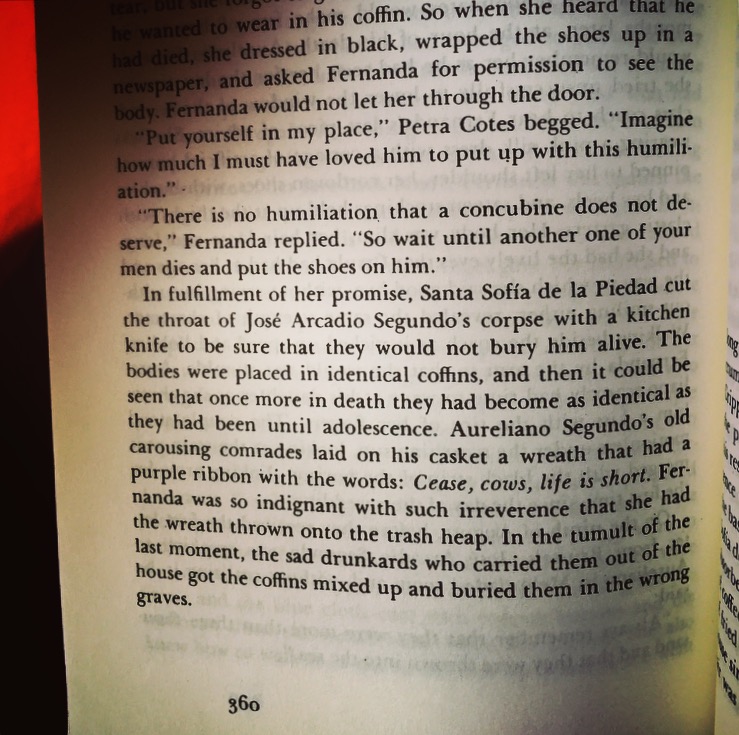
Cease, Cows, Life Is Short

Once in a lifetime, if you’re lucky enough, you manage to finish reading a book that’d make you wish you had read it sooner.

For me, it was One Hundred Years of Solitude.

one-hundred-years-of-solitude-cease-cows-life-is-short

I had begun reading the book as soon as Amazon delivered it to me — about two years ago. Then we had a falling out. I read through about sixty pages before I realised it was too complex and too “out there” for my intellect. I felt intimidated. I couldn’t understand why I couldn’t understand the narrative. Maybe it was the fine print and the font that I didn’t admire, I told myself.

Thinking I’d read it later, I cast the book aside waiting for motivation to strike me hard enough to pick it up again. Some time that time, a friend wanted a book. I suggested One Hundred Years of Solitude, but I also warned her that it had given me a block. She took it nevertheless.

That was the last I saw the book until last month, almost a year and half later.

One cold morning a line from the story popped into my mind: “Colonel Aureliano Buendía was to remember that distant afternoon when his father took him to discover ice.” Even though the book had thrown me off, that queer line had stayed with me. That’s when I realised I should give the book another chance. I got the book back from my friend and dove in right away.

It took me a good one week to finish the book. I whizzed through over half of the story, slowing down as the narrative progressed. Many times, I went back two pages to make sure I followed which Aureliano did what. I had to scan the family tree hundreds of times before I understood who’s child Amarantha was and who her child was.

I speed-read some parts while I cherished other parts of the story. I stopped at beautiful turns of phrases, and gawked at clever word choices. And then I paused and took pictures when I saw words of wonderment.

When I did finish reading it, however, I wanted to kick myself. I chided myself for missing out on so much pleasure the first time I tried reading it. If only I had tried harder to endure the initial confusion, I would’ve enjoyed a glorious read much sooner.

Perhaps it was meant to be. Perhaps I couldn’t read it then because I wasn’t mature enough. Maybe now was the time I needed it the most. Just like the Buendía family had waited a hundred years to decode the prediction of their fortunes and misfortunes, I had let history repeat itself before decoding the joys of One Hundred Years of Solitude.


You should read this book, if you haven’t already. If you have, however, tell me, what was your initial reaction?

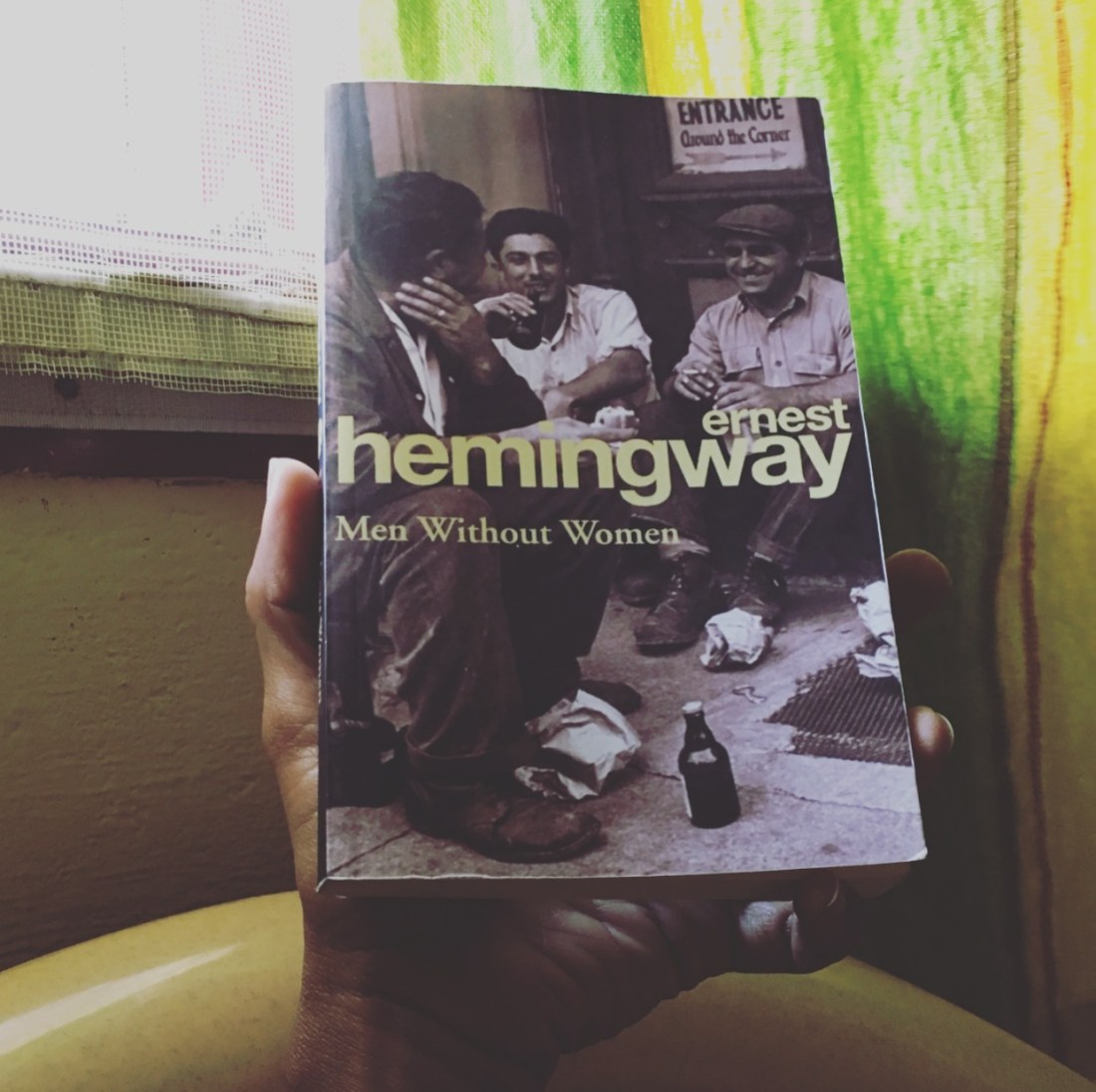
Men Without Women

men-without-women

When I first read it, the title bemused me. That’s not the kind of topic anyone at Hemingway’s time would’ve spoken about. Nowadays, sure. In the age of vapid vanity masquerading as fierce feminism, people would be more than happy to talk about men without women.

But Hemingway doing so? I wanted to go in and find out for myself why.

Like always, I read through the contents page. There were a list of lines that seemed like the titles of short stories rather than chapter names of a novel. Since the title on the cover felt like one for a novel, I hoped to read a thrilling tale of a group of men who lived without womenfolk.

Instead, I stumbled on many little stories and into the lives of many men whose egos, societal pressure, and selfish greed for power had hardened them. I had opened the book and fallen into a world of men, all of whom had no sense of what they were missing in life.

The book had a total of fourteen tales, and every one of them had vivid characters that jumped out at me. At least one character in a story refused to give in to his surroundings. I don’t know how having a woman in their lives would’ve changed their actions, but as a woman reading these men, I realised they were just jerks. And at some parts, their actions went beyond enlightening and entertained as well.

But it wasn’t all proud men wearing garlands of thorns. Some of the stories were a little dull, I admit. But every time I closed the book, thinking I’d read it later, the men on the cover called out to me. There was something about the picture on the cover, something about the three men smiling without a care in the world. As the book lay on my table, it made me wonder who those men would be and how the title of the book related to them. Men drinking and smoking, laughing and chatting — what did they speak of? Just the sight of the cover made me open the book again, hoping I’d find the answer in one of the stories.

I didn’t find the answer or the relationship between the title and the stories until after I finished the book. Two days after I had read the final story, it dawned on me how each story developed, and how every man in every story was walking proof of an empty life. And that’s when I appreciated the true power of Hemingway’s writing.

Whenever the plot vaned, Hemingway soared with the narrative. For a long time, I’ve basked in the image of Ernest Hemingway being an earnest writer. And this book proved it again. Some of the sentences and word choices popped out from print, making me gawk in awe at Hemingway’s simplicity with narrative. It’s unbelievable how basic words, with basic structure, can radiate depths of meaning. Such was Men Without Women — a joyous read.

Making the Meaningful Meaningless

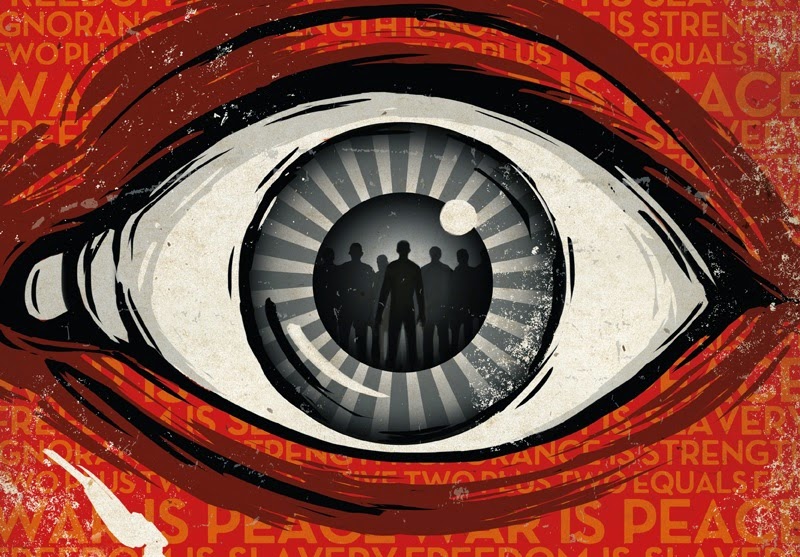
So many of my friends had told me about the wonderfulness that’s 1984. The book, I mean.

big-brother-1984

I, however, never had the chance to read the book, until now. I started reading it a while ago, and as much as I’d love to get through it in one sitting, reality keeps distracting me. Nevertheless, every chance I get, I try to sneak in a page or two in the least. And with every page I turn, I turn over a new perspective.

I haven’t even crossed a hundred pages yet, and yet every statement hits me hard in the face making me glad I’m not in 1984. To say that Orwell has a way with words is an understatement. He twists and warps simple words to suit his needs and instills fear and aversion in the reader.

As a lover of words myself, when I took in words that claimed it was a beautiful thing to destroy the words themselves, I felt my deepest horrors renewed.

After all, what justification is there for a word which is simply the opposite of some other words?

That’s a way of looking at words, unlike any way I’d come to accept. Words, for me, are not just means of expression but also means of expression in every wild way imaginable. It’s wonderful that we have so many different words describing the same thing; it’s what gives rise to rhyming words and rhythmic prose and just plain readable writing.

In the end the whole notion of goodness and badness will be covered by only six words — in reality, only one word. Don’t you see the beauty of that, Winston?

I don’t. I don’t see the beauty of it, and instead, I see only the barrenness of it. What’s the point of communication if you can’t communicate as you’d like to? If we could strip down the English language to a mere handful, then that would become the end of human interaction. We’d speak to convey messages and not ideas. We’d talk sense but wouldn’t talk from our senses. We’d think we’re free to speak, without realising we’re free from language itself.

The book throws terrifying ideas. It outlines everything that could go wrong with the world, and everything that could happen as a consequence. And shocked though I am, it makes me want to keep reading.

The Tale of a Boy at Sea

Yesterday, I read a unique book that chilled me to the bone. It wasn’t the curious case of an unsolvable mystery, it wasn’t a multi-murder crime thriller, and it wasn’t a sweet romantic proposal story. It was the tale of a young boy stranded at sea for ten days.

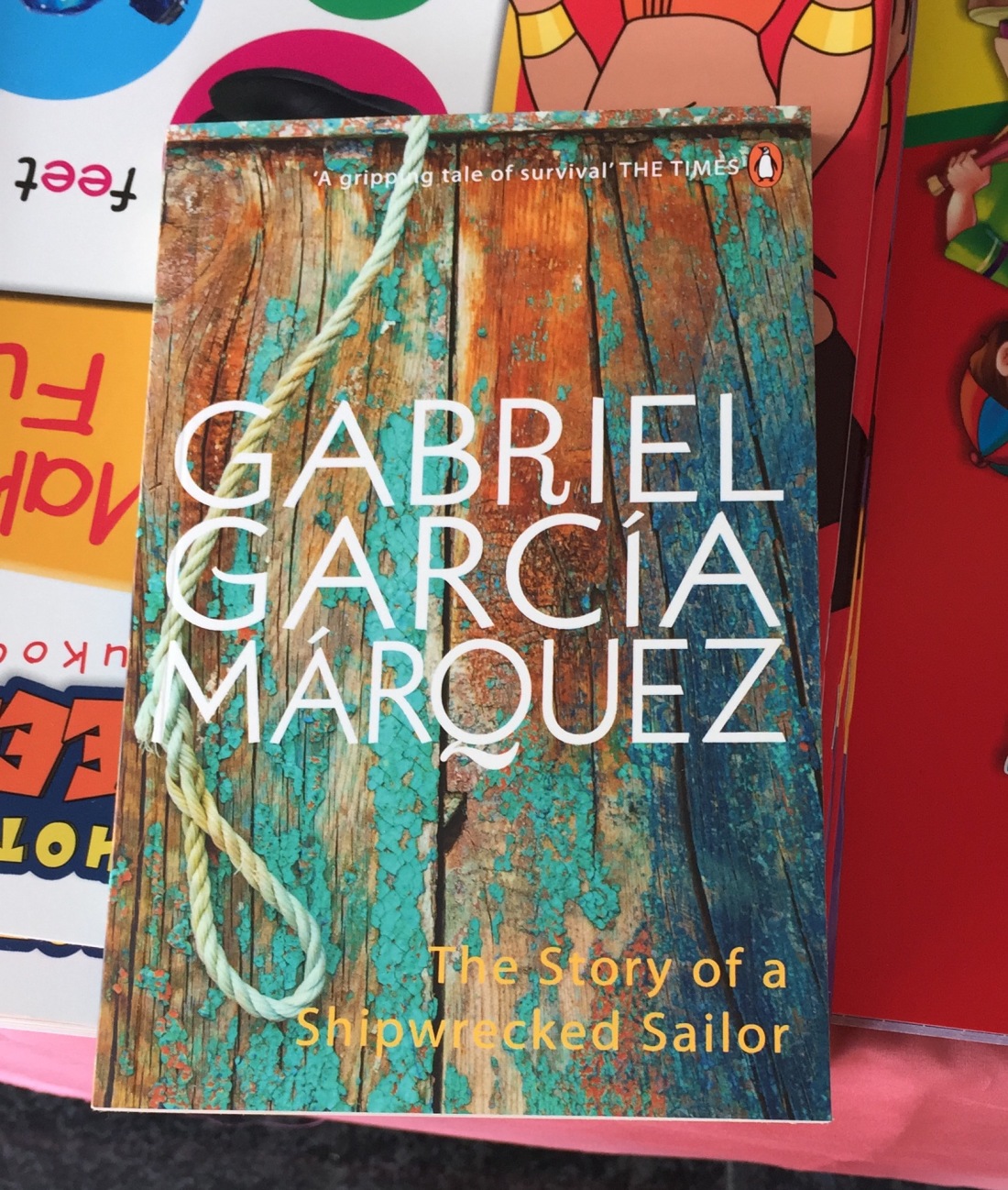
It’s not Life of Pi, but I wouldn’t blame you if you had thought so. That book is ever more popular after its movie counterpart. However, the book I just read is “The Story of a Shipwrecked Sailor,” and the author is Gabriel García Márquez.

the-story-of-a-shipwrecked-sailor-gabriel-garcia-marquez

It surprised me too. I had never heard of Márquez writing such a book. But I was curious. It was a small book, just about 100 pages. And yet as I held the book in my hands contemplating whether to buy it, all my sense of reality told me I should opt for an ebook, instead, because it would take far less physical space. I asked a friend to help me decide, and he warned me that Amazon would have the same book, for a lower price.

And so when I was almost convinced I shouldn’t buy the book, I flipped the book over and read the epilogue. That’s when I realised: this was Márquez’s first book. That piqued my interest. Besides, the cover was gripping, and it even had a review from The Times that called the narrative, “A gripping tale of survival.” And at that moment, I took a chance. I lost all sense of common sense and decided to go for it. After all, I had nothing to lose.

I’m glad I made the decision. I know I shouldn’t have gone by just the cover of the book, but this is one of those times when the gut and the cover got it right. It’s a simple story, in the first person point of view. A boy in a ship leaves for Colombia after being in port for six months. He set out homewards, to his family and soil he could call his own. In the middle of the sea, however, disaster strikes and all of his shipmates go down. He holds on to a raft and survives the sea—amidst sharks, hallucinations, hunger, and thirst—for ten days. He then makes it to land and becomes a national hero.

It’s typical and predictable in all aspects. But the best part of it is that the author narrates all the typicality and the commonness of it in such a matter-of-fact way, that you can’t help but keep turning the pages. You’d want to know what’s coming, even though your sixth sense tells you it’s nothing great for the hero.

The story reeks of emotion. You feel for the hero. When he stretches his neck looking for land, you stretch with him. When he plunges his hand into the sea trying to catch some fish, you gasp knowing that the sharks are waiting around the corner. When he wonders how shoes taste like, you’ll find yourself imagining the taste on your tongue. And as he tries to pry out the soles of his shoes, you wish you could pry it with him.

It’s an ordinary story, but it gives you an extraordinary experience. I now know why Gabriel García Márquez got a Nobel prize for literature.