What I learnt from social media about being social

I’ve grown more active than ever before on Twitter. And if there’s one thing that it’s taught me, it’s that reciprocation is everything.

When I first joined Twitter over six years ago, I looked up to celebrity accounts like every other novice. It amazed me how much the paparazzi buzzed after them and how even though they followed no one, their accounts boasted a massive following. I wanted to be like them. Shame on me, I now realise.

Because I tried so hard to be an influencer even before I understood the purpose and meaning of social media, I couldn’t get past a few tweets a week and a meagre following of friends who signed up for Twitter and forgot all about it. My account was at a sorry state and without trying too much I faltered, ignoring my account altogether. What I didn’t realise is that everyone who did well on social media were either channelling their success from offline or from other platforms. Industry specialists, cinema stars, subject matter experts—all of them were already established before they posted their first tweet.

I, on the other hand, was a scrawny 19-year-old drunk on Shakespeare, trying to be poetic in every line I said. Plus, I wouldn’t follow anyone. People should follow me for my genius—I thought every day as I logged into Twitter. I didn’t think about meeting new people, conversing, exchanging insights, or learning.

That’s why I couldn’t get the hang of social media.

It took me long enough, but I’m glad that I’ve come a long way since. After years of being a failed twitterer, I discovered how chats brought out the sociableness in me. I understood that we gain value from a network when we offer value in return. Social media isn’t about posting a fantastic message and the likes. It’s a community, instead, where we should be willing to follow other people’s train of thoughts, thank them in sincerity for their opinion, and reply only if and when appropriate.

I’ve been trying do that for a while now.

No, my followers count hasn’t peaked up overnight. And no, I don’t have paparazzi outside my window. But no, I don’t feel like a failure either.

I feel like an achievement. Because I now realise the likes and followers don’t matter as much as the ideas and their reach. Amazing how far a thought can go on social media. My old classmates (who I no longer speak to but are on my network) liking my posts doesn’t matter as much as a relevant person chatting over it—of course, retweeting and sharing helps, but it’s not what drives my worth anymore.

Every time I go on social media now, I know that I’m only a tiny speck in an ocean bigger than anything I’ve seen. The deeper I engage with people who share my interests, the more I learn that I have a lot to learn. Every day I come across people I want to probe, to ask questions from, and to discuss what I think.

Social is not one-way communication riddled with ego. It’s social—where everyone knows and accepts they’re a fool sometimes and a genius at other times.

In search of utopia

I always choose comfort first—in attire, in stance, and even in the company I keep. And when it comes to my everyday life, I don’t have many surprises. My day begins the same way every day and ends in the same way. Throughout each day, I focus on things that matter most to me—tasks I enjoy, tasks I’d be willing to repeat.

As a result, I’ve grown comfortable with a certain lifestyle. It’s my zone, my happy place, and I don’t appreciate disturbances in that.

As attractive as it sounds, there’s also the risk of becoming too comfortable. I realised this while replying on a Twitter chat. Sometimes we get so accustomed to what makes us happy, like certain choices and routines that we’d rather not break out of. Most often than not, that’s because we prefer to be happy with whatever we like instead of putting ourselves out there and exploring new opportunities.

That’s how we let great opportunities slip through our fingers. Even if we realise that a new choice or a new job offers more potential for growth, we still choose to stay where we are… because that’s the easier option. And the longer we train our minds to satisfy itself with whatever—little or much—it possesses, the harder it becomes for us to venture into newer experiences. As the combination of fear and laziness builds up, inertia creeps up on us even before we know it.

As our fear to try out new things increases, we begin to focus more on the task at hand rather than the purpose of it. We care more about completing the routine than about the satisfaction it brings us. We start to define our self-worth based on the destination rather than the journey. That’s when routines become lethal. When our journey lacks passion, our life lacks soul, too. We become afraid of unfamiliarity, associating it with discomfort. We hesitate to make decisions, and douse in doubt even when we do. And with doubt tags along the inability to forgive ourselves for our mistakes and accept embarrassment.

And all of a sudden, what once was comfortable would’ve reduced us to nothing but scrawny scared cats. Staying in the comfort zone is as handling a two-sided sword. We just have to find the right balance.

Chit chatting away

I’m not what people call the social kind. I’m more of a…

…selective-social introvert.

It means I don’t like going out in large parties, or to large parties.

It means I’m uncomfortable with more than three people in a group.

It means I prefer being alone in my room than being lonesome in a crowd.

Most of all, I don’t mind people knowing that I’m not a people-person.

As a result, I stayed away from social media, too. I’d always found it too noisy, too spontaneous, and too narcissistic. Until I discovered Twitter chats.

I’d signed up for Twitter six years ago, but for more than five years, I made only feeble attempts at understanding how it works. And then one day, I had to analyse and evaluate Twitter for my work. As I combed through their documentation and scanned popular accounts, I discovered the wonder that is Twitter chats.

It seemed promising — a closed group of people discussing issues that mattered to them. That seemed like a purposeful way to spend time on social media, unlike the posting of selfies and sharing of love-struck statuses my friends did.

Though not all together certain, I joined my first chat. The sheer number of people who contributed to the conversation surprised me. As soon as the first question came on, a bunch of people replied in kind. Funny, enthusiastic, helpful, share-worthy responses piled up. As I read through them, I realised I could contribute something as well. I had a point that no one else had mentioned yet, and I felt an irksome desire to say it out. After all, these were people in my industry speaking their own experiences. It’s fair for me to do the same.

And I typed out my perspective. Within seconds people liked and retweeted my tweet. They replied, they agreed, and some even followed up with questions. The more I shared my ideas, the more conversation I generated. I realised I knew stuff that people thought were valuable. I knew tricks of the trade I didn’t know I knew. It was exciting. Twitter was exciting for the first time in five years! Social media, for once, was social to me.

That chat hooked me right in. From that day forward, I try my best to make it every time the chat happens. Every week, more and more people join in. But I never feel the crowd bearing on my shoulders. Instead, it’s fun to have more people in the discussion. Sure, sometimes my feed floods with hundreds of tweets even before I can read a handful of replies and answer a question, but it’s still useful, engaging, and welcoming as ever.

What began at one chat transcended beyond the one. When I began to participate in many chats, I realised there were others who showed up for particular chats every week. I started to see familiar faces, and I started making friends.

I’d become social. At least on social media.

— — — — — — —

Do you hang around Twitter chats? How do you like it? If you’re interested, come say hello @s_narmadhaa.

Self, thy name’s Esther

The first time I read a few lines attributed to her, I fell in love with Sylvia Plath. Thanks to the collection board that’s Pinterest, I discovered plenty of gut-wrenching, heart-clenching verses that Plath had written. Hooked, I went on a rampage of Sylvia stalking. Before I knew it, she’d become one of my favourite writers. I’d read about her curious suicide, and I’d watched Gwyneth Paltrow’s portrayal of her life. Her story strengthened my affection for her and somewhere between feeling respect and pity towards her, I found myself doting after her as well.

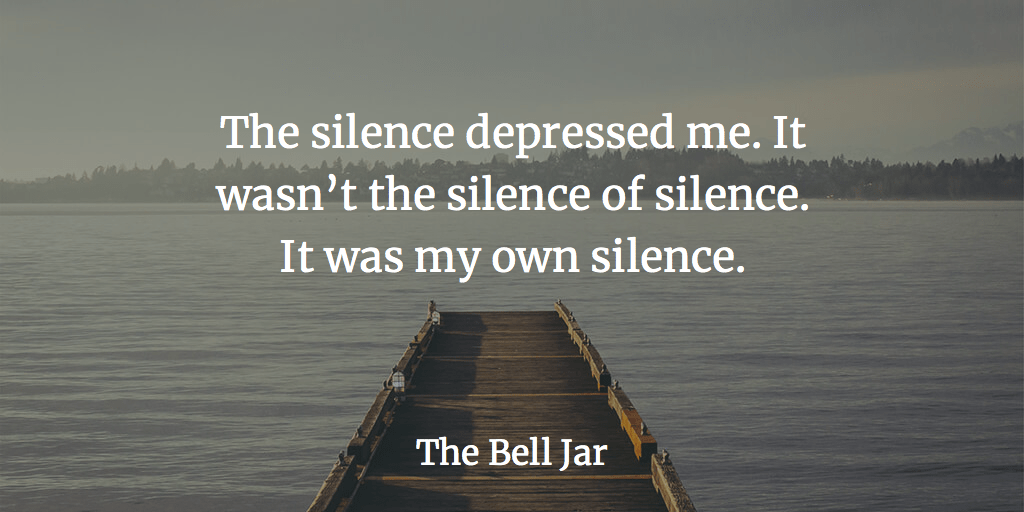
Wonderful though it all was, I’d become addicted to Plath despite reading none of her works in complete. That’s how I came upon The Bell Jar—guilt-ridden and hungry to prove to myself that I know the author I adored.

Before flipping through its pages, I didn’t know what to expect from The Bell Jar. Wanting to figure it out for myself, I read none of the reviews and asked no one I know what they thought of the story. As I began reading, I grew fascinated by the protagonist of the story, Esther Greenwood. The reason, I later realised, is that she’s in no way special. Unlike many other protagonists with their exceptional talents shining through print, Esther was simple in all sense.

The book opens with her in the middle of a writer’s scholarship—something I could appreciate as an aspirer myself. Little by little, as the story progressed, I found parts of myself relating to Esther. She reminded me of my deeper self—the unassuming, uninterested self that often prefers solitude, dabbling in self-doubt and incessant imposter syndrome.

It was later that, as the narrative turned to Esther’s psychological issues, I understood that Esther isn’t just me, but she’s every other person, too. Not only was her behaviour characteristic of me, but she was also an embodiment of the natural evolution of the teenage mind.

It’s not easy growing up, and it’s even more difficult when you’re alone and lacking guidance. That’s most of us. That’s Esther.

That’s why it became tough to separate myself from the character. I became so involved in her life that I wanted to see how each day of her life unfolded. As she cringed, so did I. As she ran away from accepting herself, as did I. I followed her every move, her every decision and instinct as if it would all affect my life in a way.

It was as if were in a vortex where Esther—who struggled to find her own way—would guide mine.

By the time I finished the book, I could do nothing but stare at the wall. I felt intense pleasure within me, a silent jubilation. Esther was recovering. She had hope in her life. Although the book didn’t affirm she found her utopia, it hinted toward it. And having gone through her life with her, relating her every moment with mine, I felt as if my own life would be fine after all. It was as if I’d ridden a roller coaster—dizzy and unsure of what I’d face next, weak in the knees with butterflies in my chest—but had come to a secure halt with my entire being intact.

I couldn’t talk about the experience for days after I’d read the book. I didn’t know how I felt, and finding the right words seemed herculean. But as time went by, my feelings also evolved. From seeing myself in Esther, without a conscious effort, I began relating everything I knew of the author’s personal characteristics with that of Esther Greenwood. Then it hit me that the author herself battled with depression and psychological issues. I began to revere Esther as much as I did Sylvia. And my respect for the writer increased when I understood that she had manifested herself in Esther, giving readers a hint of what she herself was going through during her lifetime.

What a wonderful way to express oneself. Also, a little sad.

Under unnatural circumstances

A self-professed nature lover, I adore wild trees with their branches untamed, flowers scattered about, and squirrel-bitten fruits ripening in various stages. Something about unpruned nature gets me excited every time I see it. Whenever I see manicured plants in the various housing apartments in my locality, I cringe and pass silent judgement at those who resort to a vain attempt at getting close to nature.

Regardless of my disdain, however, I realised that I appreciated the same practice when I saw it in the US. Not because it’s a foreign country and that I wouldn’t say anything against such a global leader—no. A dissenter, I can vent about the country at length. But that’s not for now. But the real reason I enjoyed organised nature in the US is because for the first time, I saw it done in style and in clear consideration. It was in Dublin, a small locality in the Pleasanton area of California.

Hacienda Drive, Dublin

The first thing that struck me about Dublin and the rest of Pleasanton is how clean the place is. I’d seen far shabbier localities in San Francisco city, so I knew Pleasanton did something different. It was when my colleague mentioned that Pleasanton is a planned city, that it dawned on me what an artificial place I was at.

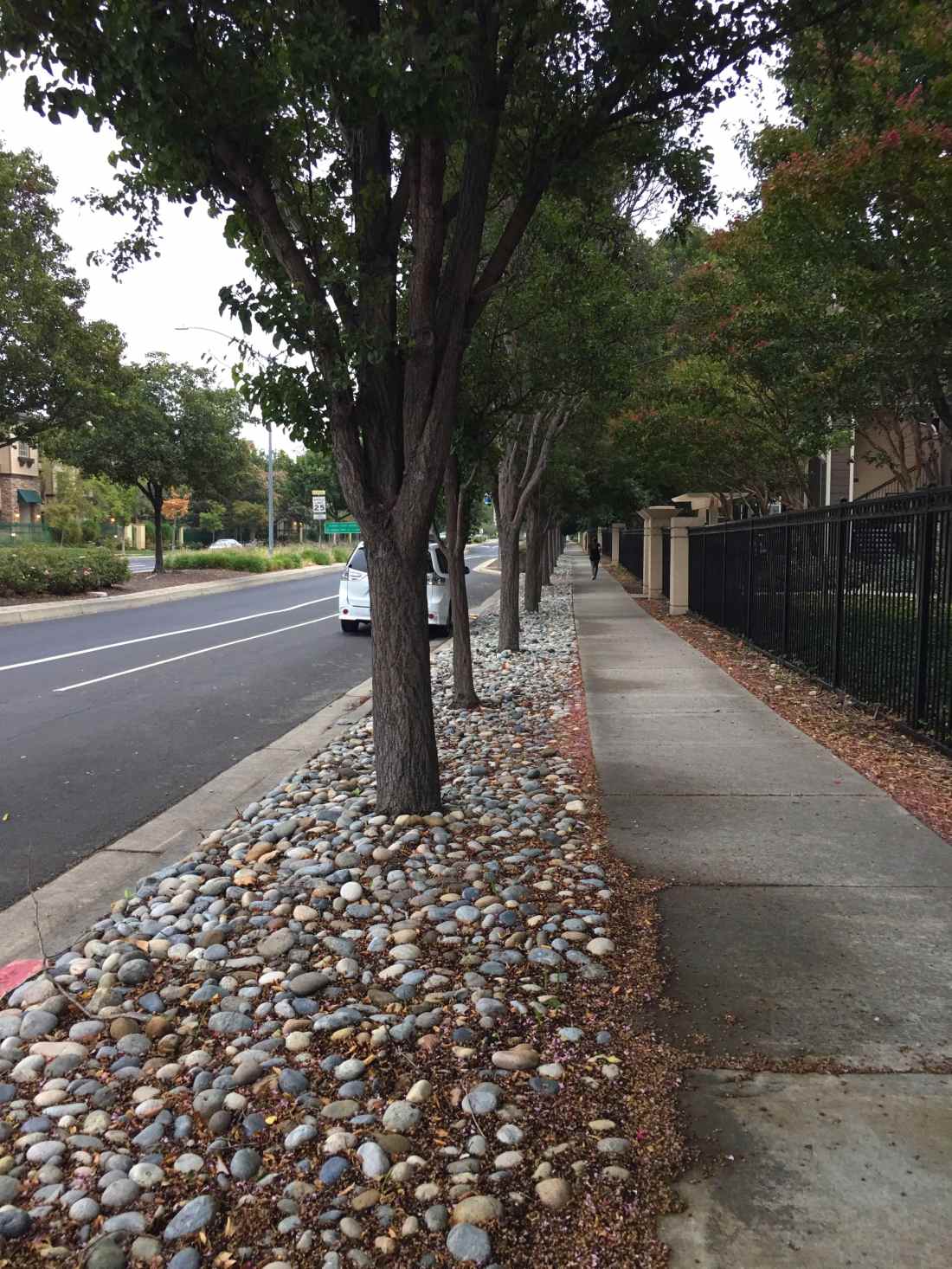
Nothing about Pleasanton seemed natural. I began to notice the little things that came from elsewhere, planted and pieced together to form the city. From the trees that lined the footpaths to the pebbles that added beauty and glint, not a twig was out of its place. Shrubberies grew well within their borders, leaves stuck to their branches, and all fruits at the same stage of ripeness.

Pathways, Dublin

Regardless of all that, I still enjoyed walking around the neighbourhood. I didn’t know why at first, but the more I explored, the more I understood. Dublin is a rich neighbourhood. Most of its population has passed middle age and is considering settling down and retirement plans. Since a lot others are either business owners or high-level corporate employees, they don’t need to haggle to get through each day. They, unlike people in unplanned cities, can afford to demand perfection. They’re so accustomed to having things their way that improperness gets on their nerves. The whole town, for instance, shuts off at about 9:30 pm. Nightlife is almost non-existent in the streets and silence rings louder than a foghorn.

Houses in Dublin

All of this was new for me. I’d never before shared privileges that the Dublin folk takes for granted. And that’s why the perfection and drastic change of scenery impressed me. Walking by house after house, each competing with the other in terms of class and bigness, I gawked in surprise. Walkways were seamless, street signals on time, traffic rare, and drivers polite. While I admired in wonder at everything I saw, it was as if nothing could surprise the locals. They’re used to everything being the way it is—designed without a single flaw.

Did I cherish my time in Pleasanton? Of course, I did. I felt elite and rich. Although I don’t see myself living in such an environment (until perhaps I’m 60 and cranky about petty things) it was wonderful nevertheless.

Dublin trees

Oh, and though authorities count and account for each tree, the sunlight glittering through them is a sight worth beyond words.