The Age Factor

I used to talk a lot about the pathetic conditions of the education system in India. Now though, it bores even me. But I came across something that made me laugh out loud, and even head to the internet for clarity.

Here it is.

age factor


This is just for fun. Print mistakes occur everywhere, but I would have liked it if the education authorities gave as much importance to details like these, as they do to grades.

P.S – This is from an official text for B.A English graduate course.

Thanking You

I know it’s a little early, but this has been a great week! This week, I crossed 200 followers.

This week, I crossed 200 followers.

And to each one of you, I can’t say how thankful I am. Thank you for coming back each time; it motivated me to keep writing, to strive for better.

This blog has been lying bare for a long time. It was only recently that I took heart from the Daily Post’s Weekly Challenges, National Blog Posting Month, Today’s Author prompts and others like those. It’s been a great opportunity to meet new bloggers and do the virtual, ‘I-do-that-too’ jig.

I’ve been pushing myself to publish regularly, and it’s thanks to my readers who’ve kept the motivation alive. I couldn’t have posted as much without the conversations and the likes.

So, thanks again for reading. Hope you all have a great day, and week.

Cheers.

The Declaration

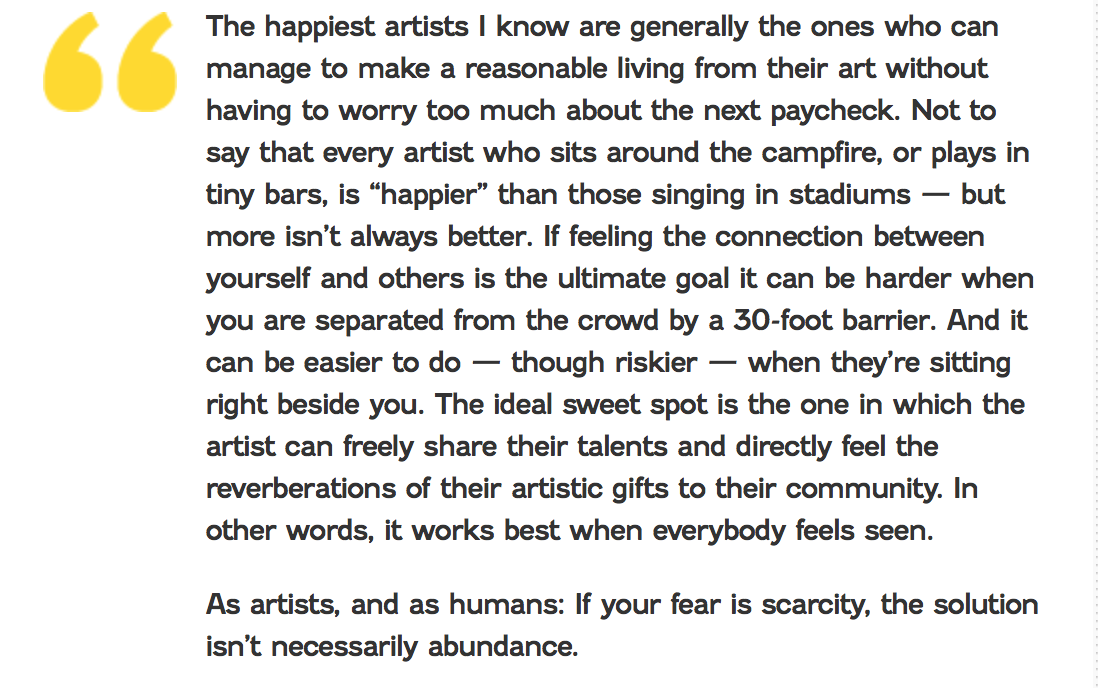
Amanda Palmer-The Art of Asking
From The Art of Asking by Amanda Palmer

“You are an artist when you say you are” – I’ve come across similar opinions a lot, and it always strikes me hard.

That moment of truth; of complete self-acceptance; the moment I declare myself as an artist – that’s the ta-da moment I’ve been waiting for.

I’ve been writing for a long time now – stories, poems, articles, blog posts, technical documents, even a first draft of a novel – but I still can’t call myself a writer. I’m still a blogger.

I’m not sure what I’m waiting for, but it’s a scary thought – it’s like the ultimate announcement. Because once you’ve declared yourself as a ‘writer,’ there’s no room for sloppiness  – a writer, or any artist for that matter – is a professional. Professional, as in, not suited and heavily-booted, but her work should be of a proper standard, and she should be able to take critical blows with a smile.

I know I’m not there yet, but I’m on my way.


The image is a screenshot from Brain Pickings Weekly (with their signature yellow quotation mark.)


Know What You Want

“Perhaps when we find ourselves wanting everything, it is because we are dangerously close to wanting nothing.” — Sylvia Plath.

All or Nothing?

We don’t always know what we want. For all we know, we could be terribly mistaken about our wants, and therefore we might end up making wrong choices. All because we’re unclear of what exactly we want.

When unsure, we tend to experiment. And by experiment, I mean, we try to get a bit of everything. Like taking a bite off every cake so as to pick the perfect one. We may end up tasting all cakes and never find the right one. The result: we’re too full to go any further. And so, we settle for something that’s probably less than the perfect cake.

And it’s just sad; that we have to settle for less than what we deserve. But to get what we deserve, we need to know for sure what it is that we deserve.

Now that’s not too easy. How are we supposed to know the value of ourselves? Do we set boundaries for ourselves? For our wants? For what we deserve? And even if we try to construct boundaries — how are we supposed to know the parameters for the boundaries? What do we base our boundaries on?

The only guide we have is whatever other people tell us. So that would mean, we need to believe — and agree — wholeheartedly that a third person’s feedback about what we deserve is right. That isn’t easy either.

It depends largely on the person whose feedback we ask for. Not only should it be someone whose judgements we value, higher than our own, but that person should also be unbiased and brutally honest.

And then there’s the question of how many people’s feedback we base our boundaries on. Because when we have multiple respondents, we have varying opinions. While a majority will appear, there’s also the matter of the collective minority.

Not unlike our election system. Of A, B and C, 40% would prefer A, whereas a minority of 30% each would prefer B and C. So, who’s the better judge? Those who prefer A — the obvious majority, or those who prefer something other than A — the minority that collectively is the majority?

It’s nearly impossible to figure this out logically.

We’ll have to go with the next best option: the gut. So, if we base our boundaries based on the party that our instinct prefers, then, in a way, we influence our own boundaries. We judge our own worth, and there’s a mild bias. We judge what’s perfect for us, based on our instinct.

So the next time we wonder what we want, we know in a way what we really want — because it’s what we’ve convinced ourselves that we deserve. Therefore, we know exactly what we want — or at least we think we do — and since we’re sure, we won’t find ourselves pondering over everything, and trying to figure out what’s perfect.

But shit just happens. After all, we’re only human.