never a weakness—
single, silent, stroke of strength
still makes a ripple
Watch out
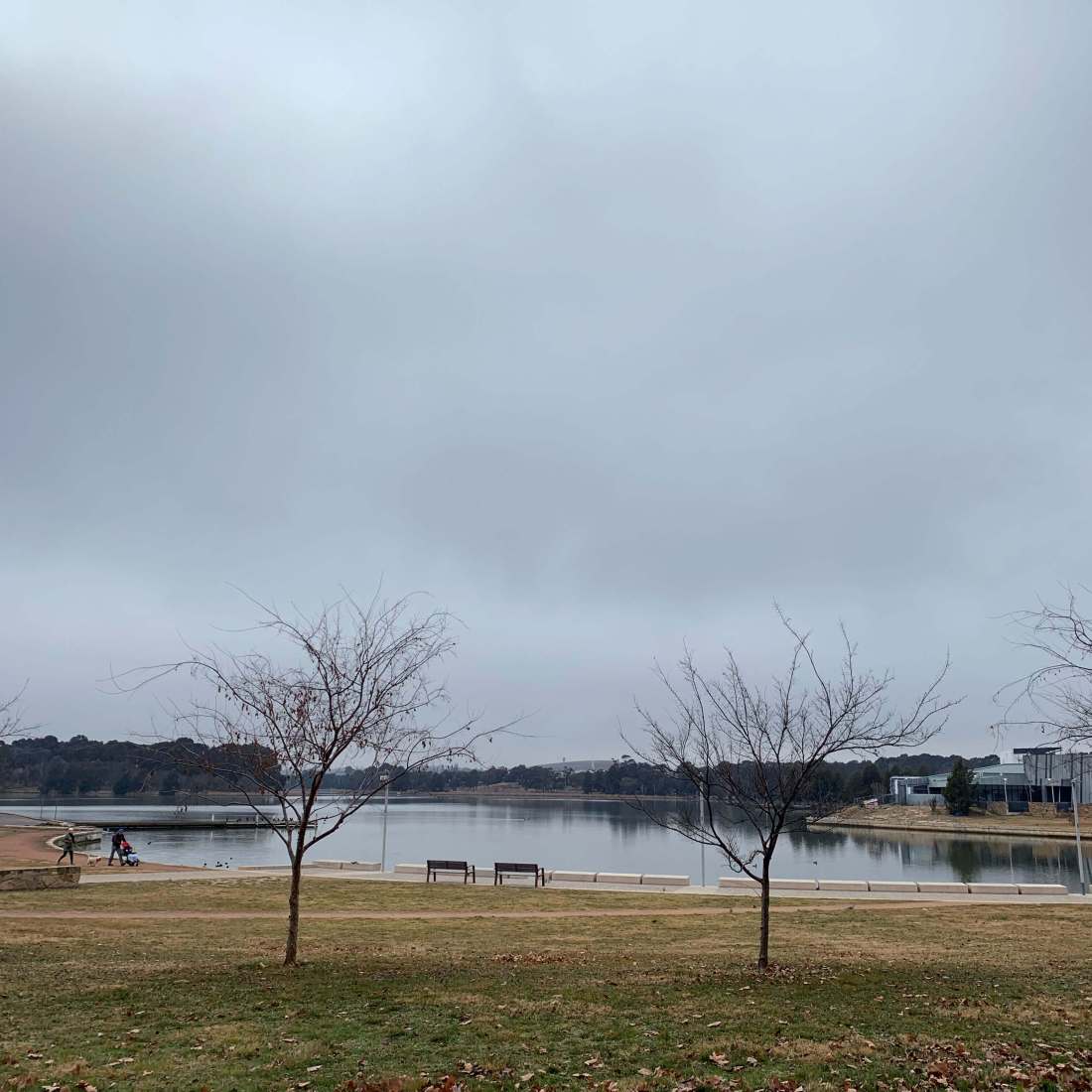
When I awoke this morning way late than usual (it’s alright, it’s Saturday), a dense fog clung to my window, shading Lake Ginninderra and the sunlight from my view.
Beyond the lake, in the distance, mild green and brown mountains rose through the mystic fog. It was so beautiful I could’ve stared at it all day. With my blanket over my shoulders, feet wrapped in cosy socks, behind the comfort of my insulated window.
I would’ve loved to leave the house and run to those foggy mountains, but I was too lazy.
In less than thirty minutes, the fog departed, clouds separated, and a mild sun streamed into my room. I sat up in an instant, shedding my blanket. The sun was out at last. I moved to sit in the sun and within five minutes told myself, “Woah, that’s too hot.”
It’s mid-winter and the sun was burning my skin.
Welcome to the bush capital.
When people in Australia say everything here is out to get you, they don’t just mean the inhabitants of our animal kingdom. They also mean the wind, winter sun, and especially the summer sun.
I haven’t experienced the summer yet, but I hear it melts leather gloves. Even though I can’t fathom why anyone would wear gloves outdoors in summer, if you do, it’ll leave you a hot sticky mess.
But that’s summer almost everywhere. Think California and Florida—it’s too warm to stay indoors, so people cool off at the beach, drinking soda and water by the litres. Mountains catch fire every other day, and everyone’s accustomed to heat waves. It’s just a tad bit worse in Australia, no thanks to the gigantic pothole in the Ozone looking down on us.
But winter is all about the chills, right? Wrong. I, along with the rest of the world, imagined winter would be all about hot chocolate, snow storms, frosty sidewalks, foggy afternoons, and an overall aura of a magical mystic.
Turns out, in Australia, you can get sunburnt in winter. That’s how harsh the rays are. I come from a hot tropical country where it’s almost always 25 degrees or more, throughout the year. But I’ve never felt such searing hatred from the sun as I have in Canberra. And I haven’t even seen temperatures go beyond 20 degrees!
Let’s not forget the wind though. A couple of weeks ago, horrible winds blew away birds in flight. My jaw dropped as I watched through my window. When I stepped outside forcing myself not to be a coward, cold air cut through my face pushing me around like a sock puppet.
By afternoon today, the lake sat still, soaking in the heat hitting it square in the face. There was no wind of a breeze to rustle the pavement leaves. And you could hear parched throats wheezing as joggers passed you by.
That’s the land down under, mate. Watch out for… everything natural.
Invading
Clunk. Clunk. Clunk. Clunk my heels in to the path clawing their way like elbowing soldier limbs snaking braving unknown land into a frozen canvas fifty shades of green a thirty more of brown like monsters fully grown towers rooted on the ground a hoodie fading in the light no other soul within my sight or even a whiff stirring dewdrops on the leaves. Clunk. Clunk. Clunk. Clunk my heels in to the path barging all along as pindrop in a morgue a crack in peace in a silent dome through outlined arches thousand echoing screeches and a hundred more whispers like black spots on pale face scattered along the maze unnamed birds picking dirt and dropping, as yeast in wort lost in a winter too cold for folks to banter.
Photo: Western Foreshore Park, Lake Ginninderra, Canberra.
Hungry
As child starved all night
tugging at its mother’s heart
laps, laps, lake water
Photo: Lake Ginninderra, Canberra
The other side
I was never a great fan of Jane Eyre.
Like most people, I also read it in middle school, when I hadn’t quite developed the patience to endure or contemplate why Jane, who was so praised for being plain and relatable, was such a big deal.
And I still don’t understand why her love for Rochester was such praiseworthy. After all, she did abandon him when she heard he’d had an unhappy marriage, only to run back to him when he almost died in the fire.
I grew up watching countless movies where the lead female character’s sole responsibility was to prance across the screen, showing off, triggering the men’s emotions, and then falling in love with them because they’re willing to die for love. If I didn’t know better, I’d say Jane Eyre, the book, was just another case of female objectification.
However, Jane Eyre, the character was something else. There were many moments in the story where I supported her decisions. I agreed when she raged at being kept in the dark about Bertha. And I believed she would’ve loved Rochester even she had known. Throughout the book, I was with Jane, but by the end of it, I wasn’t happy for her. Instead, I felt as if the story merited no merit.
Of course, Bronte’s writing was so intense and beautiful in many aspects and I, by no means, belittle the book she produced. Regardless, for some reason, Jane Eyre remained incomprehensible to me because it lacked something.
Then I read Wide Sargasso Sea. Written by Jene Rhys, this is a prequel to Bronte’s Jane Eyre.
The story unravels the life of Bertha, Rochester’s wife. Written in her perspective initially, later shifting to Rochester’s, the book walks the reader through Antoinette’s (Bertha’s first name) disturbing childhood, her mother’s fate, her family’s wealth and the implications of being a Creole heiress.
This background into Bertha’s life, in many ways, threw light into real Jane Eyre, the book.
The only references and perspectives we get from Bronte about Bertha, come from a Rochester who’s already fallen out of love with her. When he speaks of her and narrates his life with her, he’s so welded in self-pity and sadness. And as readers of Jane Eyre, we naturally cultivate a disliking to this unwanted character that was forcefully placed in our hero’s life. Our opinions are biased to begin with, and that leads us to justify Bertha’s death as a favourable outcome for the protagonist.
That’s the idea Jene Rhys challenges.
The more we learn about Bertha as a person (as opposed to Bertha as the madwoman), the more we realise the realities of life. Her entire existence was a series of events for which no one could be blamed for. There were no evil witches or antagonists attempting to disrupt her life. As a child, she lived by the rules, as a woman, she married as she was told, and as a wife, she tried her best to love her husband and seek his affection in return. She was the real plain Bertha. And yet, we see her life toppling into misfortune, dragging along an innocent Rochester.
In fact, reading Jene Rhys’s story increased my affection for Rochester. The second half of the book is entirely in his perspective and we see, despite his helplessness, a genuine desire to help the woman whose life was tangled with his. We get a fuller picture of Rochester as a character.
For me, that was the best part of Wide Sargasso Sea. Aside from addressing plenty of social and economic matters in the Caribbean and women’s health issues, this story completes the picture that Bronte paints in Jane Eyre.
Perhaps now, when I re-read Jane Eyre, I’ll appreciate it more than I did the first time.
Incredible how powerful perspective is.