Kill your darlings, they keep saying

For a few months now, Iโ€™ve been working with Claude Code on an experimental project. Itโ€™s a system to help me document my days and emotions while I attempt to walk the entire length of New Zealand.

Most people who walk this trail document their journey on social media. Instagram is naturally the best fit, because itโ€™s audiovisual and doesnโ€™t penalise you too much if you donโ€™t post chronically. TikTok is another popular choice. For those who use these two platforms to post shorter videos throughout their journey, YouTube is the endgame. Open it up and youโ€™ll see day by day logs, hour-long documentaries, and detailed series that capture the essence of what itโ€™s like to be on this epic adventure.

I wanted to post on Instagram as well. But I also wanted to document daily notes just for myself. As notes. That I can look back on. Like a journal, in written form.

So I planned it. I knew I might be too tired after walking 8-9 hours to sit down and type into a phone. Even though Iโ€™ve written several long-form pieces on my phone before, part of me doubted that I’d do that on trail.

It was easy enough to build the shell. The interface was decent with an option to record voice notes, that would be transcribed and cleaned up before saving. And because I like to double check my work and double bag my electronics, I also decided to have a text-only log. That way, I could write or talk into my phone, depending on my mood.

I tested it. Neither the record button nor the save text button worked. I sat down to diagnose. After a lot of back and forth and enabling and disabling the developer menu on Safari, I learnt how to verify the error. A bit more back and forth with Claude Chat and we finally fixed the save text button. By then, it was 2am and we still needed to figure out what was wrong with the audio record button.

So I fell asleep and forgot about the project for two weeks. That was my reality throughout this processโ€”I didnโ€™t magically build a fabulous thing over a weekend. It took me months. Work and life happened. No matter how much I wanted to ignore the world and play with Claude, I had other commitments to honour, a father recovering from surgery, and a family that loves to be dramatic.

When I eventually returned to Claude, we went through several attempts to fix the issue before realising I needed to sign up to a voice transcription service, connect its API to Claude, and only then would my record button work.

Obviously, thatโ€™s common sense. However, I was under the impression that Claude Chat, with all its mightiness, could transcribe audio. In the planning stage, I didnโ€™t ask the question specifically so Claude didnโ€™t tell me.

Now I know Claude canโ€™t transcribe audio. Neither can ChatGPT. But Perplexity does a pretty good jobโ€”it even transcribed Tamil, my first language.

Then I had to contend with two options: Sign up to a transcription tool and connect that to my Claude app. Or ditch the voice recording feature entirely.

The purpose of this project was to be able to talk into my phone. I didn’t want to get rid of it.

I took several days to think it over and kept coming back to the same idea: What if the transcription connection failed mid-way?

Iโ€™ve worked in tech long enough to know that every piece of tech you plug into another piece of techโ€”like adding more weight to your bicycle rackโ€”is a potential point of failure. This is how software works. When somethingโ€™s off, you check the plumbing, where things connect with each other, because thatโ€™s almost always the cause for a leak.

I went down that thought process rabbit hole. If transcription does fail for whatever reason, I would know fairly quickly. But thereโ€™d be no way to fix it while Iโ€™m on a 3000-km tramp. I mean, strictly speaking I could, but itโ€™d be tedious and not what Iโ€™d want to do on trail anyway.

Then thereโ€™s the issue of backup. I wanted all my entries (text and voice) to be backed up to my Zoho WorkDrive account. In case I dropped my phone in the Whanganui river, everything I’d done until that point would still be safe. If transcription fails and I fix it, then Iโ€™d also have to re-check the backup status. All of this is super simple when I have a laptop connected to a stable internet connection, sat in my home with a hot coffee by my side. Itโ€™s torture to work all of that out on my iPhone, with spotty internet, in the backcountry, sitting on an uncomfortable rock, hungry and sore from walking all day.

If transcription fails and I don’t fix it, I won’t have an alternative voice recording system thatโ€™s as efficient and battery-conscious as the one I was trying to build. My phoneโ€™s voice notes would be fine, but theyโ€™d become messy. They wonโ€™t be automatically location-tagged or categorised by emotions and regionsโ€”a feature I definitely wanted.

Eventually, I decided to remove the voice option altogether. Going the extra mile to build it didnโ€™t guarantee reliability. The extra work and admin didnโ€™t justify the risk.

This was my biggest disappointment in the whole process: Having to kill the thing that got me started.

Even without the voice recording feature, I still have other potential points of failure in my app. Iโ€™ve done what I can to minimise niggly issues, but the real test would be on trail. One way to find out.


โ€”
This is post 3 of 5.

Who will I be on trail?

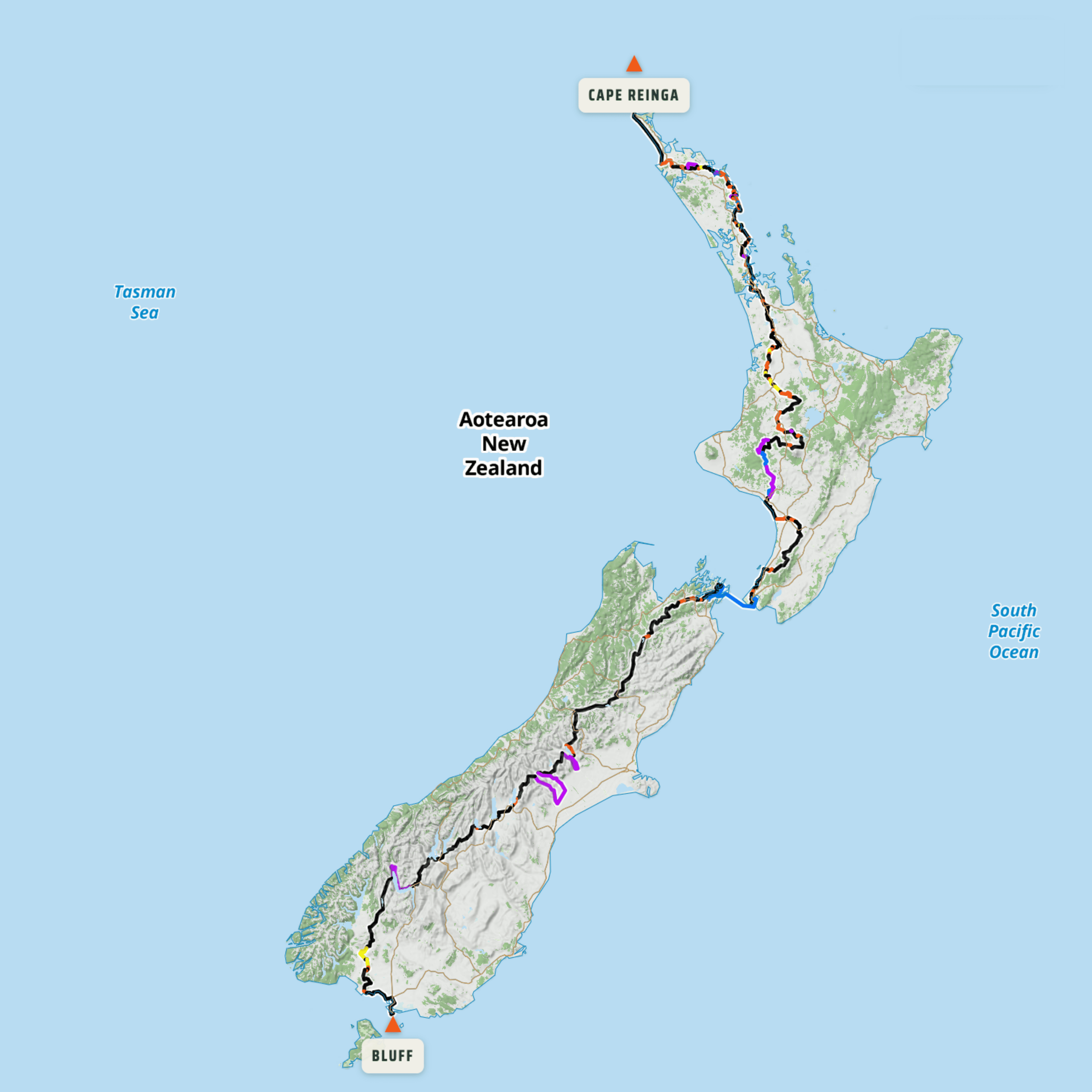
A little while ago, I decided to create something with Claude Code to help me document my upcoming hike along Te Araroaโ€”or TA. It’s a 3000 kilometre walk from one end of New Zealand to the other. Iโ€™m going southboundโ€”so from Cape Reinga at the top to Bluff at the bottom of the South Island.

Map of Aotearoa New Zealand with the Te Araroa trail running through it
Source: https://www.teararoa.org.nz/map/

I’ve never done a multi-day hike before. I’ve done lots of day hikes of varying complexities but I’ve never had to worry about not having phone signal for long stretches or being out in the wild having to fend for myself. So I don’t know what that would do to me physically and psychologically. Which is fine, and is kind of the whole point of doing the hikeโ€”to challenge myself in ways I never have before and to hopefully find the courage and resilience within me to keep going.

I don’t know the person I’d become on trail, so building any piece of technology for this person is a bit tricky. I mean, would I want to sit down and write long drawn essays at camp after walking 25 kilometres a day? What would my tolerance be like after 20 river crossings and a big gash on my foot, surrounded by sandflies? Would I even care about writing the story then as I care about it now? Maybe, but also maybe not.

And that’s a problem. Because good technology understands the user’s mindset and behaviours. For instance, if you’re sat in an office with access to unwavering internet, you take it for granted that Safari will load your website without glitches. But when youโ€™re going in and out of network areas all day, would you prioritise sending a message to your now-single and post-heart-surgery dad or would you try and open a website?

So many questions and so few answers. Thatโ€™s what I was dealing with when I first went back and forth with Claude to see what we could build together.

As nerve wracking as that was, it was also one of the best lessons from this process: I had to do my best without assuming anything about my future self.

So I started making a list of things I need to factor in, while still allowing room for failure.

My solution needed to be as light weight as possible. It needed a daily journal log, and tags and categories to filter entries by. It needed to work offline, sync online. Mobile first, basic interface, less scrolling, big font, dark text, automatic location tagging that matches the TA route map, periodic data back-up, built-in language checkerโ€ฆ all the things I needed to figure out how to do.


This is post 2 of 5.

The notebook guy started it

For a few months now, I’ve been actively thinking about and planning for the biggest trip of my life so far: Te Araroaโ€”or TA. Basically, a long walk from the top of the North Island of New Zealand to the bottom of the South Island.

An essential part of the research is watching YouTube videos of other hikers that have gone before me, to learn from their experiences, to observe their gear, and methodologies and incorporate the lessons in my own planning and preparation. In one such video, I saw a brief scene where a hiker walks into a hut and greets the rest of the hikers who return the gestureโ€”clearly they all know each other. And one of the hikers in the hut looked up from his notebook in which he’d been scribbling something.

It was the first time I saw a video of someone writing in a notebook on TA. Most people use technologyโ€”cameras, voice recorders, phones, drones. It’s not a big deal, if you think about it. Journaling is such a common habit and a lot of hikers do it. I just hadn’t seen anyone do it on a five-month endurance hike like TA.

That got me thinking about my own trip and how I’d document my journey. I hadn’t thought about that particular thing before. I loved the idea of writing on a notebookโ€”in fact, I think I’ll still have a notebook. I’d appreciate the sheer analogue-ness of it after a hard day of walking.

But I also knew, within five seconds of watching that video, that I couldn’t rely only on handwritten notebooks to document my trip. One accident on the Whanganui river canoe section and all my notes would be dripping, dead weight.

I could use the Notes app on my phone, I considered. But they’d be so scattered. I didn’t know if I could trust myself to have the discipline to date and location-tag every entry, especially when I might be going through rainy, windy, sleety, scree slopey environments every day.

So I decided to find an alternative option that’d work a bit more… the way I want it to.

As a marketing copywriter who once obsessed with being found online, I’m ashamed to admit this: I didn’t even research what other options might be out there. Instead, like so many people of my generation and industry, I figured I’d just ask Claude.

For months I’d watched people on LinkedIn rave about Claude Code and brag about how they kept hitting their limits. There were proud posts about being on the highest paid plan of Claude Code because they were just building so much cool shit that the peasant version wasn’t enough anymore.

I hadn’t tried Claude Code yet because I didn’t know what I’d build. It seemed rather frivolous to pay for it for the sake of poking it and seeing if it’d poke back.

That clip of a guy writing on his notebook was the impetus I needed. I sat down with Claude Chat to talk it through. What could I build with Claude that could be useful for me on trail, and help me learn the basics of Claude Code and building a solution on it?

So I started experimenting with Claude Code. I’m building something to help me document my trip, and structure it in a way I can look back on and appreciate in the future. But as with any experiment, although the excitement and novelty of it buoys me, I also wonder if what I’m building will truly withstand the trail. I guess there’s only one way to find out.


This is post 1 of 5.

In a time…

When artificial intelligence scrapes everything weโ€™ve created,
every poem, every song, every essay, and news article,
that story of you crying in the bathroom over a girlโ€”spilt milk, of looking at supermarket deli meat and remembering your dead mumโ€™s curry, of celebrating with your dad after a football win.
Everything remembered, synthesised, now artificially recreated.

In a time when artificial intelligence scrapes everything weโ€™ve created,
showing us what life used to be like
reminding us of that time we asked ourselvesโ€ฆ
what would we do if money werenโ€™t an object?
We’re not quite sure, we argue over it
mourn the loss of a private memory, like a child whose pencil’s been snatched away from herโ€ฆ

In a time when artificial intelligence scrapes everything weโ€™ve created,
uniting us by our miseries
and fearsโ€”
we return to those spaces we used to inhabit
the back of coffee shops
window seats at double decker buses
nooks and crannies of the city library
and the depths of spoken word communities
to seek solace
hoping for others who seek it, too