

“Wouldn’t it be better to publish directly to your blog, though?” My engineer-brother, who can’t help but make everything around him more efficient, asked me.
I was telling him about my Claude Code project, the note taking system I’m building to help me document my days on Te Araroa, the long tramping trail that goes through the entire length of New Zealand. We’re both starting to walk the trail next week, so we were talking about it and around it, as you do.
You see, I’d built a web page (with Claude Code), where my notetaker app would directly publish any of the entries I chose. I call it TA Dispatch.
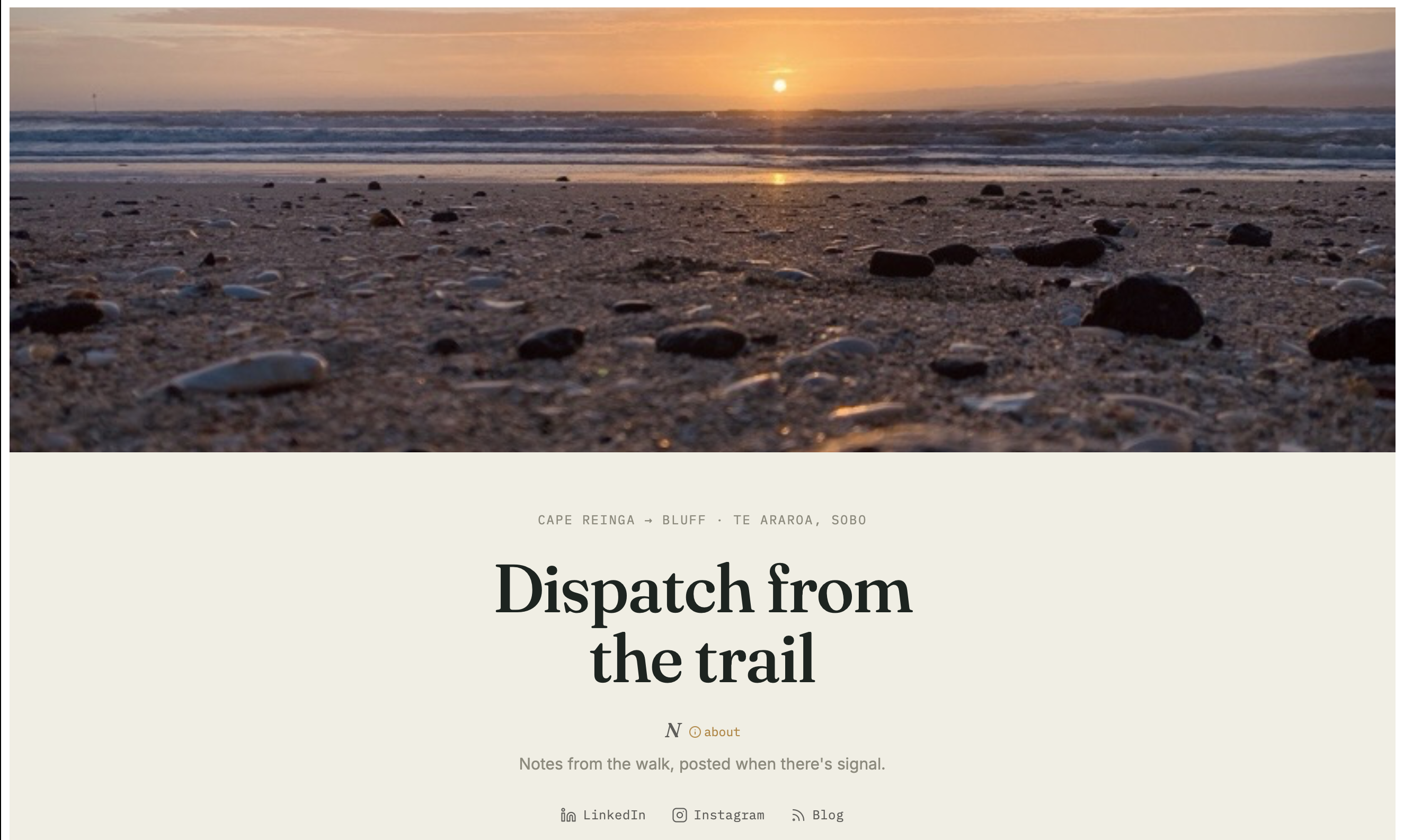
If I were to publish my trail notes directly to my blog instead of TA Dispatch, I could drive traffic and attention to my blog, a platform I’ve been writing on for 15 years.
Yo, bro. I know you’re reading this. Here’s your answer.
I had considered plugging my blog into my notetaker app. It’s the first thing I thought of when I decided it’d be nice to have something my dad and friends can use to follow my walk. Then I looked at the practicalities of it.
It wasn’t rocket science. I had to use WordPress’ write API so that every time I selected an entry on my notetaker app, it’d “write” and publish that as a post on my blog. I knew I could make it work. But Claude said something that dissuaded me.
It said I’d need internet connection for the API call to write and auto-publish. If anything were to fail in that process because I was out of network range, that entry might not publish on the blog at all. And I wouldn’t even know.
That made sense, I thought. I didn’t want another potential point of failure—I already had a system to back up my entries, and that could fail too. One risk was enough for me.
But my brother, as most siblings do, has a way of getting in my head. After his comment, I went back to Claude, and asked it to remind me why I’d decided against it. It told me the history. But this time, it also said something else:
If I really wanted to, I could still use the API. In fact, it wouldn’t be any more risky than the setup I had for backing up my entries.
Then it gave me options. Like adding the TA Dispatch page to my blog’s domain. My notetaker would still only publish to TA Dispatch, but the page would “live” on my blog.
I wanted to kick myself for not thinking of that.
Then I wanted to kick Claude for not suggesting it the first time.
As I was writing this, I asked Claude to review it. That’s when it pointed out something I hadn’t realised before: it didn’t give me options before because I didn’t ask for options.
When I first considered using the WordPress API, I’d asked Claude to do or not to do the API. Claude suggested against it.
When I went back after my brother’s observation, however, I reframed the question. Now it wasn’t a yes-or-no, but a why question. The scope was broader and my objective clearer. Claude responded in kind. It explained my initial decision and offered alternatives.
That was a fascinating experience. You hear so much about good prompts and bad prompts. There are even AI tools that convert mediocre prompts into robust ones. But I never expected a casual question, mid-conversation, would need to be as rigorously structured—because that’s not what we do when we talk to people.
If I had had the same conversation with a WordPress expert, they’d have asked me follow-up questions about what I wanted to achieve. Or they might already know the context if we’d been going back and forth on this project like I’d done with Claude. They would’ve offered suggestions earlier on and I might have considered the API option more seriously.
In the end, I didn’t use the API. But as much as I hate to admit it, my brother had a point. So I moved TA Dispatch to my blog.
Check it out: https://te-araroa.narmadhaa.com.
—
This is post 4a of 5. Because I wrote this while putting off writing the actual post 4.
Discover more from The Chaos Within
Subscribe to get the latest posts sent to your email.


2 thoughts on “Yes-or-no questions are a bit limiting, apparently”