Giving Thanks… Or Something like That

I’ve been a little behind the times lately; I almost missed to accept the Versatile Blogger award. Ha, will happen never again!

It’s all thanks to Cel who nominated me for this award. Sorry, I didn’t do this sooner Cel, and I will take that challenge as well. Just give me some time ;)

So another award! I just realized how great it feels to be recognized as a part of the blogosphere; sometimes I can’t help but feel like just a negligible speck in such a vast space.

versatile blogger

Anyhow, the rules:

  • Thank the person who gave you this award – Yup, done that.
  • Include a link to their blog – that too.
  • Nominate 15 deserving bloggers you discovered recently for the Versatile Blogger Award — you might include a link to this site – 15, huh?
  • Finally, tell the person who nominated you 7 things about yourself – get ready Cel!

Me:

  1. I love coffee, but I drink tea as much as coffee. That makes me a double addict!
  2. I almost always eat healthy – and often top it with a piece (or two) of chocolate.
  3. I don’t like pizza – I can take a piece or two, but certainly not more than that. And I’m not a fan of cheese either. Yes, you read right.
  4. I love road trips. And I hate having to reach a destination; I’d rather keep going.
  5. I so badly want to go on a solo trip, but my sense of direction is pathetic and sadly my parents know that.
  6. I just recently realized how much it hurts to hold a DSLR for long at a stretch.
  7. I love trekking.

So, there you have it! Hope it’s random enough.

I nominate:

  1. Catherine – Leaf and Twig – Have you ever felt like hitting that Like button a thousand times? That’s how I feel about Catherine’s work. It’s pity she’s disabled Likes. But I enjoy every post; she never ceases to thrill.
  2. Lucas – Through Open Lens – It’s always great to see the world through someone else’s point of view. And with someone like Lucas, you also get to enjoy a funny one-liner and an interesting fact. Classy!
  3. Meisaan – Curving toward the center – Home to some of the best haiku I’ve ever read! And she picks the greatest accompaniment photos!
  4. Quail – Butterfly Sand – A friendly voice in the neighborhood. From shady quips and daily quips to poetry and short stories, she’s like the fun aunt whose advice I’d really listen to.
  5. Sue – WordsVisual – Sue’s up to some great photography and poetry. That’s one killer of a combination; you wouldn’t want to miss that.

I’m a known rule-breaker, so there goes the ‘nominate 15 bloggers’ rule. I follow plenty of awesome bloggers – you know who you are, and you’re all awesome. Unfortunately, most of you don’t accept awards.

Anyway, it’s been great fun blogging with you guys. Stick around, and let’s keep sharing stories.

Have a great weekend y’all. Cheers.

The Writer Within Me

writer within

It began about a year after my tenth birthday. My classmates had discovered the power of hormones. Friends were categorized into guys and girls, and everywhere, butterflies erupted.

Meanwhile, I, the late-bloomer, was scratching my head at the sudden change around me. It became increasingly difficult to endure conversations with friends. How was I supposed to know how cute my friend’s neighbour was? School became a tiring, inescapable routine.

Home wasn’t any better. Luckily, my parents  lacked interest in mediocre television. We did have a TV set — modest and as old as I. Since it served the purpose, my parents preferred not to indulge in luxuries. Besides, we hardly engaged the idiot box. The news was the only thing my father deemed worthy of watching. And listening to people getting ripped off wasn’t exactly my idea of leisure.

That’s when I started looking for alternatives. It was surprising how free I was – so much time, yet so little to do.

More out of desperation than anything, I scavenged the house for old magazines. Tamil or English — it didn’t matter. As long as it kept me occupied. And occupied I was.

But when you’re reading magazines all the time, you realize they don’t publish them as often. Then I went back to square one. One day, I waited eagerly for my father’s return from work, and once he did, I stood in the doorway of his room leaning my head on the frame.

“I’m bored. Can you get me some books?”

My father isn’t the unusual kind. Good grades mattered most to him. And so he responded, “What about your school books? Are you done reading them?”

I wasn’t surprised, I half expected it. Everyone said that , it would have been surprising had he said anything else. Back then, I was young. And timid. I’d rather shut up and sit in a corner than speak back to my father. Not that I was afraid of him — he wasn’t the terrifying kind. It was the utmost respect that I held him in that prevented me from being rude. He has high regard for values and morals. Values my mother also shares. With such parents, I grew up learning to obey elders. I learnt — sometimes the hard way — that elders are experienced and know better than I ever would. It was one of those Indian mentalities you have to accept without questions.

But even I knew he asked too much of me. I was having a hard enough time in school and wasn’t willing to spend my time at home going through the same torture. I’d pretend to study just before my father returned home. When he saw me at it, he’d smile approvingly. I didn’t feel guilty — because I saw he was happy.

There was no point in being a rebel if no one’s going to benefit. That was my first action of disobedience.

But despite this little success, I was still bored. My mother was always supportive of reading. She was a voracious reader herself, but I could seldom comprehend her interest in newspaper articles. I think it was she who suggested the school library.

In the following weeks, I developed a close relationship with my school librarian. Not sure where to start, I decided to pursue a series I had always enjoyed. I discovered the entire series of Enid Blyton classics. As weeks turned into months, my librarian recommended a crime novel that not many students preferred. “The mirror crack’d from side to side” — it wasn’t love at first sight. It was a worn book with torn pages. How silly of me!

I had no way of knowing back then that that’s the mark of all wonderful creations. And so began my love for Crime.

Naturally, my father noticed. I’ve always admired his ability to recognize unconventional behavior. He’s something of a detective himself. What surprised me though, was his approval. Perhaps it was the pretense-studying, or that my grades weren’t so bad, or perhaps my mother had just put in a good word. Whatever it was, my father got me books – where from, I still don’t know.

Those were the best days of my life – days and nights of reading. And then one day, my father handed me “Harry Potter and the Sorcerer’s Stone.” I remember my hands tingling. I had heard so much about the book, of course. That day, I discovered my love for storytelling.

I read the book about twelve times continuously. To say I was hooked is an understatement. I revered the writing.

How could simple words, in sequence, captivate me so?

I tried to answer myself by reading the book and the series again. To this day, that’s what motivates my reading. The writing made me think. I knew the words; they were straightforward. So why can’t I write it?

Then I realized — writing is just finding the perfect sequence for words we overuse. Could it really be difficult? And so I began writing. Every new book I read helped me discover new styles and words, but Rowling’s writing was the  basis on which I built my passion.

Everything I read today kindles the inspiration for my short stories, poems, and blog posts.

Inspired by Anne Frank and the cartoon, “As told by Ginger,” my first writing was in my journal. I liked Anne’s idea of naming her journal “Kitty.” A neutral name — neither boy nor girl. I did the same, addressing my letters to ‘X.’ I still do.

A Man Like Us

The Unknown Citizen – W. H. Auden

He was found by the Bureau of Statistics to be
One against whom there was no official complaint,
And all the reports on his conduct agree
That, in the modern sense of an old-fashioned word, he was a
  saint,
For in everything he did he served the Greater Community.
Except for the War till the day he retired
He worked in a factory and never got fired,
But satisfied his employers, Fudge Motors Inc.
Yet he wasn’t a scab or odd in his views,
For his Union reports that he paid his dues,
(Our report on his Union shows it was sound)
And our Social Psychology workers found
That he was popular with his mates and liked a drink.
The Press are convinced that he bought a paper every day
And that his reactions to advertisements were normal in every way.
Policies taken out in his name prove that he was fully insured,
And his Health-card shows he was once in hospital but left it cured.
Both Producers Research and High-Grade Living declare
He was fully sensible to the advantages of the Instalment Plan
And had everything necessary to the Modern Man,
A phonograph, a radio, a car and a frigidaire.
Our researchers into Public Opinion are content 
That he held the proper opinions for the time of year;
When there was peace, he was for peace: when there was war, he went.
He was married and added five children to the population,
Which our Eugenist says was the right number for a parent of his
  generation.
And our teachers report that he never interfered with their
  education.
Was he free? Was he happy? The question is absurd:
Had anything been wrong, we should certainly have heard.


I had to study this poem for an exam, and only then did I realize its beauty. I read through once, and it just struck me unlike anything else I’ve read recently.

It’s the life of an unknown citizen. 

It’s the life a person not unlike you and I.

It’s my life.

And then it hit me. I could live a simple life, an unknown, insignificant life and die the same way.

It’s the nature of life. There’s not much I can do about it.

Not everyone becomes recognized. Not everyone’s good under the limelight. Most of us end up as unknown citizens. 

It’s a little sad when you think of it that way.

Nevertheless, Abraham Lincoln offers some solace,

“God must love the common man. He made so many of them.”

Well, whether we end up unknown or super-famous, it never hurt to try.

The Question, That Moment

moment

We all get to a point where we realize the truth.

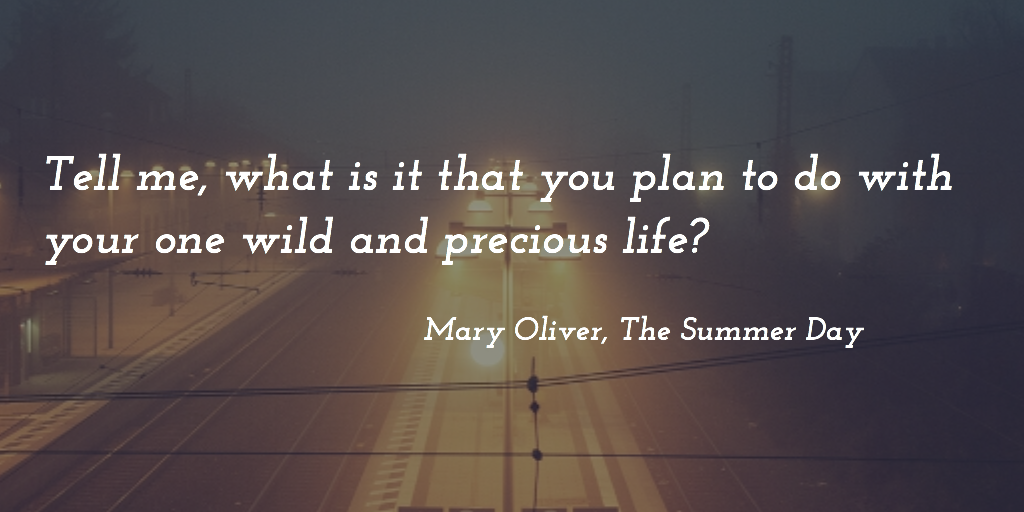
One life. Wild and precious. Are we doing what we really want to do? Or are we just making excuses, and whiling away the time?

It’s a powerful question, isn’t it?

Amazing how it just comes out of nowhere and puts you off balance. In this race called life, what would we see if we stopped and turned around?

It’s the question to topple our lives. For the better.

The Bearded Bard

The best thing about the Bard: he makes you think. He fills you with wonder, shows possibilities you hadn’t considered, and leaves you in a flurry of amazement.

bard

Shakespeare’s command over the language stuns me. How could one man possess such understanding of the language we hold dear?

Words are sharp, they are powerful. They inspire all kinds of emotions. The good, the bad – they’re all in words. Even those deep feelings we can’t put into words  —  Shakespeare has his way of bringing them to our mind’s eye.

He makes you feel the word. Is it the wording, or a full stop in place of the overused exclamation mark? A little use of the license, or a negligible grammar violation that makes a tasteful piece of writing?

No one does it as well as the Bearded Bard.

If words be actions, Shakespeare can make you cringe in shame, in such a way that you relive that moment each time you face a mirror. All these, without laying a finger on you.

The sheer thought of such power scares me.

Everything the man ever wrote is wisdom for a society that’s as foolish and as ignorant as ours. There never will come another writer whose works live as long as Shakespeare’s. Five centuries old; still as attractive, as delectable as fresh pie.

Though he largely referred to the Elizabethan society, his works seem tailored for us.

That makes me wonder  —  why do we have such a society? A society that holds self before anything else, one that judges people on birth, instead of the person they’ve become.

Why are we such Assholes?

It’s all in the marriage of two minds.

Let me not to the marriage of true minds
Admit impediments. Love is not love
Which alters when it alteration finds,
Or bends with the remover to remove.
O no! it is an ever-fixed mark
That looks on tempests and is never shaken;
It is the star to every wand’ring bark,
Whose worth’s unknown, although his height be taken.
Love’s not Time’s fool, though rosy lips and cheeks
Within his bending sickle’s compass come;
Love alters not with his brief hours and weeks,
But bears it out even to the edge of doom.
If this be error and upon me prov’d,
I never writ, nor no man ever lov’d.

We are a society that prioritizes the need for a partner. For everything. It begins at school when we look for a lunch buddy, visit the restrooms in pairs, or hang out in groups.

Solitude is taboo. We grow up to that principle. We are so accustomed to the warmth of human companionship that we reach a point where the quality doesn’t matter as much.

We’re happy as long as we have a partner. Perhaps that’s what forces us to rush into relationships, both marital and otherwise.

Perhaps we don’t dedicate thought to the person we commit to spending our time with. Because when we do, we realize the subtleties and positives of the relationship.

If only people’s minds were married instead of the bodies, we would have a whole different populace.

Our attitude toward life would differ. It would be a full, retrospective thought process, where we’d have worthy priorities.

People would marry for true love, they would sacrifice, and do so, knowing the consequences. And everything we do would have clarity. Our society would sincerely respect each other.

Or as the great man says himself, we’d know from experience,

“Love is not love … which alters when it alteration finds,”

Once we realize the truth in those words, nothing would be greater than true love. Love that spreads warmth and compassion across the world.

And that would be a world worth protecting.