Mischief not managed

I’ve watched the movie yet again – I’ve lost count as to how many times I’ve watched it, but it, as always, leaves me  hollow, pained and angry.

It really is surprising how an unknown actor, after a mind-blowing performance as your favourite fantasy character, can suddenly become an inspiration; an idol. That’s exactly what happened with Gary Oldman. I didn’t know  about him before Batman and Harry Potter. Having been lucky enough to read the books before watching the movies, easily my favourite character was Sirius Black. Of all the stories I’ve read post Harry Potter, I can still confidently say Sirius is my favourite. I’m not joking; I’m totally Sirius!

The moment I read the episode of Sirius’ death, I swore to myself that I wouldn’t ever watch the movie. The book and the words haunted me and I knew the movie wouldn’t be better. It proved worse. A few months later I, just like every other fool, thought I was ready to see the movie at last. I needed some time after the book and I indeed took it. Only, my calculations of being mature enough to handle it, were pathetic.

After his appearance in the 3rd movie, Gary had really made a mark on me. I was enjoying that moment when you realize that an actor did total justice to the character himself. Yes, I did enjoy the feeling. Having expected to see Gary as Sirius in the fourth movie, I was terribly disappointed. But no matter, I told myself, I’ll be soon watching part 5 and I’d see Sirius again. By this time, he felt like family.

When I did see him, I was utterly awed. He looked nothing less than handsome. What I liked most about Sirius is the fact that he turned a blind eye towards others’ view of himself. He wore decent robes and looked decent but underneath all those niceties that mischief and spark in the eye were still intact, unscathed. And I felt Gary had incorporated every cell of Sirius’s non-existent body into his own, and I adore him for it.

When I finally got round to watch the 5th movie, I honestly believed that I was prepared, despite knowing that it would be difficult to witness. I was mistaken. It wasn’t difficult; it was heart breaking. Every time I saw Harry and Sirius in the same frame (which wasn’t many) I could feel the powerful rush of emotion in my veins.

The movie being well poised, when the sad part came, I was first moved and then infuriated, which I feel even to this day. The movie had an extra piece of exchange between Harry and Sirius moments before Sirius’ death. When Harry artfully disarmed Lucius Malfoy, Sirius appreciated him, “Nice one James”. Those were his last words.

Sirius addressed Harry as James; Harry’s father and Sirius’ best friend. Sirius saw James in Harry while Harry saw his godfather as the closest he felt to a father. The brief relationship between them is one of the most beautiful relationships in the story. Sirius’ last words made my insides squirm. The old friendship story between James, Sirius and Remus ran amok in my head.

In less than a minute after this came Sirius’ death. That was irritating. Very.

Just after a wonderful scene from his own imagination, the director and the crew, did ultimate injustice to Sirius’ death. I’ve already mentioned (more than once, I think!) that Sirius is my favourite. Insulting his death got my blood boiling.

As far as I know, Sirius was never hit by a Killing Curse. It was another spell that threw him off-balance, right through the veil.The movie didn’t show it that way though. They seemed to think that a killing curse would’ve been interesting. So they made it that Bellatrix had cast a killing curse, thus killing him even before his body floated through the veil.

Sirius was not such a fool to let his wand-arm hang loosely by his side and catch a killing curse squarely on his chest, and I feel the movie had been filmed so. Watching it, with the knowledge that it shouldn’t have been that way, felt like Sirius’ character was incomplete.

Five Point Someone

A best seller, adopted into a Hindi movie which topped the charts for several weeks.

Well, that’s not a petty description. It’s the highest a novice author can dream of. Chetan Bhagat shook the Indian literary industry with his first novel; Five Point Someone, in which he portrayed life in India’s greatest institute of technology (or in simple terms, life in the hell on Earth) which, by the way, is supposed to be IIT.

 Though it portrayed a normal college story craftily, and there were some parts which were highly enjoyable, on the whole, I wasn’t too impressed by the story. I have no reasons, but the novel didn’t seem unique to me.

Though it was highly advertised that the book was adopted into a movie, I didn’t see too many similarities between the book and the movie. Only the theme seemed similar.

I am usually interested in the cover of a book. In this case, the cover just didn’t appeal to me. Firstly, it was white. The next thing, it looked like an illustration of a highly confused mind. Maybe that’s the way IITians’ minds are: disorganized.

Bhagat has openly criticized certain habits in IIT, though it’s worth noticing that Chetan Bhagat is an IIT alumnus himself. This is a story about three youngsters, who didn’t take long to realize that their common dream had taken the wrong turn, right into a nightmare. The story relates their lives, their trials and their not-too-many triumphs.

They go through a lot and love blooms, in addition to the educational burden. Their lives move on, and they never score more than five-point-something. At the end of their final year, they leave, as three five-point someones, each pursuing a different career. Life at IIT is tastefully said in this story, and yet again, IIT proves to be a student’s choice of a suicide spot. I am confused as to whether the author was criticizing the overall educational system or the way thing are done at IIT, or both. That, in my view, is the only confusion in this otherwise artfully knit story.

O Alquimista

“When you want something, all the universe conspires in helping you to achieve it.” 

~The Alchemist~

Well, that’s the subject matter of  ‘The Alchemist’. It’s a story, simply portrayed; a story that conveys a not-so-simple message in a way that anyone can understand.

This is the tale of a young shepherd by the name of Santiago, who follows his recurring dreams all the way to Egypt and back again. His encounters with an old king, love, fears, an  alchemist and others carry the story.

We all have or would have had deep desires and ambitions. We abandon our desires for the fear of not being able to achieve it and then regret our decisions throughout our existence. Santiago was different. He gave up his comfortable life and became a shepherd for his love of travelling.

The best part of the story, in my opinion, is the fact that it gives a great piece of advice to all aspirants: “Listen to your heart.” It’s simple, yet powerful. The heart, like the brain, ‘is a many layered thing’ and has the ability to lead the body in the right path. (That is, if your heart is in the right place!)

It really is a book that should be read, enjoyed and passed on.

I’m just plainly glad that I read this story (even if it were only an abridged edition). It changed my life for the better. I have a feeling that, had I read the story earlier in my life, it would have had a better impact on me, but it’s never too late to read.

Second Time Around

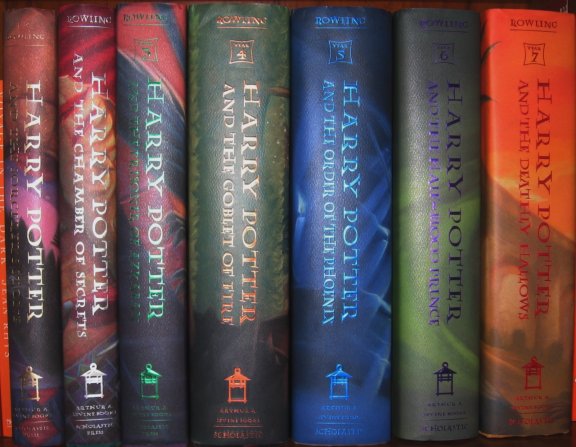
Which book would I want to re-read for the second time? That was the prompt a few months back. Re-reading? I can name a few. I read books but I don’t own much, and of the few that I have at my disposal, the book that I’ve read on multiple occasions is ‘Harry Potter and the Philosopher’s Stone’.

Harry Potter:

I got ‘Harry Potter and the Philosopher’s stone’ from a cousin and I have read that book almost twelve times now. Though I don’t have the others of the series, I’ve read them more than once too. The series actually made me recommend it to some of my other friends, who thoroughly enjoyed it. I read somewhere from a HP fan that Harry Potter has lessons for generations. A lot of fans say that, and people might think that Harry Potter is a school text-book. I see the books as an account of the lives of a few teenagers and the transition they undergo over the years and how events mould their characters effectively.

Wikipedia says that according to Rowling, ‘death’ is the underlined theme of the series, but one can quite easily identify other dominant themes like, adolescence, friendship, power-hunger, confronting fears, making choices, obsession. It’s the presence of these wide topics that make the series an interesting read, and in the words of most fans, a lifetime’s lesson.

Throughout each chapter of every book of the series, JKR’s mystical storytelling tactics are prevalent and urge the reader to have the pleasure of a second-time read.

Even now, after many years of having read the books, whenever I feel like I’m having a bad day, Harry Potter helps. Sometimes people around us – Harry Potter haters – seem to think that Harry Potter is only for children; they are of the opinion that it’s just a fantasy tale of a few troublesome teens. Yes, they are not perfect; there are a few flaws in the books, I don’t deny it; but I have to add that it introduced me to the pleasure of reading and writing.

Though a whole lot of people enjoyed HP, similarly, a large people criticized it as even foolish and unnatural. I just have this to say: Harry Potter is a novel that could be enjoyed only by those who would allow themselves to be lost in a powerful den of words. Only those who are willing to convince themselves to believe wholeheartedly in the impossible and to find solace in it, will enjoy the series. Those who seriously want to dwell only on reality; those who deny to let in the subtle and fantasy-like emotions, are never going to enjoy a book such as this. Also, in my opinion, the reader has to place himself in between the characters to appreciate JKR’s words.

Something I really enjoyed about the books is that they were not too descriptive. There were a lot of vivid descriptions, yes, but the thing was  that some parts and scenes of the story were left to the readers’ imagination.  I like the kind of stories that respect the readers’ imagination. I’m not sure if that was the reason for my liking the series, but it certainly was one of the reasons.

Reading Harry Potter is like dwelling in a completely different world; a world that you wouldn’t want to come out of. A world where an entirely different lifestyle exists. Once in, I wouldn’t want to come back to reality that has, nowadays, become more far-fetched than Harry Potter‘s world of magic itself.

The White Tiger

“All the world’s a stage” said William Shakespeare.

Here, Aravind Adiga, in his novice attempt at a novel, has illustrated the world as a jungle. Not much of a surprise; we meet animals on the streets everyday!

This story ‘The White Tiger’ is about Balram Halwai who is far more intelligent than his classmates and so earns the title ‘White Tiger.’ A white tiger is a rare thing that is born only once in a generation. Thus the name.

Unlike a typical intelligent schoolboy, Balram turns out a different person altogether. The reason is that he was from the Darkness. His was a poor family and he had to drop out of school early. Here’s the secret: India is the only country in which one can find two main partitions; Darkness and Light. The poor families in the ‘underdeveloped’ villages, (not ‘developing’ as the rest of the world calls it (or rather, villages that face barriers to development)) who have to struggle hard daily for half a meal and those who have to drop their children’s education to pay off debts, make up Darkness.

The rest of the world turns a blind eye towards Darkness.

This is the kind of story that helps readers realize the harsh realities of life and the author has made no effort whatsoever to diminish the harshness. It’s blunt and to the point; no beating around the bush.

Mr Ashok Sharma alias Balram Halwai,  a driver; a thief; an entrepreneur; a murderer and the White Tiger, on hearing the news of the Chinese Premier’s visit to India, writes a letter to him explaining the realities of India, which he wouldn’t otherwise know. He narrates his entire life story; the story of how a simple boy from Laxmangarh became the driver of a wealthy man in Dhanbad, his journey to New Delhi; the story of how Delhi corrupted his America-return master and himself, and his transition from a faithful servant to murderer and then an entrepreneur.

The author discusses the concepts of caste, poverty, weakness, vulnerability, corruption, freedom and mainly, the difference between Darkness and Light.

This is not a fast paced story, and I really enjoy some pace in the story. This wasn’t a polished and colourful story, it’s just a narrative of facts. If truth be told, the story didn’t appeal to me; seems hard to accept, maybe because the truth is always bitter or maybe because the incidents are similar to those I’ve seen in movies.

The narrative contains spoilers for those who hold India in sky heights. Nevertheless, the tale gives an insight into another India altogether; another India that lives so close to us, yet remains unnoticed.

P.S: It’s interesting to note that Balram, after slitting his master — Mr Ashok’s — throat and running away to Bangalore, takes up his ex master’s first name as his; he becomes Mr Ashok Sharma the successful entrepreneur.