I wandered into a book store…

The day after I landed in Portland, I woke up to a cold, dull morning of about 11 degrees Celsius. For the first time in my trip, I felt scared to go out. Not only was the temperature colder than I’d ever been in, but experts predicted rains for an entire week—rains I wasn’t prepared for. I hadn’t even a raincoat with me and what I thought a sweater in India turned out to be a light jacket or a thick shrug in Portland terms. Perhaps Portland was a mistake, I thought to myself as I stood mulling over in the shower. I let the warmth of the water engulf over me, and watching the bathroom window fogging only made me feel worse about my decision.

Nevertheless, I was there. And there was nothing else to do but take what came. So shuddering to myself, I headed outdoors and felt the cold air sting my face. Although it wasn’t raining when I left my host’s house, I’d borrowed an umbrella anyway. And sure enough, as I approached the light rail station, it began to drizzle. A train arrived not long afterwards, and I rode to the infamous Powell’s Book Store.

I hadn’t researched the place, but I’d heard from my friends that it’s a book lover’s paradise. And so a little apprehensive of what I’d find there, I approached the store. It was quaint. It was as if I’d walked into the Gryffindor common room as described in the Harry Potter books. Not that the store brimmed with magic references and coloured scarves, but there was a mythical aura that emitted from the piles of books extending to the ceiling. It was a semi-wet day and the atmosphere within the store was calm and comfortable. People shuffled about in silence, some picking out weird covers, some leaning on shelves peering into parched pages, while most observed the display without comment.

I’d never seen so many books in one place. Aisle after aisle books rested stacked up in a neat order, enticing readers and antagonising me. I’d always thought of myself as a book enthusiast. I don’t read as much as most people I know, I know, but I do enjoy reading for the pleasure of it. However, as I looked at books I’d never heard of or had heard of but never read before, I felt like a fraud reader. Everyone around me seemed curious and excited to fill up their shopping carts (an old woman pushed a cart full of book worth $100), while I went back and forth like a pendulum trying to find one familiar book so that I—too—would feel as I belonged in a library of such grand scale.

Powell's Book Store 1

Drowning the self-hate that ballooned within me, I past the ten or so book shelves that stood in the area I entered the store. On one corner was the information desk and as I approached, a smiling woman behind the counter asked me if I was looking for anything specific. Reciprocating, I denied. She smiled back understanding—perhaps she’s seen a lot of indecisive folk in her time behind the counter. “Feel free to grab a map of the store and look around,” she advised before smiling again and turning to the next person in line.

Huh. So there’s a map for this place?

I opened the bookmark-like piece of paper, stunned to realise that the store contained nine colour-coded rooms, each hosting thousands of books in every category and industry imaginable. The building occupies about 1.6 acres of ground space and has over two million volumes. Though that information, and the visual representation of it, overwhelmed me, it also made me feel a lot better about myself. There’s no way that anyone in the world would feel like a know-it-all in this store. Everyone who entered would see how much there’s still to learn—maybe that’s why the store’s so popular. Every person I came across within the store had an excited gleam in their eyes. Not only are Portlanders well-educated folk, I observed, but they are also eager to explore and learn new things. As an outsider, I felt happy amidst a populace that was both intellectual and yet so ego-less and welcoming.
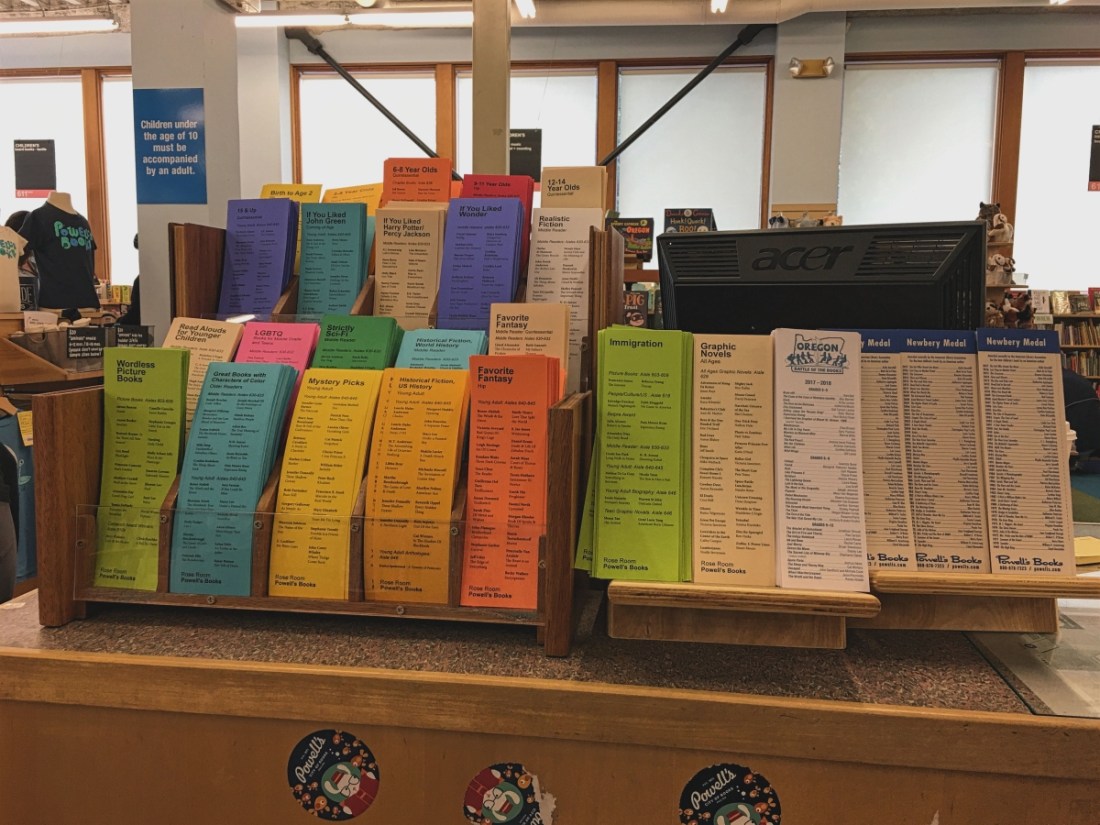
Powell's Book Store 2

While the though lifted my mood, my attitude shifted, too. All of a sudden, I felt curious and excited to see the rest of the store. I spent the next two hours combing through shelves in wonderment. It didn’t matter that I had no clue about the titles and the topics it covered. I felt pleased and humbled to exist in the presence of such knowledge. It made me crave reading more than ever. Everywhere I turned to, a book sat snug in a shelf, urging me to reach out. From deep astronomy to fantasy, from invasions to abrasions, from brush strokes to swimming stokes, the topics were endless. It amazed me how many undisclosed topics there are that more readers and writers should discuss.

Running into books, I hadn’t expected to run into so many conflicting emotions. Nonetheless, I walked out of Powell’s Books Store happy. Even though I had read almost none of the books on display, I’d learnt an invaluable lesson: You’re never too early or late to read.

Shadows of the past

I’ve never cared much for translated novels. They never quite work for me, because I don’t know whom to credit when I want to quote from the novel. Should I appreciate the original author of the thought or the translator who managed to convey a foreign concept in a language I understood, and in a way I appreciated? Well, that’s why I often conclude it’s better to avoid translated pieces altogether. Although I know by doing so I’d let go of a vast pool of literature, I’d still choose an English novel over the English version of an unknown original. And I held fast to these beliefs until a few weeks ago.

A few weeks ago, I borrowed a hefty book from my friend. Slapped across the cover in bold words was the title of the book: The Shadow of the Wind.

Interesting, I thought as I flipped through the pages without reading any of it. I hadn’t read much in a while, and was desperate to take home the first book I saw. And this book, in fact, seemed like a promising one, too. It wasn’t until after I had got home and gulped down half of my coffee did I realise the book was a translation.

I groaned a little, but read on. The plot unravelled fast enough, and so I want to give up midway.

I’m thankful for that over-caffeinated decision.

Soon after I realised that the story was a translation, my keenness had dropped a few notches. Although the first few pages retained my attention, once I entered the seventh chapter or so, things slowed down a little. In hindsight, this change of pace isn’t out of the ordinary. Many books linger on a slower pace, and the slowest part of this book was still much faster compared to most others. As a reader, I soon left the lag behind and the story picked up its momentum. And from that point forward, until I turned to the last page, I remained hooked—for the lack of a better word.

Not only did the book turn out exciting, but the narrative flowed with such ease that I didn’t even feel like closing the book. It was the first time in a long time that I had wanted to keep on reading, inspite of my initial aversion.

Set in Barcelona, this is the story of a young boy, who finds a book, and finds that its author had a mysterious past. He sets out to solve the mystery, and along the way, discovers how his life entwines with the unknown author’s by total coincidence.

From the book—

“Julian had once told me that a story is a letter the author writes to himself, to tell himself things that he would be unable to discover otherwise.”

That was the most captivating part of this story. Halfway through the book, I could see the young boy walking the same steps as the person he’s trying to uncover. As a reader, I experienced history repeating itself, and watched in wonderment as two people unrelated and unknown to each other in every imaginable way converged in the same place for the same cause.

To make an otherwise serious narrative light-hearted, the author instigates humour through a vital character. In the way he’s portrayed, the character of Férmin breathes life into our dull protagonist. Every now and then, he amuses the reader with quirky love advice, strewing his speech with abundant wit and nerve. The pair undergoes many adventures, scanning the streets for clues, encountering blows from an evil policeman, and sometimes strolling through alleyways in disguise.

You can’t help but fall in love with the author’s attention to detail. Whether it’s Daniel’s (the hero) father saving up to buy a pen for his son, or a publisher’s employee spending her fortune on the same pen for the man she adored, every character is well-formed and deserving of awe. Each scene is meticulous, and each dialogue reveals the inner most emotions of the character.

In five-hundred pages, the author takes us round and round similar incidents and similar people, but each time, there’s something different and magnetic enough to pull the reader. That’s why I enjoyed every moment of this book, and so would you.

From the book —

“What the flower vendor interpreted as ‘pretty nasty’ was only the intensity that comes to those who, better late than never, have found a purpose in life and are pursuing it to make up for lost time.”

Having said all of that, though, I still don’t know if I like Carlos Ruiz Zofón’s writing or Lucia Graves’s translating. That’s an internal turmoil I’d never disentangle.

Even if you’re not a history buff, a fan of fantasy, or a thrill seeker, you’d still amaze with this book. The Shadow of the Wind is a tale of an avid reader, but it’s also a tale of a novelist, a tale of a book seller, and a tale of a publisher all mingled in one. If you’re a book lover in any form, this one should be on your list next.


Afterthought: This book has so much to talk about that it deserves a part two, too. Coming soon.

A story

He crouched over the parchment, fingers, enveloping a phoenix quill, quivering in agitated uncertainty. A thousand thoughts flooded his mind, creeping doubt attempting to clamber onto his bony frame.

He cleared his throat to help clear his mind. Characters had walked in and out as remnants of a shady past. He’d animated them, but ended up eliminating them altogether. He’d fallen in love with some and out with others, spending days staring at the sky, his mind wandering.

Throat clearing hadn’t helped. Heaving, instead, he dipped his quill in the ink bottle and scribbled, “It was the best of times,”

An extreme society, narrated

It’s not the first time that I’ve felt this way. It’s not the first time that a book has taken over my entire soul, twisted it, wrung it, and then left me on the counter struggling to unravel myself. But The Handmaid’s Tale did that a lot harder than the other books I’ve read so far.

The Handmaid's Tale

A few days ago, I wrote about a book that confused me, that left me with so many unidentifiable feelings. I was referring to this one. And now that I’ve finished reading it, I can assert that I’m still lost in an ocean of emotion.

A colleague asked me what this book was about, and it took me more than a few moments of staring behind his ears and then some more into his expecting eyes to reply I didn’t know how to explain it. I don’t.

But what I do know is what I felt reading The Handmaid’s Tale. A close friend recommended the book and I obliged. So even as I flipped the cover I knew I’d like the book. I read through the first few pages, and grew confused with every paragraph I read. Who’s this woman, trapped against her will? And why has she accepted her fate without rebellion? Those were the two questions that popped into my head right at the onset. And they remained unanswered throughout the forty-six chapters of the book.

The story is set in a time and place that I didn’t recognize. It wasn’t historic and most characters seemed aware of modern social niceties. Which was good, except for the fact that there was this woman—the protagonist, the narrator—who lived in a closed room much like a prison cell. She had a red uniform and a constant veil over her eyes and head preventing her from looking at others or others from looking at her. She didn’t choose this life, but she didn’t protest against it either. It was her home, and she was a handmaid to a Commander. Her sole duty was to bear children for the Commander, and she had three years to do it. If she failed, she’d be cast aside to a worse fate. A mistress, she says she would’ve been in olden times.

She went to a school where she had to learn to live as a handmaid. She had classmates — other handmaids in training — and yet none of them were young women. They were all middle aged-women, I later learnt, who had led different lives before.

Every page I turned told me something new about this unfamilar world I was venturing into. And the confusion kept me going until all the pieces of the puzzle unravelled before my eyes, leading me to the final few pages — historical notes.

Part of it reminded me of Inception, the movie. A reality and a woman pining for the past. Her past, her life and society of the past is now the reality for me the reader. And so, it felt as if I was reading the life of a woman in the future. But it wasn’t too far into the future because they still had normal television sets and simple cars. It seemed so much to me like the present. Although it was also an alternate reality—no one in their right mind would stifle a woman as a mere container to bear children, at least not in this century.

The further I read, the more I understood what had happened. And that terrified me to the bone. An ordinary woman snatched away from her husband and child, stripped from her ability to live as an independent, and thrust into becoming a utility. And the reasoning: men and women were too busy with their own lives that they didn’t want children anymore. Ha, I mused before my recognition gave way to more terror. That’s what’s happening in our world right now. In the story, birth rates plummeted. In our world, it soon might. In the story, their solution is to force women to give birth. In our world—?

At that moment, I realised that The Handmaid’s Tale could one day become my own. We could walk into a future like that. After all, it’s not unheard of—we’ve seen polygamy in history, maybe that’s the future as well. Maybe, like in the story, we’ll have a bunch of gun-held ruffians walking into a workplace threatening to shoot down the manager unless he dismisses all his women staff. Maybe one day these ruffians would incorporate new laws and bring The Republic of Gilead into existence.

It does seem far-fetched, and even neurotic to an extent, but then again, so’s everything in the news every day.

“Superlative exercise in science,”

Angela Carter calls this book.

It is. In every sense. But it’s also an enjoyable read. I don’t believe that Gilead would one day become a reality, but I do believe that Ms. Atwood has covered the essential mentality of our flippant society. This book will make every woman’s eyes roll in wonder, it’ll inflame her ego and dignity. But it’ll also leave every reader a little scared. It’ll haunt me for the rest of my life, but it’s also one of the best books I’ve read. No regrets.

Reading now

reading

Books never cease to amaze. I’m reading such a book at the moment—one that came with trusted recommendation. I’ve been reading it far longer than my usual pace, but I attribute that to work and insufficient leisure. Nevertheless, it’s the first time that reading a book for a prolonged period hasn’t bothered me. Other times it happened, I got bored and lost my involvement soon enough. This one, however, keeps me coming back every evening, even if it’s only for a couple of pages.

Somedays I don’t even have the time to read through and appreciate an entire chapter. Even then, the narrative is captivating enough to grip my curiosity. It’s not a detective story—there’s no Sherlock-like whiz running around in handsome overcoats solving crimes and annoying cops all over the place. It’s not a romantic comedy with a bride to be, a confused groom to become, and fidgety bridesmaids arguing over nail colours. It’s not even adult fiction with the heroine trying to battle her adolescent pangs and a drug addled mother. All those story lines are common—I’ve seen them in movies, I’ve heard about them from friends who’ve been to the movies, and I’ve read them myself or reviews of such books.

The one I’m reading now, however—which shall remain unnamed until I finish it—is about a woman and how she’s accepted what’s become of her reality. And each page leaves me a terrified. So much so that I turn the page by instinct to find out what happens next. I relate to the main character, but it’s the last thing I want to do. I don’t want a life like hers and yet I can feel her terror, her disgust, and her mindset carrying over to my own. When she squirms, I do too. When she glows for the tiniest of victories, so do I. As she turns away from the people who command her, as do I. I feel her and know her as if she’s me. And in the fleeting second in between turning the page, I wonder—in terror—she could well be me. And that’s what keeps me going, wanting to get to the end of the story.

Despite my eagerness to know what happens at the end of the story, the build up so far also has me apprehensive. What if it doesn’t end well? I won’t want to read through, to live through, this woman’s life only to figure out that she ends up with what she endured: disappointment. And so a part of me wishes this story would go on, that the weirdness would continue—ironic though it seems.

Stay tuned for more detailed observations.