
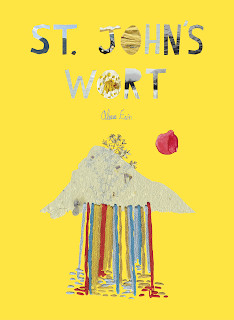
It’s hard to say what Alexus imagined when she titled this book, St. John’s Wort. It’s the name of a European medicinal shrub known for treating depression. Like most of the world, if you consider the book at face value, you’ll think it’s therapeutic, that it calms and elevates your experiences.
It does.
However, as you read through the poems, over and over again, to make sure you don’t miss a beat or the depth of meaning folded neatly in between lines and stanzas, you’ll realise that Mayo Clinic was perhaps right. As one of the top possible side effects of St. John’s wort (the shrub), it lists agitation. Which is what you feel when you’ve read these poems.
Alexus doesn’t look at the world around her and burst into flowery language. Instead, her poems are deliberate. Each line, each syllable rings with meaning, and whether or not you directly relate to it, you feel what she sees, and you see what she feels.
Imagery is for the ear as much as it is for the eye, you learn as she describes in Laughter,
“I know God laughed
when night bathed tabletop-
tabletop cradled the New York Times, a pound cake. I sang carols over the brushed, high-hat hiss of a Vanilla Coke can.”
Alexus’s poetry isn’t simple. Layers upon layers of complexity lie in each poem, and she makes you work to reap the sweet benefits of the sadness lingering in those hard words.
“When I learned my father had an aneurysm, I thought about the day his brother had the aneurysm.
I thought about Plath, then Hughes
then about how suddenly I needed to buy pudding
from the grocery store.”
When referencing a father dying of aneurysm, not everyone draws a parallel with Sylvia Plath’s “Daddy“, where she confesses struggling to forgive her father’s involvement in the Holocaust and his lack of self-care that resulted in a gradual demise. Alexus cleverly matches the Plath reference with the seemingly related Hughes, while instead, with a subtle streak, alluding to pulmonary artery aneurysms, a rare autoimmune disease first described by British physicians Hughes and Stovin.
Good poetry resounds though your being, leaving blotches of reality, like ink on paper, marking you for life. This collection of poems takes it further—you have to marvel at Alexus’s wordliness, the way she’s melded poetry with dark reality, and the way she’s dejargoned medicine, revealing it in bits, like droplets on whiskey, just enough to hit you with a boldness that momentarily disarms you.
It’s not, however, a book you need to pair with a high-edition dictionary—although a nice Riesling surely complements. Scattered throughout the book, in snippets that speak the truth as it is, are poems so simple and so pristine that you can’t help but pause to inhale the beauty of words.
“What among us won’t, one day,
Be turned inside out?”
She asks in such tepidity that it strikes you, slices through your pretence, as intense as hot knife through cold butter.
Alexus ends that poem, Year of the Rabbit Hole, hinting at self-help, while artfully voiding her voice of the unworthiness that comes with such books.
This collection is a chain, flaunting a range of topics, all bound by the string of tragedy. Every poem is an ode to an incident in life—sometimes personal, often not—leaving you with a shudder, questioning you, and enticing you to question the world you see.
 The Chaos Within