History is Mere Gossip

Oh yes!

I revere History as a subject. That’s also why I hate that it’s become so subjective. No one knows what the truth is anymore, we’re all so engrossed in stories that interest us so much that we often forget that​ the words “story” and “history” don’t even belong in the same sentence.

​It hurt so bad when I came across in my text book that Queen Elizabeth the second took the throne in 1963 when the very next page claimed that it was in 1953. Though that is more of a valuation of our education system than History, it still put a thorn on my head.

tiara

That’s when it all came crashing down. We don’t care what happened all those years ago, we only care for what’s more sensational. The more interesting story goes into school books — to become history. The more interesting a story, the more it’s spoken about. And we all know the more we talk of something — especially in schools — the more the chances are of it becoming a fact.

It’s quite sad that people are so used to telling and retelling facts as stories. Besides, how much of a difference would it make if the Queen wore a tiara instead of a crown; ​the tiara is the fancier word isn’t it?

What starts with a tiara grows on to elephant rides becoming horse rides, corn becoming cotton, and eventually ​Pakistan becoming India. It’s just a matter of time.

Is it the human craving for adrenaline that makes us morph the truth — or what’s commonly accepted as the truth — into something a bit more… racy?

What’s wrong with calling an execution an execution? Must we make it a chase and kill?

It’s all subjective; we’re are so used to talking about heroics and racing cars that we like to incorporate them in our narratives. The sad part of it all: we do it instinctively, we do it without care, we are so offhanded that in a way, we kill the essence of our History.

Sometimes, we just have to accept our forefathers for what they were — cowards. Sometimes we have to live with knowing they lived bad lives, and that they had priorities we deem unworthy. Because only when we accept history for what it is, can we learn and not duplicate the very lifestyles we mask with gossip.

The Career Conundrum — An Open Letter to a High-Scorer

arts

Hey there!

I heard you got your SSLC (Secondary School Leaving Certificate) results sometime last week.

Looks like you’ve done pretty well, huh?

The whole of Tamil Nadu rejoiced that over 40 students had scored 499/500. What fierce competition! And for something as trivial as memorizing a certainly erroneous textbook.

Surprised? Didn’t you realize how silly your syllabi were? How can you claim printing blunders as petty?

Plus, the top people in the education department worry about the falling standards. At this rate, they say, top-scorers wouldn’t stand a chance in a nation-wide evaluation.

Some even suggested new syllabi for better education.

No worries though. This result is still a big deal.

Your parents know it. But it seems you don’t. And that’s why I decided to knock some sense into your over-creative head.

How come you haven’t realized it yet? This result determines your future! The more you score, the greater your chances are for groups 1 or 2 — which is eventually Engineering. Or Medicine  —  if you’re that ambitious.

But I hear you have something else in mind. Trust me, you don’t want to hear about the third group.

Only those who are too stupid and lazy to study choose the Arts. Oh, yes.

As Indian, nothing is more prestigious than becoming an Engineer or Doctor. They are the highest-paying jobs and will earn you a lump dowry in the marriage market. Why would you want to give up on that?

There’s a saying, “Indians become an Engineer first and then decide what they want to become in life.” Like most people, you probably think it’s just another of those Facebook fads, but it sure as hell is not.

True, most Engineering graduates spend four years discerning the mechanics of things they care naught for.

Then there’s the MBA infatuation.

After wasting years and parents’ money, they spend a couple more years suited-up in college. They hope it’ll be their cherry, but none of them notices the ice-cream melting.

Because it’s all part of the social convention. The more you follow the common folk, the less they’ll look down on you.

Besides, melting ice-cream’s pretty amazing, don’t you think?

Choose the Arts, and people would judge you sooner than your high-school teacher. Arts graduates spend the next five to all their years explaining to an unbelieving mob why they don’t like Engineering.

And how can you not like Engineering? It’s not like you have a choice  —  it’s like primary education.

Denying a degree in engineering is declining a basic need. After all, in today’s India, engineering is survival instinct.

Choose the Arts, and you’ll be lower than everyone else who were wise enough to avoid it.

Choose the Arts, and you’ll drabble in unemployment and poverty for the rest of your life.

Choose the Arts if your Dad’s a money machine. Otherwise, be wise.

Unless you can become the next Shakespeare or Michael Jackson  — just  don’t do the Arts. Only a fool picks the Arts over Engineering.

Trust me though; no one else will say this to your face. Instead, they’ll tell you it’s awesome to follow your dreams  — because no one else dares.

There’s a reason no one else dares.

Your classmates  —  the would-be engineers who hope to land an unrelated career  —  would tell you how pitiful their life is. At least your family considered your interests.

Whereas your family would counsel you on how foolish it is to choose the Arts. How it’s a dying breed, how doing Engineering before anything is a backup if you ever flunk your dream  —  because hey, shit happens.

If you come out of it, and still wish to do Arts, then perhaps I underestimated you. Perhaps you do have a strong will.

No matter. The rest of society will succeed where your family didn’t. A month or two in the real world and you’ll probably run off to an Engineering college, realizing  — but not accepting  — ‘Mom knows best.’

There aren’t many people who endure all that negativity and still stand their ground.

Of those few, just a handful succeed. Most of the Arts folk are just depressed, alone and bitter. And definitely cynical.

Because that’s what society does to you. They’d tell you to be yourself  — but if you do, they’ll crush you.

You could be unknown, you could be broke  — but remember one thing. No one knows Banksy, the person.

And real Artists don’t care.

Testing Times

testing times

Amit feverishly flipped through his worn MBA books. The final test was upon him. He was now just one step away from the corporate life.

Ah! How much he had heard!

He would clear the interview; he would show his father. Amit snorted. His father, the old fool. He had no idea how competitive the corporate world is. He had been constantly pressuring Amit about not getting through in campus interviews.

“Well, what does he know? He’s just a petty banker!” Amit thought to himself furiously. A ‘cling’ from his phone brought him back to reality.

“Why aren’t you at the party? Everyone’s here!”- It was Tina, his girlfriend – No. Friend. Just friend. He sighed.

“I’ve got to study. :( You guys have fun.” – Hitting send, he cast his phone on the bed and returned to his books.


Amit sat outside the manager’s room. Cracking his knuckles, he waited to be interviewed. He was called, and barely managed to avoid the usual foot-trip.

The next few minutes went exactly as planned. They asked him a few questions, and he answered them perfectly. Then came the usual question.

“Do you have a recommendation?”

Amit’s eyes lit up. This time, he did. He handed over the letter – from a respected politician. After Amit’s outbreak last time, his father had agreed to pay for the letter.

“Welcome to our company, Mr. Amit.”

The Insatiable Quest

Though they spend many years looking for enlightenment, not many people find it. The reason? They look in all the wrong places.

the insatiable quest

That’s how we’re taught though. Since childhood, we’re encouraged to ask those who might know, or refer heavily bound books. We’re taught to look for someone or something that might answer all our questions. And nowadays, you only need to type out a search term and you’ll have all the answers pouring in front of your eyes.

It’s quite natural that we turn to a larger source to acquire knowledge, but why do we expect the internet for enlightenment?

Zen quotes, Zen habits, ways to live peacefully, the art of living, the science of happiness and all those popular buzz words – what’s the point of it all?

I know we read through these articles, but do we really practice or implement them in our daily lives? I’ve seen no one who does that. Sure, for a day we will. Perhaps two days – a week at the most, but soon after that, it’s just empty reading. These web articles hardly help us live a better life.

But if we turn to a better, more personal source, we’d definitely find what we’re looking for. And there’s no higher quality of life than that.

“It is the brain, the little grey cells on which one must rely. One must seek the truth within – not without.” – Hercule Poirot

The Age Factor

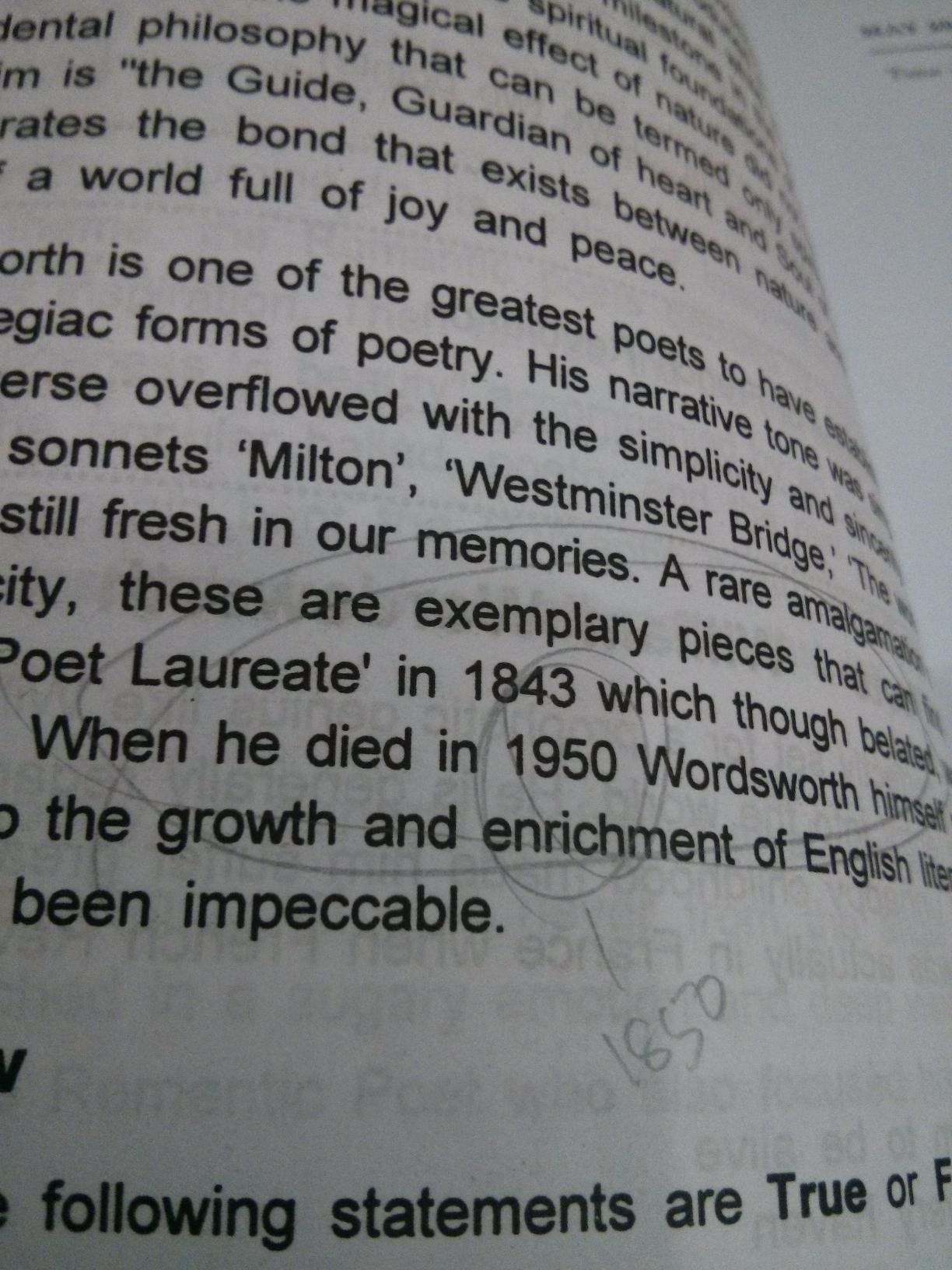
I used to talk a lot about the pathetic conditions of the education system in India. Now though, it bores even me. But I came across something that made me laugh out loud, and even head to the internet for clarity.

Here it is.

age factor


This is just for fun. Print mistakes occur everywhere, but I would have liked it if the education authorities gave as much importance to details like these, as they do to grades.

P.S – This is from an official text for B.A English graduate course.